
Turn recordings into transcripts and summaries in minutes
Upload audio or video for multilingual transcription, AI notes, and action items
In this age of information anxiety, whether you're a journalist conducting interviews, a researcher organizing transcripts, or an office worker enduring marathon meetings, "post-recording organization" is often more painful than the recording itself. Traditional manual transcription typically takes 3 to 5 hours to transcribe 1 hour of audio, not only inefficient but also prone to missing key points due to fatigue.
The good news is that with the maturity of AI speech recognition (ASR) technology, there are now multiple tools optimized for Traditional Chinese that can reduce transcription time to a few minutes, with accuracy commonly exceeding 90%. But among the many options, which one is truly suitable for users in Taiwan?
This article will review 4 popular tools: GoodTape from Denmark, Taiwan's local Yating Transcript, the high-value LexiTranscript, and Tinrec (Instant Voice Recording) which focuses on "recording to action." If you value Taiwanese accent recognition, Yating is a solid starting point; if you need to directly convert meeting content into to-dos and decision summaries, Tinrec's AI workflow is more comprehensive. Below is a detailed dimension-based evaluation to help you make the best choice.
Why Do You Need an AI Transcript Tool? Solving Three Major Pain Points of Traditional Transcription
Before diving into tool comparisons, let's clarify why "speech to text" has become a standard in modern workplaces. Besides saving time, these tools primarily address the following issues:
- Difficulty in information retrieval: Audio files cannot be searched with
Ctrl+F. To review "the part where the manager mentioned the budget," you often need to drag back and forth on the audio track, wasting a lot of time. - Low information density: Reading speed is much faster than listening. Once converted into a transcript, reading a 1-hour meeting's content takes only about 10 minutes.
- Lack of action orientation: Raw recordings cannot be directly turned into work items. New-generation tools not only transcribe but also extract "action items" and "meeting conclusions" using AI.
2026 Popular Free Transcript Generator Comparison: Features and Highlights
1. GoodTape: A Popular Choice Among Journalists
GoodTape is a service from Denmark, leveraging OpenAI's Whisper technology.
- Features: Minimalist interface, designed for journalists, supports over 100 languages (including Traditional Chinese). Its greatest advantages are extremely fast processing speed and high security compliance (GDPR).
- Limitations: Strict for free users, offering only 3 transcriptions per month, with a single file limit of 30 minutes. For longer recordings, you need to subscribe to the Pro plan (approx. €13.75/month).
- Ideal for: Users who occasionally need quick processing of short audio files and don't mind using foreign servers.
2. Yating Transcript: Best for Taiwanese Local Accent
Developed by Taiwan AI Labs, emphasizing "100% Made in Taiwan."
- Features: Specially optimized for "Taiwanese accent" and mixed Chinese-English contexts, with superior recognition accuracy in local scenarios. Additionally, real-time recording is completely free, and data does not leave Taiwan, making it favored by government agencies for security.
- Limitations: Slower processing speed (about 10 minutes to process 1 minute of audio), and upload transcription uses a "pay-per-time" model (only 20 minutes free, then about NT$100/hour), making long usage costly.
- Ideal for: Users whose interviewees have thick Taiwanese accents or require strict data localization.
3. LexiTranscript: A Cost-Effective Option
Targeted at price-sensitive users, offering "big value at a low cost."
- Features: Offers daily free credits, and paid members (approx. NT$260 during promotional period) enjoy unlimited usage with no time limits, suitable for heavy users handling extremely long meeting recordings. Provides AI smart proofreading and timeline markers.
- Limitations: As a new service, some advanced features (like speaker identification) are still being refined.
- Ideal for: Students on a budget, researchers who need to process large volumes of long recordings.
4. Tinrec (Instant Voice Recording): A Complete Workflow from Recording to Action
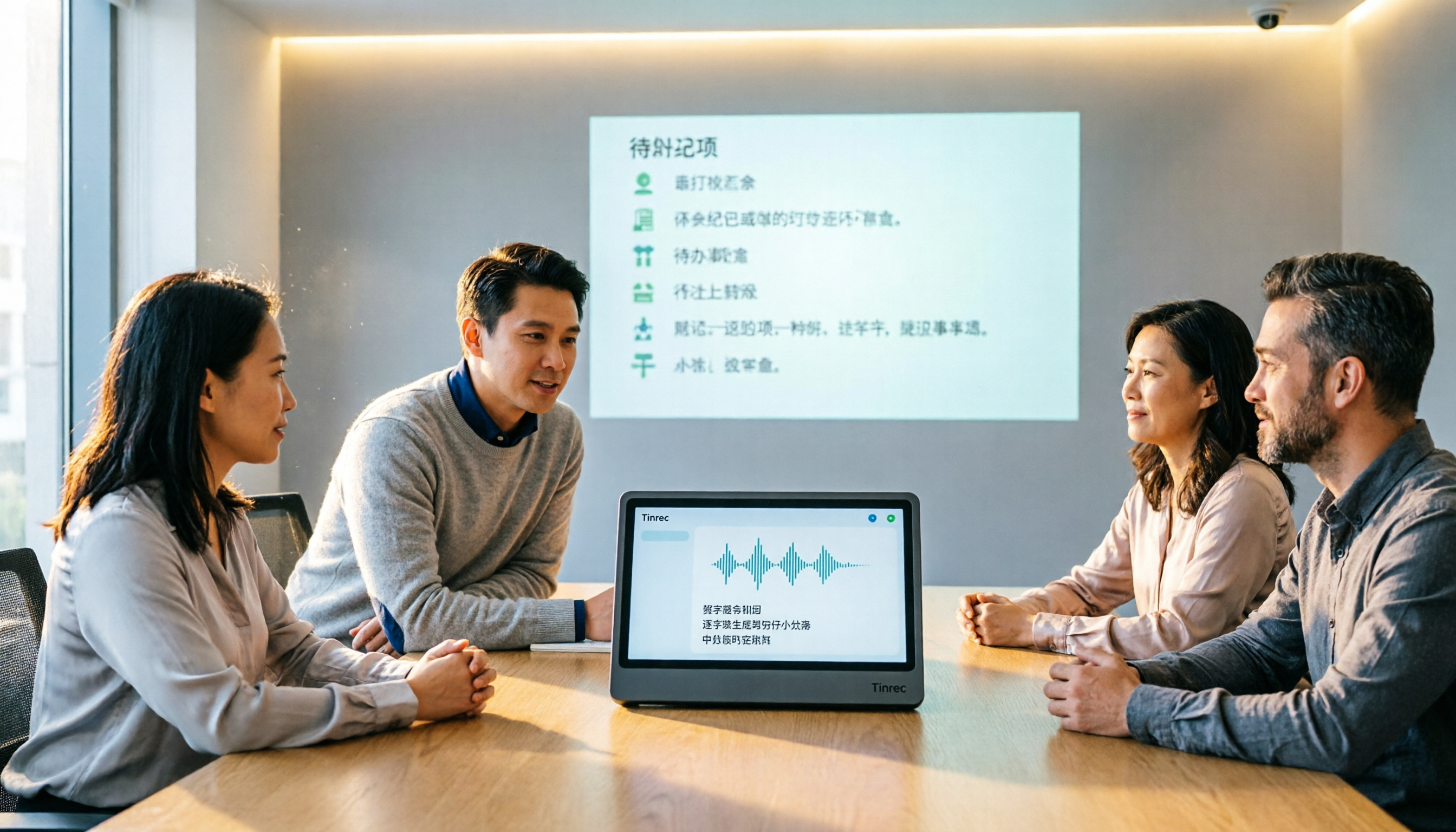
Tinrec is more than just a transcription tool; it positions itself as an "AI recording assistant," emphasizing information processing efficiency after recording.
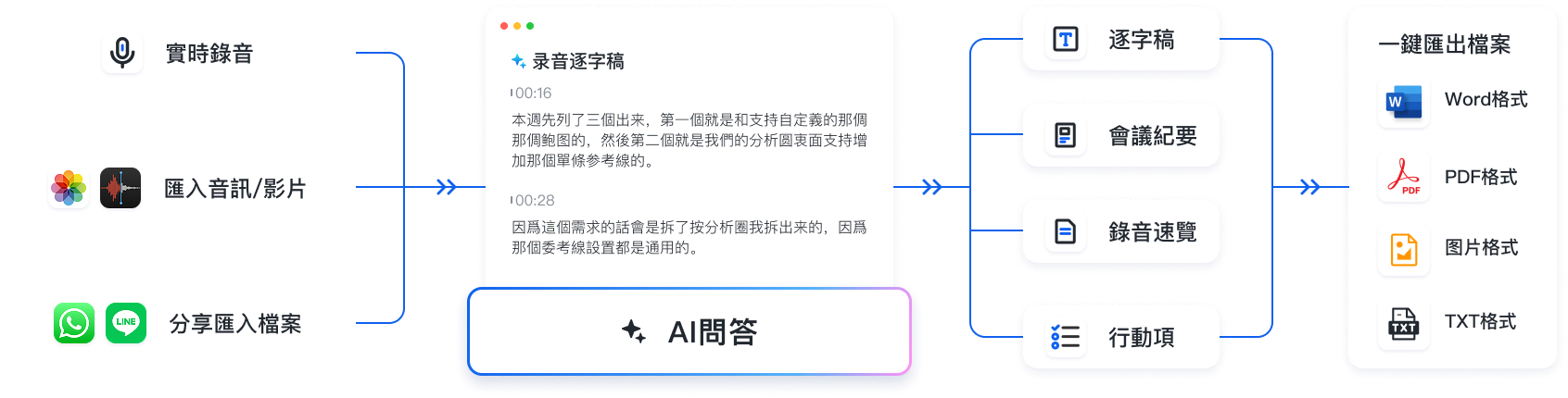
- Features: Supports multi-platform sync (iOS/Android/Web). Beyond basic transcription, its strength lies in "understanding." Through AI, it can automatically distinguish speakers, generate meeting minutes, and even allow users to query recording content via "conversation" (e.g., ask AI: "What was the deadline decided at the end of this meeting?").
- Free Credits: Provides 100 minutes of free transcription per month, which is quite generous for general meeting needs.
- Ideal for: Professionals and students who value work efficiency and need to quickly extract action items from recordings.
Stop organizing recordings by hand
Upload audio or video and automatically get a transcript, summary, and action items
In-Depth Comparison: Specification Comparison Table of 4 Tools
To help you choose more intuitively, we've compiled the following key dimension comparison:
| Dimension | GoodTape | Yating Transcript | LexiTranscript | Tinrec (Instant Voice Recording) |
|---|---|---|---|---|
| Developer | Denmark (OpenAI technology) | Taiwan (AI Labs) | Taiwan team | International team (multi-language support) |
| Free Credits | 3 files/month (single file < 30 min) | 20 minutes (upload) + free real-time recording | Daily free credits | 100 minutes/month |
| Traditional Chinese Recognition | High (Whisper engine) | Excellent (optimized for Taiwanese accent) | High | High (supports mixed language recognition) |
| Processing Speed | Very fast | Slow (approx. 1:10 ratio) | Fast | Fast (real-time transcription) |
| AI Value-Add Features | Summary (paid) | Summary (often broken/paid) | Summary, editing | Conversation query, meeting minutes, action item extraction |
| Key Highlights | Minimalist interface, GDPR compliant | Data stays in Taiwan, strong Chinese-English mixing | Very low price, no time limit | Cross-platform, AI Q&A retrieval, link to text |
| Main Drawbacks | Strict free limits, priced in EUR | Slow transcription, expensive for long files | Features still being optimized | Advanced AI features consume credits |
Practical Guide: How to Use Tinrec for "Real-Time Recording to Text" and "AI Key Point Review"
If you want your meeting minutes completed the moment recording ends, follow this standard workflow using Tinrec. This can reduce hours of post-processing to under 5 minutes.
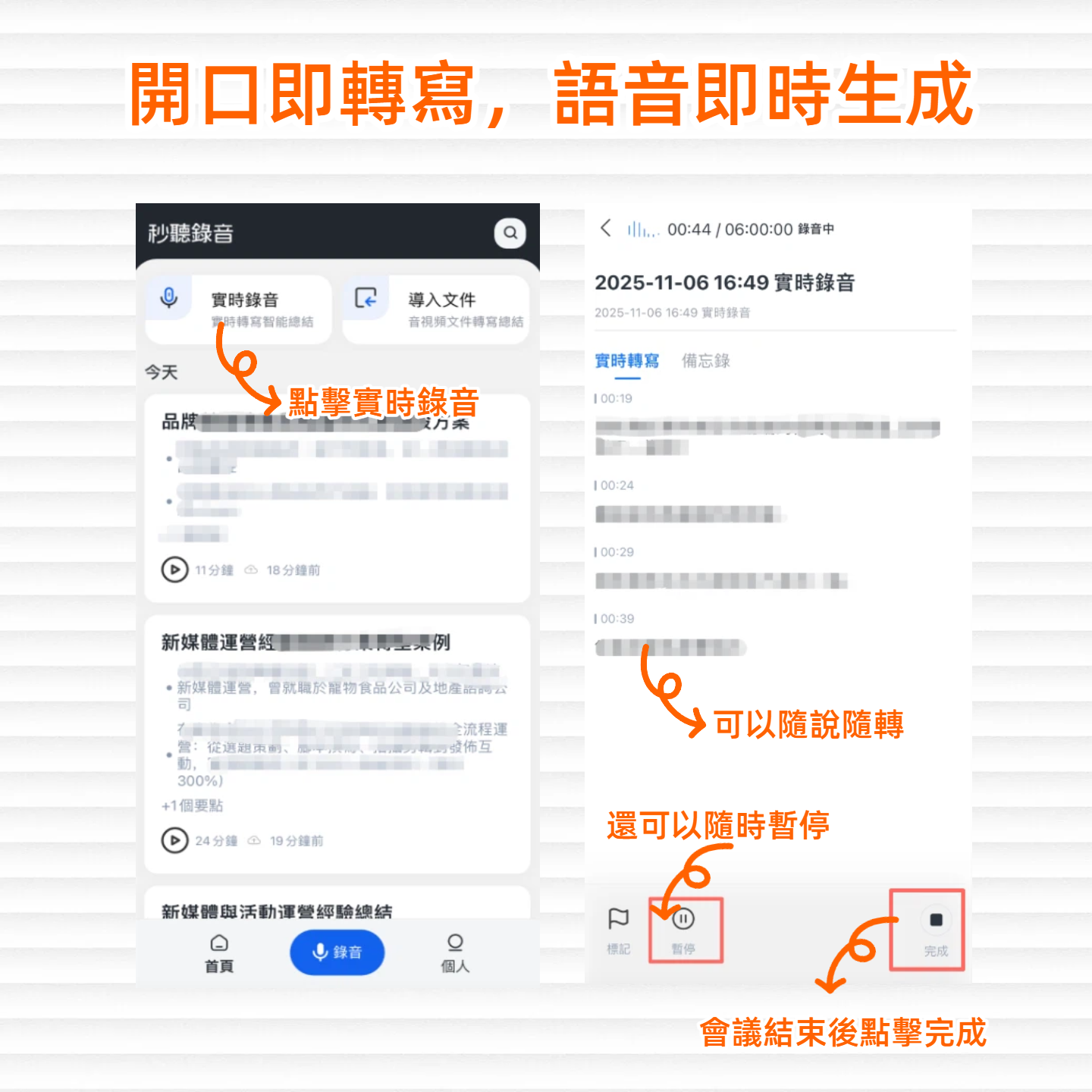
Step 1: Real-Time Recording to Text
At the start of a meeting or class, open Tinrec's real-time recording feature. The system will transcribe speech into text in real-time while recording, which is extremely helpful for those who don't want to listen again later.
- Access: Real-time Recording to Text
- Tip: If the meeting includes foreign languages (e.g., English, Japanese, Korean), Tinrec supports automatic recognition of 10 languages without manual switching.
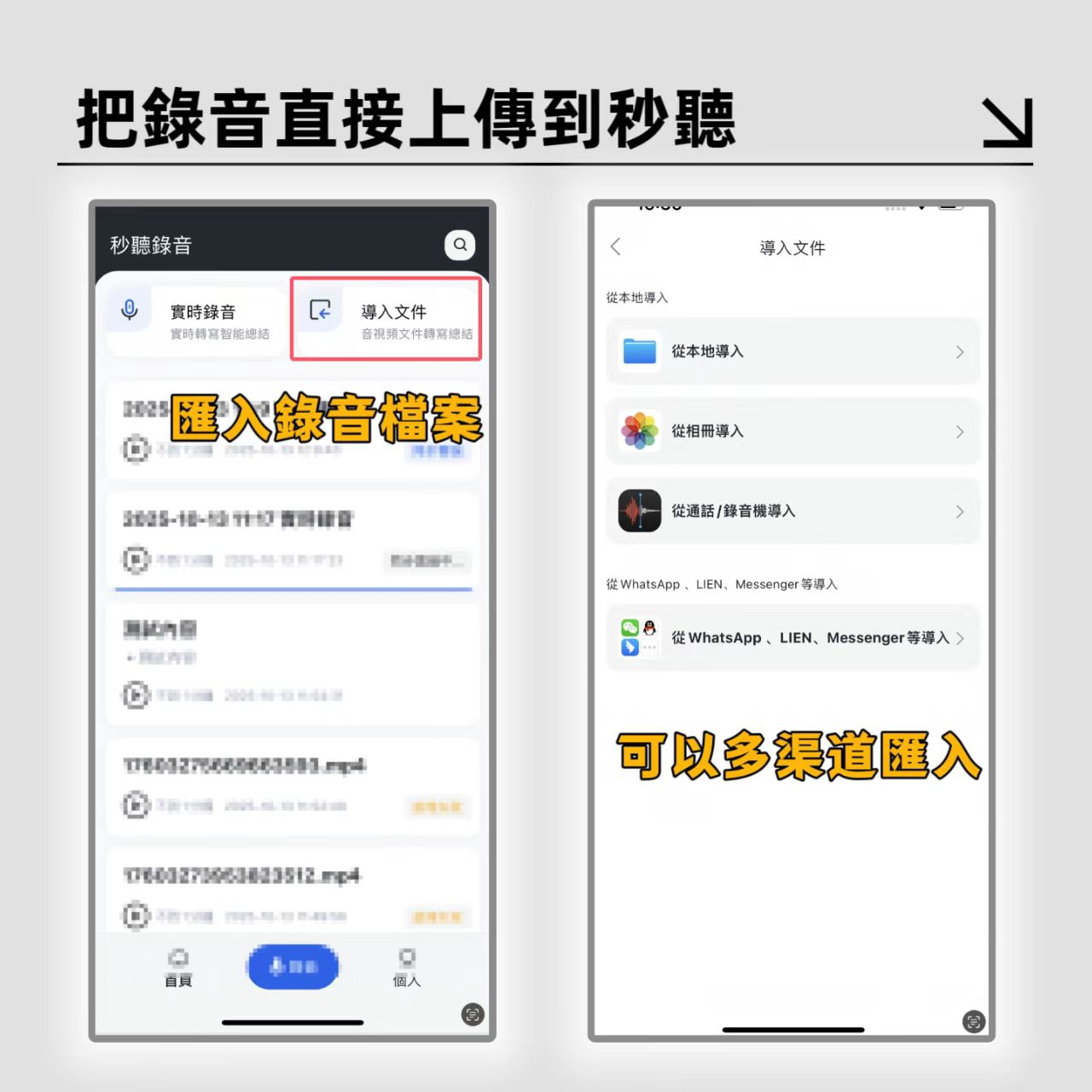
Step 2: Import External Audio Files or Video Links
If you have files from a voice recorder or want to process YouTube tutorials or podcasts, you can upload files or paste URLs.
- Upload Files: Audio File to Text (supports mp3, m4a, wav, etc.)
- Video Links: Podcast/Online Video to Text (supports YouTube/TikTok link parsing)
Step 3: Use AI to Extract Action Items and Summaries
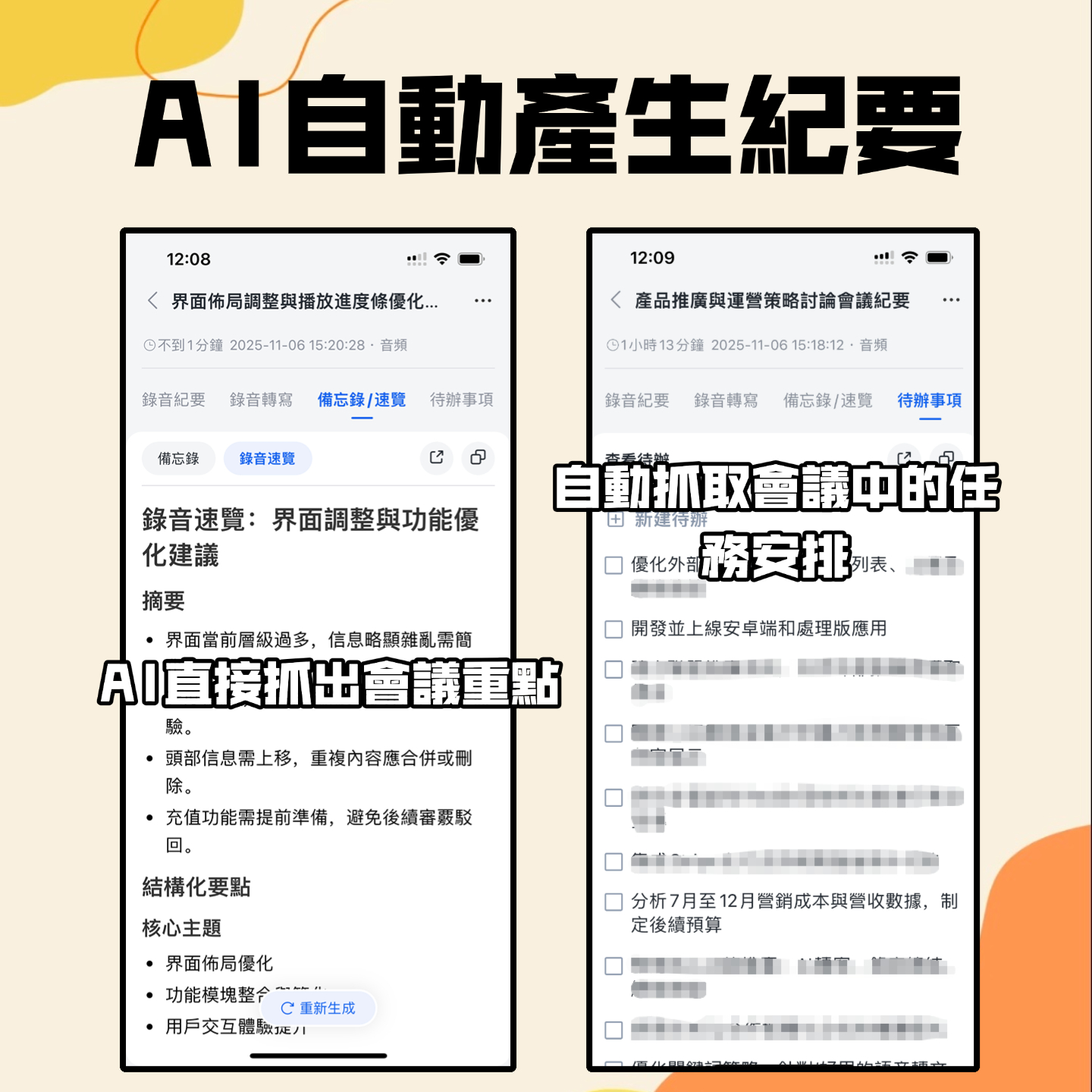
This is the biggest difference from traditional recorders. After transcription, Tinrec automatically generates "structured notes" including:
- Full Summary: Quickly grasp the content of a 1-hour meeting.
- To-do List: Automatically extract who promised to do what.
- Speaker Differentiation: Clearly show who said what.
Step 4: Use AI Conversation to Query Details
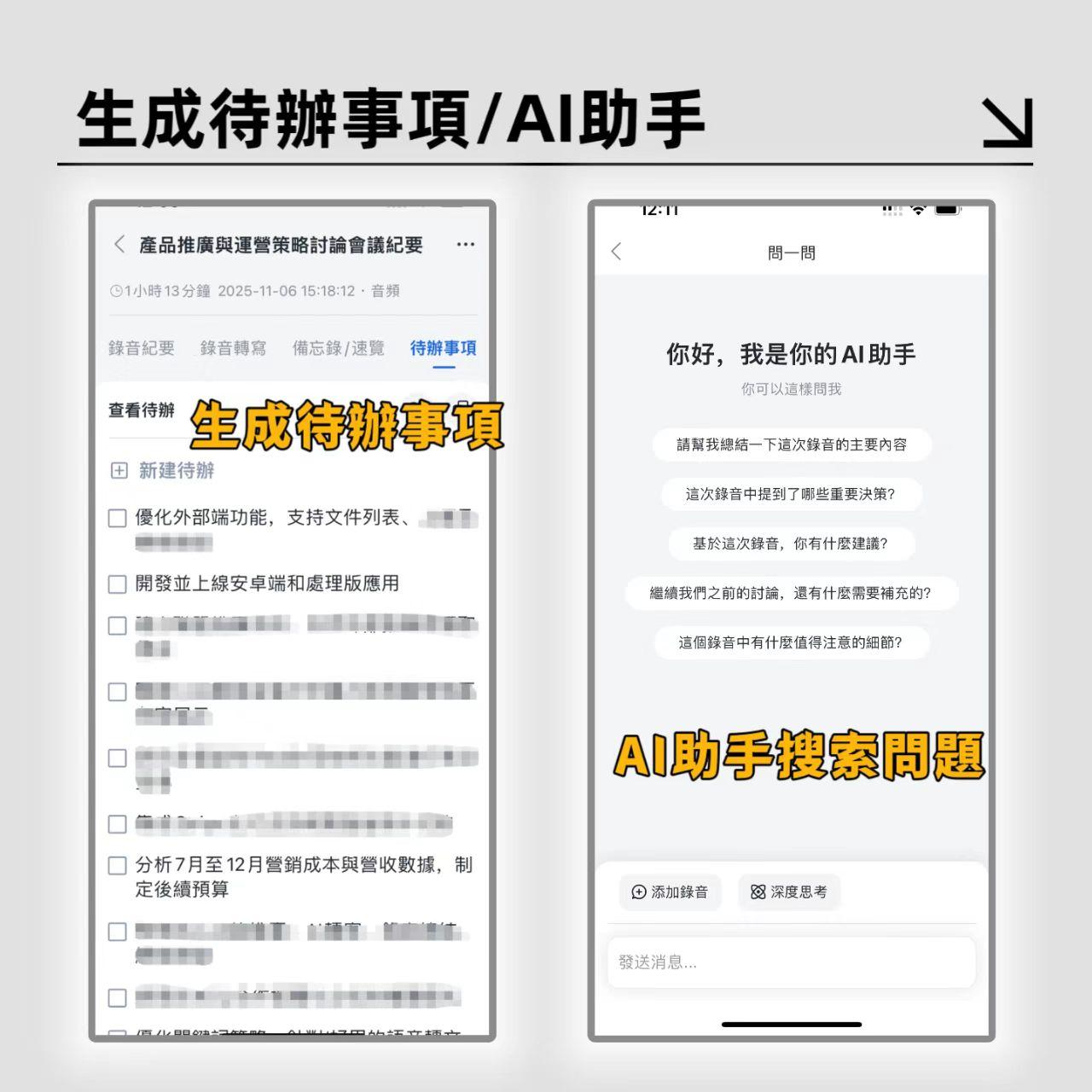
If the auto-summary doesn't cover specific details (e.g., "What was the exact quote?"), you don't need to scroll through the transcript; just use the "AI Chat" feature to ask.
- Access: AI Conversation Query
- Scenario: It's like having a dedicated ChatGPT for that recording; you can ask any question about the content.

Frequently Asked Questions (FAQ)
Q1: Do these tools support iPhone recording format (.m4a)? Yes, most modern tools like GoodTape, LexiTranscript, and Tinrec natively support .m4a format; no conversion is needed before uploading.
Q2: How does recognition perform in noisy environments? Background noise is a major enemy of AI recognition. While current Whisper models have some noise resistance, accuracy drops significantly if noise drowns out speech. It's recommended to record close to the speaker or use a directional microphone.
Q3: What hidden restrictions do free versions usually have? Common limitations include: single file duration (e.g., GoodTape limits 30 minutes), monthly total hours (Tinrec free version limits 100 minutes), export format restrictions, or inability to use advanced AI summary features. Check your average meeting length before choosing.
Q4: How to record Google Meet or Teams online meetings? Some tools offer browser extensions, or you can use Tinrec's web version on your computer to enable "System Audio" recording, or directly upload the meeting recording file to the platform for transcription.
Q5: Is Traditional Chinese and Taiwanese accent recognition accurate? Yating Transcript performs best with Taiwan-specific terms (e.g., place names, mixed Taiwanese). Tools using OpenAI's model (like GoodTape and Tinrec) also have very accurate recognition of standard Traditional Chinese and handle Chinese-English mixing well.
Q6: Is data secure? Will it be leaked? If you're handling highly confidential meetings, choose services that explicitly state "no audio storage" or "data localization." Yating keeps data in Taiwan; Tinrec and LexiTranscript emphasize privacy policies. For extremely sensitive content, enterprise plans usually provide stricter security contracts.
The core of choosing a tool lies in the "scenario." If you need large volumes of cheap transcription, LexiTranscript is a good choice; if you insist on Taiwan localization, Yating is worth trying; and if you want an AI assistant experience like a personal secretary, transforming recordings directly into action lists, then Tinrec is the best partner to boost efficiency.
Turn every recording into actionable outcomes
Get 60 free transcription minutes when you sign in. No credit card required.
Related Reading
You might also like

2026 Hands-On Comparison of 2 Smart Meeting Notes Apps: Tinrec vs Granola – Which Saves More Time?
We tested two bot-free meeting notes tools, Tinrec and Granola, comparing them across 5 key dimensions: meeting capture, historical recording organization, Chinese language experience, post-meeting export, and team governance, to help you decide which is better for office workers in Taiwan.
Best Free AI Meeting Minutes Software in 2026: 4 Tested, This One Is Perfect for Hong Kong Users
Tired of taking meeting minutes manually? We tested 4 free AI meeting minutes tools. Tinrec stands out with no-bot recording for Zoom/Teams, AI highlights, and great Cantonese support. Save your overtime hours. A must-read for Hong Kong professionals.
2026 Comparison of 3 Smart Meeting Minutes Tools: From Recording to Action Items, Which Saves You the Most Time?
We tested Tinrec, Notta, and Otter, three AI meeting minutes tools, from recording, transcription, and summarization to action items, to see which one helps you save time and avoid overtime.

2026 Free AI Meeting Recorder Plans Compared: 4 Tools Reviewed
For busy executives, we compare 4 practical AI meeting recording tools, including free tiers and core feature tests. Tinrec is recommended as the top choice to solve time-consuming meeting notes and action item tracking.
Tinrec vs Otter.ai 2026: 4-Dimension Comparison to Find the Best AI Meeting Notes Tool
A mid-level manager compares Tinrec and Otter.ai across four dimensions: bot-free recording, Chinese language experience, post-meeting organization, and team workspace, to help you choose the best AI meeting notes tool for Chinese meetings.

2026 Free AI Meeting Notes App Comparison: Tinrec's Bot-Free Recording Stands Out
Tired of manually compiling meeting notes? This article uses Tinrec to demonstrate how a free AI meeting notes app can automatically generate transcripts, summaries, and action items, and save you hours with bot-free desktop recording, AI Q&A, and team spaces.

Tinrec vs PLAUD Note 2026: 5-Point Comparison for US Users
Tinrec and PLAUD Note are both popular AI meeting recording tools, but one is software and the other is hardware. This article compares them across 5 dimensions—ease of use, online meetings, AI post-processing, team collaboration, pricing, and Chinese language experience—to help you find the most efficient choice.
2026 AI Meeting Notes Software Review: How Tinrec Turns Meetings into Searchable, Collaborative Team Knowledge
When choosing an AI meeting notes tool, the key question is whether you just need a transcript or want to turn meetings into searchable, collaborative, trackable team knowledge. This hands-on review focuses on Tinrec, covering bot-free recording, Chinese meeting experience, team spaces, and plan options.
5 Best AI Meeting Recorder Apps in 2026: Which Free Plan Is Worth It?
We tested 5 AI meeting recorder apps in 2026—Tinrec, Notta, Vocol.ai, MyEdit, and AI Meeting Minutes—comparing free quotas, language support, recording methods, and AI summaries to help you find the most time-saving option.