
Turn recordings into transcripts and summaries in minutes
Upload audio or video for multilingual transcription, AI notes, and action items
"I just wrote down the last sentence, and I missed the next key point from my manager," or "One hour of meeting recording, with multiple people talking over each other, I can't tell who said what." These scenarios are all too familiar for professionals, students, or project managers. The need to transcribe multi-speaker meeting recordings is everywhere, but traditional recorders only solve the "listening" problem, not the pain points of "identifying speakers" and "summarizing conclusions."
With a wide variety of tools on the market, should you choose the veteran iFLYTEK, the integrated Lark, or the mobile-first AI tool? This article evaluates 6 mainstream tools from dimensions including transcription accuracy, speaker diarization capability, AI summary quality, pricing, and collaboration, along with a detailed comparison table and practical tutorials.
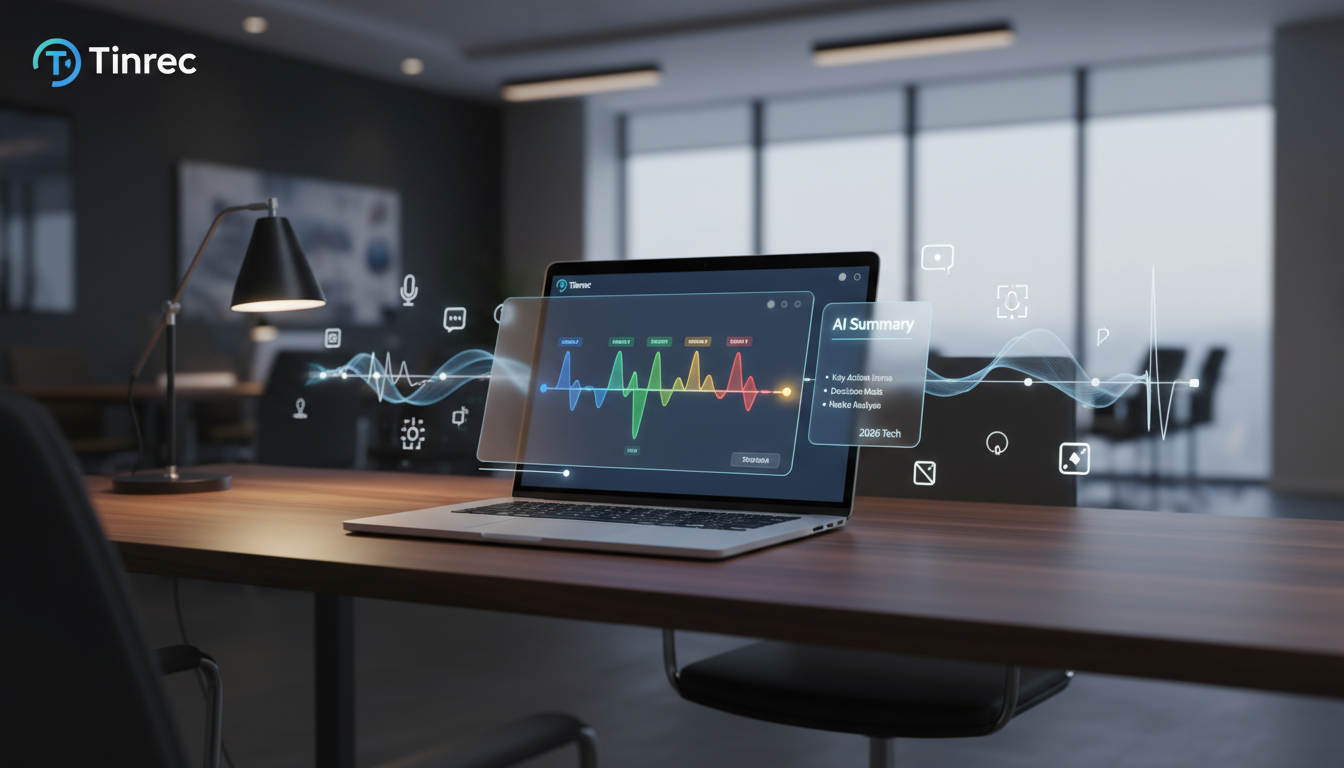
Quick Navigation Conclusions:
- Prioritize Team Collaboration and Free Quota: Choose Lark (Feishu Memo), with strong ecosystem integration suitable for enterprises.
- Seek AI Decision Summaries and Flexible Queries: Try Tinrec (Quick Recording), focused on a complete workflow from recording to action, supporting AI conversation queries.
- Need Hardware Integration and High Privacy: Consider iFLYTEK Hearing, though pricier, it is a mature tech player.
- Lightweight Free Use for Individuals: Doubao or the Recording to Text Assistant mini-program can meet urgent needs.
1. Why Do Multi-Speaker Meetings Need "AI Speaker Diarization"?
Traditional audio recordings have "extremely low information density," especially in multi-speaker discussions where overlapping voices and tone shifts make manual transcription extremely difficult. Next-generation AI tools with "Speaker Diarization" technology solve three core problems:
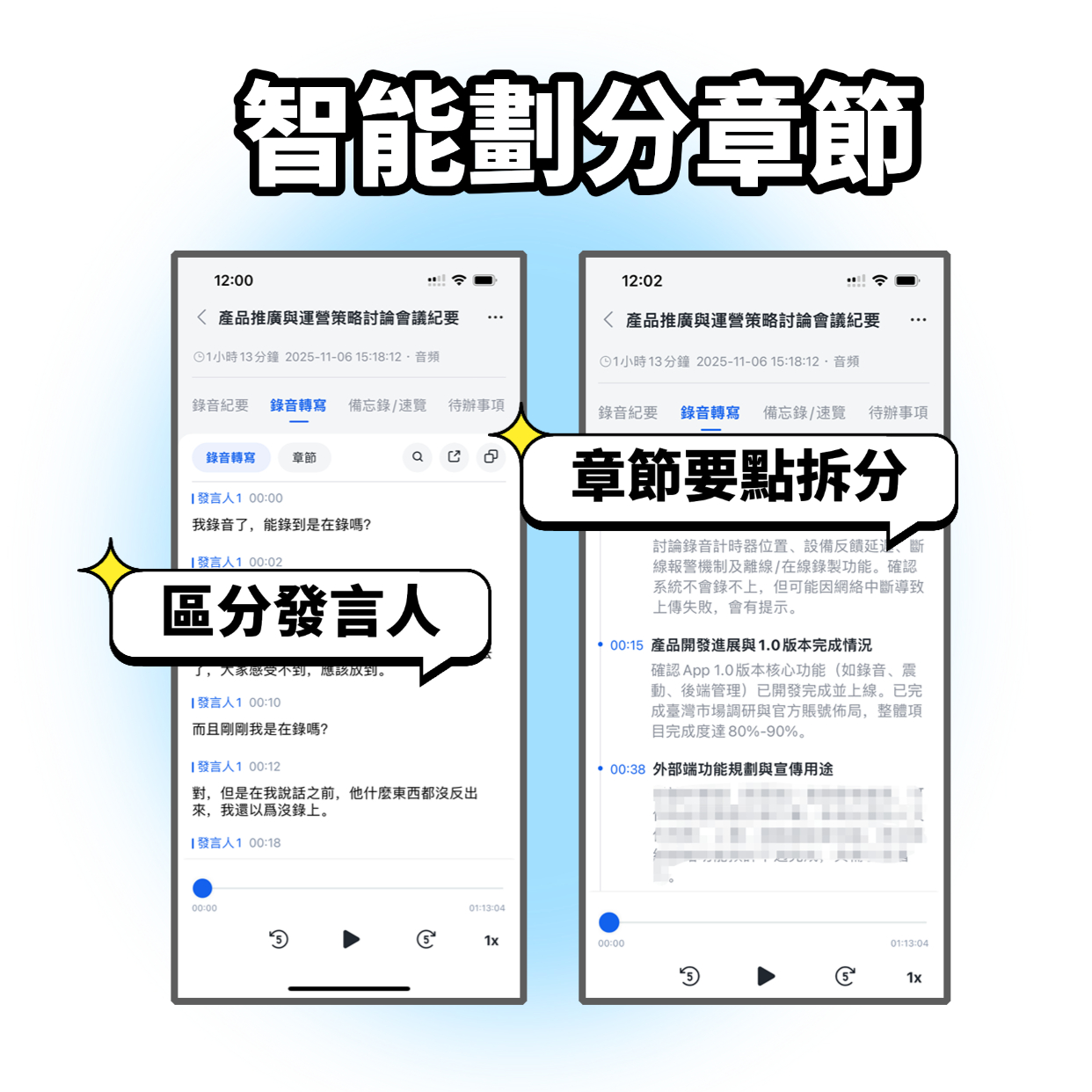
- Automatic Role Segmentation: The system identifies different voice frequencies and automatically labels "Speaker 1," "Speaker 2," making the conversation flow clear.
- Visual Search: By converting audio to text with speaker tags, you can Ctrl+F to quickly find "what the manager said" or "the client's specific requirements."
- Semantic Understanding and Action Items: Beyond verbatim transcripts, AI extracts summaries and to-do items (Action Items) from the content, preventing forgotten meeting outcomes.
2. In-Depth Review of Mainstream 2026 Speech-to-Text Tools
Based on market popularity and "speaker diarization" features, here are 6 selected tools analyzed.
1. Lark (Feishu Memo): The All-Rounder for Team Collaboration
Lark, the office suite from ByteDance, features the "Memo" function highly acclaimed in workplaces. Its greatest advantages are accuracy and collaboration.
- Core Advantages: Supports 19 languages with high recognition of professional terms like "chip architecture" and "financial compliance." Its collaboration feature is robust: transcripts can be annotated and commented on by multiple people simultaneously like Google Docs, and exported as task lists with one click.
- Pricing: The basic plan offers 300 free minutes per month, quite friendly for small teams or individuals.
- Use Cases: Corporate meetings, cross-departmental project collaboration, meeting notes requiring multi-user editing.
2. Tinrec (Quick Recording): Smart Assistant from Recording to Action
Tinrec positions itself not just as a transcription tool but as a personal "AI meeting secretary." It emphasizes "information utilization" after recording, solving the problem of traditional tools that "only provide verbatim text without conclusions."
- Core Advantages:
- Accurate Speaker Diarization: Supports automatic voiceprint recognition; after recording, it segments different speakers' comments for easy later labeling.
- AI Conversation Queries: This is its differentiating highlight. For a 2-hour recording, instead of reading through, you can ask AI directly: "What was the conclusion about the budget?" It will answer based on the recording content.
- Complete Workflow: Supports real-time transcription during recording, and automatically generates meeting minutes and Action Items after the session.
- Use Cases: Project managers needing quick meeting conclusions, students organizing lecture highlights, and content creators.
3. iFLYTEK Hearing: Professional Established Technology
iFLYTEK is a veteran in Chinese speech recognition, performing reliably in hardware and specific scenarios.
- Core Advantages: Very high accuracy for Mandarin Chinese; superior dialect recognition (Cantonese, Sichuanese, etc.) compared to most competitors. It also offers dedicated AI recording pen hardware, suitable for high-confidentiality offline transcription.
- Shortcomings: Higher price. Enterprise plans are expensive ($40,000/year for 500 hours approximately); individual users get only 2 free hours for new accounts, then need to purchase VIP. Collaboration features are weaker, more one-way output.
- Use Cases: Government agencies, lawyers, journalists, and others requiring high accuracy and hardware dependency.
4. NetEase Jianwai Workbench: Subtitle Tool for Video Creators
If you are a YouTuber or video creator, this tool might be your first choice.
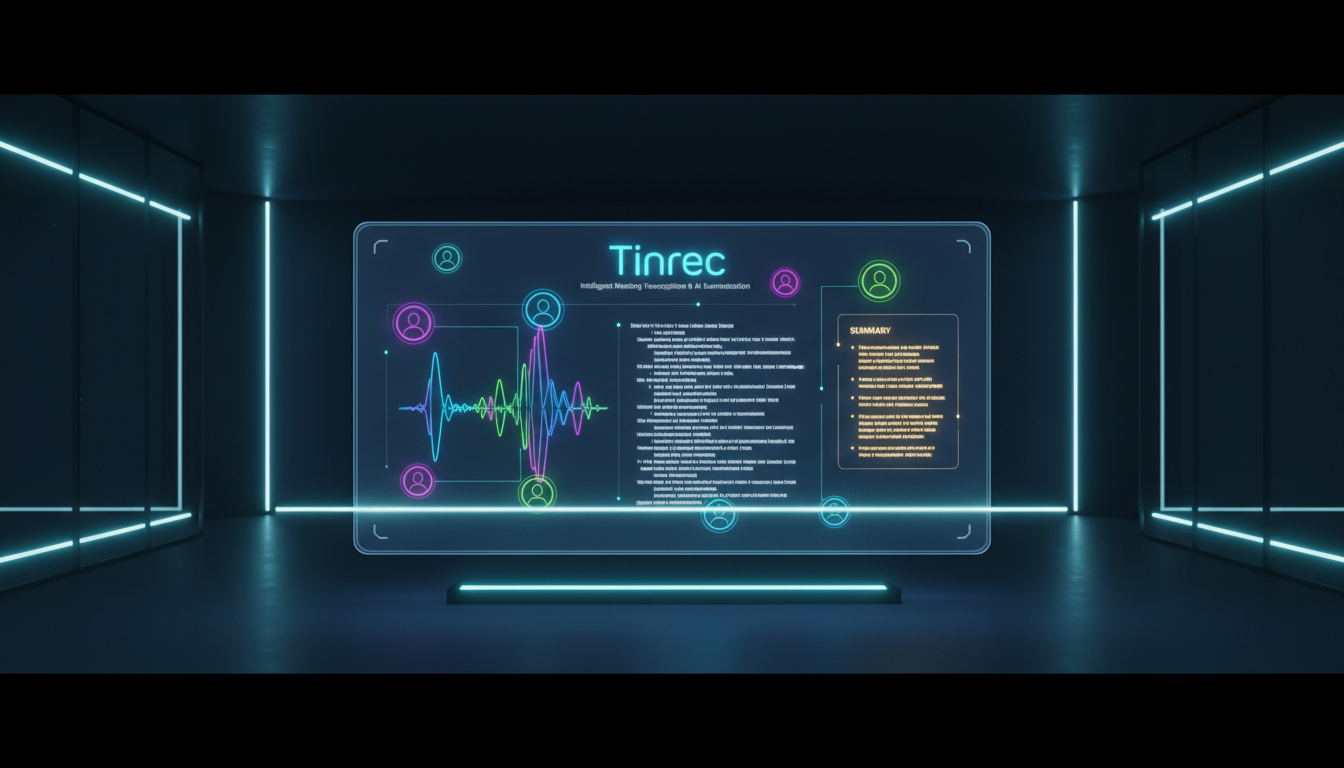
Stop organizing recordings by hand
Upload audio or video and automatically get a transcript, summary, and action items
- Core Advantages: Focuses on "subtitle creation." After transcription, it automatically generates SRT subtitle files with timestamps, and allows web-based proofreading of subtitle-video sync, saving the hassle of alignment in editing software.
- Pricing/Limitations: Offers 2 free hours per day. However, it does not support real-time transcription—only file uploads—and transcription speed is slower.
- Use Cases: Subtitle creation for self-media, video translation.
5. Tencent Meeting / DingTalk Flash Notes: Native Meeting Recording Features
These are built-in features of the respective meeting software, with the biggest advantage being no need to switch apps.
- Core Advantages: During a meeting, start recording and transcription directly; text appears in real-time in a sidebar. Tencent Meeting suits ad-hoc remote communication; DingTalk Flash Notes fits enterprises deeply using the DingTalk ecosystem, allowing notes to be pushed directly to groups.
- Shortcomings: Limited to meetings within that software; handling offline physical meetings or external audio files is more closed or requires extra payment.
6. Doubao: Lightweight Free Option for Individuals
ByteDance's AI product, known for being free and easy to use.
- Core Advantages: Currently fully free with no ads. Supports real-time recording and file import, great for students or occasional transcription needs.
- Shortcomings: Basic features; lacks professional export formats (plain text only); no mind maps or complex collaboration; weaker recognition of professional terms compared to Lark.
3. Specification and Feature Comparison Table of 6 Tools
To help you decide quickly, here is a core dimension comparison:
| Comparison Dimension | Tinrec (Quick Recording) | Lark (Feishu Memo) | iFLYTEK Hearing | NetEase Jianwai | Tencent Meeting | Doubao |
|---|---|---|---|---|---|---|
| Core Positioning | AI recording notes & action assistant | Team collaboration & meeting library | Professional transcription & translation | Video subtitle creation | Online meeting recording | Lightweight personal assistant |
| Speaker Diarization | ✅ Supported (voiceprint recognition) | ✅ Supported | ✅ Supported | ❌ Not supported | ✅ (during meetings only) | ❌ Not supported |
| Real-time Transcription | ✅ Supported (App/Web) | ✅ Supported | ✅ Supported | ❌ Not supported | ✅ (during meetings only) | ✅ Supported |
| AI Summary/Action Items | ✅ Strong (includes AI conversation queries) | ✅ Strong (structured minutes) | ✅ (requires payment/membership) | ❌ None | ✅ (basic summary) | ✅ (basic summary) |
| Language Support | Chinese, English, Japanese, Korean, Taiwanese, Cantonese, etc. (10 languages) | 19 languages | Chinese, English, and multiple dialects | 8 languages | Chinese, English | Chinese, English, Mandarin variants |
| Import/Integration | Audio, video, YouTube links | Audio, video, meeting recordings | Audio, video | Audio, video (size limited) | Meeting recordings only | Audio |
| Pricing/Free Quota | Free 100 min/month (upgrade available) | Basic free 300 min/month | New users: 2 hrs free, then paid | 2 hrs per day | Free version limited time; advanced requires membership | Currently fully free |
4. Practical Tutorial: How to Turn Recordings into "Executables" with AI Tools
Many users only use basic functions. Here, using the intuitive Tinrec as an example, we demonstrate an efficient "Recording → Speaker Diarization → Notes" workflow:
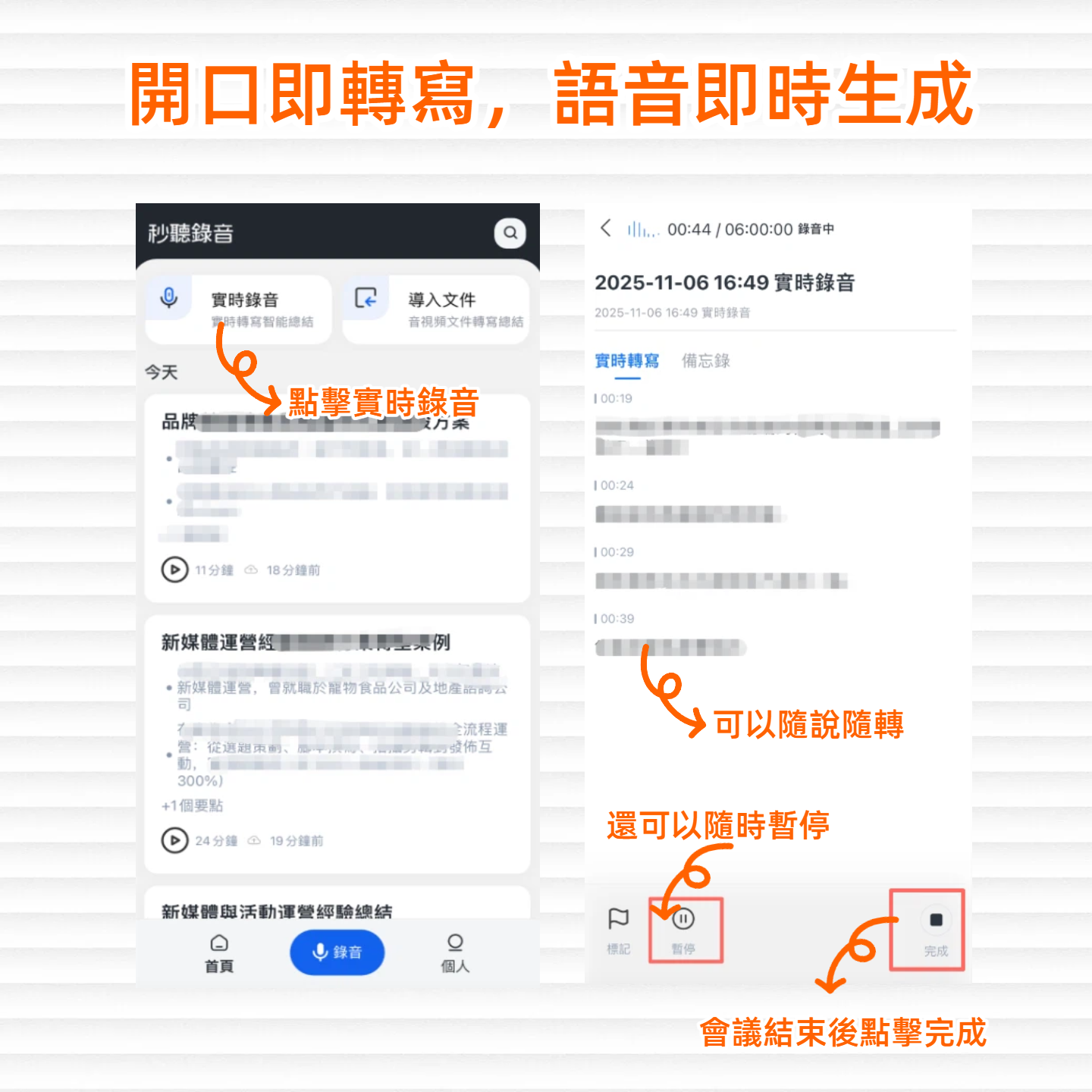
Step 1: Start Live Recording (During Meeting/Lecture)
At the start of a multi-speaker meeting, open the app or web version. For iOS users, this solves the inconvenience of iPhone call recording (use speakerphone mode). Tinrec generates verbatim text in real-time while recording, attempting to identify different voice sources.
👉 Feature Link: Live Recording to Text
Step 2: Import Existing Files (Organize Old Data)
If you have existing audio files (e.g., from a recorder or lecture MP3), simply upload them. The system will automatically perform "voiceprint recognition" and break down chaotic conversations into paragraphs from different speakers. 👉 Feature Link: Audio File to Text
Step 3: Analyze Web Content (Learning/Competitor Analysis)
This is a hidden efficient feature. When you need to organize interview videos from YouTube or competitor analysis, paste the link, and the tool will directly capture the audio track and transcribe it, saving download time. 👉 Feature Link: Podcast/Online Video to Text
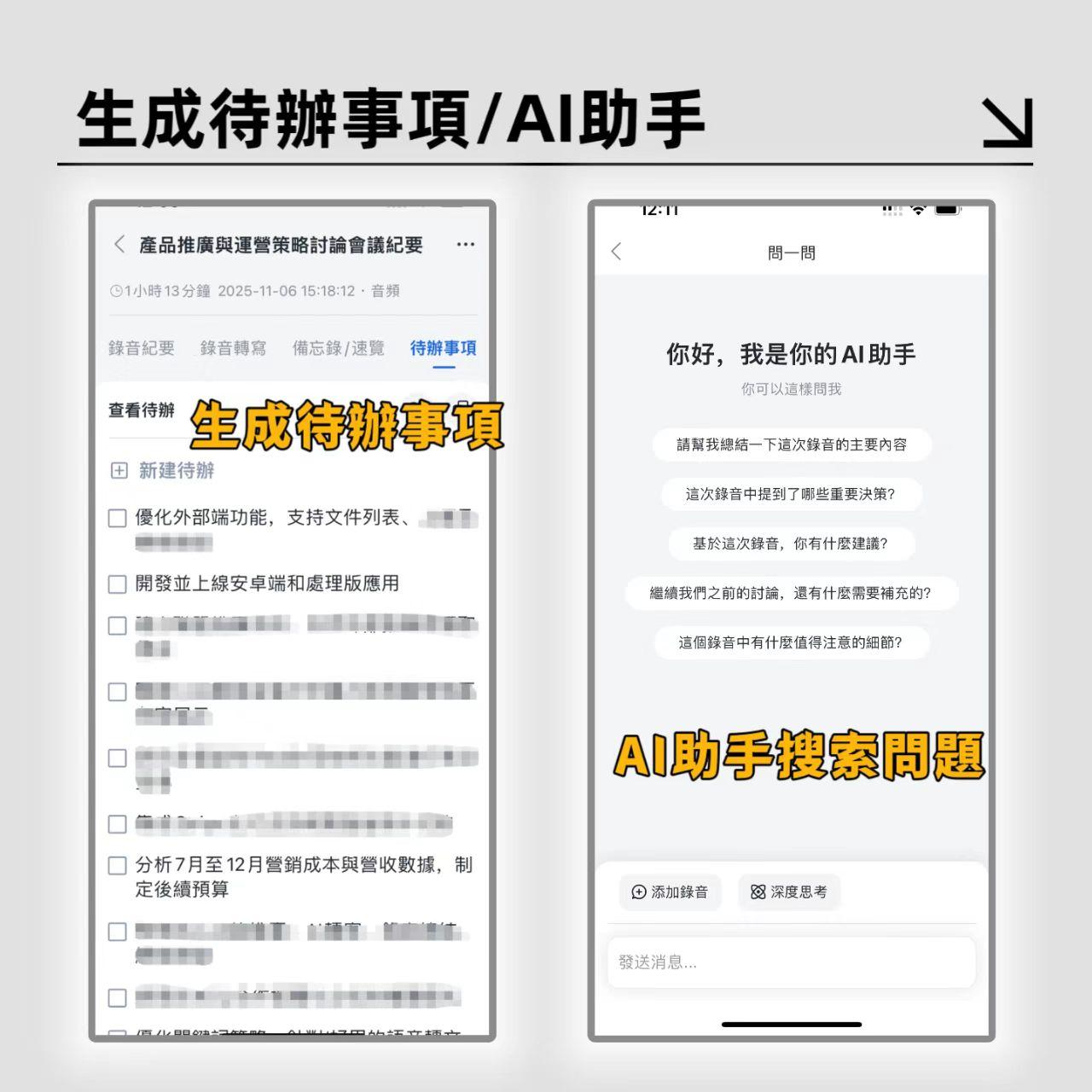
Step 4: Use AI Conversation Queries to Review (Recap and Decision)
This is the biggest difference from traditional tools. After transcription, don't read from start to finish. Instead, type in the AI chatbox on the right: "List the budget issues mentioned by John" or "Organize the to-do items into a table." This saves significant review time.
👉 Feature Link: AI Conversation Queries
5. Frequently Asked Questions (FAQ)
Q1: Are there limitations when recording on iPhone? Due to iOS privacy restrictions, recording system calls directly within an app is not supported. However, you can use Tinrec or Lark's app to record in "in-person meetings" or "speakerphone calls," and the results are still good.
Q2: Is speaker diarization accurate when multiple people speak simultaneously? Current AI voiceprint recognition still faces challenges with overlapping speech. If two people speak loudly at the same time, the system may label it as one person or fail to recognize. It's recommended to speak in turn during meetings to significantly improve recognition accuracy.
Q3: How accurate are dialect or mixed Chinese-English recognition? Lark and iFLYTEK perform best with dialects and specialized terms (e.g., semiconductor jargon). Tinrec supports Taiwanese, Cantonese, and other languages, and handles mixed Chinese-English in general business meetings. Setting the primary language in advance enhances accuracy.
Q4: Can I use the transcribed text directly, or do I need manual proofreading? Current AI models (like Whisper or proprietary models) generally achieve over 95% accuracy. However, names, places, or extremely obscure terms may still contain errors. It's recommended to use "AI summaries" to capture key points, and treat the verbatim transcript as a reference—no need for meticulous proofreading, for maximum efficiency.
Q5: What happens when the free quota runs out? For heavy users (2+ hours per day), consider a paid plan. For example, Tinrec's Basic plan at $4.9/month offers 600 minutes, which is highly cost-effective compared to manual transcription services that can cost hundreds of dollars per hour. Lark's Pro plan suits enterprise bulk purchases.
Q6: What export formats are supported? Most tools support TXT and Word. For subtitle creation, choose NetEase Jianwai or a tool that supports SRT export. Tinrec supports PDF, Word, TXT, and more for easy editing and archiving.
Turn every recording into actionable outcomes
Get 60 free transcription minutes when you sign in. No credit card required.
Related Reading
You might also like

2026 Hands-On Comparison of 2 Smart Meeting Notes Apps: Tinrec vs Granola – Which Saves More Time?
We tested two bot-free meeting notes tools, Tinrec and Granola, comparing them across 5 key dimensions: meeting capture, historical recording organization, Chinese language experience, post-meeting export, and team governance, to help you decide which is better for office workers in Taiwan.
Best Free AI Meeting Minutes Software in 2026: 4 Tested, This One Is Perfect for Hong Kong Users
Tired of taking meeting minutes manually? We tested 4 free AI meeting minutes tools. Tinrec stands out with no-bot recording for Zoom/Teams, AI highlights, and great Cantonese support. Save your overtime hours. A must-read for Hong Kong professionals.
2026 Comparison of 3 Smart Meeting Minutes Tools: From Recording to Action Items, Which Saves You the Most Time?
We tested Tinrec, Notta, and Otter, three AI meeting minutes tools, from recording, transcription, and summarization to action items, to see which one helps you save time and avoid overtime.

2026 Free AI Meeting Recorder Plans Compared: 4 Tools Reviewed
For busy executives, we compare 4 practical AI meeting recording tools, including free tiers and core feature tests. Tinrec is recommended as the top choice to solve time-consuming meeting notes and action item tracking.
Tinrec vs Otter.ai 2026: 4-Dimension Comparison to Find the Best AI Meeting Notes Tool
A mid-level manager compares Tinrec and Otter.ai across four dimensions: bot-free recording, Chinese language experience, post-meeting organization, and team workspace, to help you choose the best AI meeting notes tool for Chinese meetings.

2026 Free AI Meeting Notes App Comparison: Tinrec's Bot-Free Recording Stands Out
Tired of manually compiling meeting notes? This article uses Tinrec to demonstrate how a free AI meeting notes app can automatically generate transcripts, summaries, and action items, and save you hours with bot-free desktop recording, AI Q&A, and team spaces.

Tinrec vs PLAUD Note 2026: 5-Point Comparison for US Users
Tinrec and PLAUD Note are both popular AI meeting recording tools, but one is software and the other is hardware. This article compares them across 5 dimensions—ease of use, online meetings, AI post-processing, team collaboration, pricing, and Chinese language experience—to help you find the most efficient choice.
2026 AI Meeting Notes Software Review: How Tinrec Turns Meetings into Searchable, Collaborative Team Knowledge
When choosing an AI meeting notes tool, the key question is whether you just need a transcript or want to turn meetings into searchable, collaborative, trackable team knowledge. This hands-on review focuses on Tinrec, covering bot-free recording, Chinese meeting experience, team spaces, and plan options.
5 Best AI Meeting Recorder Apps in 2026: Which Free Plan Is Worth It?
We tested 5 AI meeting recorder apps in 2026—Tinrec, Notta, Vocol.ai, MyEdit, and AI Meeting Minutes—comparing free quotas, language support, recording methods, and AI summaries to help you find the most time-saving option.