

Turn recordings into transcripts and summaries in minutes
Upload audio or video for multilingual transcription, AI notes, and action items
Visiting customers is a daily routine for salespeople, but the real headache starts after the visit. Are you also worried about missing details in handwritten notes, struggling to maintain Excel sheets, or finding it hard to locate key points in audio recordings? With so many tools on the market, which one is truly the best for customer visit recording? In this article, I'll share my hands-on experience to compare several mainstream tools and tell you which one is best for salespeople who need to quickly organize visit records and track customer commitments.
The Pain Point of Visit Recording: You Don't Need More Notes, You Need a System That Auto-Organizes
Most salespeople have similar experiences: they're focused during the customer visit, but back at the office, they spend twice as long re-listening to recordings, filling in notes, and even transcribing into CRM or Excel. Worse, different salespeople use different formats, so when managers want to track progress, they often see scattered text with no key points.
If you only have recordings, re-listening is a huge time sink; if you only have paper notes, you risk missing key needs and commitments mentioned by the customer. What you need is a tool that "transcribes while recording and auto-organizes," not another manual data entry burden.
Before Choosing a Customer Visit Recording Tool, Understand These 4 Key Points
1. Accuracy: Don't Just Trust Official Numbers. Many tools claim high accuracy, but that's measured in a quiet recording studio. Real visit scenarios may include street noise, conference room echo, customer accents, etc., and that's where differences between tools truly show. We recommend trying free trials with your own recordings to see the actual performance.
2. Cross-Platform: You Need It on Both Phone and Computer. During customer visits, you usually only have your phone, but back at the office, you'll want to organize on a computer. If a tool only supports one device, you'll be in trouble. Tinrec does this well, with iOS, Android, and web versions.
3. AI Organization Features: Can It Directly Produce Usable Records? Simply transcribing audio to text isn't enough; it's best if the tool can automatically generate summaries, to-dos, and even let you ask questions like "What budget issues did the customer mention last time?" Tinrec's AI Q&A feature serves this purpose, so you don't have to manually search through transcripts.
4. Team Collaboration: Records Should Be Shareable and Handover-Ready. If your visit records need to be reviewed by managers, or if team members leave and need to hand over, the tool must have team spaces and member management. This is especially important for SMBs.
Tinrec – Our Top Pick After Testing
Tinrec is an AI meeting recording and collaboration tool for individuals and teams, but it's also great for customer visit recording. Think of it as a voice recorder on your phone plus an AI assistant that automatically organizes meeting notes.
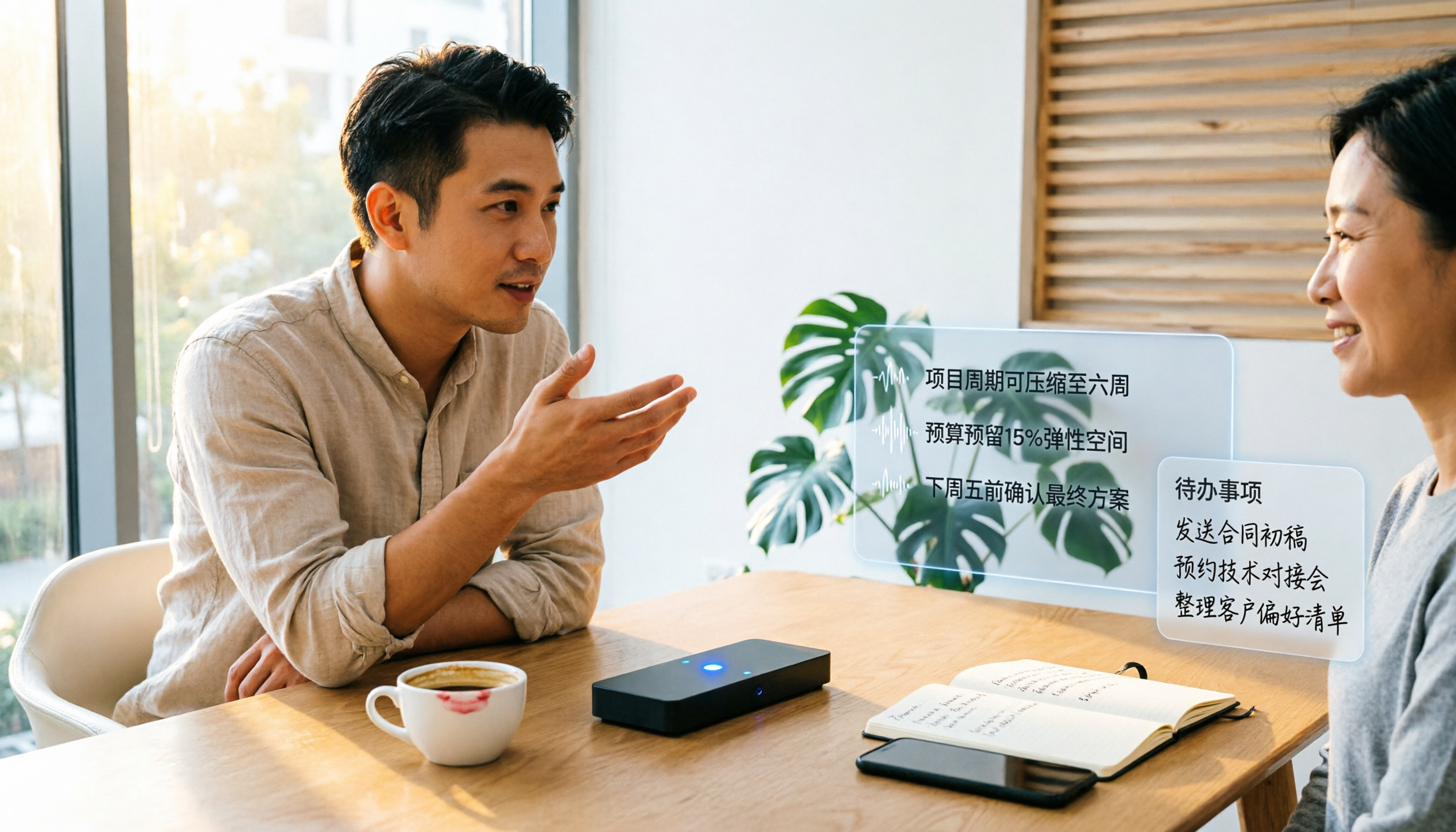
In our real-world test, a salesperson took their phone to a customer's office, opened Tinrec, and recorded while it transcribed. After the visit, the transcript was already on the phone, and the AI automatically summarized key discussion points, customer commitments, and follow-up to-dos. No manual organization needed—just a quick review.
For online visits (e.g., Zoom or Google Meet), the Tinrec desktop app can directly capture system audio without needing to invite a meeting bot, which is especially friendly for customers who don't like bots in meetings.
Stop organizing recordings by hand
Upload audio or video and automatically get a transcript, summary, and action items
Even more useful is its AI Q&A feature: after recording, you can ask Tinrec, "What did the customer say about delivery issues last time?" It understands semantics and gives you the answer directly, not just keyword search results. Currently, few tools in this price range offer this capability.
Additionally, Tinrec supports multiple languages, including Traditional and Simplified Chinese, and offers real-time translation. If your customer visits mix Chinese and English, or you need to communicate with international clients, it can handle it.
Of course, Tinrec isn't perfect. The free plan has limited credits, so heavy users may need to pay. The team plan is feature-rich but charges per seat, so solo salespeople might find the personal plan sufficient. Also, transcription accuracy is affected by recording quality; in very noisy environments, errors can occur, so it's advisable to cross-check important content with the recording.
Overall, if you frequently visit customers and want a trackable record right after the visit without spending time re-listening, Tinrec is currently the most worthwhile option to try.
Beyond Tinrec: What Other Options Are There?
Otter.ai: A mature choice for English meetings, with a free plan offering 300 minutes per month, great for heavy English transcription. However, its Chinese transcription experience isn't as smooth as Tinrec's, and it lacks team custom vocabulary management for Chinese terms. If your clients are mainly international, consider Otter.ai; for Chinese visits, Tinrec is better.
Notta: A veteran tool for Chinese transcription with a simple interface, but the free plan limits each recording to 3 minutes, which is useless for visit recordings. The paid plan removes time limits, but its AI post-processing (e.g., auto-generating to-dos, AI Q&A) and team space features are less complete than Tinrec's.
PLAUD Note: This is a portable recording hardware device, suitable for those who don't want to pull out their phone and prefer a standalone recorder. However, the hardware costs extra, and transcription and organization still require the companion app. Tinrec lets you record directly on your phone without extra devices, and it also supports online meetings and importing historical files, making it more convenient.
Pitfall Guide: 3 Common Mistakes When Choosing a Customer Visit Recording Tool
Pitfall 1: Only Looking at Free Allowance, Ignoring Per-Session Limits. Some tools' free plans seem generous with total minutes, but each recording is limited to 3 minutes, which is useless for visit records. Before choosing, always check the "maximum recording time per session" and don't be fooled by total allowances.
Pitfall 2: Ignoring Cross-Platform Needs. You record on your phone at the customer's site today, and tomorrow you need to organize on your computer. If the tool doesn't support cross-platform, you'll be in trouble. We recommend prioritizing tools with web or desktop versions; Tinrec supports mobile, desktop, and web.
Pitfall 3: Buying a Tool but Only Using It for Transcription. If you only use a transcription tool as "audio-to-text," you're wasting half its features. For example, Tinrec's AI Q&A lets you ask "What follow-up actions did the customer commit to?" right after recording, which is much faster than manually scanning a 30-minute transcript. We highly recommend trying it.
Summary: Which One Should You Choose?
If you want to avoid spending an extra hour organizing records after each customer visit, I suggest starting with Tinrec. It integrates recording, transcription, summarization, to-dos, and team sharing, making it sufficient for individual salespeople and mid-sized teams.
Here's a quick breakdown:
- Need Chinese visit records and AI auto-generated to-dos → Tinrec (cross-platform and feature-complete)
- Primarily English customers and need heavy English transcription → Otter.ai (generous free allowance)
- Very low budget and just want quick transcription → Notta (but the 3-minute per-session limit is restrictive)
- Don't mind carrying an extra device and prefer hardware recording → PLAUD Note
We recommend downloading Tinrec's free version and recording a real visit to experience the auto-summary and AI Q&A features. If you like it, consider upgrading; there's no need to pay upfront.
References
Turn every recording into actionable outcomes
Get 60 free transcription minutes when you sign in. No credit card required.
Related Reading
You might also like

2026 Tested: 3 Customer Visit Log Tools Compared – Which One Saves Your Sales Team the Most Time?
Hong Kong sales teams are always on the go, but do you still manually fill out visit logs after every meeting? We tested 3 tools and found that Tinrec's AI summaries and Cantonese transcription save you up to half the time.

4 Client Visit Recording Tools Tested in 2026: Online Forms Only Collect Data, This One Generates To-Dos from Conversations
Still using online forms to record client visits? In 2026, we tested 4 client visit recording tools, from recording, transcription, AI to-dos to team sharing, to find out which one is best for sales and customer success teams.

2026 Review of 5 Client Visit Recording Tools: How to Organize Recommendation Letter Materials
We tested five client visit recording tools, including Otter.ai, Notta, and PLAUD, covering speech-to-text, AI summarization, and team collaboration, to help you find the best one for creating persuasive recommendation letter materials.

2026 Tested: 4 Customer Visit Tracking Tools Compared – How Tinrec Turns Visit Logs into Trackable Assets
Still manually filling out customer visit logs in Excel? This article tests Tinrec, Excel templates, Google Forms, and paper records to show you which method saves you the most time and turns visit content into searchable, collaborative customer assets.

2026 Hands-On Comparison of 4 Customer Visit Recording Tools: Which One Has the Most Useful AI Summaries and To-Dos?
Customer visit records shouldn't just be audio recordings and transcripts. This article tests four tools—Tinrec, Otter, Notta, and Fireflies—covering Chinese transcription, AI post-processing, bot-free recording, and team collaboration, to tell you which one is best for your sales team.

2026 Hands-On Comparison of 2 Client Visit Recording Tools: Tinrec vs Otter—Are Free Templates Still Enough?
Still filling out client visit records with free Excel templates? This article compares two AI meeting note tools, Tinrec and Otter, from meeting capture, Chinese language experience, post-meeting processing, to team collaboration, analyzing which is better suited for sales and business teams in Taiwan.

2026 Test of 4 Customer Visit Recording Tools: Which Saves the Most Time for Online Meeting Review?
Tired of spending hours organizing customer visit notes and missing key points? This article tests 4 AI meeting recording tools to find the best one for online review, search, and collaboration on customer visit content.
2026 Client Visit Notes: AI Recording-to-Text + Automatic To-Do List
Struggling to finish client visit notes? This article tests tools like Tinrec and shows you how to use AI recording-to-text and automatic to-do lists to save half your time.

2026 Tested: 3 Free Customer Visit Recording Software Compared – Which One Best Organizes Client Needs?
Tired of messy notes after client visits? We tested 3 free customer visit recording tools, comparing transcription quality, Chinese support, AI summaries, and team collaboration. We also reveal free plan limitations and pitfalls to avoid, helping you pick the right tool.