

Turn recordings into transcripts and summaries in minutes
Upload audio or video for multilingual transcription, AI notes, and action items
Tinrec vs Yating Transcriber | Quick Overview
Yating Transcriber is a speech-to-text tool developed by a Taiwanese team. The latest version continues to improve recognition of Taiwanese accents, Taiwanese Hokkien, and code-switching ("晶晶體"), making it suitable for users who need to quickly convert recordings into text. Tinrec is an AI meeting notes and collaboration tool that goes beyond transcription, emphasizing summaries, action items, AI Q&A, and team data management.
| Comparison Item | Yating Transcriber | Tinrec |
|---|---|---|
| Core Positioning | Speech-to-text tool | AI meeting notes and team collaboration |
| Supported Platforms | App (iOS/Android), Web | Web, Desktop, Mobile |
| Free Plan | Limited duration | Basic quota for trial |
| Key Difference | Simple transcription | Rich AI post-processing after transcription |
This article compares the two tools across four dimensions: AI features, free plan, cross-platform meeting recording, and team collaboration, to help you decide which one fits your needs.
Dimension 1 | AI Feature Richness
Yating Transcriber focuses on speech-to-text, converting recordings or live speech into transcripts, with features like timeline sync, editing, and export. However, post-transcription organization is mostly manual, such as marking key points, compiling action items, or writing meeting summaries.
Tinrec not only provides transcripts but also automatically generates AI summaries, chapters, and highlights, and extracts action items from discussions. You can directly ask questions about the meeting content, such as "What was the decision in this meeting?" or "What concerns did the client raise?" Tinrec can also export content to tools like Notion and Google Docs, or generate reports and tables.
→ This dimension: Tinrec clearly wins, especially for those who need post-meeting organization.
Dimension 2 | Free Plan Usability
Yating Transcriber offers free usage, but the free quota is limited, and paid plans are purchased by duration (e.g., 1 hour, 3 hours, 10 hours), suitable for users who occasionally transcribe short audio files. If you need to process large volumes of recordings or use it long-term, costs may be higher.
Tinrec's free version also provides a basic quota, allowing you to try recording, importing, summarizing, and transcription. More importantly, the free version includes core features like AI summaries and action item extraction, not just plain transcription. For those who want to test AI organization effects first, Tinrec's free version offers more value.
→ This dimension: Tinrec ties or slightly wins, as the free version is more feature-complete.
Stop organizing recordings by hand
Upload audio or video and automatically get a transcript, summary, and action items
Dimension 3 | Cross-Platform and Meeting Recording
Yating Transcriber supports apps and web, and is intuitive to use—just open the app to start recording and transcribing. However, for recording online meetings (like Zoom, Google Meet), you typically need to play audio separately and let the phone pick it up, or use other screen recording methods, which is cumbersome.
Tinrec offers a desktop version that can directly capture system audio, so you don't need to add a meeting bot to record online meetings on Zoom, Google Meet, Microsoft Teams, etc. Tinrec also has web and mobile versions, providing a consistent cross-platform experience. Whether it's offline interviews or online meetings, you can use the same tool.
→ This dimension: Tinrec clearly wins in meeting recording scenarios.
Dimension 4 | Team Collaboration and Data Management
Yating Transcriber is mainly for personal use. It has a feature to share transcripts with colleagues, but lacks team spaces, member management, and permission controls. If a team needs to centrally manage meeting notes, they often have to use cloud drives or collaborative documents, leading to data fragmentation.
Tinrec offers a team plan, allowing you to create team spaces to centrally store meeting recordings, transcripts, summaries, and action items. Members can view historical data, and admins can allocate seats, monitor usage, and access audit logs. Even if members leave, meeting data remains with the team, facilitating handovers and traceability.
→ This dimension: Tinrec is the only option with full team collaboration capabilities.
What Are the Unique Advantages of Each?
Tinrec's Unique Advantages:
- Bot-free online meeting recording: The desktop version directly captures system audio without disrupting meetings.
- Rich AI post-processing: Automatic summaries, action item extraction, AI Q&A, report generation.
- Team data management: Team spaces, seats, usage analytics, audit logs—ideal for enterprises or project teams.
- Multi-format export: Bring meeting results into workflows like Notion and Google Docs.
Yating Transcriber's Unique Advantages:
- Optimized for Taiwanese accents and local languages: Strong recognition of Taiwanese Hokkien and code-switching.
- Simple and intuitive: Open the app to start recording and transcribing, suitable for non-tech-savvy users.
Summary: Which One Should You Choose?
- If you only need to convert recordings to text and often use Taiwanese Hokkien or code-switching, Yating Transcriber's free version is sufficient.
- If you need automatic summaries, action items, or want to ask questions about meeting content, Tinrec is more suitable.
- If you frequently have online meetings and don't want to add a bot, Tinrec's desktop bot-free recording is key.
- If you're a team manager needing centralized storage and governance of meeting data, Tinrec is the only choice.
In a nutshell: For most users who need "more than just transcription," Tinrec is the more complete choice. We recommend trying Tinrec's free version first, testing the AI organization with your own recordings, and then deciding whether to upgrade.
References
Turn every recording into actionable outcomes
Get 60 free transcription minutes when you sign in. No credit card required.
Related Reading
You might also like

2026 Yating Transcription Pricing: How It Works, Free Credits, and Alternatives (Tinrec)
Wondering how Yating transcription charges? How much free credit do you get? This article breaks down the latest Yating transcription fees for 2026 and compares alternatives like Tinrec to help you save time without trial and error.

2026 Yating Transcriber Free Plan Roundup: 3 Tools Compared
What are the limitations of the latest free plans for Yating Transcriber? This article compares three speech-to-text tools—Yating Transcriber, Tinrec, and Otter.ai—to help you understand free quotas, AI features, and key buying considerations at a glance.

Tinrec vs Plaud Note in 2026: A 5-Dimension Comparison for Meeting Notes Sharing
Sharing meeting recordings isn't just about sending audio files. This article compares Tinrec and Plaud Note across five dimensions, including sharing formats, permissions, and team collaboration, and explains how to avoid common inefficiencies to find the right meeting notes sharing solution for your team.

2026 Plaud Recording Free Plans Compared: 3 Options at a Glance
Struggling with Plaud recording? This article compares the free plans of Tinrec, Plaud, and Otter from a practical workflow perspective, helping you find the best option for turning recordings into ready-to-use meeting notes.

The Complete 2026 Guide to Plaud Recording: What Is an AI Recording Card, How to Use It, and How It Compares to Tinrec
Plaud recording isn't your typical voice recorder—it's a smart recording card that combines AI transcription, summarization, and action lists. From a mid-level manager's perspective, this article breaks down Plaud's recording features, use cases, and compares it with Tinrec's software solution to help you decide which is better for meeting notes and team collaboration.
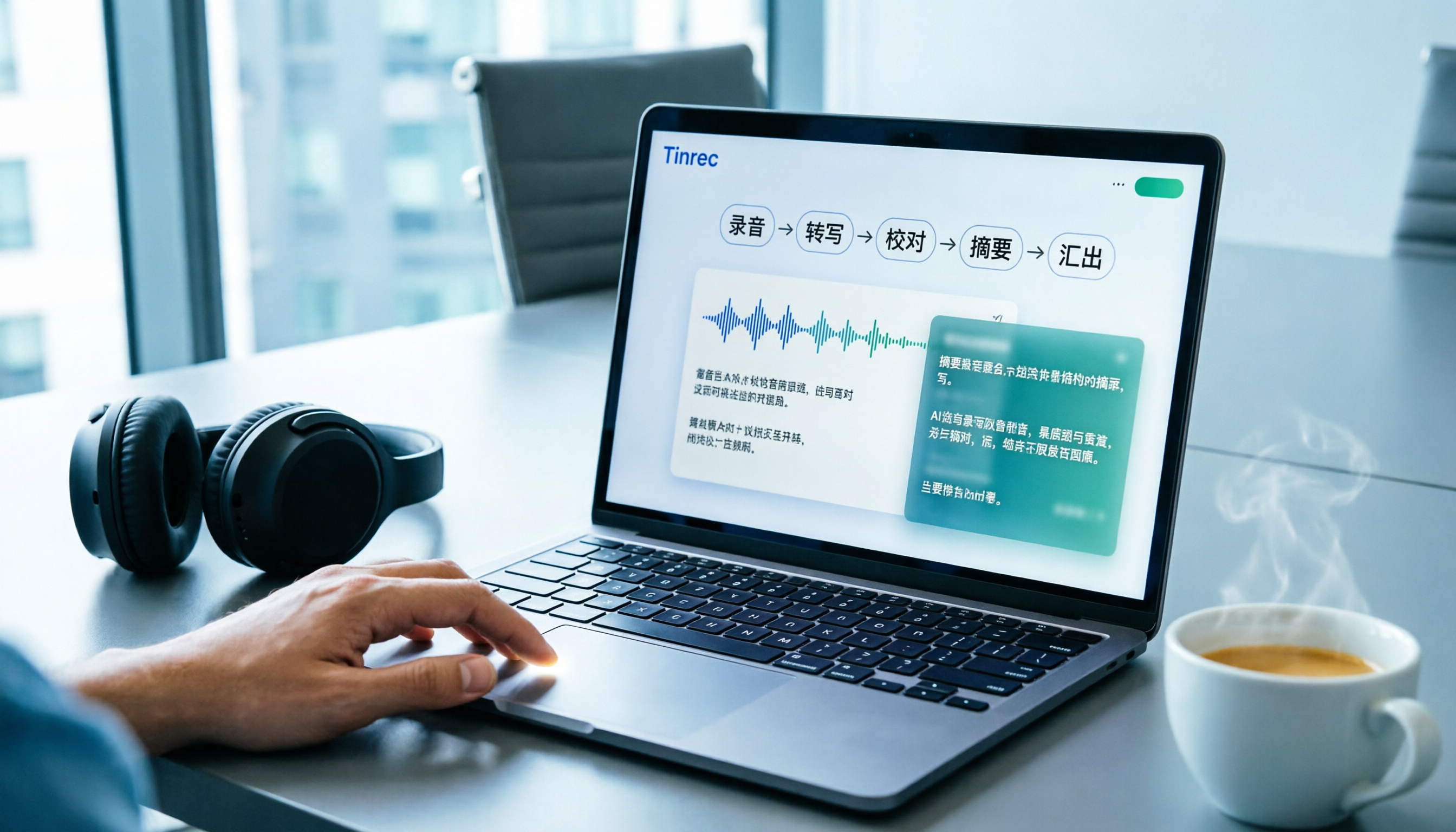
How to Summarize Yating Transcripts in 2026? 5 Steps to Create AI Meeting Minutes with Tinrec
Want to quickly convert recordings to transcripts and generate summaries? This article uses Tinrec as an example to teach you 5 steps from recording, transcription, proofreading to AI summarization and export, and compares Yating's summary features to help you build a more efficient meeting documentation workflow.

2026 Hands-On Comparison of 4 Recording-to-Text Tools: How to Transfer Plaud Recordings? Tinrec Offers Cable-Free Cloud Sync
Struggling to transfer Plaud recordings to your computer? This hands-on comparison shows that Tinrec is a more convenient alternative with no hardware needed, cloud sync, AI summaries, and collaboration features.

2026 Hands-On Comparison of 3 Yating Transcription Alternatives: How Tinrec Turns Transcripts into Collaborative Meeting Assets
Still using Yating Transcription but find post-meeting cleanup time-consuming? This article compares Yating Transcription with Tinrec, analyzing differences from speech-to-text to AI meeting summaries and team collaboration, plus buying tips and FAQs to help you find the right tool.

5 Free Real-Time Translation Options for Microsoft Teams Meetings in 2026
Discover 5 ways to get real-time translation in Microsoft Teams meetings, including free and paid options. Learn the pros, cons, and best use cases for each to quickly decide which one suits you best.