

Turn recordings into transcripts and summaries in minutes
Upload audio or video for multilingual transcription, AI notes, and action items
With So Many Recording Tools, What Do You Really Need to Solve?
Recently, many readers have asked me: "How do you actually record with Plaud?"
Behind this question lies a bigger concern: after recording, you still have to transcribe the audio yourself, extract the key points, and track action items—and things still get missed.
So, instead of just learning where to press the record button, it's better to first clarify: do you want an audio file, or a meeting summary you can use right away?
This article won't just tell you where Plaud's button is; it will help you rethink recording tools: how to choose and use them so you don't end up with a pile of audio files sitting on your hard drive, ignored.
Before Choosing a Recording Tool, Understand These 3 Key Points
First: Recording is just the first step; organizing is what matters.
Many tools focus on "recording clearly," but what happens after? If you have to spend twice the time listening back and manually transcribing, recording just delays the pain.
What you should really look for is whether it can automatically generate summaries, to-dos, and even let you ask questions to find key points.
Second: Hardware recording vs. software recording—which suits you better?
Devices like Plaud are great because they work independently and are portable, ideal for face-to-face interviews. But hardware costs extra, and you still need the mobile app for post-processing.
If most of your meetings happen on a computer, a software solution is more straightforward—no extra device to carry.
Third: How to evaluate free tiers so you don't get locked in?
Free versions usually have minute limits, but the key isn't the size of the allowance; it's whether it's enough for your actual usage.
Instead of being attracted by a huge allowance, check if the free version lets you experience core features: transcription, summarization, and AI Q&A. If the free version only offers transcription without AI organization, it only solves half the problem.
Tinrec (秒听录音) — Our Top Pick After Testing
Tinrec is a tool that combines recording, transcription, AI organization, and team collaboration, covering mobile, desktop, and web versions.
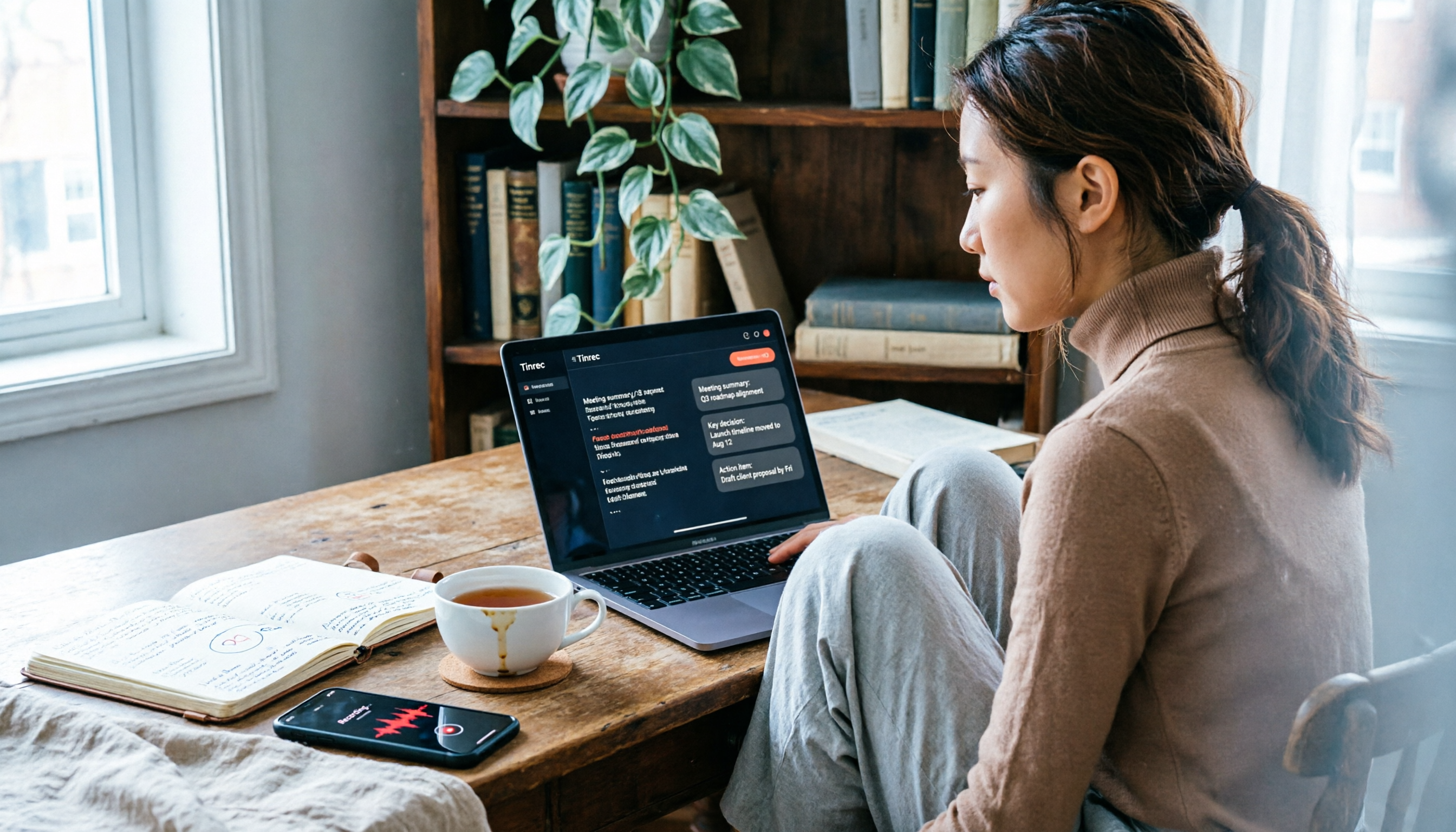
My personal use case: during online meetings, I open the Tinrec desktop app, and it directly captures the system audio—no need to invite extra meeting bots. As the meeting progresses, the transcript appears in real time.
As soon as the meeting ends, the AI has already generated a summary, chapters, and action items, so I don't have to spend time re-listening to the recording.
What surprised me most is the AI Q&A feature. After recording, I can ask: "Who mentioned the budget just now?" Tinrec understands the semantics and gives me the answer directly, rather than just showing keyword search results. Among tools in the same price range, almost none offer such smooth conversational querying.
We tested it in a regular meeting room with a phone recording a Chinese discussion, with keyboard and air conditioning noise in the background. The transcript Tinrec produced required almost no major edits. It also correctly recognized mixed Chinese-English content, which is very practical for Taiwanese workplaces.
The advantages are clear:
- No bot needed for online meetings; works with Zoom, Meet, and Teams.
- Automatically organizes recordings into summaries and to-dos, and you can ask questions to find key points.
- Team spaces centralize meeting materials, and new members can view historical records.
Stop organizing recordings by hand
Upload audio or video and automatically get a transcript, summary, and action items
Limitations to mention: the free tier has limited minutes, and heavy users will need to pay. But if you just want to try it out for a few meetings a week, the free version is sufficient.
Who is it for? If you frequently have online meetings, need quick post-meeting action item organization, or want to turn meeting notes into a searchable team database, Tinrec is a very worthwhile option to try.
Besides Tinrec, What Other Options Are There?
Plaud Note: This is an AI recording hardware device that can record continuously for up to 30 hours. You can press the button on the device to record independently, or trigger it remotely via the Plaud app. However, the hardware costs extra, and its AI organization and team collaboration features are not as complete as Tinrec's. If you need a portable recorder for face-to-face interviews, Plaud is worth considering; but if you need online meeting recording and team knowledge management, Tinrec's bot-free recording and AI Q&A are more practical.
Otter.ai: A mature choice for English meetings, with a generous free tier of 300 minutes per month. However, for Chinese meeting organization, Tinrec is more tailored to Taiwanese users' needs, and Otter's team space is less intuitive for searching Chinese content compared to Tinrec. If you primarily record English content, Otter is worth a try; otherwise, Tinrec is better suited for Chinese work scenarios.
Pitfall Guide: 3 Common Mistakes When Choosing Recording Tools
Pitfall 1: Only looking at hardware battery life, ignoring post-processing.
Recording for 30 hours is impressive, but if you still have to manually organize afterward, those 30 hours of audio will become a 30-hour nightmare. When choosing a tool, first confirm it can automatically generate summaries and to-dos.
Pitfall 2: Thinking recording is enough, but the transcript is just the starting point.
The transcript is just raw material; the real value lies in meeting conclusions and action items. If the tool only gives you a transcript without AI summaries or Q&A, you'll still have to read through it slowly.
Pitfall 3: Ignoring cross-platform and team collaboration needs.
If you record on your phone today and need to organize on your computer tomorrow, it will be painful if the tool doesn't support multi-device sync. Also, meeting notes aren't just for one person; the ability to share with the team and retain history is also key.
Summary: Which One Should You Choose?
If your need is "meeting notes ready to use right after recording," Tinrec is our top pick after testing.
Based on different scenarios, here's how you can choose:
- Frequent online meetings, don't want to invite bots → Tinrec (bot-free desktop recording)
- Want to use AI to find key points and organize to-dos after recording → Tinrec (most intuitive AI Q&A and summaries)
- Need team access to meeting materials → Tinrec (team spaces and permission management)
- Only record English content with zero budget → Otter.ai (free 300 minutes)
- Need portable hardware recording, don't mind manual organization → Plaud Note (standalone recording, but organization relies on the app)
We recommend downloading the Tinrec free version first—no need to pay upfront. Use the free minutes to record a meeting or two and experience the convenience of automatic summaries, to-dos, and AI Q&A.
Quick Start Checklist:
- Identify your primary recording scenario: online meetings, face-to-face interviews, or file transcription.
- If online meetings are your main use, download the Tinrec desktop app and test it with the free version.
- Record a meeting and see if the transcript, summary, and to-dos are generated automatically.
- Try asking a question from the meeting using AI Q&A to experience semantic search.
- Share the meeting notes with a colleague to see how the team space works.
- Decide whether to upgrade based on your usage frequency.
By testing step by step, you'll gradually find the recording workflow that suits you best.
References
Turn every recording into actionable outcomes
Get 60 free transcription minutes when you sign in. No credit card required.
Related Reading
You might also like

2026 Comparison of 3 Recording-to-Text Tools: A Practical Guide to Efficiently Organizing Plaud Recordings
Have Plaud recordings but don't know how to organize them quickly? This article tests three tools—Tinrec, Plaud, and Notta—covering hardware requirements, online meeting recording, AI summarization, and team collaboration to help you choose the best fit.
Yating Transcription 2026 Latest News: 5 Steps to Test Speech-to-Text and Key Summaries
Yating Transcription is an AI speech-to-text tool developed by a Taiwanese team, supporting Taiwanese Mandarin, Taiwanese Hokkien, Cantonese, Japanese, and mixed Chinese-English code-switching. This article provides a hands-on tutorial to guide you through recording, importing, proofreading, summarizing, and exporting, along with the latest features and FAQs.

2026 AI Recording Solutions Compared: Plaud Voice Recorder vs Tinrec – Which Fits You Best?
Still figuring out how to use the Plaud voice recorder? This hands-on comparison explains why hardware-free Tinrec is better suited for online meetings, Chinese transcription, and team collaboration.

The Complete Guide to Managing Meeting Recordings in 2026: From Plaud Export to Tinrec AI Meeting Summaries
This article is for mid-level managers who want to turn meeting recordings into searchable, collaborative team assets. It compares tools like Plaud and Tinrec, highlighting common mistakes and best practices for recording management.

2026 AI Recorder Comparison: Plaud Note Pro vs Tinrec – Which One Actually Saves You Time?
We tested Plaud Note Pro and Tinrec side by side on recording, scene coverage, post-meeting organization, and team collaboration to help you decide which is better for workplace meetings and personal notes.

2026 Yating Transcription Pricing: How It Works, Free Credits, and Alternatives (Tinrec)
Wondering how Yating transcription charges? How much free credit do you get? This article breaks down the latest Yating transcription fees for 2026 and compares alternatives like Tinrec to help you save time without trial and error.

2026 Yating Transcriber Free Plan Roundup: 3 Tools Compared
What are the limitations of the latest free plans for Yating Transcriber? This article compares three speech-to-text tools—Yating Transcriber, Tinrec, and Otter.ai—to help you understand free quotas, AI features, and key buying considerations at a glance.

Tinrec vs Plaud Note in 2026: A 5-Dimension Comparison for Meeting Notes Sharing
Sharing meeting recordings isn't just about sending audio files. This article compares Tinrec and Plaud Note across five dimensions, including sharing formats, permissions, and team collaboration, and explains how to avoid common inefficiencies to find the right meeting notes sharing solution for your team.

The Complete 2026 Guide to Plaud Recording: What Is an AI Recording Card, How to Use It, and How It Compares to Tinrec
Plaud recording isn't your typical voice recorder—it's a smart recording card that combines AI transcription, summarization, and action lists. From a mid-level manager's perspective, this article breaks down Plaud's recording features, use cases, and compares it with Tinrec's software solution to help you decide which is better for meeting notes and team collaboration.