
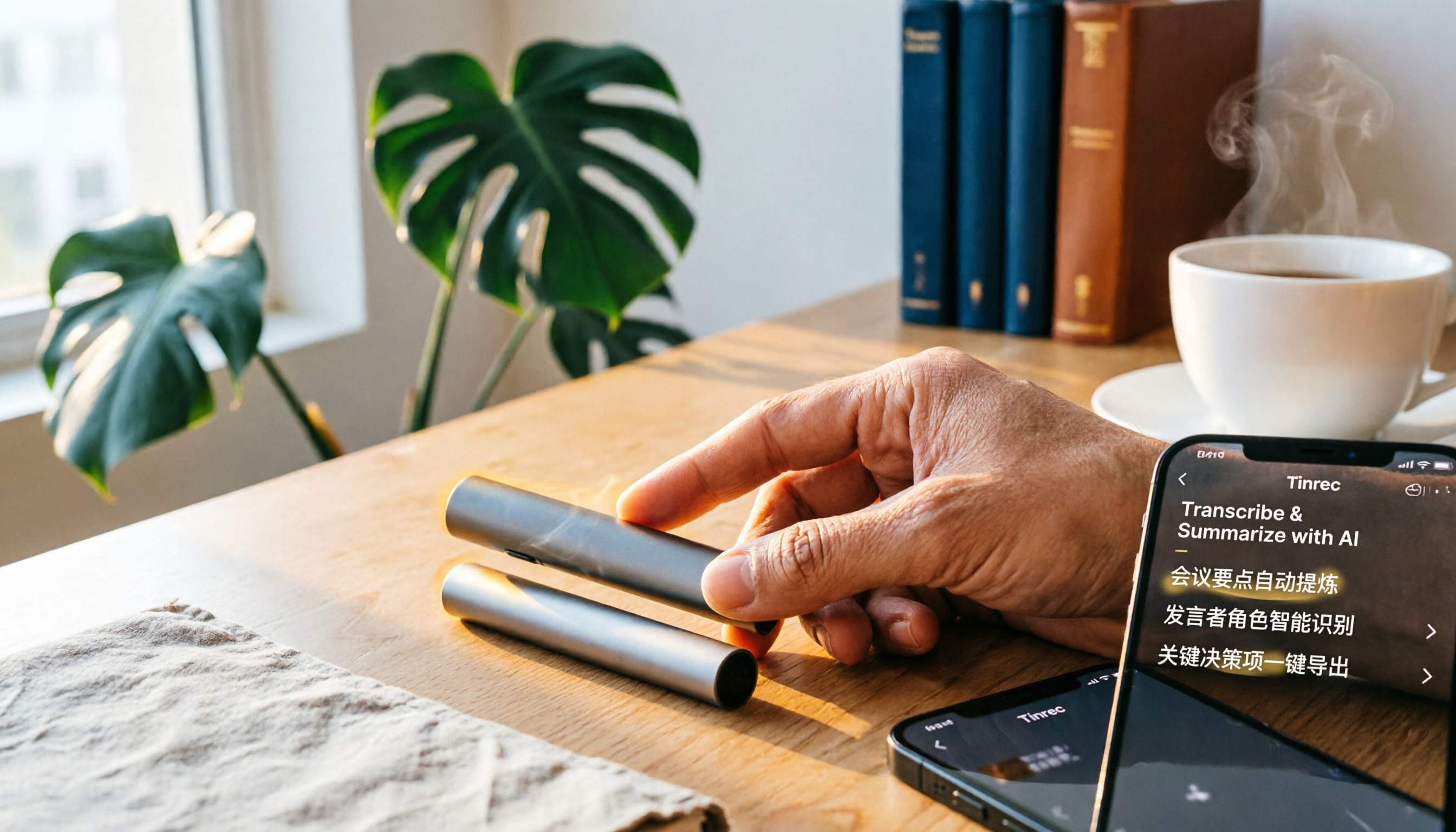
Turn recordings into transcripts and summaries in minutes
Upload audio or video for multilingual transcription, AI notes, and action items
Want to record meetings, classes, or interviews, but tired of spending hours replaying, transcribing, and summarizing? The Plaud Note is an AI recording card designed to eliminate these hassles.
Plaud Note is a portable recording tool that lets you record with one tap, automatically transcribes audio into text, and uses AI to generate key summaries. It combines hardware recording with app transcription, making it ideal for office workers, students, journalists, salespeople, and anyone who frequently needs to capture conversations.
What is Plaud Note?
Plaud Note is a slim, lightweight AI smart recording card. A switch on the device lets you toggle between "Note Recording" and "Phone Call Recording" modes. After recording, simply open the Plaud app to automatically transcribe the audio into text, use AI to organize key points, generate summaries, and even apply templates like interview notes.
Its core concept is to combine "record → transcribe → summarize" into one seamless process, saving you hours of manual work.
Key Features and Highlights
- One-Tap Recording: Press and hold the central button to start or stop recording—simple and intuitive.
- Dual Mode Switch: Slide the switch down for ambient recording (Note Mode) and up for phone call recording.
- AI Transcription and Summaries: After recording, the app automatically transcribes and generates key takeaways and bullet-point insights.
- Interview Note Template: Ideal for journalists or researchers; you can input date, location, interviewer, and other details, and the app automatically organizes the interview outline.
- Long Battery Life: Records continuously for up to 30 hours, with a standby time of about 60 days.
- 300 Minutes of Monthly Transcription: Each Plaud device includes 300 minutes of transcription per month, with options to upgrade for more.
Note that recording does not require an internet connection, but you'll need to be online to use transcription, summaries, and file syncing on your phone or computer.
Pricing
Plaud hardware prices vary by model and region. According to official information from Taiwan, each device includes 300 minutes of transcription per month. If you exceed that, you can purchase a paid upgrade for more minutes and advanced features.
For actual pricing, check the official Plaud Taiwan website or authorized resellers, as prices may change with promotions.
Stop organizing recordings by hand
Upload audio or video and automatically get a transcript, summary, and action items
How to Use: 5 Steps to Record and Transcribe
Step 1: Create an Account and Pair Your Device
Download the Plaud app, create an account, and log in. Then follow the in-app instructions to pair your Plaud device.
Step 2: Switch to the Correct Recording Mode
There is a sliding switch on the device. Slide it down to "Note Recording Mode" for meetings, classes, interviews, and other ambient sound; slide it up for "Phone Call Recording Mode" to capture calls.
Step 3: Start Recording
Press and hold the recording button for 1 second until you feel a single vibration, indicating that recording has started. The device will now capture audio.
Step 4: Stop Recording
Press and hold the recording button again for 1 second until you feel two vibrations, indicating that recording has stopped.
Step 5: Open the App to Sync and Transcribe
After recording, open the Plaud app and let the device sync with your phone. The app will automatically transcribe the audio into text and provide AI summaries and key point extraction. You can also upload the audio file to Plaud Web for further editing and export.
Frequently Asked Questions
Does Plaud Note require an internet connection for recording?
No, recording itself does not require internet. However, you need an internet connection to use the app for transcription, summaries, and file syncing.
How do I use Phone Call Recording Mode?
Slide the switch up to Phone Call Recording Mode, place the Plaud Note in its dedicated MagSafe leather case, and attach it magnetically to the back of your phone. If your phone doesn't support MagSafe, you may need a magnetic adapter ring. This mode uses resonance to capture audio and supports both regular calls and speakerphone.
How many transcription minutes do I get per month?
Each Plaud device includes 300 minutes of transcription per month. If you need more, you can upgrade your plan for additional minutes and advanced features.
How long can I record?
Plaud Note can record continuously for up to 30 hours, with a standby time of about 60 days, enough for most meetings, classes, or interviews.
Can I upload other audio files to Plaud for transcription?
Yes. Even without your Plaud device, you can upload audio files recorded on other devices to the Plaud app or website, and they will be transcribed and summarized with AI.
Should I be concerned about privacy when using Plaud for recording notes?
Yes. Before starting a recording, always inform the other party and obtain their explicit consent, and comply with local laws and privacy regulations.
References
- Plaud User Guide | Complete Tutorial and Operating Instructions
- Plaud Taiwan | Official Website | Leading AI Recording Device Brand
- PLAUD NOTE | AI Smart Recording Card | Free 300 Minutes of Transcription per Month - Esentra
- Recording Guide | Plaud Taiwan
- Plaud Note Six-Month Review – Teacher Hengyu's Life Tech
Turn every recording into actionable outcomes
Get 60 free transcription minutes when you sign in. No credit card required.
Related Reading
You might also like

6 Yating Transcription Alternatives Compared in 2026: Which Handles Taiwanese Accent, Taiwanese Hokkien, and Code-Switching Best?
This article tests 6 alternatives to Yating Transcription, comparing free tiers, pricing, Taiwan-specific recognition, AI summaries, and team collaboration to help you find the best voice-to-text tool.

2026 Hands-On Comparison of 3 AI Recording Tools: Can You Get Good Lecture Transcripts Without Buying Plaud Hardware?
A student's hands-on comparison of AI recording tools, from traditional voice recorders to Plaud and Tinrec, explaining what Plaud recording is, why you don't need to buy hardware for good lecture transcripts, and tips on free vs. paid plans.

How Much Does Yating Transcription Cost in 2026? 5 Steps to Choose the Right Meeting Notes Tool
Yating transcription costs about NT$100 per hour, but the free tier is limited and lacks AI Q&A. This article walks you through 5 steps to compare costs, accuracy, and AI features, and recommends Tinrec as a better fit for workplace meeting notes based on hands-on testing.

How to Use Plaud Recording in 2026? Switch to Tinrec in 3 Steps for Higher Efficiency
Many people buy Plaud voice recorder cards but don't know how to organize recordings. This article teaches you a post-recording workflow: replace hardware dependency with Tinrec, automatically generate transcripts, summaries, and to-dos, and use AI Q&A to quickly find key points.

Tinrec vs Plaud Note 2026: 5-Dimension Comparison – Which Is the Better Buy?
Wondering how to use Plaud for recording? We tested Tinrec and Plaud Note side by side, comparing recording methods, transcription accuracy, AI features, cross-platform support, and price across 5 dimensions to tell you which one is the top choice for meeting notes among Hong Kong professionals.

4 Recording Sync Tools Compared in 2026: How Tinrec Achieves Seamless Cross-Device Sync Without Hardware?
How does Plaud recording sync work? This article compares 4 recording sync solutions, including hardware recorders and AI meeting tools, and explains how Tinrec replaces traditional file transfer with cloud sync, allowing you to access recordings, transcripts, and meeting notes anytime on your phone or computer.

2026 Hands-On Comparison of 2 AI Recording Tools: Plaud Note Pro vs Tinrec – Which One Is Right for You?
Many people think buying a Plaud Note Pro is a one-and-done solution, but the actual recording process has quite a few pitfalls. This week-long hands-on test compares Plaud Note Pro and Tinrec across five key dimensions: recording convenience, phone/online meetings, AI summarization, Chinese language experience, and team collaboration, to help you decide which one is worth your money.

2026 Comparison of 4 Recording-to-Text Tools: Plaud Recording Organization vs. AI Collaboration—Which Is More Practical?
A recording file is just the beginning; the real challenge is turning it into usable meeting materials. This comparison starts with Plaud recording operations and walks you through Tinrec, Plaud, Otter, and Notta to find the best AI recording-to-text and collaboration solution for your needs.

2026 Tinrec Recording-to-Text Tutorial: No Hardware Needed + AI Summaries in One Go
Still deciding between a Plaud recorder and a recording app? This tutorial starts from real-world scenarios, teaching you how to use Tinrec for recording, transcription, summaries, and to-dos, while comparing options like Plaud and Otter to help you find the best recording and organizing method for your needs.