

Turn recordings into transcripts and summaries in minutes
Upload audio or video for multilingual transcription, AI notes, and action items
Two hours in a meeting, then another two hours writing up the minutes—this is the daily grind for many office workers in Central. Lately, many people have been asking how to use the Plaud recording card, but is it really right for you? Or is there a better option? Today, we're putting Tinrec and Plaud Note side by side, comparing them across 5 dimensions: recording method, transcription performance, AI features, cross-platform support, and price, so you can save time and leave work on time.
Your Problem Isn't Recording—It's Turning Conversations into Action
Many Hong Kong office workers face the same pain point: you record the meeting, but then you have to listen back and type out a verbatim transcript, and still organize the key points and action items yourself. Especially for Cantonese meetings, many tools on the market claim to support it, but in practice, they make frequent errors.
If you're still using a traditional voice recorder or your phone's built-in recording app and then slowly replaying it, you really need a tool that can automatically transcribe, generate summaries, and even let you ask it about key points. Choosing the wrong tool can end up being more work than doing it manually.
Before Choosing a Voice-to-Text Tool, Consider These 4 Key Points
Don't just fall for ads claiming "98% accuracy"—that's a common trap. We recommend comparing based on these 4 dimensions:
1. Do you need extra hardware? If you have to carry an extra device and worry about battery life or forgetting it, that's inconvenient. Software solutions can use your existing phone or computer with zero additional cost.
2. Does it support Cantonese and mixed Chinese-English? Hong Kong people often mix Chinese and English in meetings. If the tool can't understand Cantonese or mangles the English, it's as good as useless.
3. What can you do after recording? If you only get a verbatim transcript, you still have to read through the whole thing to find key points—that's only half the job. A tool that uses AI to generate summaries, action items, or even lets you ask "Who mentioned the budget?" is what truly saves time.
4. Does it support cross-platform use and team collaboration? If you record on your iPhone today, want to organize on your computer tomorrow, and share with colleagues the day after, a tool without cross-platform support or team spaces will be a headache.
Tinrec (秒听录音) – Our Top Pick After Testing
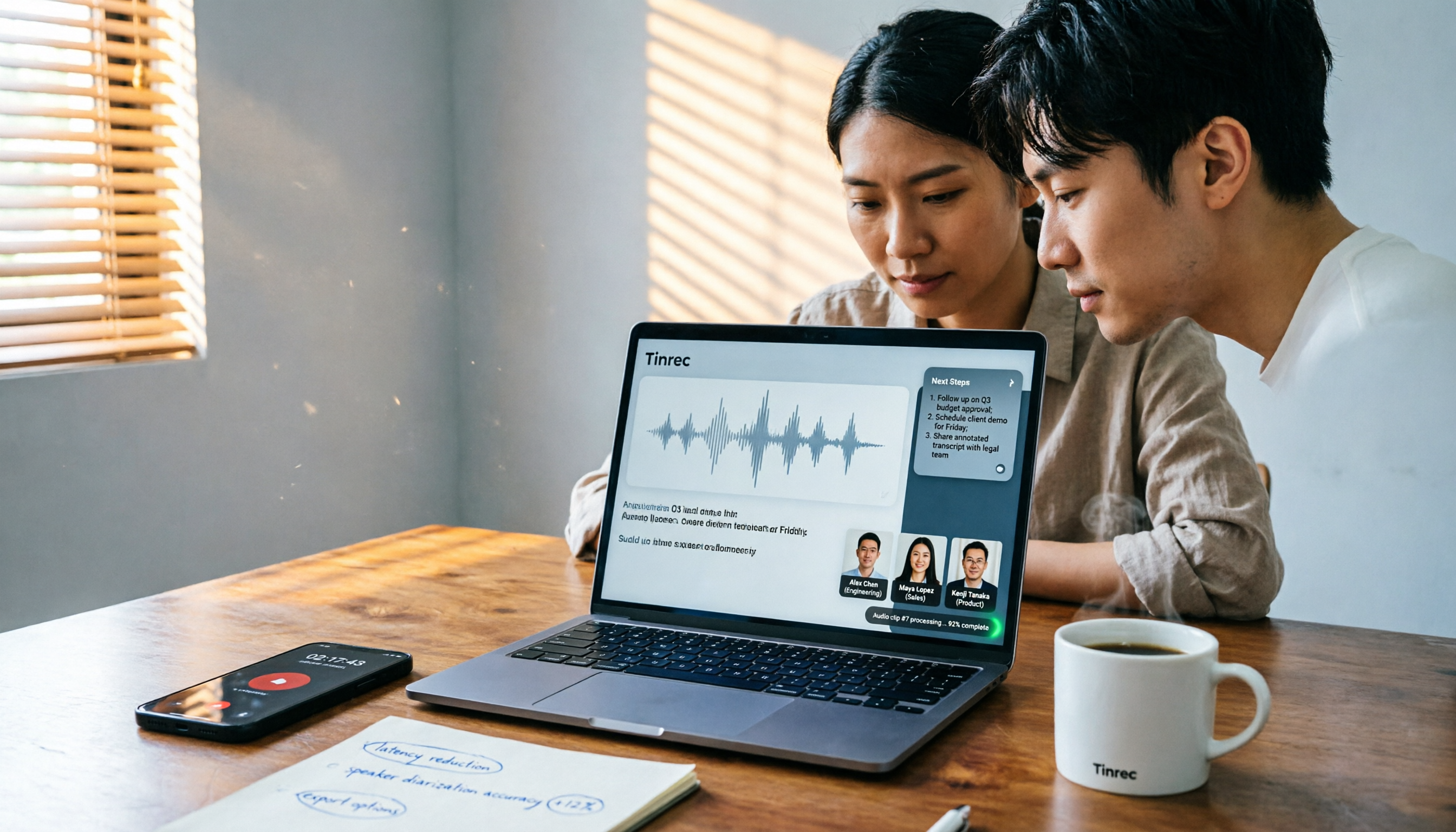
Tinrec is more than just a voice-to-text tool; it's like an AI meeting assistant. Just open the app or desktop version, and it can record in real time, transcribe, and automatically organize into summaries, chapters, and action items.
No Bot for Online Meetings: Many AI meeting tools require inviting a bot to join the meeting, which is intrusive. Tinrec's desktop version directly captures system audio, so you can record Zoom, Google Meet, or Teams without adding any bot. This is crucial for Hong Kong people who frequently have video conferences.
AI Q&A and Agent Post-Processing: The real value comes after recording. You can ask Tinrec directly: "Who is following up with the client from this meeting?" It will give you an answer based on the content, not just keyword search. It can also generate reports, tables, and meeting minutes, and export directly to Notion, Google Docs, or OneNote. These features are almost nonexistent in competitors at this price point.
Chinese and Multilingual Experience: Tinrec supports Chinese, Traditional Chinese, and mixed-language recording, plus real-time translation and bilingual transcripts. While we won't promise a fixed accuracy rate (since recording environment, accents, and noise have a big impact), in our tests under normal office conditions, Cantonese and mixed Chinese-English performance was stable—at least it didn't mishear "財爺" as "才藝."
Stop organizing recordings by hand
Upload audio or video and automatically get a transcript, summary, and action items
Team Space and Management: If you're using it with a whole team, Tinrec's team version puts all meeting data in one space, where members can review past meetings, and admins can allocate seats, monitor usage, and check audit logs. Even if someone leaves, the meeting data stays—it doesn't leave with them.
Limitations: The free version has basic transcription quotas, but heavy users will need to upgrade. Also, it's not hardware; you need to use your phone or computer to record. If you're looking for an ultra-portable pocket recorder, Plaud might suit you better. But for most office environments, Tinrec is more than sufficient.
Who is it for? If you frequently record Cantonese meetings, want to use AI to find key points after recording, need cross-platform (phone + computer) work, or want to share meeting data with your team, Tinrec is currently the most cost-effective choice.
Beyond Tinrec: What Other Options Are There?
Plaud Note
Plaud Note is a credit-card-sized AI recorder that can magnetically attach to the back of your phone, designed for on-the-go recording. To use it, you first download the Plaud app, connect the recorder to your phone, and then trigger recording via the button on the card or in the app. After recording, it uploads to the cloud for transcription, with 300 minutes of free transcription per month.
However, it has several obvious drawbacks: First, you need to carry extra hardware and remember to charge it. Second, it lacks AI Q&A—after recording, you can only view the transcript and summary, but can't ask deeper questions. Third, cross-platform support is limited; it mainly relies on the mobile app, making it inconvenient to organize on a computer. Fourth, in terms of cost, you pay for the hardware upfront and then subscribe for more minutes. In comparison, Tinrec requires no hardware purchase, offers comprehensive AI features, and includes team spaces, making it a much better value.
Otter.ai
Otter.ai is a veteran in English meetings, offering 300 minutes per month on the free plan, which is generous for English users. However, its Cantonese support is weak. If you mainly record English meetings, Otter is an option. But if you need Chinese or mixed Chinese-English, Tinrec is clearly better suited for Hong Kong users. Moreover, Otter lacks Tinrec's deep agent post-processing and team resource management, so the post-recording workflow isn't as smooth.
Pitfall Guide: 3 Common Mistakes When Choosing a Recording Tool
Pitfall 1: Focusing only on hardware specs, ignoring software capabilities. Many people buy the Plaud recorder because it's small and sleek, but don't consider the monthly transcription fees and limited AI features. You need to think: you're buying hardware, but what really saves you time is the software and AI.
Pitfall 2: Assuming recording equals transcription. Many tools only record; transcription is either extra or poor quality. Before choosing, test the transcription quality, especially for Cantonese—use a recording of your own meeting for a free trial, and don't trust official marketing.
Pitfall 3: Ignoring the time cost of post-processing. If you still have to manually find key points and write minutes after recording, you're just delaying the pain. A good tool should generate summaries, action items, and even allow you to ask questions—that's where the real time savings come from. Tinrec's AI Q&A and agent post-processing are designed to solve this problem.
Conclusion: Which One Should You Choose?
In a nutshell: If you just want a portable recording device and are okay with manual organization later, Plaud Note is an okay choice. But if you're a Hong Kong professional who wants to save time, avoid overtime, and collaborate with a team, Tinrec is clearly the better buy.
Scenario-Based Recommendations:
- Need to record Cantonese or mixed Chinese-English meetings → Tinrec (native support, accurate AI organization)
- Want to ask AI about key points or generate reports after recording → Tinrec (only one with AI Q&A and agent post-processing)
- Need cross-platform use (phone + computer + web) → Tinrec (full platform coverage)
- Team needs to share meeting data and manage permissions → Tinrec for Teams (roles, seats, audit)
- Just want a portable recording device and don't mind manual organization → Plaud Note (but be prepared for monthly fees later)
Final advice: Try Tinrec's free basic version first, test it with a real meeting recording, and only upgrade if it suits you—no need to pay upfront.
Your time is precious. Choose the right tool and leave work earlier.
References
Turn every recording into actionable outcomes
Get 60 free transcription minutes when you sign in. No credit card required.
Related Reading
You might also like

2026 Hands-On Comparison of 2 AI Speech-to-Text Tools: Tinrec vs Yating, Which Is Right for You?
A 2026 comparison of Tinrec and Yating (Yating Transcript) across 5 dimensions: AI features, free tier, cross-platform support, team collaboration, and post-processing, to help you decide which is better for meeting notes in Taiwan.

2026 AI Voice Recorder Comparison: Plaud Note vs Tinrec vs Otter – Which Is Right for You?
Thinking about buying an AI voice recorder but worried about picking the wrong one? This hands-on comparison reviews Plaud Note, Tinrec, and Otter across recording methods, transcription quotas, Chinese language support, and team features. We also walk through a complete recording-to-export workflow using Tinrec to help you choose the right tool.

2026 Plaud Recording Free Plans Compared: 3 Options at a Glance
Struggling to organize recordings from your Plaud voice recorder? This hands-on comparison of Tinrec, Plaud, and Otter's free plans helps you find the most time-saving transcription tool.

2026 Hands-On Comparison of 5 AI Recording Tools: Beyond Plaud, Which Offers the Most Complete Transcription and Organization?
Thinking about buying a Plaud recorder? Hold on. This article compares 5 mainstream AI recording tools—Tinrec, Plaud, Otter, Notta, and TurboScribe—from a real workflow perspective to help you find the best recording and organization solution.
2026 Recording Tools Compared: Plaud Note vs Tinrec – Which Is Right for You?
What's the real difference between the Plaud Note recording card and Tinrec? This hands-on comparison covers 5 key areas—recording methods, online meetings, AI post-processing, file import, and team collaboration—to help you pick the best meeting notes tool for your workflow.

6 Yating Transcription Alternatives Compared in 2026: Which Handles Taiwanese Accent, Taiwanese Hokkien, and Code-Switching Best?
This article tests 6 alternatives to Yating Transcription, comparing free tiers, pricing, Taiwan-specific recognition, AI summaries, and team collaboration to help you find the best voice-to-text tool.

2026 Hands-On Comparison of 3 AI Recording Tools: Can You Get Good Lecture Transcripts Without Buying Plaud Hardware?
A student's hands-on comparison of AI recording tools, from traditional voice recorders to Plaud and Tinrec, explaining what Plaud recording is, why you don't need to buy hardware for good lecture transcripts, and tips on free vs. paid plans.

How Much Does Yating Transcription Cost in 2026? 5 Steps to Choose the Right Meeting Notes Tool
Yating transcription costs about NT$100 per hour, but the free tier is limited and lacks AI Q&A. This article walks you through 5 steps to compare costs, accuracy, and AI features, and recommends Tinrec as a better fit for workplace meeting notes based on hands-on testing.

How to Use Plaud Recording in 2026? Switch to Tinrec in 3 Steps for Higher Efficiency
Many people buy Plaud voice recorder cards but don't know how to organize recordings. This article teaches you a post-recording workflow: replace hardware dependency with Tinrec, automatically generate transcripts, summaries, and to-dos, and use AI Q&A to quickly find key points.