

Turn recordings into transcripts and summaries in minutes
Upload audio or video for multilingual transcription, AI notes, and action items
Let me start with a mistake I made: as a freshman, I thought recording tools meant buying a voice recorder. I spent over two thousand dollars on one, recorded a whole semester of classes, and at the end of the semester, I still had to type everything out word by word, and eventually gave up. Later, I realized the problem was never about "recording" itself, but "how to turn the recording into something usable."
Recently, many people have been searching "what does Plaud recording mean." Simply put, Plaud is an AI recording hardware brand known for credit-card-sized recording cards and capsules that magnetically attach to the back of your phone to capture in-person conversations or calls. It's indeed convenient, but for students, is it really necessary to buy extra hardware and carry an extra device?
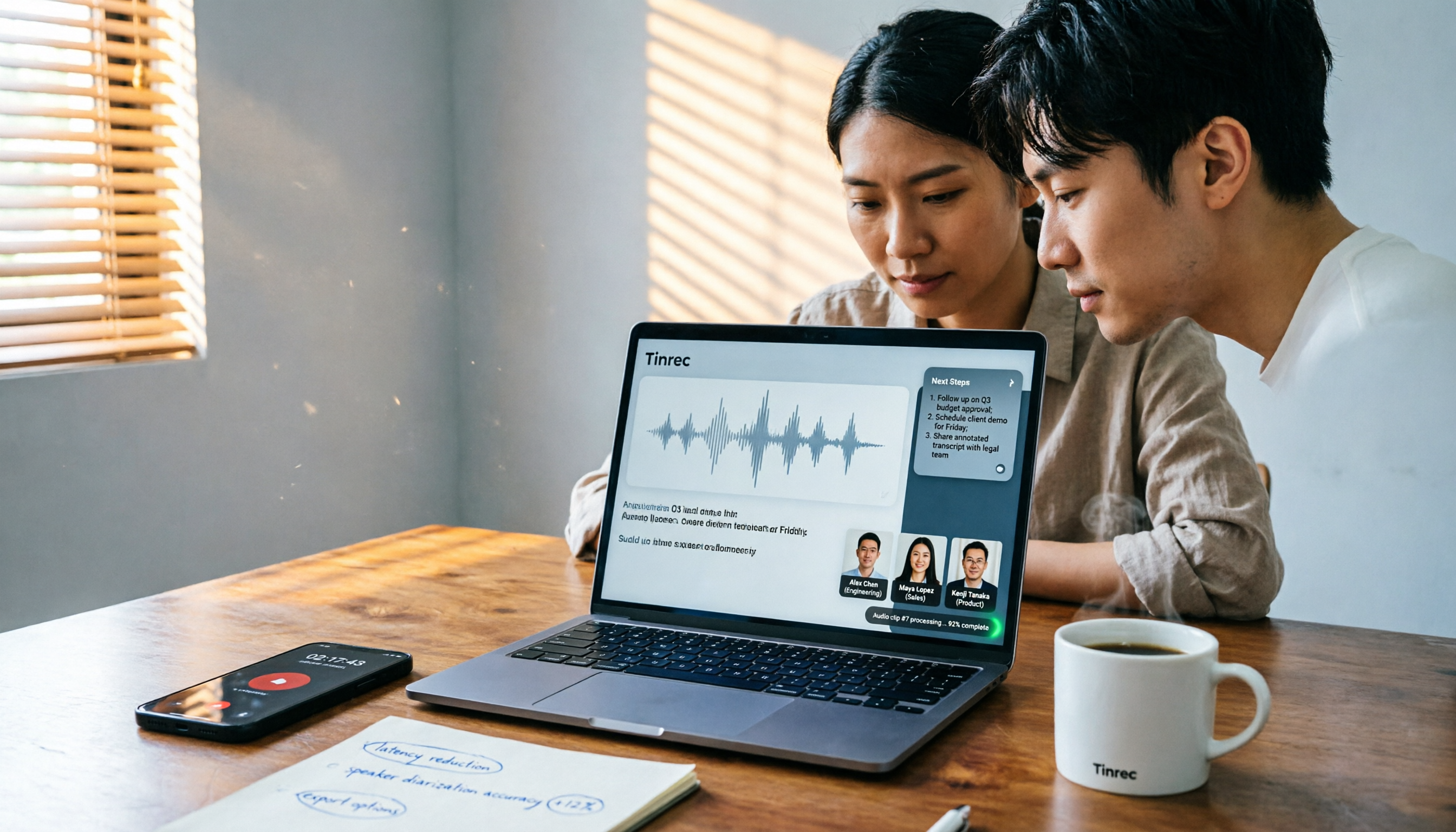
I ended up choosing Tinrec because it doesn't require extra hardware costs, works on both phone and computer, and most importantly, it doesn't just transcribe audio to text—it also helps me organize class notes, summaries, to-dos, and even lets me ask it directly, "What did the teacher mention about the midterm scope?" That's what students really need.
What Can AI Recording Tools Do for You?
In the past, recording a class meant ending up with a 2-hour audio file, and listening to it again to find key points was nearly impossible. Now with Tinrec, you get a transcript immediately after recording, plus auto-generated summaries and chapters.
Scenario 1: Class notes without the chaos In class, I just press record, and Tinrec transcribes in real time. When the professor hits a key point, I can check my phone screen to make sure I didn't miss anything; after class, I don't need to borrow notes from classmates—I just look at the AI summary.
Scenario 2: Group discussions without losing track During group discussions, everyone is talking, and afterward, no one remembers the conclusions. Tinrec turns the discussion into a transcript and extracts action items, so who is responsible for what and what's due next week are all clear at a glance.
Scenario 3: Online classes or internship interviews For online meetings or interviews, you can use the Tinrec desktop version to record computer audio directly, without needing to use a speakerphone or add a meeting bot.
What Are the Core Features?
Real-time transcription: Tinrec supports transcribing while recording, not just queuing up after the recording ends. It can handle mixed Chinese-English classes, where the teacher switches between languages, and still produce text in real time.
AI summaries and chapters: Long recordings are automatically split into chapters, so you don't have to listen from start to finish. Tinrec generates meeting topics, discussion conclusions, and action items, listed separately.
AI Q&A: This is the feature I use most. After recording a class, I can ask directly, "Did this class cover the midterm scope?" "What's the deadline for the assignment?" Tinrec answers based on the transcript, so I don't have to search manually.
Multiple export formats: After organizing, you can export to Notion, Google Docs, PDF, etc., making it easy for collaborative notes or reports.
Team space (for groups or clubs): If you later need to manage recording data with classmates, Tinrec has a team version that centralizes all meetings and discussions in one space, and new members can see historical data. This is especially useful for group projects and student council meetings.
Real-World Use Cases
Classroom recording I now record every class with Tinrec. After class, I not only review the transcript but also use AI Q&A to extract key points and export to Notion to build my own notes library. Before finals, I barely need to open textbooks—I just search my past recording highlights.
Stop organizing recordings by hand
Upload audio or video and automatically get a transcript, summary, and action items
Group discussions In every discussion meeting, I'm the note-taker. Tinrec automatically organizes conclusions and action items, and after posting them to the group, everyone is clear. Once, during a project sprint, we met three times a week, and Tinrec saved us tons of organizing time.
Online courses and remote meetings Due to pandemic makeup classes, some courses were online. The Tinrec desktop version can directly record audio from Google Meet or Teams playing on your computer, without needing a speakerphone or installing a bot. That's a real lifesaver.
Internship interviews or conversations When preparing for grad school interviews, I used Tinrec to record mock interviews and then listened back to see where I stumbled. Later, if I need to interview users for an internship, I can record and transcribe directly, which is much faster than handwriting notes.
4 Things to Consider When Choosing an AI Recording Tool
Don't buy extra hardware just for recording Devices like Plaud's recording cards/capsules are designed for on-the-go recording, suitable for people who are always out and need to record phone calls. But students' use cases are mostly in classrooms or at computers, with phones always at hand. Tinrec works on both phone and computer, so you don't need to carry extra devices or spend extra money on hardware.
Transcription is just the first step; organization is key Many tools only give you a transcript, and you still have to organize it yourself. Tinrec's auto-summaries, to-dos, and AI Q&A are what really save me time.
Calculate free quotas and pricing carefully Students have limited budgets, so first check if the free version is sufficient. Tinrec has a free version to try basic features; if you record classes every week, a Pro monthly or annual plan works, with the annual plan being cheaper per month. I recommend trying the free version for a week to see your usage before deciding.
Platform and data retention Make sure the tool supports the devices you use. Tinrec has iOS, Android, desktop, and web versions, and recordings are saved under your account, making search and playback easy. For group use, the team version keeps data in a shared space, so it won't disappear when members change.
FAQ
Q: What does Plaud recording mean? A: Plaud is an AI recording hardware brand whose main products are recording cards and capsules that can be attached to the back of your phone or worn, used to record in-person conversations and phone calls, and transcribe via an app. It's suitable for people who are always on the go and need to record calls. But for students, if it's just for classroom recording and online meetings, you don't necessarily need extra hardware; software tools like Tinrec are more direct.
Q: Is the Tinrec free version enough? A: The free version has basic quotas, suitable for occasional class recordings. If you record more than 3-4 classes per week or need to record long meetings, I recommend upgrading to Pro, and the annual plan is cheaper per month. I personally used the free version for two weeks and upgraded only after finding I used it regularly.
Q: Can I record if the teacher or classmates haven't agreed? A: It's best to inform and get consent first. Laws and school regulations vary in Taiwan, and Tinrec's official guidance also reminds users to comply with local laws. I usually tell the professor or classmates before class, and everyone is fine with it.
Q: How accurate is it? A: Tinrec doesn't promise a fixed accuracy rate; it's affected by recording quality, accents, background noise, and multiple people talking at once. In my experience, when the teacher speaks clearly, the Chinese-English transcript quality is very good; if the background is noisy or accents are heavy, you'll need to cross-check with the recording.
Q: Can I record online meetings? A: Yes. The Tinrec desktop version captures system audio directly, so it can record Zoom, Google Meet, Teams, and Webex without adding a bot to the meeting. Just remember to inform participants before you start recording.
Summary
If you're searching "what does Plaud recording mean," now you know: it's AI recording hardware, convenient but requires buying a separate device. But for students, most of the time your phone and computer are enough; the key is finding a tool that "organizes after recording."
I've used Tinrec for a whole semester, from class notes to group discussions to mock interviews, relying on it to turn recordings into truly usable material. I suggest you try the free version first, record a class to see the AI summary and Q&A effects, and then decide whether to pay. That's the best way to avoid pitfalls.
References
- Plaud Taiwan | Official Website | Leading AI Recording Device Brand
- Plaud Note | The Smartest AI Voice Recorder Card
- PLAUD Smart Recorder | Recorders/Audio Accessories - PChome 24h Shopping
- Plaud Note Pro Unboxing Review | Portable AI Smart Recorder Upgraded! Is It Good? Who Should Buy It? - Mr. Mad
- Plaud User Guide | Complete Tutorial and Operation Manual
Turn every recording into actionable outcomes
Get 60 free transcription minutes when you sign in. No credit card required.
Related Reading
You might also like

2026 Hands-On Comparison of 2 AI Speech-to-Text Tools: Tinrec vs Yating, Which Is Right for You?
A 2026 comparison of Tinrec and Yating (Yating Transcript) across 5 dimensions: AI features, free tier, cross-platform support, team collaboration, and post-processing, to help you decide which is better for meeting notes in Taiwan.

2026 AI Voice Recorder Comparison: Plaud Note vs Tinrec vs Otter – Which Is Right for You?
Thinking about buying an AI voice recorder but worried about picking the wrong one? This hands-on comparison reviews Plaud Note, Tinrec, and Otter across recording methods, transcription quotas, Chinese language support, and team features. We also walk through a complete recording-to-export workflow using Tinrec to help you choose the right tool.

2026 Plaud Recording Free Plans Compared: 3 Options at a Glance
Struggling to organize recordings from your Plaud voice recorder? This hands-on comparison of Tinrec, Plaud, and Otter's free plans helps you find the most time-saving transcription tool.

2026 Hands-On Comparison of 5 AI Recording Tools: Beyond Plaud, Which Offers the Most Complete Transcription and Organization?
Thinking about buying a Plaud recorder? Hold on. This article compares 5 mainstream AI recording tools—Tinrec, Plaud, Otter, Notta, and TurboScribe—from a real workflow perspective to help you find the best recording and organization solution.
2026 Recording Tools Compared: Plaud Note vs Tinrec – Which Is Right for You?
What's the real difference between the Plaud Note recording card and Tinrec? This hands-on comparison covers 5 key areas—recording methods, online meetings, AI post-processing, file import, and team collaboration—to help you pick the best meeting notes tool for your workflow.

6 Yating Transcription Alternatives Compared in 2026: Which Handles Taiwanese Accent, Taiwanese Hokkien, and Code-Switching Best?
This article tests 6 alternatives to Yating Transcription, comparing free tiers, pricing, Taiwan-specific recognition, AI summaries, and team collaboration to help you find the best voice-to-text tool.

How Much Does Yating Transcription Cost in 2026? 5 Steps to Choose the Right Meeting Notes Tool
Yating transcription costs about NT$100 per hour, but the free tier is limited and lacks AI Q&A. This article walks you through 5 steps to compare costs, accuracy, and AI features, and recommends Tinrec as a better fit for workplace meeting notes based on hands-on testing.

How to Use Plaud Recording in 2026? Switch to Tinrec in 3 Steps for Higher Efficiency
Many people buy Plaud voice recorder cards but don't know how to organize recordings. This article teaches you a post-recording workflow: replace hardware dependency with Tinrec, automatically generate transcripts, summaries, and to-dos, and use AI Q&A to quickly find key points.

Tinrec vs Plaud Note 2026: 5-Dimension Comparison – Which Is the Better Buy?
Wondering how to use Plaud for recording? We tested Tinrec and Plaud Note side by side, comparing recording methods, transcription accuracy, AI features, cross-platform support, and price across 5 dimensions to tell you which one is the top choice for meeting notes among Hong Kong professionals.