
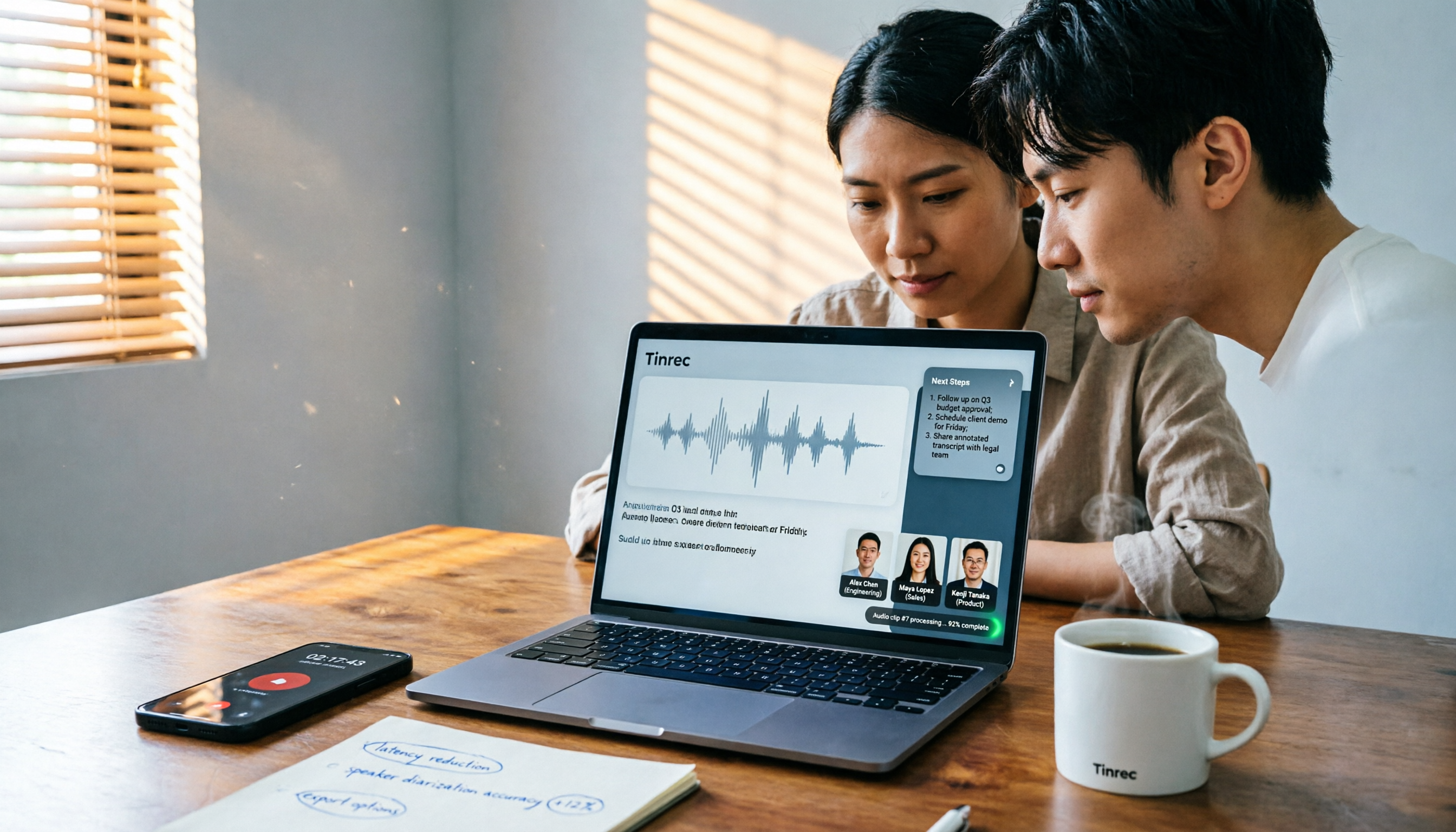
Turn recordings into transcripts and summaries in minutes
Upload audio or video for multilingual transcription, AI notes, and action items
Many people assume that buying a recording device (like the Plaud Note) solves all meeting note problems, but recording is just the first step—the real challenge is transcription, organization, and collaboration. This article compares Plaud Note and Tinrec across 5 dimensions to show you which one fits your workflow better.
Plaud Note vs Tinrec | Quick Overview
Plaud Note is an AI-powered recording card designed for on-the-go, standalone recording with long battery life, paired with an app for transcription and summaries. Tinrec is an AI meeting notes and collaboration software that works on mobile and desktop without extra hardware, supporting live recording, online meeting capture, file import, and team collaboration. They serve different purposes, but if you want a complete meeting notes workflow, Tinrec is more aligned. Here's a 5-dimension comparison.
- Price: Plaud Note hardware starts at $159 (AI plan sold separately); Tinrec has a free tier, with Pro available monthly/yearly.
- Platform: Plaud has a physical device + iOS/Android app; Tinrec offers Web, desktop, and mobile apps.
- Core difference: Plaud is hardware, Tinrec is software.
Dimension 1 | Recording Methods & Hardware Requirements
Plaud Note is a physical recording card you need to carry, but it can record independently without a phone—great for field interviews. However, if you're used to working on your phone or computer, carrying an extra device can be a hassle. Tinrec requires no extra hardware; you can record directly from the mobile app, desktop app, or web, and even import existing audio/video files, offering more flexibility. For most people, using devices you already own is more convenient—Tinrec wins here.
→ Winner: Tinrec.
Dimension 2 | Online Meeting Recording
While you can place the Plaud Note near your computer to record meeting audio, it relies on a microphone, so ambient noise and distance can affect quality. Tinrec's desktop version captures system audio directly—no meeting bot needed—for clear recordings of Zoom, Google Meet, Microsoft Teams, and more, with more stable sound. If you frequently join online meetings, Tinrec is clearly more practical.
→ Winner: Tinrec.
Dimension 3 | AI Post-Processing & Workflow
The Plaud app offers AI transcription, summaries, and templates, but mainly for content from the recording card. Tinrec goes beyond transcription, summaries, chapters, and action items, adding AI Q&A, report/document generation, and exports to Notion/Google Docs, turning meeting content into actionable work material. Post-meeting cleanup saves time. Tinrec's feature set is more complete here.
→ Winner: Tinrec.
Stop organizing recordings by hand
Upload audio or video and automatically get a transcript, summary, and action items
Dimension 4 | File Import & Historical Audio Organization
If you have many existing recordings or videos to organize, Plaud's hardware is designed for new recordings; while the app may support import, it's not the core use case. Tinrec natively supports uploading audio/video files for quick transcription, summaries, and action items—ideal for organizing past meetings, interviews, or lectures. For users with large backlogs, Tinrec is more convenient.
→ Winner: Tinrec.
Dimension 5 | Team Collaboration & Management
Plaud offers team memberships and device management, but it's mainly for hardware sharing. Tinrec's team plan is a dedicated collaboration space with member roles, seat management, usage analytics, audit logs, and a recycle bin, turning meeting materials into team assets. If you need shared meeting notes and permission management, Tinrec suits team use.
→ Winner: Tinrec.
What Are Their Unique Strengths?
Tinrec's unique strengths:
- Bot-free online meeting recording: captures system audio without interrupting the meeting.
- AI Q&A and agent post-processing: ask follow-ups about meeting content, generate reports and tables.
- Team space and governance: roles, seats, audit logs, recycle bin—enterprise-ready.
- No extra hardware needed: works on phone, computer, and web.
Plaud Note's unique strengths:
- Standalone recording hardware: compact and portable, record anytime without relying on a phone.
- Long battery life: up to 30 hours of continuous recording, ideal for extended field sessions.
Summary: Which Should You Choose?
- If you don't want to buy extra hardware and prefer using existing devices for recording and organizing → Tinrec
- If you need to record online meetings without a bot → Tinrec
- If you need team sharing of meeting materials and permission management → Tinrec
- If you're often on the go, need standalone recording, and don't want to carry your phone → Plaud Note
In short: For most professionals, Tinrec is the more complete software solution; Plaud Note suits specific hardware needs.
FAQ
Q1: How do I record with Plaud Note? A: Press the button on the recording card to start, or trigger it via the app on your phone. After recording, connect to the app for transcription and summaries.
Q2: Do I need to buy hardware for Tinrec? A: No, Tinrec is software that works on your phone or computer; you can also upload audio/video files for transcription.
Q3: Can I record online meetings with Plaud Note? A: Yes, you can place it near your computer, but audio quality is affected by the environment; Tinrec captures system audio directly for clearer results.
Q4: Does Tinrec have a free plan? A: Yes, the free plan includes basic quotas for recording, importing, summaries, and transcription.
Q5: Which is better for teams? A: Tinrec's team plan offers more collaboration and management features like team space, seats, and audit logs; Plaud's team membership mainly manages devices.
Q6: I have many existing recordings—which tool organizes them faster? A: Tinrec supports uploading existing audio/video files and quickly generates transcripts and summaries, making it more suitable.
References
Turn every recording into actionable outcomes
Get 60 free transcription minutes when you sign in. No credit card required.
Related Reading
You might also like

3 AI Recording Tools Compared in 2026: From Portable Hardware to Meeting Collaboration, Which One Fits You Best?
Still debating whether to buy a Plaud voice recorder? The key to choosing a recording tool isn't about hardware weight, but the complete workflow from recording to organizing and collaborating. Based on hands-on experience, this article compares Plaud Note, Otter.ai, and Tinrec side by side to help you find the most effective way to boost productivity.

Best AI Voice Recorders in 2026: Tinrec vs Plaud vs Otter – No Extra Hardware Needed for Office Workers
Are Plaud voice recorders any good? We tested Plaud, Tinrec, and Otter to see which is best for office workers in Hong Kong, helping you skip overtime for meeting notes. Tinrec requires no extra hardware and excels in Cantonese transcription, AI Q&A, and team collaboration.

What Is the 2026 Plaud Recorder? 5 Steps to Understand AI Recording Cards and Find a Better Meeting Notes Tool
From a mid-level manager's practical perspective, this article explains what the Plaud recording card is, how to manage recording files, and compares AI meeting notes tools like Tinrec to help you choose the most time-saving solution.

Which Plaud Voice Recorder Is Best? 2026 Hands-On Test of 2 Options: Tinrec Is the Lightweight Choice Without Hardware
Thinking about buying a Plaud voice recorder? This article hands-on tests two AI recording tools, Plaud and Tinrec, comparing hardware requirements, online meetings, team collaboration, and more to help you find a better meeting notes solution.

How to Choose Speech-to-Text in 2026? Compare Yating Transcriber and Tinrec in 5 Steps
Still deciding between the latest Yating Transcriber and Tinrec? This article walks you through 5 steps to evaluate post-transcription processing, AI Q&A, and team collaboration, helping you make a truly time-saving choice.

2026 Hands-On Comparison of 2 AI Speech-to-Text Tools: Tinrec vs Yating, Which Is Right for You?
A 2026 comparison of Tinrec and Yating (Yating Transcript) across 5 dimensions: AI features, free tier, cross-platform support, team collaboration, and post-processing, to help you decide which is better for meeting notes in Taiwan.

2026 AI Voice Recorder Comparison: Plaud Note vs Tinrec vs Otter – Which Is Right for You?
Thinking about buying an AI voice recorder but worried about picking the wrong one? This hands-on comparison reviews Plaud Note, Tinrec, and Otter across recording methods, transcription quotas, Chinese language support, and team features. We also walk through a complete recording-to-export workflow using Tinrec to help you choose the right tool.

2026 Plaud Recording Free Plans Compared: 3 Options at a Glance
Struggling to organize recordings from your Plaud voice recorder? This hands-on comparison of Tinrec, Plaud, and Otter's free plans helps you find the most time-saving transcription tool.

2026 Hands-On Comparison of 5 AI Recording Tools: Beyond Plaud, Which Offers the Most Complete Transcription and Organization?
Thinking about buying a Plaud recorder? Hold on. This article compares 5 mainstream AI recording tools—Tinrec, Plaud, Otter, Notta, and TurboScribe—from a real workflow perspective to help you find the best recording and organization solution.