

Turn recordings into transcripts and summaries in minutes
Upload audio or video for multilingual transcription, AI notes, and action items
You're thinking about buying a Plaud recorder, but wait—do you really need "recording," or do you need "usable data after recording"? Lately, many people ask me how to use Plaud and whether it's worth it. My first question is usually: What do you plan to do with the files after recording? If you just need a portable recording tool, Plaud is convenient. But if your goal is to turn meetings and interviews into searchable, organized, and shareable data for your team, the choice is completely different. In this article, I'm not just talking about Plaud; I'm laying out several mainstream AI recording solutions on the market and helping you decide which one fits you best from a practical workflow perspective.
Why Do You Need AI Recording Tools?
Modern people spend a large part of their time on "reorganizing": replaying recordings, manually transcribing, summarizing key points, and assigning tasks. Traditional recorders only handle the "recording" part, leaving the rest to you. The value of AI recording tools isn't about recording more clearly; it's about turning audio directly into usable text, summaries, to-dos, and even letting you find key content through Q&A. So, the key to choosing isn't hardware or software—it's whether it can save you time after recording.
Option 1 | Tinrec (秒听录音) — The Most Complete AI Meeting Notes and Collaboration Tool
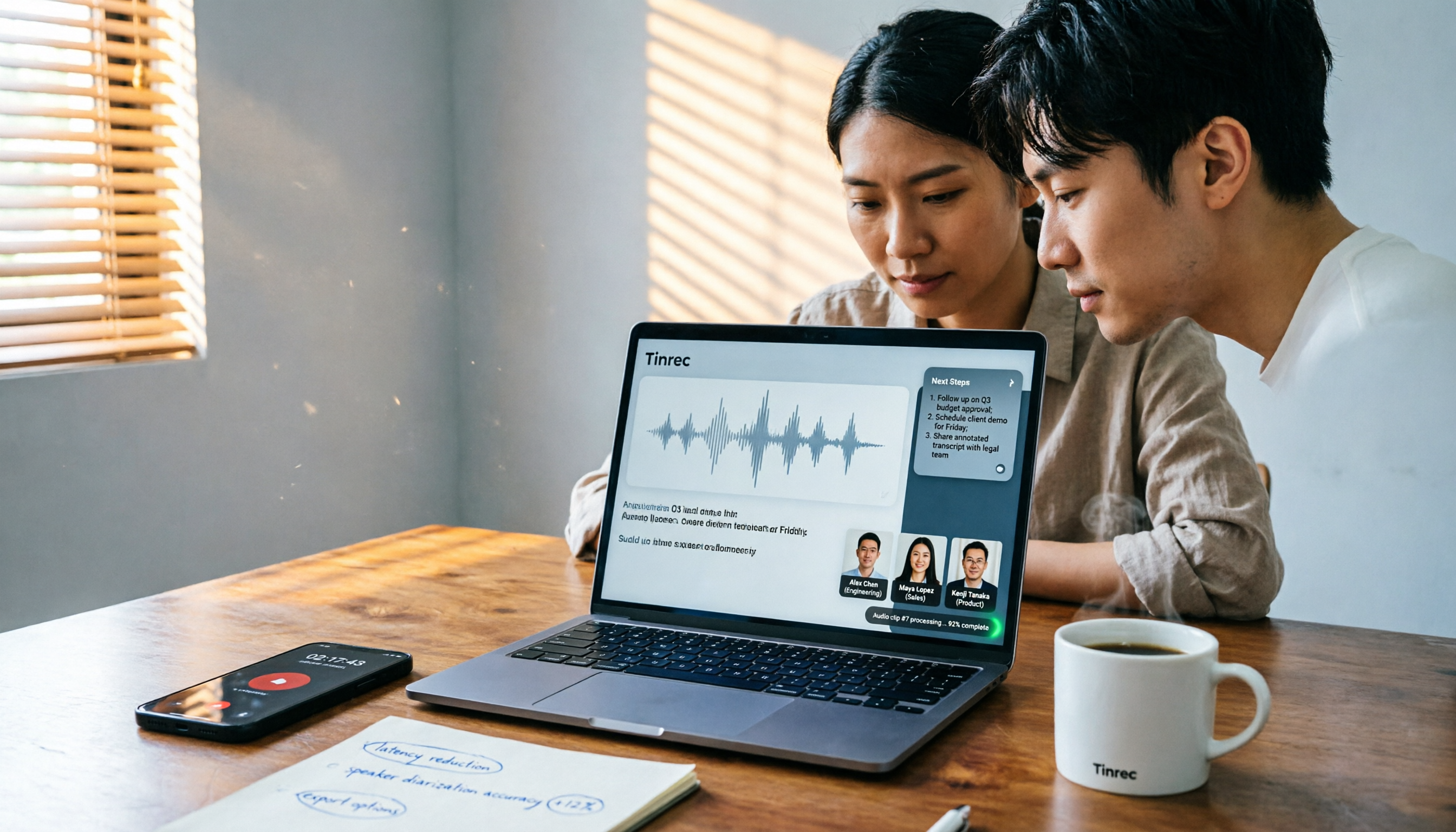
The first one I'll introduce isn't hardware but a complete meeting data workflow. Tinrec's core concept is that recording is just the starting point; the real value lies in turning meetings into searchable, collaborative, and queryable team data. Its biggest difference from typical recorders is that it doesn't require you to purchase additional devices. Open Tinrec's desktop version, and it can directly capture your computer's system audio to record online meetings on Zoom, Google Meet, Teams, etc., without inviting a bot to join. For offline scenarios, you can record instantly with your phone or upload existing audio/video files for transcription. After transcription, Tinrec automatically generates summaries, chapters, key points, and to-dos. My favorite feature is its AI Q&A: you can ask things like "What specific needs did the client mention?" or "What decisions were made in last week's meeting?" and it will find answers from the meeting data. For teams, Tinrec's team space centrally stores all meeting data, and new members can view historical records. Admins can manage members, seats, and usage, and even see who used how many minutes. Pricing: Tinrec offers a free version to try, with paid plans based on usage. The team plan starts at USD 29.80 per month, with discounts for annual billing. Who it's for: Those who need extensive meeting organization, cross-team collaboration, or want to turn meeting data into a knowledge base. If you care most about the post-recording workflow, Tinrec is currently the most feature-complete choice.
Option 2 | Plaud Note / NotePin — Portable AI Recording Hardware
Plaud is a representative hardware recorder, designed for recording anytime, anywhere. Its biggest advantage is being a standalone device—you can record with one tap without needing a phone or computer. It offers both ambient and phone call recording modes, and with the MagSafe case, you can magnetically attach it to the back of your phone to record calls. Plaud's recording quality is good, and battery life is sufficient, with up to nearly 480 hours of recording. After recording, you transcribe and summarize via the app, which includes 300 minutes of transcription per month, with paid upgrades for more. However, note that Plaud handles the "recording" itself; subsequent transcription and organization rely mainly on its app, and it's more geared toward personal use. If you want to record online meetings, you'd still need to play audio on your phone or computer and capture it via hardware, which is less direct than capturing system audio. Pricing: NotePin is around USD 159, Note Pro around USD 189, with additional monthly or annual plans. Who it's for: Those who are often on the go, need to quickly capture ideas or conversations, or prefer not to rely on phone recording. But if your primary scenario is online meetings, Plaud isn't the top choice.
Stop organizing recordings by hand
Upload audio or video and automatically get a transcript, summary, and action items
Option 3 | Otter.ai — Mature English Meeting Assistant
Otter is very mature in the English market, supporting Zoom, Teams, Meet, etc. It can automatically join meetings and transcribe in real time, with accurate speaker identification and an AI Chat for Q&A. The free plan offers 300 minutes per month, while Pro (annual billing) is about USD 8.49/month, including 1,200 minutes and 10 file imports. However, Otter's strength is in English; the Chinese experience is relatively average, and since it primarily joins meetings via a bot, it may not suit those who don't want an extra participant in meetings. Who it's for: International teams with English-centric meetings, or those needing a mature meeting bot solution.
Option 4 | Notta — Multilingual Transcription and Translation Tool
Notta's positioning is somewhat similar to Tinrec, supporting multi-device transcription, file imports, translation, and team plans. The free plan offers 120 minutes per month, with a 3-minute limit per session, which is quite restrictive; Pro (annual billing) is about USD 8.17/month, providing 1,800 minutes. Notta's interface is simple, and its translation feature is decent. If you mainly handle foreign-language audio and need quick transcription, Notta is a lightweight choice. However, it leans more toward being a "transcription tool," and its post-meeting organization, AI Q&A, and team data accumulation aren't as deep as Tinrec's. Who it's for: Those who occasionally need to transcribe foreign-language content, have a limited budget, or only need basic transcription features.
Option 5 | TurboScribe — High-Value Long-File Transcription
TurboScribe specializes in file transcription, ideal for long recordings or large volumes of audio. The free plan allows 3 files per day, with a 30-minute limit per file; the paid Unlimited plan is USD 120 per year, supporting files up to 10 hours long and batch uploads of up to 50 files. If you have lots of historical recordings, interviews, or lectures to transcribe in bulk, TurboScribe is cost-effective. However, it doesn't support live meeting recording, nor does it offer AI Q&A or team spaces—it's more of a pure transcription engine. Who it's for: Those who need to transcribe existing audio files in large quantities and quickly, but don't require much post-processing or collaboration.
With So Many Options, How Do You Choose?
The key is to identify your most common recording scenarios. • If you mainly record online meetings and want summaries and to-dos right after, or even use Q&A to find key points → Tinrec is the most complete choice because it doesn't require a bot to join and turns meetings into searchable team data. • If you're often on the move and need a standalone device to quickly capture conversations or calls, and you don't mind manual organization later → Plaud Note is suitable. • If most of your meetings are in English and you're used to mature tools like Otter → Otter.ai is a good alternative. • If you only occasionally transcribe foreign-language audio or need to transcribe many long files on a budget → Notta or TurboScribe are worth considering. But honestly, if what you need isn't just "recording" but "data you can use right after recording," Tinrec is one of the few tools that integrates transcription, organization, Q&A, and team collaboration.
Things to Know Before Using AI Recording Tools
- Recording is just the first step; organization is key. Don't just compare recording quality—see if it can generate summaries, to-dos, or let you review content via Q&A.
- Accuracy is affected by the environment. Regardless of the tool, noisy environments and overlapping speech will reduce transcription quality, so it's best to cross-check important content against the original recording.
- Be mindful of recording consent. Before meetings or interviews, inform participants and obtain consent to avoid legal issues.
- Start with free plans. For example, Tinrec's free version or Plaud's Starter 300 minutes—try them for a week or two to ensure they fit your workflow before paying.
Conclusion
Back to the original question: How do you use a Plaud recorder? The answer is: first, clarify your needs. If you want a portable hardware recorder, Plaud is great; but if you want to turn meetings and interviews into team-usable knowledge assets, I suggest starting with AI meeting tools like Tinrec. My approach: use Tinrec to record online meetings directly, use my phone to record offline interviews and then upload them to Tinrec for organization, and finally keep transcripts, summaries, and to-dos in the team space. Tools are just supporting actors; methodology is key. Define your workflow first, then choose your tool, so you won't end up buying a recorder and still spending hours on manual organization.
References
- Plaud Taiwan | Official Website | AI Recording Device Leader
- PLAUD NOTE | AI Smart Recording Card | Free 300 Minutes of Transcription per Month - Esentra International
- Meeting Recording, Call Logging, and AI Summaries: I Now Rely on Plaud Desktop + Note Pro for Everything - Applealmond - iPhone/iOS/Tech Media
- Review | AI Takes Your Notes: The Ultimate Plaud NotePin ...
- PLAUD NOTE | ChatGPT AI Smart Recording Card | Free 300 Minutes of Transcription per Month (Includes Black Case) - Authorized Dealer
Turn every recording into actionable outcomes
Get 60 free transcription minutes when you sign in. No credit card required.
Related Reading
You might also like

3 AI Recording Tools Compared in 2026: From Portable Hardware to Meeting Collaboration, Which One Fits You Best?
Still debating whether to buy a Plaud voice recorder? The key to choosing a recording tool isn't about hardware weight, but the complete workflow from recording to organizing and collaborating. Based on hands-on experience, this article compares Plaud Note, Otter.ai, and Tinrec side by side to help you find the most effective way to boost productivity.

Best AI Voice Recorders in 2026: Tinrec vs Plaud vs Otter – No Extra Hardware Needed for Office Workers
Are Plaud voice recorders any good? We tested Plaud, Tinrec, and Otter to see which is best for office workers in Hong Kong, helping you skip overtime for meeting notes. Tinrec requires no extra hardware and excels in Cantonese transcription, AI Q&A, and team collaboration.

What Is the 2026 Plaud Recorder? 5 Steps to Understand AI Recording Cards and Find a Better Meeting Notes Tool
From a mid-level manager's practical perspective, this article explains what the Plaud recording card is, how to manage recording files, and compares AI meeting notes tools like Tinrec to help you choose the most time-saving solution.

Which Plaud Voice Recorder Is Best? 2026 Hands-On Test of 2 Options: Tinrec Is the Lightweight Choice Without Hardware
Thinking about buying a Plaud voice recorder? This article hands-on tests two AI recording tools, Plaud and Tinrec, comparing hardware requirements, online meetings, team collaboration, and more to help you find a better meeting notes solution.

How to Choose Speech-to-Text in 2026? Compare Yating Transcriber and Tinrec in 5 Steps
Still deciding between the latest Yating Transcriber and Tinrec? This article walks you through 5 steps to evaluate post-transcription processing, AI Q&A, and team collaboration, helping you make a truly time-saving choice.

2026 Hands-On Comparison of 2 AI Speech-to-Text Tools: Tinrec vs Yating, Which Is Right for You?
A 2026 comparison of Tinrec and Yating (Yating Transcript) across 5 dimensions: AI features, free tier, cross-platform support, team collaboration, and post-processing, to help you decide which is better for meeting notes in Taiwan.

2026 AI Voice Recorder Comparison: Plaud Note vs Tinrec vs Otter – Which Is Right for You?
Thinking about buying an AI voice recorder but worried about picking the wrong one? This hands-on comparison reviews Plaud Note, Tinrec, and Otter across recording methods, transcription quotas, Chinese language support, and team features. We also walk through a complete recording-to-export workflow using Tinrec to help you choose the right tool.

2026 Plaud Recording Free Plans Compared: 3 Options at a Glance
Struggling to organize recordings from your Plaud voice recorder? This hands-on comparison of Tinrec, Plaud, and Otter's free plans helps you find the most time-saving transcription tool.
2026 Recording Tools Compared: Plaud Note vs Tinrec – Which Is Right for You?
What's the real difference between the Plaud Note recording card and Tinrec? This hands-on comparison covers 5 key areas—recording methods, online meetings, AI post-processing, file import, and team collaboration—to help you pick the best meeting notes tool for your workflow.