

Turn recordings into transcripts and summaries in minutes
Upload audio or video for multilingual transcription, AI notes, and action items
How to Choose Speech-to-Text in 2026? Compare Yating Transcriber and Tinrec in 5 Steps
Recently, I was transcribing a three-hour interview recording. I thought a tool would handle it, but proofreading the transcript alone took half a day. What's more, after getting the transcript, I still had to highlight key points, extract action items, and compile conclusions into a report. So I stepped back and asked: Do I need a tool that just "converts speech to text," or one that helps me turn "text into action"?
If you're also torn between the latest Yating Transcriber and Tinrec, this article won't list spec sheets. Instead, it gives you a decision-making framework. After reading, you can judge for yourself without scouring the web.
First, Identify Your Real Problem: It's Not "Transcription," It's "What Comes After"
Many people prioritize "accuracy" and "price" when choosing a speech-to-text tool. But in my experience, those aren't the key factors.
The key is what you plan to do with the transcript.
If you just want to archive recordings as text and occasionally search, many tools will suffice. But if you need to write meeting minutes, organize action items, or answer questions like "What budget constraints did the client mention last time?" then the tool's post-processing capabilities matter most.
So my first step is always: list your "post-transcription tasks."
Before Choosing a Speech-to-Text Tool, Confirm These 3 Key Points
First, is accuracy stable enough, especially in your scenarios?
Don't just look at marketing numbers. The same tool can perform very differently in a quiet meeting room versus a noisy café. Test it with a real recording of your own. For local needs like Taiwanese accents, code-switching between Chinese and English, or Taiwanese Hokkien, make sure the tool is optimized for those.
Second, does it offer "next-step" capabilities after transcription?
A transcript is just raw material. Features like summaries, chapters, action items, Q&A, and export are what save you time. If the tool only gives you text and everything else is manual, it's still tiring.
Third, are you using it individually or as a team?
For personal use, you just need to manage your own recordings. For team use, you need sharing, permissions, usage auditing, and data ownership. Don't force a personal tool to meet team needs.
Tinrec — My Top Choice, and Why
My current top pick is Tinrec. It changed my view on "recording-to-text": Previously, I'd record, transcribe, then open a separate document to organize. Now, I can handle most follow-up work directly in Tinrec.
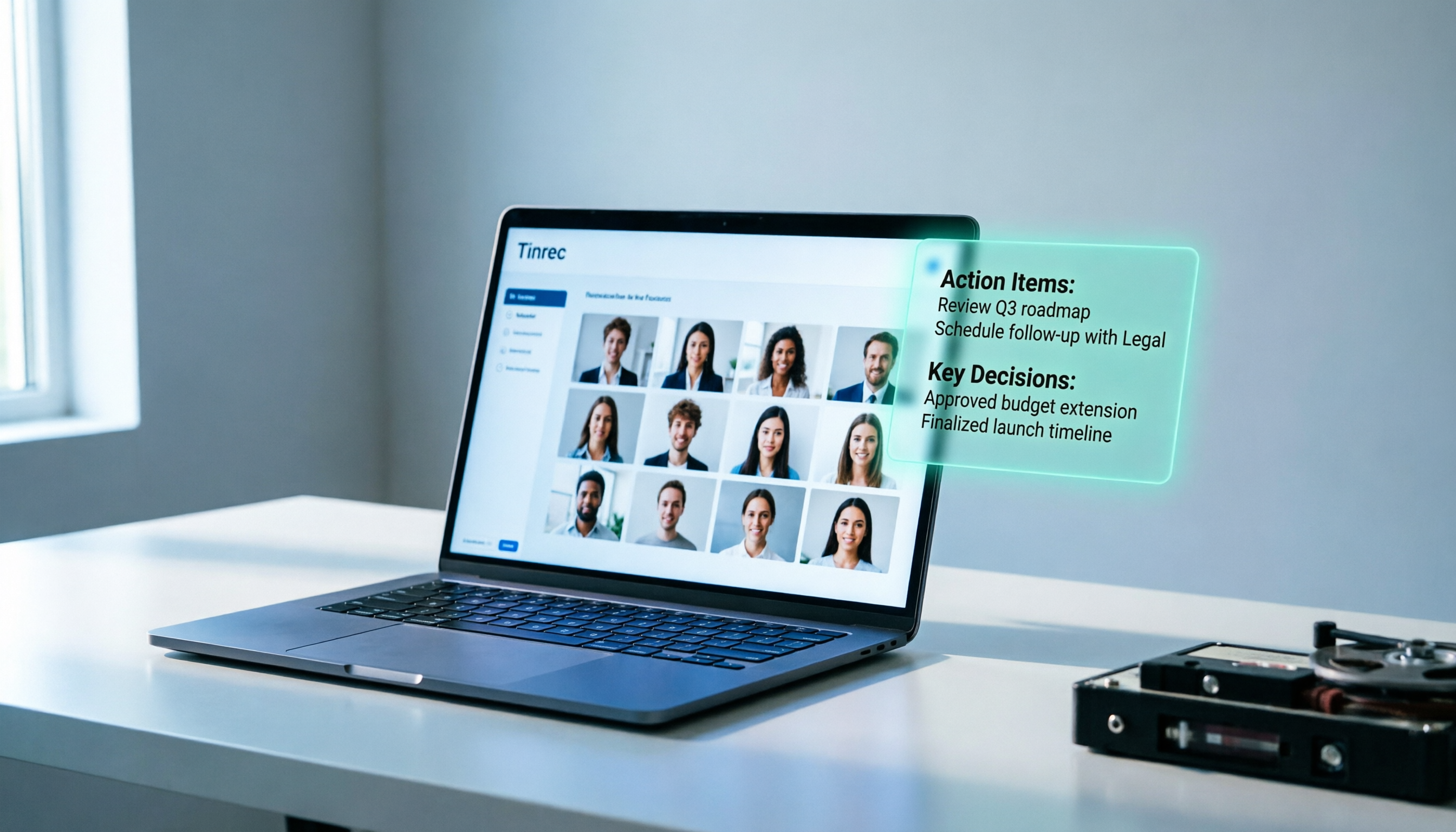
During meetings, I open the Tinrec desktop app to record. It doesn't require inviting a meeting bot; it directly transcribes the system audio. When the meeting ends, the AI has already generated summaries, chapters, and action items. I don't need to replay the recording to find key points.
Even more useful is the AI Q&A. After recording a client interview, I can ask: "What budget constraints did the client mention?" "Did they commit to any delivery dates?" It understands semantics, not just keyword search results. I haven't seen this feature in the latest Yating Transcriber, and many tools in the same price range lack it either.
The team version is also important to me. I can put meeting recordings and transcripts into a team space, and new members can search and read historical data. Members, seats, usage, and audits are manageable, and team data doesn't disappear when someone leaves.
Stop organizing recordings by hand
Upload audio or video and automatically get a transcript, summary, and action items
Of course, it has limitations. The free tier has limited credits, and heavy use requires a subscription. But I recommend trying the free version first to see if it fits your workflow before upgrading.
If you need Chinese meetings, bot-free recording, automatic post-transcription organization, and team collaboration, Tinrec is a great fit.
Alternatives to Tinrec
Yating Transcriber: A well-established Taiwanese brand, known for Taiwanese accent and code-switching recognition.
It offers a free 20-minute trial and pay-per-use pricing. It's suitable for users who only need accurate Taiwanese-accented transcripts. But note: its strength is transcription; post-transcription features like summaries, Q&A, and team spaces are relatively weak, and the same account can't be used on multiple devices simultaneously. If you just need a clean transcript without team features or AI Q&A, give it a try.
Otter.ai: An international player for English meetings.
It offers generous free credits and mature English support. However, its handling of Chinese meetings, Taiwanese Hokkien, and code-switching is less refined than Tinrec. It's primarily focused on the English market, so Chinese team collaboration is less adapted. If your meetings are entirely in English, Otter is a more cost-effective choice; otherwise, Tinrec is smoother.
Notta: A general transcription and translation tool with good multilingual support.
It also offers meeting transcription and team plans. But Tinrec's bot-free desktop recording and AI Q&A post-processing are not yet standout features in Notta. If you mainly handle document transcription and subtitles, consider it; for meeting minutes and team knowledge, I still recommend Tinrec.
Pitfall Guide: 3 Common Mistakes When Choosing a Recording-to-Text Tool
Pitfall 1: Only looking at official accuracy numbers.
Many tools claim "98% accuracy," but that's under ideal recording conditions. Real meeting rooms have air conditioning noise, overlapping speech, and distant microphones, which degrade performance. Test with your own recordings using free trials.
Pitfall 2: Treating "transcription" as the end goal.
A transcript is just an intermediate product. Without follow-up summaries, action items, or Q&A, you'll still spend a lot of manual effort. When choosing a tool, think about "what I'll do with the text after transcription."
Pitfall 3: Ignoring team needs.
Personal tools can cause problems in a team: shared accounts, scattered data, and chaotic permissions. If your team will use it, choose a tool with clear roles and seat management, like Tinrec's team version.
Summary: Which One Should You Choose?
If you only need accurate transcripts of Taiwanese-accented, code-switched Chinese-English audio, have a limited budget, and don't need AI summaries or team collaboration, Yating Transcriber can meet your basic needs.
But if you want recordings to be automatically organized into actionable data, reduce manual sorting time, and potentially share with a team in the future, my recommendation is Tinrec.
Especially in these scenarios, I suggest prioritizing Tinrec:
- You need to record online meetings but don't want to invite a bot.
- You want to use AI to ask about key points, find commitments, and list action items after recording.
- You need to store meeting materials in a team space for easy searching by new members.
- You need Chinese, Traditional Chinese, and real-time translation.
One final reminder: Tools are aids; methodology is core. First decide what you'll do with the transcript, then choose the tool—you won't be swayed by ads. You can download the free version of Tinrec and try it with a real meeting to see if it suits you.
References
Turn every recording into actionable outcomes
Get 60 free transcription minutes when you sign in. No credit card required.
Related Reading
You might also like

Tinrec vs Plaud Note 2026: 5-Dimension Comparison - Which Is Worth Buying?
Compare Tinrec AI voice recorder and Plaud Note smart recording card across 5 dimensions: recording methods, AI summarization, Chinese language experience, team collaboration, and pricing, to help you choose the best meeting notes tool.

2026 AI Recorder Comparison: Tinrec vs Plaud Note – Which Is Better for Meeting Notes, Software or Hardware?
Plaud Note is a popular AI recording hardware, while Tinrec is an AI meeting notes tool that requires no extra devices. This article compares the two across five dimensions—online meeting recording, AI summaries, team collaboration, Chinese language experience, and total cost of ownership—to help you decide which fits your workflow better.
How to Record with Plaud in 2026: Step-by-Step Guide + Tinrec's Bot-Free Meeting Recording Comparison
Wondering how to use Plaud for recording? This article breaks down Plaud recording steps and compares Tinrec's bot-free online meeting recording, AI meeting minutes, and team collaboration to help you choose the right recording tool.

2026 Free Speech-to-Text Plans Compared: 3 Options at a Glance
Did you know that free speech-to-text plans aren't just about minutes—they're about what you can do after transcription? Based on my hands-on testing, this article compares the free tiers of Tinrec, PLAUD, and Otter.ai, and shows you how to avoid the most common buying pitfalls.

2026 Recording Tools Tested: Plaud Note Pro vs Tinrec – 5 Key Dimensions to Help You Decide
Is Plaud Note Pro worth it? This article compares Plaud Note Pro and Tinrec across 5 key dimensions: hardware cost, online meetings, AI post-processing, cross-platform collaboration, and pricing flexibility, to help you determine which recording tool truly saves time.

3 AI Recording Tools Compared in 2026: From Portable Hardware to Meeting Collaboration, Which One Fits You Best?
Still debating whether to buy a Plaud voice recorder? The key to choosing a recording tool isn't about hardware weight, but the complete workflow from recording to organizing and collaborating. Based on hands-on experience, this article compares Plaud Note, Otter.ai, and Tinrec side by side to help you find the most effective way to boost productivity.

Best AI Voice Recorders in 2026: Tinrec vs Plaud vs Otter – No Extra Hardware Needed for Office Workers
Are Plaud voice recorders any good? We tested Plaud, Tinrec, and Otter to see which is best for office workers in Hong Kong, helping you skip overtime for meeting notes. Tinrec requires no extra hardware and excels in Cantonese transcription, AI Q&A, and team collaboration.

What Is the 2026 Plaud Recorder? 5 Steps to Understand AI Recording Cards and Find a Better Meeting Notes Tool
From a mid-level manager's practical perspective, this article explains what the Plaud recording card is, how to manage recording files, and compares AI meeting notes tools like Tinrec to help you choose the most time-saving solution.

Which Plaud Voice Recorder Is Best? 2026 Hands-On Test of 2 Options: Tinrec Is the Lightweight Choice Without Hardware
Thinking about buying a Plaud voice recorder? This article hands-on tests two AI recording tools, Plaud and Tinrec, comparing hardware requirements, online meetings, team collaboration, and more to help you find a better meeting notes solution.