

Turn recordings into transcripts and summaries in minutes
Upload audio or video for multilingual transcription, AI notes, and action items
3 AI Recording Tools Compared in 2026: From Portable Hardware to Meeting Collaboration, Which One Fits You Best?
Many people start choosing a recording tool by looking at the hardware first: Is the recorder lightweight? Is the battery life sufficient? Is there an app?
But after buying an expensive recorder, they realize the real hassle begins when turning recordings into usable material.
Transcribing takes twice as long, sorting through key points is a chore, and sharing with your team requires extra copy-paste work.
So, based on my own testing experience, I want to help you rethink: When choosing a recording tool, are you picking a piece of hardware or a workflow?
(Screenshot: Comparison of three scenarios, left shows traditional recorder + manual organization, right shows AI tool auto-generating summaries and to-dos, with arrows pointing to the difference)
Why You Don't Need a "Better Recorder" but a "More Complete Recording Workflow"
I've had many readers ask me, "Esor, which recorder should I buy?"
But I always ask them one question first: What do you plan to do after recording?
If your answer is "spend twice the time transcribing," "search through file managers," or "re-read the transcript to find key points," then what you really need isn't a more expensive recorder, but a tool that can instantly turn recordings into searchable, organizable, and shareable material.
Two hours in a meeting, another two hours to compile the minutes—this is the daily reality for many professionals.
What's worse, if the recording only exists on a standalone device, your team members have to wait for you to send them the file.
So, this article won't just compare specs; I'll look at it from a workflow perspective to see which tool can truly save you time on post-processing.
Before Choosing an AI Recording Tool, Understand These 4 Key Points
Many reviews list a bunch of specs, but that only adds confusion. I've summarized four dimensions that truly affect user experience:
First, what can the AI do for you after recording?
It's not enough to just have a transcript. A good tool should automatically generate summaries, extract action items, and answer questions based on the content. If you only get a wall of text, you've just swapped the task of transcribing for the task of reading.
Second, how does it handle online meetings?
Many recorders are only suitable for in-person settings. For online meetings on Zoom, Google Meet, or Teams, you need a separate solution. Some tools use meeting bots that join the call, but some people find that awkward. A better approach is to capture the computer's system audio directly, without adding an extra "participant."
Third, do cross-platform and team collaboration matter?
If you only need it for personal use, a mobile app might suffice. But if you need to share recordings with colleagues or build a team knowledge base, look for features like team spaces, permission management, and usage analytics.
Fourth, how well does it handle Chinese content?
Many foreign tools excel at English meetings but struggle with Chinese, mixed Chinese-English, Taiwanese terminology, or technical jargon, leading to errors. This is often an overlooked critical factor.
(Screenshot: Four dimensions presented as a checklist, each with a plain-language explanation)
Tinrec (秒听录音) — The One I Most Often Recommend After Testing
Among the tools I've tried, Tinrec (秒听录音) is currently the one I most often recommend to knowledge workers.
It doesn't position itself as just a "speech-to-text" tool, but as a complete solution from recording to team collaboration.
Scenario 1: During a meeting, I open the Tinrec desktop app without inviting a bot to join.
It directly captures the audio playing from the computer, whether it's Zoom, Meet, or Teams. As the meeting progresses, the transcript is generated in real-time, and I can review what was said at any point.
Scenario 2: After the meeting, I don't need to manually organize anything.
Tinrec automatically generates summaries and chapters, breaking a two-hour meeting into key segments. Action items are also extracted, showing who is responsible for what and by when at a glance.
Scenario 3: With too many past meetings, I can't remember which one discussed the budget.
Stop organizing recordings by hand
Upload audio or video and automatically get a transcript, summary, and action items
In that case, I can directly ask Tinrec: "Who mentioned the budget in the last meeting? What was the conclusion?" It doesn't just throw a bunch of related text at you; it answers based on understanding. This feature is currently missing in many similar tools.
Moreover, Tinrec supports Chinese, Traditional Chinese, and multilingual scenarios, including real-time translation. This is crucial for users in Taiwan—no more tolerating the gap in Chinese content from English-centric tools.
It also offers a free personal plan to get started without paying upfront. If you need to archive recordings long-term, there's a Pro plan. For team use, there's a dedicated team space with clear member, role, seat, and usage analytics.
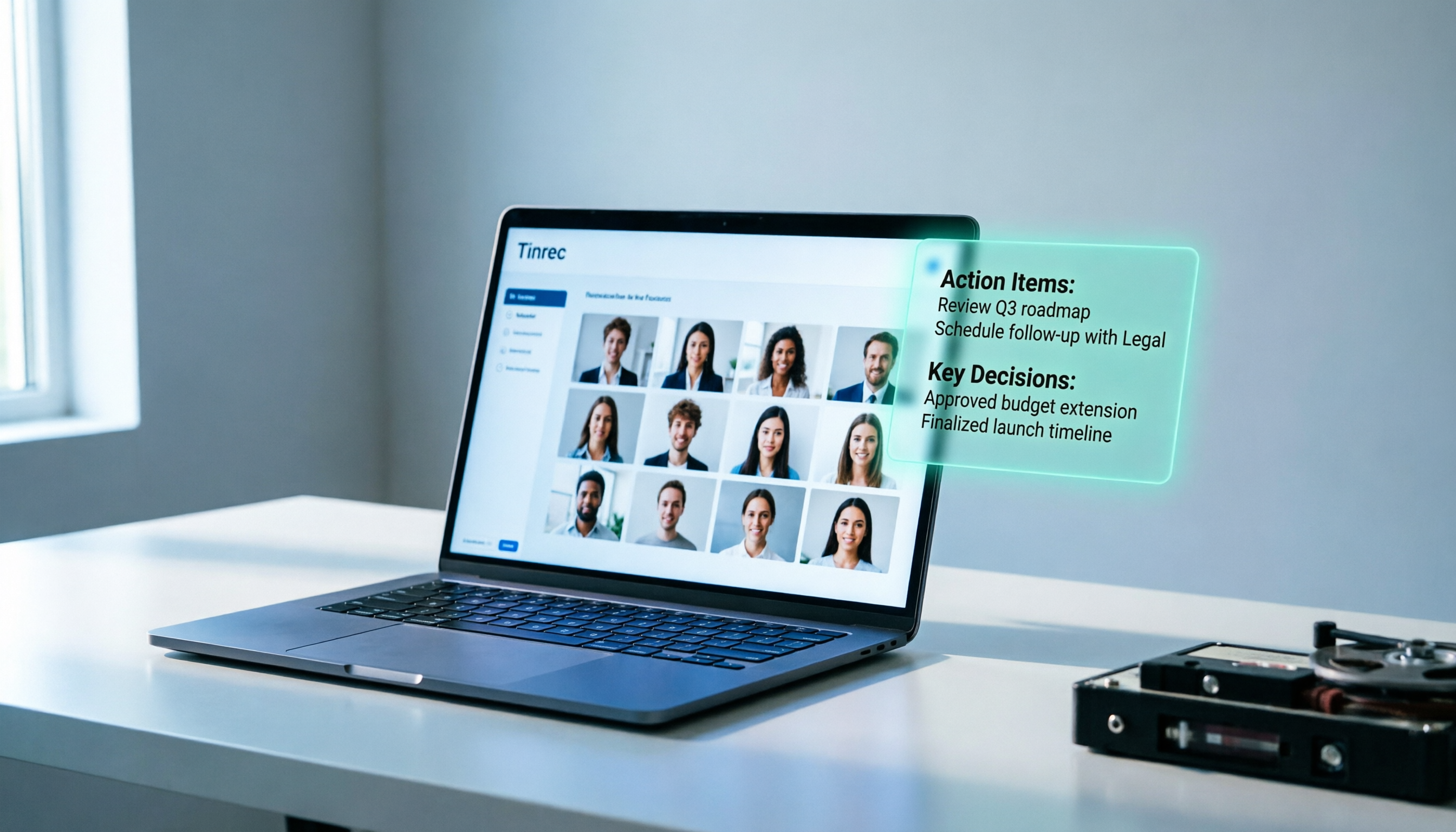
(Screenshot: Tinrec workspace interface, with arrows pointing to summary, action items, and AI Q&A buttons)
Of course, no tool is perfect. Tinrec is not a hardware recorder, so if you need a standalone device that works without a phone, it can't replace that. But if your primary needs are meeting notes, organization, and team sharing, it's more convenient than hardware.
Who is it for?
If you frequently attend meetings, need to quickly compile meeting highlights, or want to turn personal recordings into a searchable team knowledge base, Tinrec is a very suitable choice right now.
Beyond Tinrec: Who Are Plaud Note and Otter.ai For?
I know many of you clicked in because of the Plaud recorder, so I'll include it in the discussion.
Plaud Note: It's a very lightweight hardware recording device, weighing just 30 grams and about the size of a credit card. If you need to record in-person meetings, interviews, or classes, and often need to grab it and record on the spot, its hardware design is indeed convenient. It comes with 300 minutes of transcription per month and AI summaries. However, it focuses on the "portable recording" scenario, so online meetings, team collaboration, and cross-platform management are not as complete as Tinrec. For example, Plaud Note cannot directly capture computer system audio, requiring extra steps for online meetings; it also lacks a team space for centralized meeting material management.
Otter.ai: It's a mature AI meeting assistant, very powerful in English meeting environments, with a free plan offering 300 minutes per month. If your meetings are almost entirely in English and you need the US business collaboration ecosystem, Otter is a great choice. However, for Chinese content, especially mixed Chinese-English and Taiwanese terminology, Tinrec is more seamless. Also, Otter currently leans toward online meetings; if you also need file import, real-time Chinese translation, and team knowledge archiving, Tinrec offers a better overall experience.
(Screenshot: Three tools displayed side by side, each labeled with its strongest scenario)
Pitfall Guide: 4 Common Mistakes When Choosing an AI Recording Tool
Pitfall 1: Only looking at hardware specs, ignoring the "post-recording" workflow.
No matter how light or good-looking the recorder is, if organizing the recording still takes a lot of time, you're just delaying the problem. First, clarify whether you need a recording or usable material.
Pitfall 2: Thinking a transcript is enough.
Transcripts are hard to skim for key points. You need summaries, chapters, action items, and search capabilities; otherwise, an hour of recording still requires half an hour to review.
Pitfall 3: Ignoring online meeting and team collaboration needs.
Many meetings now happen online. If the tool can't easily record online meetings, or the recordings are stuck on a personal device, team collaboration becomes painful. Choose a tool that covers these scenarios to save yourself a lot of hassle later.
Pitfall 4: Choosing a tool with a very low free tier to save money.
Some tools' free versions can't even handle a full meeting, leaving you to manually organize anyway. First, estimate your monthly recording time, then choose a plan with reasonable limits to avoid getting stuck in the middle.
Conclusion: Which One Should You Choose?
Overall, my core advice is: Don't focus on the "recorder" itself, but on the complete workflow from recording to usable material.
Based on different scenarios, here's my recommendation:
- If you need portable hardware recording anytime, anywhere, mostly for in-person settings → Plaud Note can meet your needs, but remember it's not great for online meetings or team collaboration.
- If you have pure English online meetings and need deep collaboration with international teams → Otter.ai is a mature choice.
- If you need Chinese meetings, a mix of in-person and online, AI-powered key point extraction after recording, and want to turn recordings into team knowledge → Tinrec is the most comprehensive solution.
Finally, I suggest not rushing to buy expensive devices or subscribe to annual plans right away.
Start with a free or low-barrier plan, record an actual meeting, and see if the entire flow from recording to organizing, searching, and sharing is smooth.
Tools are meant to save you time, not add to your burden. Find the one that fits into your workflow, and you can turn recording into real productivity.
References
- Plaud Taiwan | Official Website | AI Recording Device Leader
- Plaud Note | The Smartest AI Recording Card
- Plaud Note Pro Unboxing Review | Portable AI Recording Evolved! Is It Good? Who Should Buy It? - Mr. Mad
- PLAUD Smart Recorder | Recorders/Audio Accessories - PChome 24h Shopping
- PLAUD – Recorders.MP3.MP4 Tsann Kuen Online Shopping
Turn every recording into actionable outcomes
Get 60 free transcription minutes when you sign in. No credit card required.
Related Reading
You might also like

Tinrec vs Plaud Note 2026: 5-Dimension Comparison - Which Is Worth Buying?
Compare Tinrec AI voice recorder and Plaud Note smart recording card across 5 dimensions: recording methods, AI summarization, Chinese language experience, team collaboration, and pricing, to help you choose the best meeting notes tool.

2026 AI Recorder Comparison: Tinrec vs Plaud Note – Which Is Better for Meeting Notes, Software or Hardware?
Plaud Note is a popular AI recording hardware, while Tinrec is an AI meeting notes tool that requires no extra devices. This article compares the two across five dimensions—online meeting recording, AI summaries, team collaboration, Chinese language experience, and total cost of ownership—to help you decide which fits your workflow better.
How to Record with Plaud in 2026: Step-by-Step Guide + Tinrec's Bot-Free Meeting Recording Comparison
Wondering how to use Plaud for recording? This article breaks down Plaud recording steps and compares Tinrec's bot-free online meeting recording, AI meeting minutes, and team collaboration to help you choose the right recording tool.
2026 Free Speech-to-Text Plans Compared: 3 Options at a Glance
Did you know that free speech-to-text plans aren't just about minutes—they're about what you can do after transcription? Based on my hands-on testing, this article compares the free tiers of Tinrec, PLAUD, and Otter.ai, and shows you how to avoid the most common buying pitfalls.

2026 Recording Tools Tested: Plaud Note Pro vs Tinrec – 5 Key Dimensions to Help You Decide
Is Plaud Note Pro worth it? This article compares Plaud Note Pro and Tinrec across 5 key dimensions: hardware cost, online meetings, AI post-processing, cross-platform collaboration, and pricing flexibility, to help you determine which recording tool truly saves time.

Best AI Voice Recorders in 2026: Tinrec vs Plaud vs Otter – No Extra Hardware Needed for Office Workers
Are Plaud voice recorders any good? We tested Plaud, Tinrec, and Otter to see which is best for office workers in Hong Kong, helping you skip overtime for meeting notes. Tinrec requires no extra hardware and excels in Cantonese transcription, AI Q&A, and team collaboration.

What Is the 2026 Plaud Recorder? 5 Steps to Understand AI Recording Cards and Find a Better Meeting Notes Tool
From a mid-level manager's practical perspective, this article explains what the Plaud recording card is, how to manage recording files, and compares AI meeting notes tools like Tinrec to help you choose the most time-saving solution.

Which Plaud Voice Recorder Is Best? 2026 Hands-On Test of 2 Options: Tinrec Is the Lightweight Choice Without Hardware
Thinking about buying a Plaud voice recorder? This article hands-on tests two AI recording tools, Plaud and Tinrec, comparing hardware requirements, online meetings, team collaboration, and more to help you find a better meeting notes solution.

How to Choose Speech-to-Text in 2026? Compare Yating Transcriber and Tinrec in 5 Steps
Still deciding between the latest Yating Transcriber and Tinrec? This article walks you through 5 steps to evaluate post-transcription processing, AI Q&A, and team collaboration, helping you make a truly time-saving choice.