
Turn recordings into transcripts and summaries in minutes
Upload audio or video for multilingual transcription, AI notes, and action items
According to the latest online sentiment analysis in 2026, AI tools have evolved from simple chatbots to more vertical applications. For learners or creators who rely on podcasts for information, the biggest pain point is often not "not finishing episodes" but "forgetting what you heard." An hour-long audio is hard to review key points, and searching for a specific section feels like finding a needle in a haystack. Often, all we want is a clean transcript with key takeaways for quick absorption.
This article compares the mainstream AI solutions for "automatic podcast content organization." We'll evaluate them based on input convenience, Chinese transcription accuracy, and summary logic, and provide a practical workflow to turn podcasts into study notes. If you're a heavy listener or content creator, this article will save you significant time on organizing.
Quick Navigation Conclusion:
- If you need academic research and multi-source integration: Recommended: Google's NotebookLM.
- If you need multilingual comparison and direct translation from YouTube/Podcast links: Priority evaluation: Tinrec (Miao Listening Recorder).
- If you already have text files and only need polishing: ChatGPT or Gemini are still powerful assistants.
Why Do We Forget Podcasts? You Need "Audio Visualization" Tools
The biggest issue with traditional recordings or podcasts is "information density" and "searchability." According to a survey by DailyView, in 2025 AI tool rankings, tools like NotebookLM (ranked 8th) and Gemini (ranked 2nd) that handle large amounts of information and multimodal content rose significantly, showing users' need for "data organization" far exceeds casual chatting.
For podcast listeners, an ideal AI assistant should solve the following problems:
- Can't understand/unclear audio: Need real-time captions or translation for foreign languages or fast speech.
- No time to re-listen: Need a transcript with timestamps to quickly jump to key sections.
- Lack of action items: After listening to an interview, cannot convert insights into concrete to-do lists.
Comparison of Popular 2025 Podcast Organization Tools
To help readers choose the right tool, we selected top performers in "long-form text understanding" and "speech processing." This includes general-purpose AIs (like Gemini) and tools specialized in recording workflows (like Tinrec).
| Comparison Dimension | Tinrec (Miao Listening Recorder) | NotebookLM (Google) | Gemini / ChatGPT | Regular Recorder App |
|---|---|---|---|---|
| Core Function | Recording/link-to-text and action management | Note and research integration | General-purpose generative AI | Simple audio storage |
| Input Method | Supports links (URL), file upload, live recording | Upload PDF/text/audio files | Need to copy-paste text (or upload short files) | Live recording only |
| Podcast Support | Supports YouTube/Podcast link parsing | Need to download file first then upload | Does not support direct link parsing | Not supported |
| Transcription | Auto-generate + speaker diarization | Yes, but weak on speaker diarization | Weak (mainly relies on user-provided text) | Only high-end models support |
| AI Interactive Query | Chat about recording content | Query uploaded sources | General knowledge responses | None |
| Summary & Action Items | Auto-extract to-do items (Action Items) | Generate summary | Requires instructions to generate | None |
Stop organizing recordings by hand
Upload audio or video and automatically get a transcript, summary, and action items
Analysis: If you want a "lazy mode" where you drop a podcast link and get notes instantly, tools that support URL parsing (like Tinrec) are more efficient than tools that require downloading an MP3 first (like NotebookLM) or text-only generation (ChatGPT).
Tinrec (Miao Listening Recorder): A Specialized Assistant for "Time-Based Content"
Among many AI tools, Tinrec is not just a transcription tool; it's a workflow product designed to solve "forget after listening." Compared with general-purpose AIs on the rankings, it has several distinct advantages when handling podcasts or interview recordings:
1. Link Direct Import (Link to Text)
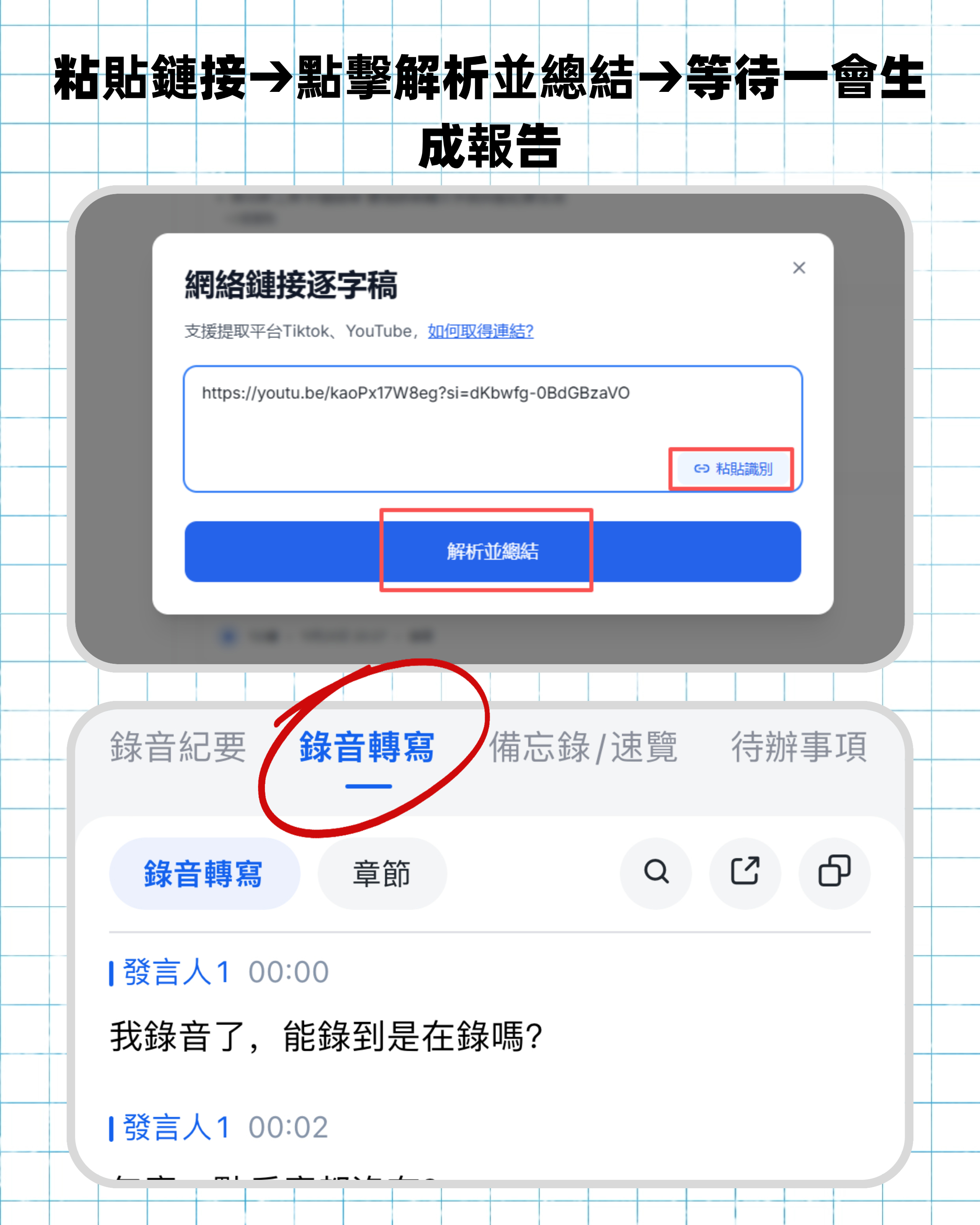
Many podcasts are simultaneously published on YouTube or have public audio links. Tinrec supports direct URL input for parsing, saving the tedious step of downloading MP3 files via third-party tools. This is very friendly for content creators quickly organizing competitor content or learners organizing courses.
2. Structured AI Notes
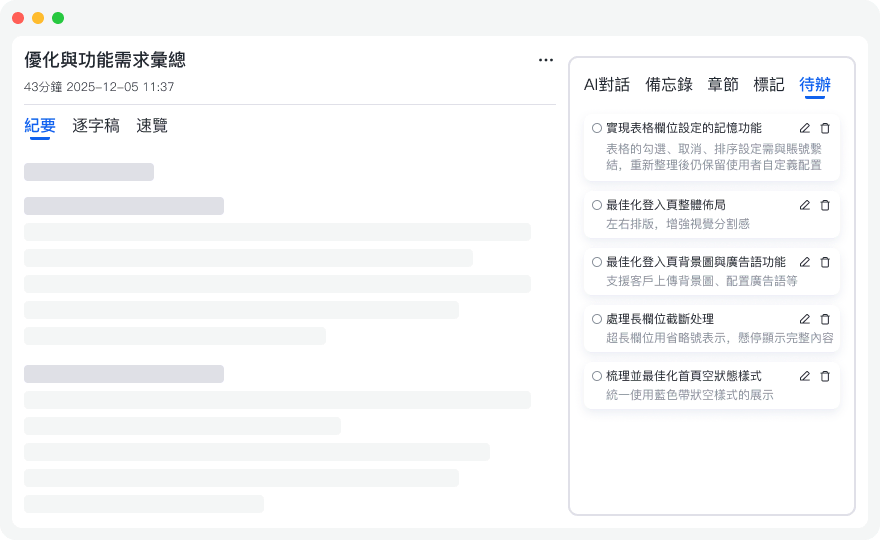
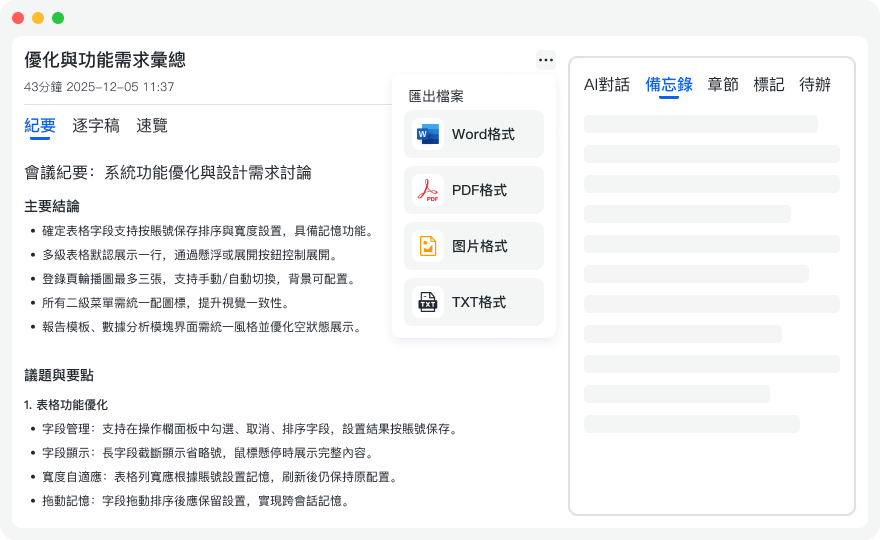
Unlike traditional recorders that output a block of text, Tinrec tries to structure the recording content. It not only provides a transcript but also automatically generates "meeting minutes" and "action items." This is especially useful for business and productivity podcasts, directly converting speakers' suggestions into your to-do list.
3. Multilingual Mixed Recognition
Podcast interviews often mix Chinese and English, or feature pure foreign language content. Tinrec supports recognition of 10 languages including Chinese, English, Japanese, and Korean, providing a basic guarantee for cross-language information acquisition.
Tutorial: 3 Steps to Turn a Podcast into High-Value Notes
Below, using Tinrec as an example, we show how to turn a 40-minute interview into readable notes in 5 minutes.
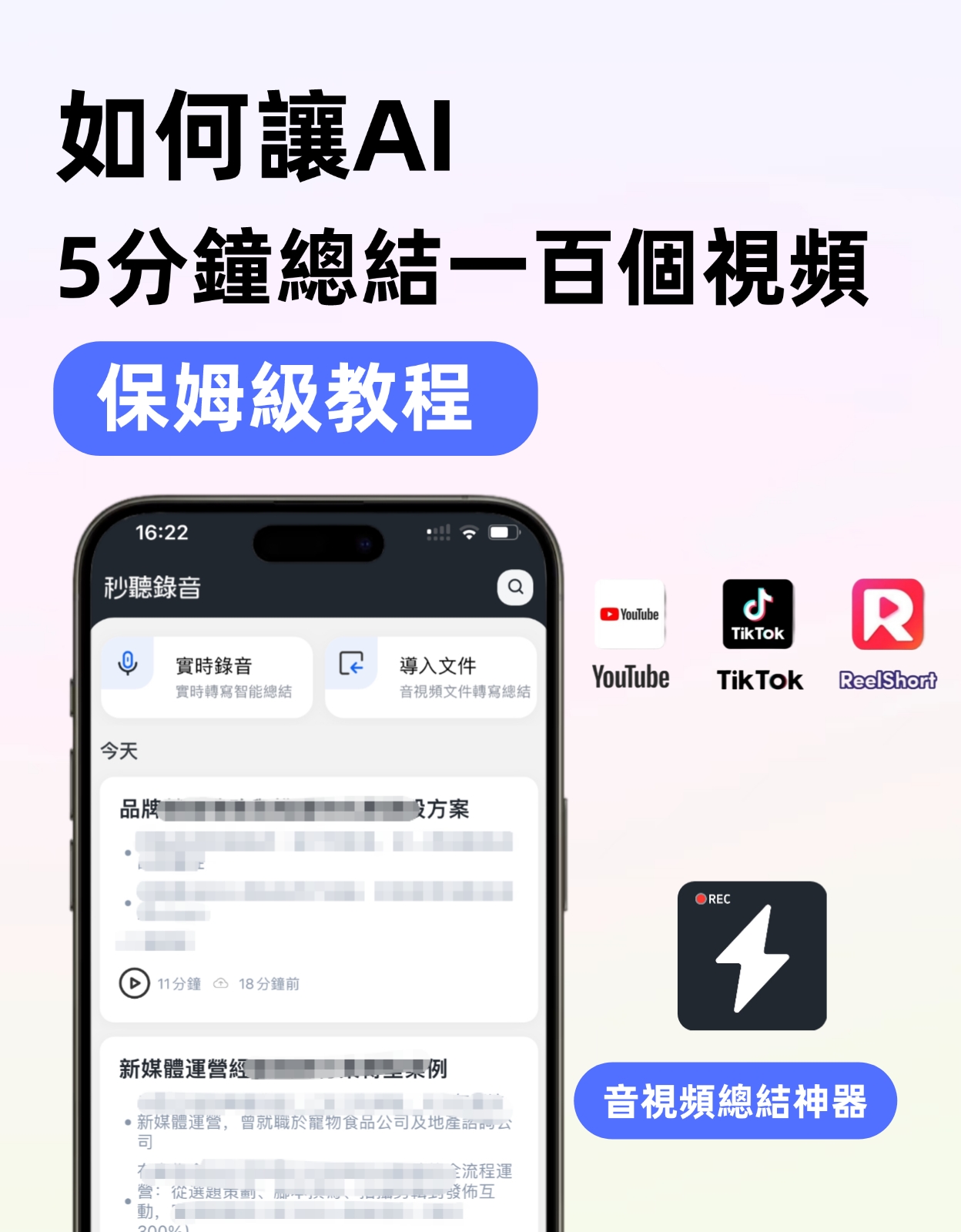
Step 1: Import Audio Source
You can import content in two ways:
- File Upload: If you have MP3/M4A files, simply drag and drop them onto the platform.
- Link Parsing: Copy a public YouTube or Podcast URL and paste it into the "Podcast/Online Video to Text" feature.
Step 2: View Transcript with Timestamps and Speaker Diarization
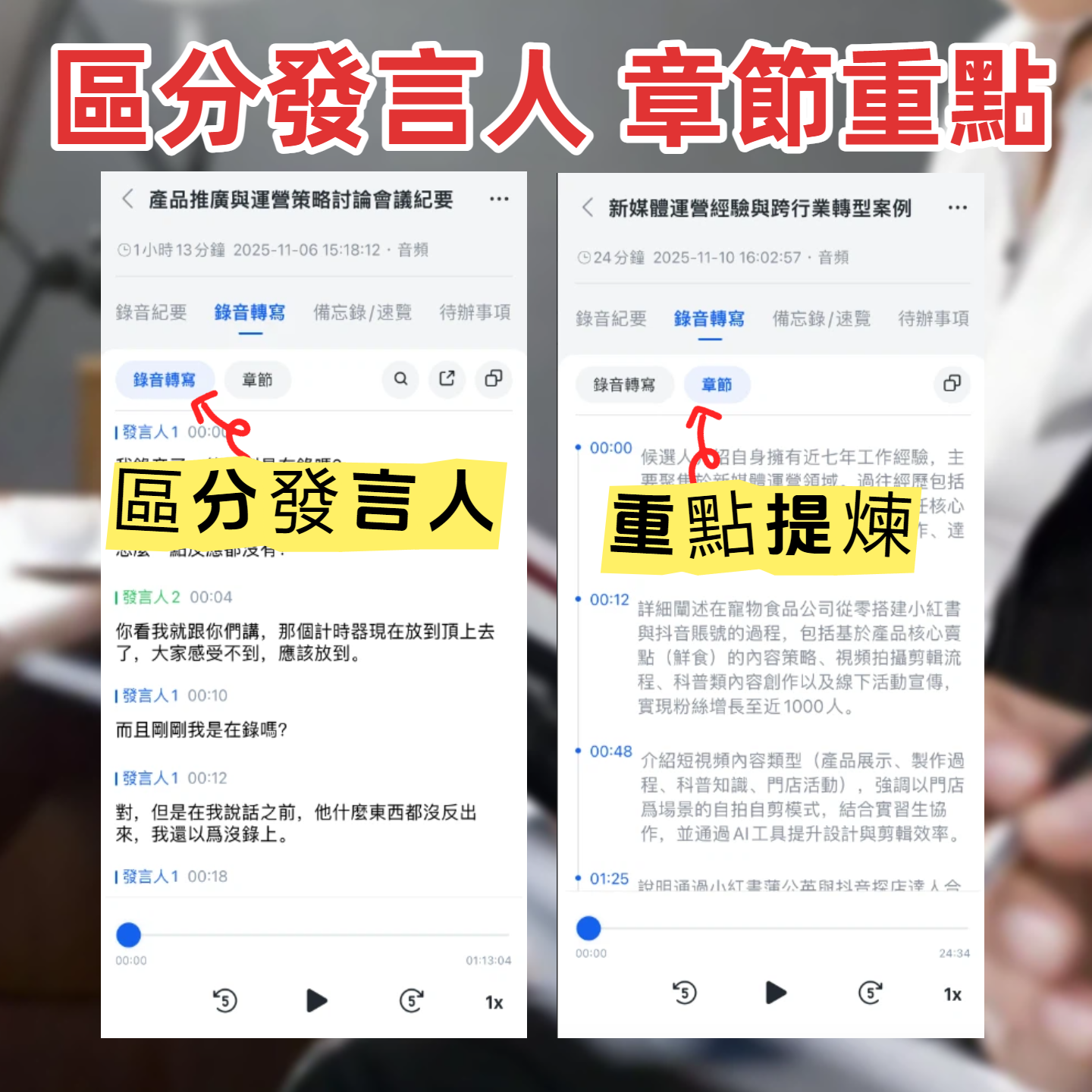
Once processed, the system automatically generates a transcript with timestamps. For interviews, Tinrec attempts to differentiate speakers (Speaker A, Speaker B).
- Tip: Click any paragraph in the transcript; the audio will sync to that point, allowing you to verify unclear sections.
Step 3: Use AI Chat to Uncover Deeper Insights
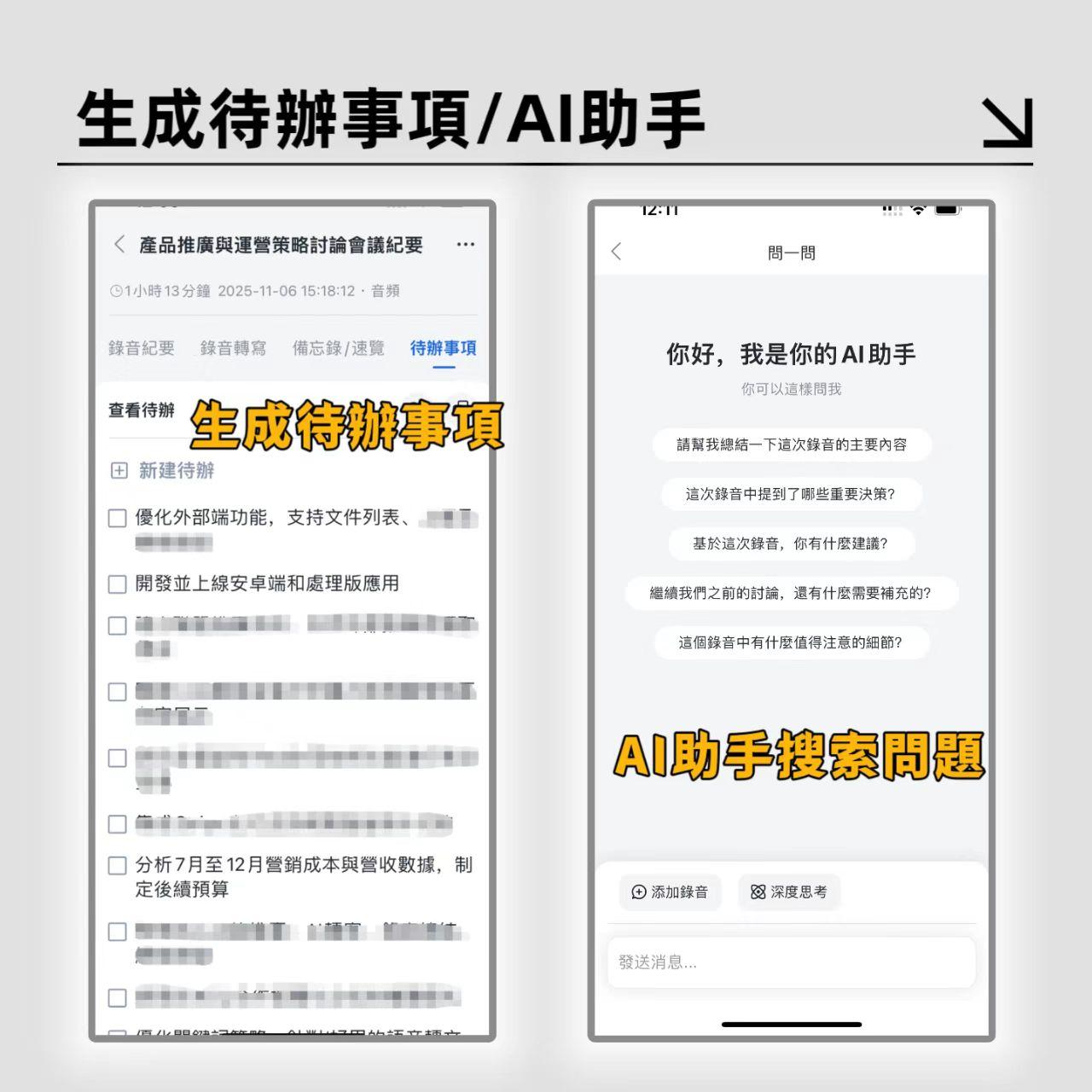
This is the most crucial step. Don't just read the summary; use the "AI Chat Query" feature to ask questions like a tutor:
- "What are the three marketing strategies mentioned by the guest in this podcast?"
- "Please list the books recommended by the speaker."
- "What is the conclusion on AI trends from this conversation?"
By doing this, you move from passive information reception to active interaction with the content, greatly enhancing learning efficiency.
FAQ
Q1: How accurate are AI-generated transcripts?
Accuracy typically depends on recording quality and accent clarity. For standard conversations in quiet environments, modern AI tools (like Tinrec) can achieve over 90% accuracy. However, noisy backgrounds or overlapping speech reduce accuracy; it's recommended to use the "click text to play audio" feature for verification.
Q2: Can iPhone users record podcasts or meetings directly?
iPhone's built-in recording feature is basic and cannot transcribe in real-time. Third-party apps that support iOS (like Tinrec) can transcribe while recording and solve file export issues.
Q3: Do these tools support Taiwanese or Cantonese?
Some tools like Tinrec claim to support multiple languages, including Taiwanese and Cantonese. This is great for listeners of localized podcasts or radio shows, but actual performance varies with dialect strength.
Q4: What are the typical limitations of free versions?
Most AI tools use a freemium model. For example, Tinrec's free version offers a monthly quota (e.g., 100 minutes) of transcription time, sufficient for light users who occasionally summarize a podcast. For heavy users processing many long interviews, a subscription plan may be necessary.
Q5: Can I export organized notes to Notion or Word?
Yes. For further editing, most tools support exporting transcripts and summaries as TXT, Word, or Markdown, making it easy to integrate into your personal knowledge base.
Q6: Can online YouTube videos be transcribed to text?
Yes, that's exactly what the "link parsing" feature excels at. As long as the video has an audio track, the tool treats it as audio and generates text. This is very useful for those who want key points without watching the entire video.
Turn every recording into actionable outcomes
Get 60 free transcription minutes when you sign in. No credit card required.
Related Reading
You might also like

2026 Hands-on Comparison of Two Business Meeting Speech-to-Text Tools: Which AI Summarization Saves You the Most Effort?
How to choose a speech-to-text tool for business meetings? This article hands-on compares Notta and Tinrec, from input sources, AI summarization depth, Chinese language experience to downstream applications, guiding you step by step to find a truly time-saving workflow, and provides a quick-start checklist.

Tinrec vs Yating Transcript 2026: 4-Dimension Comparison – Which Free Phone Transcription Tool Is Better?
Looking for a free way to turn phone recordings into text? This article compares Tinrec and Yating Transcript across four dimensions: free credits, AI organization, cross-platform support, and Chinese accuracy. Find out which tool truly boosts your productivity.

2026 Comparison of 2 Speech-to-Text Apps: Which Free Plan is Best for Workers?
In-depth comparison of two AI recording tools, Tinrec and PLAUD NOTE, across 5 dimensions: core features, input sources, post-processing, pricing, and cross-platform experience. Discover which app offers the best free plan for productivity.

2026 Comparison Test of 4 Speech-to-Text Apps: Which AI Meeting Notes Actually Saves You Time?
We tested 4 popular speech-to-text apps for the workplace, comparing accuracy, AI summaries, cross-platform support, and free tiers. Tinrec stands out with AI chat query and multi-source support, especially for Mandarin and Cantonese meetings. This review helps you avoid buying mistakes and find the most time-saving solution.
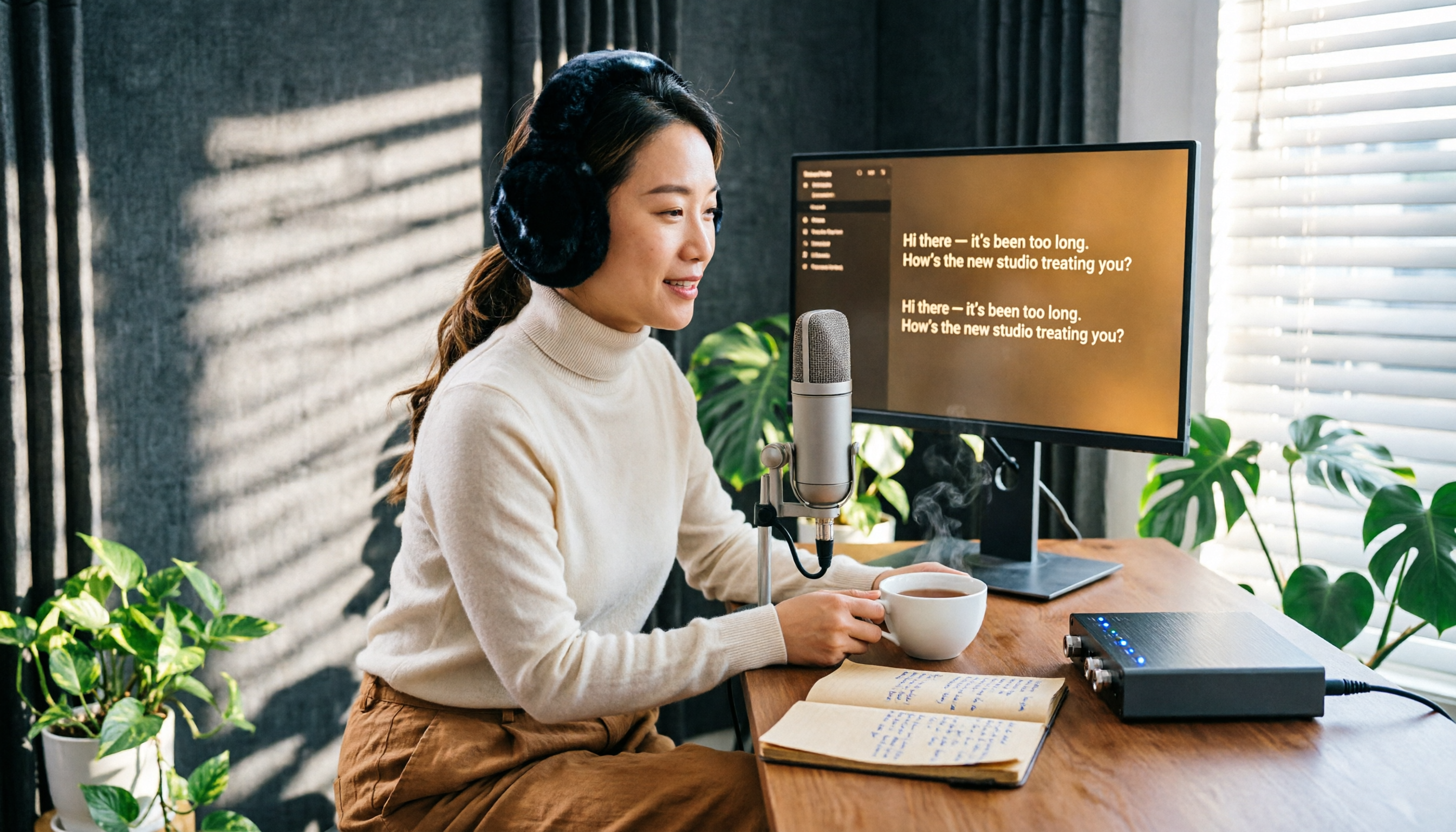
The Complete Guide to Podcast Transcription in 2026: Features, Use Cases, and Tool Recommendations
This guide is tailored for podcasters, covering the most practical transcription features of Tinrec—from interview transcripts, key summaries, to note exports—helping you save hours of post-production time, and providing key points for choosing a transcription tool.

2026 Hands-On Comparison of 5 Meeting Note Apps: Which AI Assistant Really Saves Office Workers Time?
A mid-level manager who attends 15 meetings per week personally tests 5 meeting note apps—from voice-to-text transcription, AI summarization, to-do lists, to cross-device sync—to find out which one saves you the most time on meeting minutes so you can focus on what truly matters.
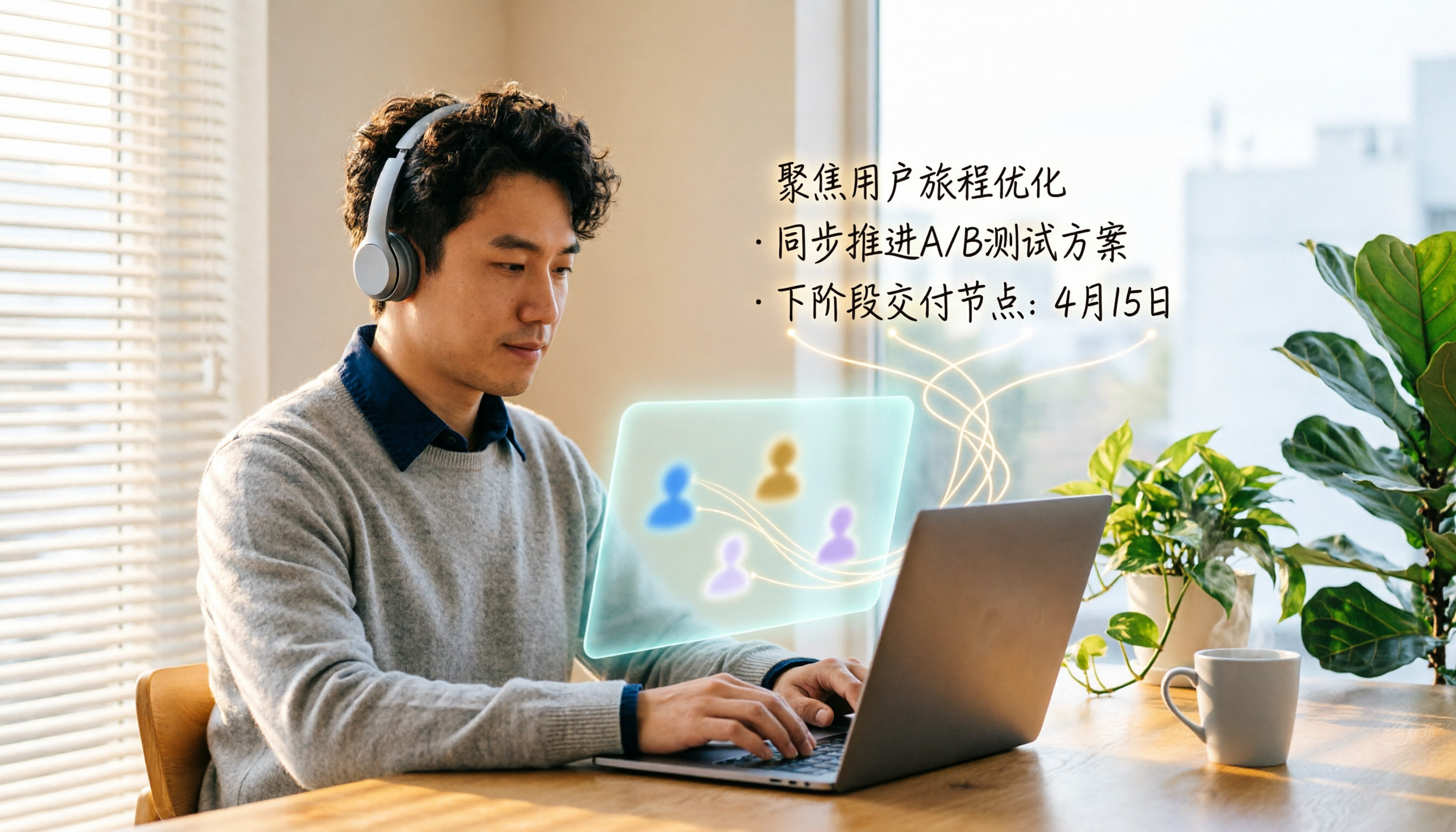
2026 Comparison of 4 Remote Work Meeting Note Tools: Which AI Summary Saves the Most Time?
The biggest fear in remote work is losing meeting notes. We tested four mainstream meeting note tools, comparing Chinese accuracy, AI summary quality, and cross-platform support to help you find the best choice for your remote team.

4 Transcription Tools Comparison in 2026: Find the Best Solution for Organizing Performance Review Recordings
Organizing performance review recordings doesn't require manual transcription. We compare four transcription tools—Tinrec, Notta, Otter.ai, and Fireflies.ai—focusing on Chinese accuracy, AI summarization, and pricing to help you choose the best tool.
4 Transcription Tools Comparison in 2026: Find the Best Solution for Organizing Performance Review Recordings
Organizing performance review recordings doesn't require manual transcription. We compare four transcription tools—Tinrec, Notta, Otter.ai, and Fireflies.ai—focusing on Chinese accuracy, AI summarization, and pricing to help you choose the best tool.