
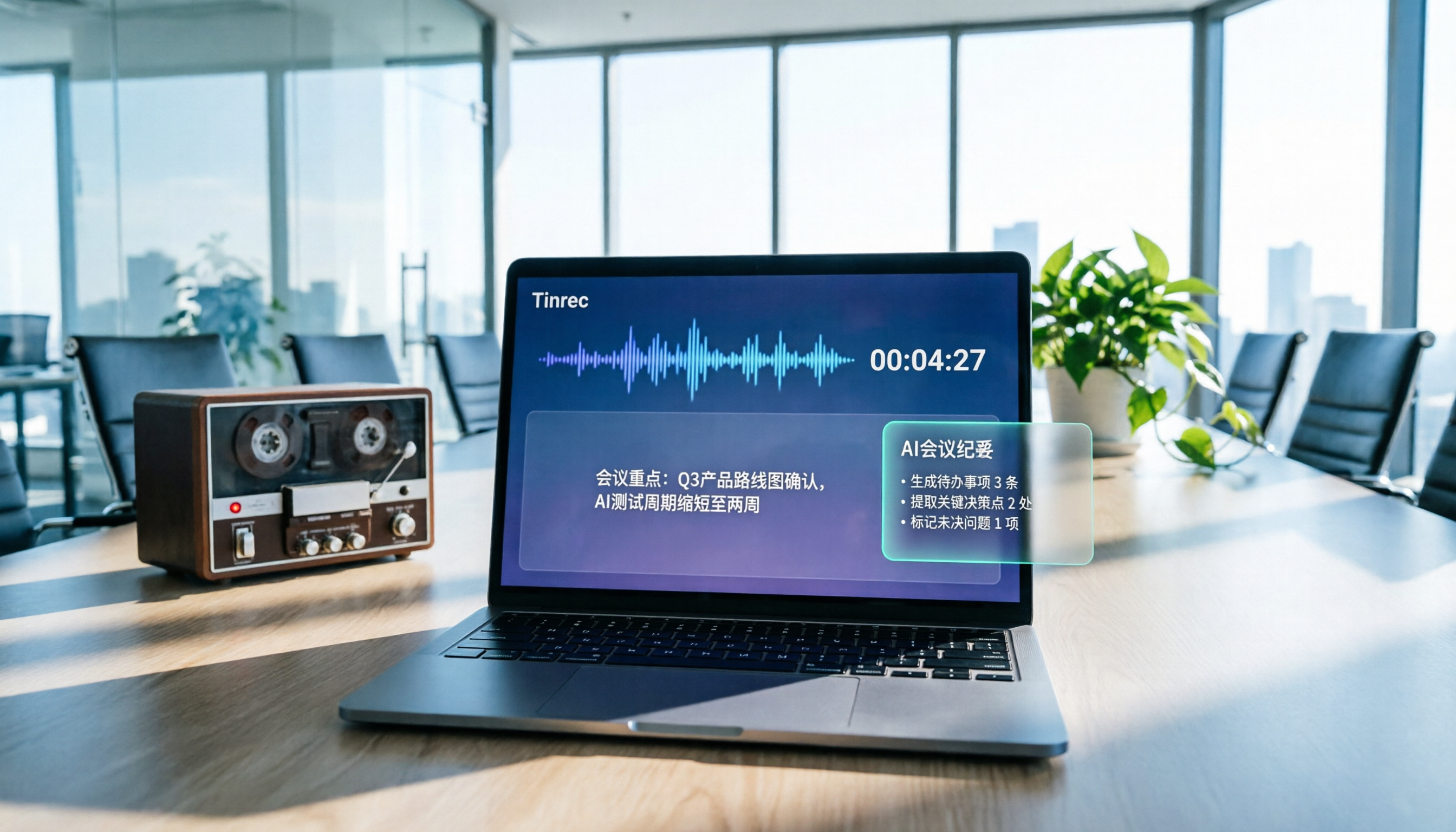
Turn recordings into transcripts and summaries in minutes
Upload audio or video for multilingual transcription, AI notes, and action items
Tinrec as a Plaud Alternative in 2026: Free Recording-to-Text + AI Meeting Minutes
Why Are People Looking for a Plaud Alternative?
Plaud is an AI recording hardware device that focuses on portable recording, phone call recording, and 300 minutes of free transcription per month. It does solve the problems of "poor smartphone recording quality" and "handwritten meeting notes," but it also brings several common pain points: you have to spend money on hardware upfront, the free allowance is only enough for light use, and unlocking full features requires a long-term subscription. If you are a manager or department head in a small or medium-sized business who attends more than 5 meetings a week, you'll quickly find that the total cost of ownership for hardware plus subscription is not low, and the recorded content remains scattered across personal devices, making it inconvenient for team sharing or retrieval.
If you are evaluating such solutions, or if you're stuck behind Plaud's hardware barrier, Tinrec is worth checking out. It requires no additional hardware; you can record, transcribe, summarize, and collaborate with your team directly from your computer or phone.
Tinrec vs Plaud: What's Different in Core Experience?
Hardware Barrier
Plaud requires you to purchase the recorder hardware before you can use its core recording features. Tinrec, on the other hand, is a software solution—your laptop or phone is the recording device. For teams that don't want an extra device in the drawer or that need to allocate budget wisely, Tinrec has a lower entry barrier.
Free Plan and Flexibility
Plaud's free plan offers 300 minutes of transcription per month but is tied to the hardware. Tinrec's free version also provides a basic allowance, letting you try recording, importing, and summarizing without paying for hardware upfront. More importantly, Tinrec's team plan includes a 7-day free trial, 1 free seat, and 300 minutes of shared import allowance, so you can invite colleagues to test it before deciding to upgrade.
Online Meeting Recording
Plaud relies mainly on hardware to capture audio. For online meetings like Zoom or Google Meet, you need to point the recorder at the speaker, which limits effectiveness. Tinrec's desktop app directly captures your computer's system audio, so no extra bot needs to join the meeting. The transcript of online meetings is cleaner and generated in real time.
AI Post-Processing Capabilities
Plaud's app can generate summaries, but Tinrec goes further: besides summaries and chapters, it can automatically extract action items, answer questions about the meeting content via AI, and generate reports and tables. For example, after a 1-hour project meeting, you can directly ask Tinrec, "What was the conclusion? Who is responsible for what?" and it will give you answers based on the transcript, without manually flipping through 30 pages of notes.
Team Collaboration and Governance
Plaud's content is mostly tied to personal accounts; sharing with the team requires exporting or screenshots. Tinrec has built-in team spaces where meeting data belongs to the team, and data doesn't disappear when a member leaves. Admins can allocate seats, view usage, set keywords, and even check operation logs. For small and medium-sized businesses that need to retain decision records, this is much more practical than a voice recorder.
Tinrec's Core Features at a Glance
Real-Time Recording-to-Text
Open Tinrec, and the text appears in sync with the recording, with less than 1 second of delay. During in-person interviews or face-to-face meetings, you can listen and confirm you haven't missed key points; the transcript is already complete by the time the meeting ends.
Bot-Free Online Meeting Recording
Tinrec's desktop app directly captures the meeting audio playing on your computer, so you don't need to invite a bot to join Zoom, Google Meet, Microsoft Teams, or Webex. You meet as usual, Tinrec transcribes in the background in real time, and you get a summary right after the meeting.
Stop organizing recordings by hand
Upload audio or video and automatically get a transcript, summary, and action items
AI Summaries, Chapters, and Action Items
Long meetings are scary without key points. Tinrec automatically breaks content into chapters, highlights key points, and extracts action items from the discussion. For example, after a client meeting, you directly get a list of "client needs, objections, and commitments," saving you 20 minutes of manual work.
AI Q&A and Post-Meeting Generation
You can ask questions about a single meeting or the entire team database: "What was the conclusion about the budget last month?" Tinrec answers based on semantic understanding. It can also generate meeting minutes, reports, tables, or mind maps, which is great for weekly reports or reporting to your boss.
Multi-Format Export and Third-Party Integrations
Tinrec supports exporting transcripts, summaries, and action items to tools like Notion, Google Docs, OneNote, and Dropbox. If you already have an established workflow, Tinrec doesn't lock you into a single platform.
Real-World Use Cases
Recurring Weekly Meetings
For department weekly meetings or project syncs, use Tinrec's desktop app to record, and it automatically produces summaries and action items. No more rotating meeting notes or chasing colleagues for notes after the meeting.
Client Interviews and Requirement Discussions
When sales or consultants visit clients, use the Tinrec mobile app to record in real time, listening and watching the transcription as you go. After the meeting, use AI Q&A to find key client needs and commitments, then export to CRM notes or follow-up lists.
Course and Lecture Notes
When attending classes or lectures, record the content, and Tinrec automatically segments and summarizes. You can search for specific topics, and even use the bilingual comparison feature to help understand foreign-language content.
Team Knowledge Base Accumulation
Centralize recordings, transcripts, and summaries from every meeting in the team space. New members can quickly search historical decisions. When a member leaves, the data remains in the team, so no file handover is needed.
What to Look for When Choosing a Recording-to-Text Tool
Do You Need Extra Hardware?
First, confirm whether you're willing to carry an extra device. If your main scenarios are online meetings or recording at your computer, a software solution is usually more convenient. Tinrec uses your phone or computer, saving hardware costs.
Are Input Sources Diverse?
Besides real-time recording, does it support uploading existing audio or video files? Tinrec can import old meeting recordings and interview clips, and it can also handle some web links, which is helpful for organizing historical data.
What Can You Do After Transcription?
The transcript is just the starting point. A good tool should help you summarize, find key points, track action items, and even answer questions. Tinrec's AI Q&A and post-processing features cut organization time from half an hour to 5 minutes.
Team Sharing and Permission Management
If you're a department head, consider content ownership and member permissions. Tinrec's team plan includes roles, seats, usage analytics, and audit logs, ensuring meeting assets truly belong to the company.
Is the Free Plan Sufficient?
Start with the free version to confirm transcription quality fits your scenarios. Tinrec's free version provides a basic allowance, and the team plan has a trial, so you can verify effectiveness without spending money.
Conclusion: Is Tinrec Worth Trying?
If you're looking for a tool that doesn't require buying hardware first, supports Chinese meetings, and automatically turns recordings into summaries and action items, Tinrec is currently one of the few options that meets all three. Especially for managers or department heads in small and medium-sized businesses, what you need is not a voice recorder, but a system that turns meetings into team assets.
Overall recommendation: 9/10 (for meeting minutes and team collaboration). We suggest starting with Tinrec's free version and testing transcription quality and AI organization with your actual meetings. If you need multi-user sharing, activate the team plan's 7-day free trial and invite 2-3 colleagues to verify the team space and permission management. Spending 10 minutes to try it is more direct than reading any review.
References
- Plaud Taiwan | Official Website | AI Recording Device Leader
- Plaud Note | The Smartest AI Voice Recorder Card
- Does PLAUD NOTE Cost Money? Complete Cost-Benefit Analysis of Free Plan and Subscription - UpToGo
- Plaud Note Pro Unboxing Review | The Next Evolution of Portable AI Recording! Is It Good? Who Should Buy It? - Mr. Mad
- Meeting Minutes and Class Notes Made Easy! 5 Steps to Use Plaud's Free AI Voice-to-Text
Turn every recording into actionable outcomes
Get 60 free transcription minutes when you sign in. No credit card required.
Related Reading
You might also like

2026 Plaud Recording Platform Review: Switch to Tinrec for Bot-Free Recording & AI Meeting Minutes
Plaud recording platform is known for its hardware recorders, but for Hong Kong professionals who attend meetings daily and need to produce minutes quickly, Tinrec's software solution may be more practical. This article compares the two and shows you how to use Tinrec for bot-free recording and AI meeting minutes, saving you hours of manual work.

2026 Hands-On Comparison of 4 AI Recording Tools: Plaud Voice Recorder vs. Tinrec—Which Suits Managers with Back-to-Back Meetings?
Middle managers tested AI recording tools like Plaud Note, Plaud Desktop, and Tinrec, covering bot-free recording, transcripts, AI summaries, and team collaboration, to help you choose the right one for a heavy meeting load.

2026 Hands-On Comparison of 3 Recording-to-Text Tools: Tinrec for Online Meetings, PLAUD for On-the-Go Hardware
Looking for an online recording solution but unsure if PLAUD's hardware device fits your needs? This hands-on comparison of Tinrec, PLAUD, and Otter tells you which tool to choose for each scenario.

2026 PLAUD Voice Recorder Alternatives: 3 Workplace Reasons to Switch to Tinrec
Still on the fence about buying a PLAUD voice recorder? This article looks at the real meeting needs of a mid-level manager, compares PLAUD and Tinrec, and explains why Tinrec is a better fit for professionals who need online meeting notes, post-meeting organization, and team collaboration.

How to Choose an AI Recorder in 2026: 5-Step Comparison of Tinrec vs Plaud Note
Still deciding between Plaud Note and Tinrec? This article compares them across 5 key dimensions, from online meeting recording and Chinese transcription accuracy to AI features and team collaboration, to help you find the best fit for your workflow.

Best Free Recording-to-Text Apps? 2026 Hands-On: Plaud Note vs Tinrec – No Hardware Needed
Plaud Note offers 300 free transcription minutes per month but requires buying hardware first; Tinrec's free version needs no extra devices and records online meetings directly. Which one is right for you? This article explains it all.

2026 Tested: 4 Free AI Transcription Tools Compared – Is Plaud's 300 Monthly Minutes or Tinrec a Better Deal?
Want to transcribe Plaud recordings for free? We tested 4 tools, comparing free quotas, hardware costs, and AI features, and show how Tinrec can handle meeting notes without buying hardware.

2026 PLAUD Voice Recorder Alternatives: Tinrec Makes Student Recording Easier
On a student budget, is buying a PLAUD voice recorder really worth it? This article shares a senior student's real experience comparing PLAUD voice recorders with Tinrec, explaining why you don't need extra hardware to turn classroom recordings into key notes.

How to Convert Voice to Transcript in 2026? 5 Steps Tested with Gemini and Tinrec
A senior student shares hands-on experience using AI tools to turn lecture recordings into transcripts. Compare free quotas, accuracy, and AI features of Google Gemini and Tinrec to find the best value for students.