

Turn recordings into transcripts and summaries in minutes
Upload audio or video for multilingual transcription, AI notes, and action items
From Learning English with Podcasts to Cramming for Exams—What You Need Is a Solution, Not Just a Tool
Last semester, I took a course taught entirely in English. The professor spoke so fast it felt like 2x speed. I decided to use podcasts to practice listening, tuning in to one episode during my daily commute. But here's the problem: I could catch the gist, but missed all the details. The built-in transcripts on my phone weren't available for every episode, and typing out the transcript myself meant spending two hours on a half-hour show. Worse, when I heard unfamiliar words, I had to guess the spelling and look them up, which made me question my life choices.
Eventually, I started searching for "podcast transcription and translation" tools and realized how deep this rabbit hole goes. Some tools output gibberish, some translations are worse than Google Translate, and some free versions are practically useless. If you're like me—wanting to use podcasts to learn English, take notes, or just understand the content—this article is the result of a whole semester of trial and error.
Before Choosing a Podcast Transcription Tool, Understand These 4 Key Points
Accuracy: Don't Just Trust Official Claims. Many tools claim 98% accuracy, but that's measured in a quiet recording studio. Real podcasts have background music, multiple speakers, and accents, which reduce accuracy. My testing method: pick an English interview with slight background noise, transcribe it, and manually compare to see how many errors there are.
Language Support: Beyond English, Mixed Chinese-English Matters. Some tools only support a single language and fail with bilingual content. If you listen to bilingual podcasts like I do, make sure the tool supports multilingual mixed transcription.
Translation Quality: Transcription Is the Foundation, Translation Is the Key. Many tools only provide the original text, leaving you to paste it into Google for translation. A truly useful tool should offer side-by-side bilingual output, or even let you read the translation while listening.
Free Quota: What Students Care About Most. I don't have much money from my part-time job. If a tool's free version only transcribes 5 minutes, I might as well do it myself. The free quota should be enough to test a full podcast episode to judge its value.
Tinrec (秒听录音)—My Top Pick After Testing
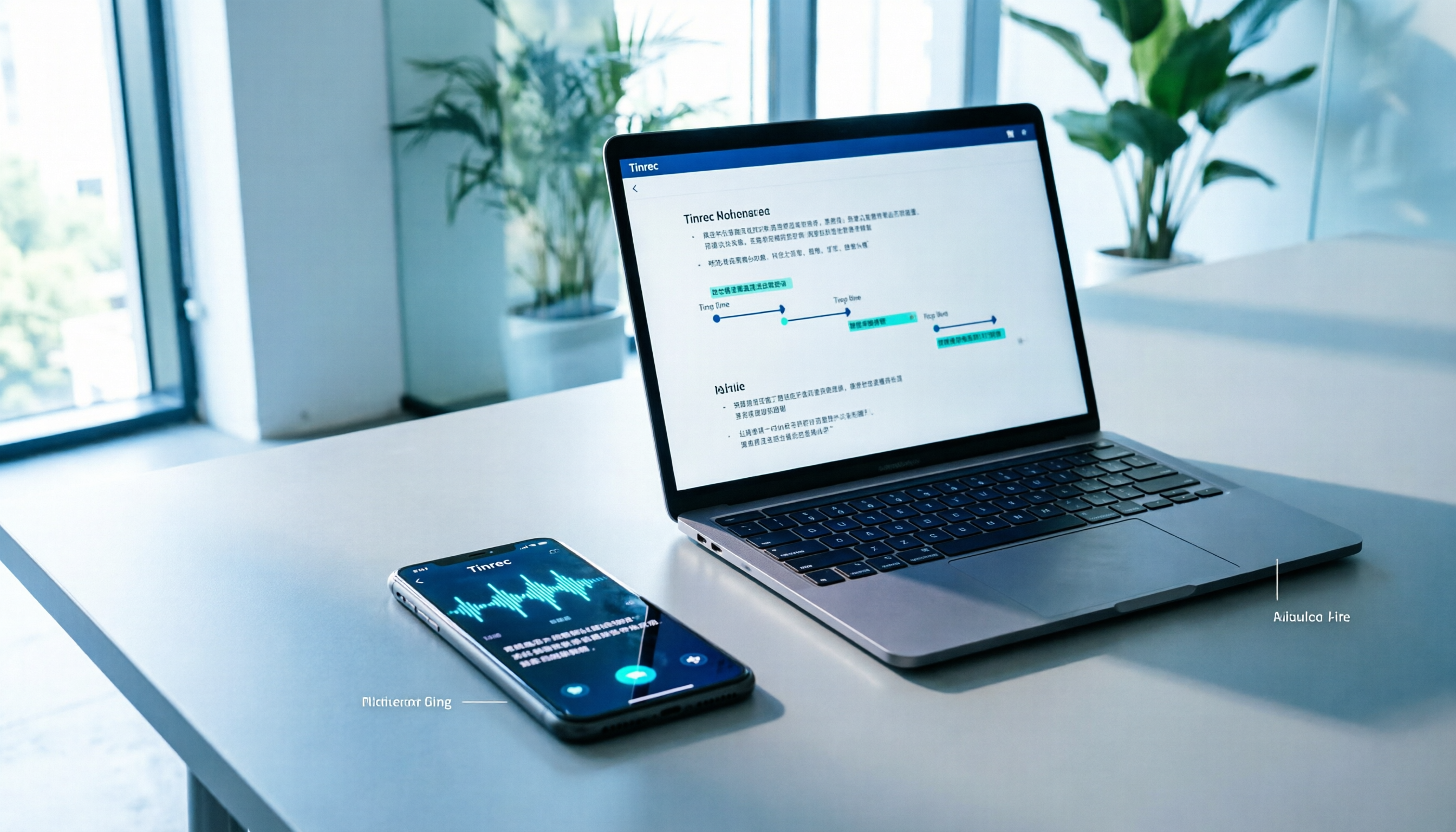
Tinrec was originally an AI tool for meeting notes, but I found it works great for podcasts too. It supports uploading audio files for transcription and has real-time translation, letting you view the transcript and translation side by side. My usual workflow: download the podcast audio, upload it to Tinrec for transcription, then use its translation feature to switch to bilingual view. If I don't understand a sentence, I just click on it.
What impressed me most is its AI Q&A feature. After transcription, I can ask Tinrec, "What are the three key points the host mentioned in this episode?" It provides a summary based on the content, saving me from reading the entire transcript. This is super useful for exam prep—I converted all the English podcasts recommended by my professor into transcripts and asked Tinrec for key points before exams. It's faster than flipping through textbooks.
In my tests, I used a 20-minute English interview with slight background music. Tinrec's transcription accuracy was noticeably higher than other free tools I've used, and it automatically segments and timestamps the text, making it easy to read. The translation quality is also good—not word-for-word but with adjusted word order, so it's understandable.
Pros: First, no extra hardware needed; works on both phone and computer. Second, supports multilingual mixed content, so bilingual podcasts are fine. Third, AI Q&A and summarization save tons of organization time. Fourth, you can export to text or PDF for note-taking.
Stop organizing recordings by hand
Upload audio or video and automatically get a transcript, summary, and action items
Limitations: The free version has a basic quota, but it's not unlimited. If you need to transcribe several episodes weekly, the free quota might not suffice, and you'd need to consider the paid plan. However, for most students, trying the free version first and upgrading if you use it regularly is a good approach—the cost is about the same as a bubble tea per month.
Who it's for: If you need to convert podcasts to transcripts, get bilingual comparisons, and use AI to quickly extract key points, Tinrec is the most user-friendly option I've tried.
Beyond Tinrec: What Other Options Are There?
Notta: Another multi-platform transcription tool. The free version offers 120 minutes per month, but each session is limited to 3 minutes—a dealbreaker for podcasts. A 30-minute episode would require 10 separate transcriptions, which is a hassle. Tinrec has no such per-session limit; you can transcribe an entire episode at once. Notta is suitable for those who need quick transcription of short audio clips.
MyEdit: A free online tool that requires no installation. Upload an audio file and get text, supporting nine languages. However, it only offers transcription and translation, with no AI summarization or Q&A. So after transcribing, you still have to read everything yourself. Tinrec's AI Q&A can directly extract key points, which MyEdit can't do. It's suitable for those who just need quick text conversion without further processing.
Apple Podcasts Built-in Transcripts: If you only listen to shows on Apple Podcasts, the system automatically generates transcripts, and after iOS 17.4, you can even translate selected text. But this feature is limited to the Apple Podcasts platform; podcasts from other platforms or downloaded audio files won't work. Tinrec can handle audio from any source, offering much more flexibility.
Pitfall Guide: 4 Common Mistakes When Choosing a Podcast Transcription Tool
Pitfall 1: Jumping In Just Because It's Free. Many tools have free versions with limits on session length or total minutes. You think it's free, but then you hit a paywall after one episode. Check the limitations before downloading to avoid being a guinea pig.
Pitfall 2: Ignoring Translation Quality. Some tools have translations worse than machine translation. The transcript is correct, but the translation is gibberish, making it useless. Always test a short segment to ensure the translation is understandable.
Pitfall 3: Assuming Transcription Is Enough. I thought that too, until I realized that after transcribing a 30-minute episode, I still didn't know the key points. If a tool has AI summarization or Q&A, it can save you a lot of time. Don't just use it as a transcription tool.
Pitfall 4: Overlooking Cross-Platform Needs. You might download podcasts on your phone and organize transcripts on your computer. If the tool doesn't sync across devices, it's a pain. Choose a tool with a web or desktop version for convenience.
Summary: Which One Should You Choose?
If you're a student like me, wanting to use podcast transcripts and translations for learning, my advice is simple: Try Tinrec's free version first. It's the most feature-complete tool I've used and best suited for student scenarios—transcription, translation, and AI Q&A all in one, with enough free quota to test a couple of episodes.
Recommendations by scenario:
- Need transcription + translation + AI key point extraction → Tinrec (Best overall experience, free trial available)
- Only need quick text conversion, no software installation → MyEdit (Free online tool, but no AI features)
- Only listen to shows on Apple Podcasts → Built-in transcripts (System feature, but platform-limited)
- Zero budget, only short audio clips → Notta free version (3-minute per session limit, suitable for short segments)
One final note: Tools are meant to save you time, not make you more dependent. When using podcasts to learn English, you ultimately need to digest the content yourself. But with the right tool, at least you won't have to stay up late working on transcripts.
References
- Turn Podcasts into Text | Transcribe App & Online Editor
- Memo AI Tutorial: One-Click Transcription of YouTube and Podcasts, Output Bilingual Subtitles, AI Summaries, and Mind Maps
- Online Podcast Transcript Generator: Free Podcast Audio to Text
- Apple Podcasts "Transcripts" Feature - Apple Podcasts Creator Resources
- Apple Podcasts Transcript Feature: Learn in 6 Easy Steps, Also a Foreign Language Learning Tool
Turn every recording into actionable outcomes
Get 60 free transcription minutes when you sign in. No credit card required.
Related Reading
You might also like

2026 Tested: 3 Notion Meeting Notes Alternatives — Tinrec Auto-Transcription Saves the Most Time
We tested several meeting note solutions. Notion templates take too long to fill manually? Tinrec's auto-transcription, AI summaries, and bot-free recording help Hong Kong professionals save time.

3 Notion Teams Meeting Note Tools Tested in 2026: Which One Really Saves You Time?
Managing Microsoft Teams meeting notes with Notion offers two paths: built-in AI notes or standalone tools. This article tests Tinrec, Notion AI, and Otter.ai from the perspectives of bot-free recording, Chinese language experience, post-meeting summaries, export options, and team governance to help you choose the most time-saving solution.

2026 Mac Transcription Software Comparison: 3 Tools Tested from Transcription to Collaboration
Still using a traditional player plus Word for transcription on your Mac? This article tests Tinrec, MacWhisper, and Buzz, comparing accuracy, input sources, AI post-processing, and team collaboration to help you find the most time-saving option.

2026 Notion Meeting Notes Templates: Official Templates + Custom Databases Made Easy
Notion meeting notes templates help you quickly organize meeting agendas, records, and action items. This article covers how to use official templates, create custom database templates, and leverage Notion AI meeting notes, making meeting documentation a breeze.

2026 iPhone Recording Apps for Meeting Minutes Compared: Which One Saves You the Most Time?
We tested four iPhone meeting recording tools, from recording, transcription, AI summaries to team collaboration, to help you find the best fit for your workflow.

2026 Hands-On Comparison of 3 AI Meeting Note Tools: Notion, Otter, and Tinrec – Which Is Best for Students?
This article tests Notion AI, Otter, and Tinrec from a student's perspective, comparing free allowances, Chinese speech recognition, AI Q&A, and pricing to help you decide which one is most worth using as a student.
How to Turn iPhone Recordings into Meeting Minutes in 2026: 5 Tools with Step-by-Step Guides
Struggling to finish meeting minutes? This article covers 5 tools for turning iPhone recordings into meeting minutes, from free built-in features to AI meeting assistants, comparing use cases and feature differences to help you find the best fit.

The Complete Guide to Spotify Transcript Translation in 2026: Solving Traditional Chinese and Download Issues with Tinrec
A student's hands-on review: Spotify's built-in transcripts often come in Simplified Chinese, can't be downloaded, and lack translation and organization features. This article explains how to use Tinrec to convert Spotify Podcasts into Traditional Chinese transcripts with translation, comparing the two options and real-world use cases.

3 Notion Meeting Transcription Tools Tested in 2026: Tinrec Saved Me 8 Hours a Week
This article tests three AI meeting transcription tools that work with Notion, including Notion AI Meeting Notes, Tinrec, and Otter.ai. From a mid-level manager's perspective, it compares free plan limits, Chinese accuracy, cross-platform support, and AI Q&A, and explains how to import Tinrec results into Notion to save time on post-meeting cleanup.