

Turn recordings into transcripts and summaries in minutes
Upload audio or video for multilingual transcription, AI notes, and action items
Are you evaluating AI meeting transcription tools? Before you decide to pay, the most important question isn't "Can it transcribe?" but "After transcription, can it turn meeting content into actionable data?" This tutorial uses Tinrec as an example to walk you through how to use AI to turn meeting recordings into transcripts, summaries, and to-dos, while highlighting key points to consider when choosing a tool.
What Can AI Meeting Transcripts Do for You?
Scenario 1: Meeting Notes Ready in 5 Minutes After the Meeting
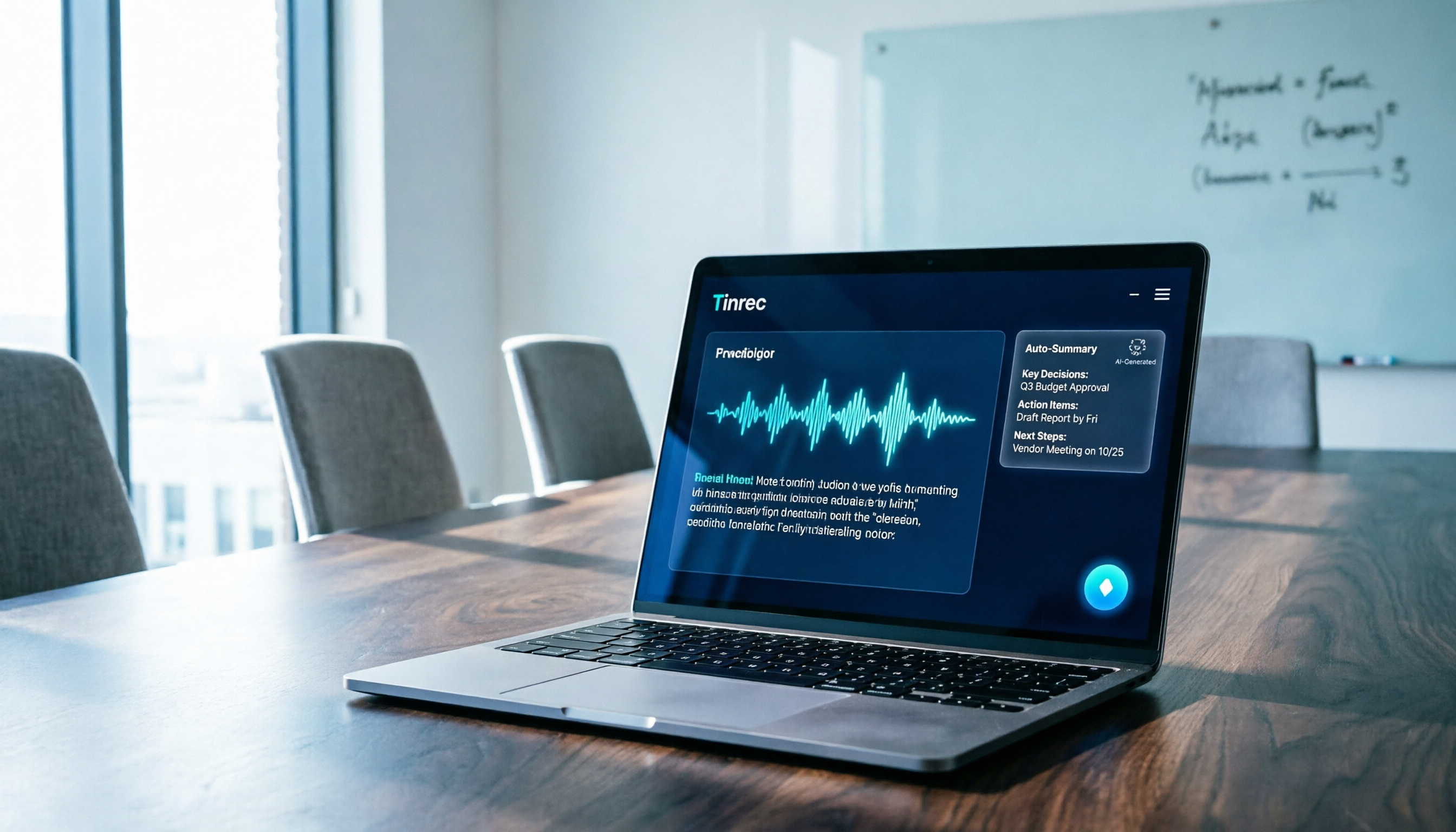
Previously, after a two-hour meeting, you might spend another hour organizing notes. Now with Tinrec, the moment the meeting ends, AI has already generated summaries, conclusions, and action items—who is responsible for what and deadlines are clear at a glance.
Scenario 2: Keep Up with Cross-Language Meetings
If your team has international members, Tinrec's real-time translation lets you view the original text, translation, or bilingual content during recording, without needing to translate afterward.
Scenario 3: Quickly Organize Historical Recordings
Upload past recordings to Tinrec, and it will automatically transcribe them, generate chapters and key points, turning old data into searchable knowledge.
Scenario 4: Team Collaboration and Knowledge Retention
The team version centralizes all meeting materials in one space, allowing new members to review past meetings without digging through chat logs or USB drives.
What Are the Core Capabilities of AI Meeting Transcripts?
Real-Time Transcription
Tinrec supports transcription while recording, whether for in-person or online meetings. Text appears almost simultaneously, so you can check for missed points as you go.
AI Semantic Summaries
Instead of condensing the transcript into a single paragraph, it organizes information structurally—meeting topic, discussion conclusions, action items, and owners are listed separately.
AI Conversation Query
After transcription, you can ask Tinrec questions directly—"Who mentioned the budget in the meeting?" "What was the client's feedback?"—and it will answer based on semantic understanding.
Action Item Extraction
It automatically extracts follow-up actions from the discussion, such as "Submit the quote by Monday" or "Ask the design team to update specs," so you don't have to manually pick them out.
Multi-Format Export
You can export results to tools like Notion, Google Docs, OneNote, and Dropbox, integrating meeting data directly into your existing workflow.
Practical Use Cases
Scenario 1: Online Meetings (Zoom, Google Meet, Teams, Webex)
Just open the Tinrec desktop app on your computer; it captures system audio directly, so you don't need to invite a bot to the meeting. When the meeting ends, transcripts, summaries, and action items are already prepared.
Scenario 2: In-Person Interviews or Client Meetings
Open Tinrec on your phone, record with one tap, and get real-time transcription. After the interview, you can share key points with your team without staying up late to organize.
Stop organizing recordings by hand
Upload audio or video and automatically get a transcript, summary, and action items
Scenario 3: Class or Lecture Notes
Students or researchers can use Tinrec to turn lecture recordings into searchable notes and ask AI questions like "What example did the teacher give in Chapter 3?"
Scenario 4: Content Creation Material Organization
Podcasters or video creators can transcribe interview recordings and use AI Q&A to quickly find quotable segments, saving hours of manual transcription.
4 Things to Consider When Choosing an AI Meeting Transcription Tool
1. Meeting Recording Method
Some tools require a bot to join the meeting, which may raise privacy concerns. Tinrec's desktop app captures system audio directly, with no extra participants—cleaner.
2. Post-Transcription Processing
Transcription is just the first step; the key is whether it can generate summaries, action items, and support Q&A. Tinrec doesn't just give you a transcript; it helps you turn it into actionable data.
3. Language Support and Chinese Experience
If you often have meetings in Chinese, pay special attention to the tool's ability to recognize Traditional Chinese and mixed Chinese-English content. Tinrec covers Chinese, Traditional Chinese, and multilingual meeting scenarios, and supports organizing mixed Chinese-English content.
4. Team Collaboration and Data Ownership
If you're using it as a team, confirm who owns the meeting data and whether it disappears when members leave. Tinrec's team version assigns data to the team, and when members exit, resources can be transferred, preventing knowledge gaps.
FAQ
Q1: What's the difference between Tinrec and regular recording software?
Regular recording software only records. Tinrec converts recordings to text, organizes summaries, chapters, and action items, supports AI Q&A, translation, and export, and centralizes data in a team space.
Q2: Does Tinrec require a meeting bot to join?
No. Tinrec's desktop app captures system audio directly; you just open Tinrec and start recording. It will capture online meetings without any extra bots.
Q3: Is the free plan sufficient?
The free plan provides basic credits, suitable for occasional transcription or experiencing the full workflow. If you have meetings weekly, consider the Pro or Team plans for more generous usage.
Q4: Will meeting data disappear when team members leave?
No. Team resources belong to the team. When a member leaves or is removed, their resources must be transferred to other active members, so data stays in the team space.
Q5: How accurate is it?
We don't recommend promising a specific accuracy rate, as actual results depend on recording quality, accents, noise, and overlapping speech. Tinrec provides high-quality transcription in clear audio and common scenarios; for important content, we recommend cross-referencing with the recording.
Conclusion
AI meeting transcripts aren't futuristic technology; they're efficiency tools you can use today. If you have more than three meetings a week and still manually organize meeting notes, we strongly recommend trying Tinrec. The free plan's basic credits are enough to experience the full workflow and see what it's like to have AI organize your meeting notes. Starting today, turn meetings from a burden into your team's digital asset.
References
- Meeting Ink - 2026 AI Meeting Notes Tool Test: 7 Speech-to-Text and Summary Speed Comparison | Meeting Ink - AI Meeting Notes Assistant, Auto-Transcribe and Summarize
- Meeting Ink - AI Meeting Notes Assistant, Auto-Transcribe and Summarize
- How to Use AI for Meeting Minutes? Gemini Notebook, Gemini, EchoScript Explained | 104 Career Force
- Meeting Ink - Transcript AI Meeting Summary Speech to Text - Google Play App
- How to Use AI for Meeting Minutes? How to Organize Meeting Transcripts? | AI Speech-to-Text Tutorial | 104 Career Force
Turn every recording into actionable outcomes
Get 60 free transcription minutes when you sign in. No credit card required.
Related Reading
You might also like
Tinrec vs Plaud Note 2026: 5-Dimension Comparison – Is the Dcard-Hyped Recorder Worth It?
Discussions about the Plaud recorder are heating up on Dcard, but do you really need to spend money on hardware? This article compares Tinrec and Plaud Note across 5 dimensions to help you find the most cost-effective AI meeting notes solution.

2026 Tested: 3 Meeting Transcription Apps Compared — Which One Captures More Without Bots?
Meeting notes take the most time after the meeting. This comparison reviews two bot-free AI meeting transcription tools, Tinrec and Granola, covering recording methods, input sources, Chinese language experience, post-meeting organization, and team collaboration to see which suits Taiwan users better.

2026 Tested: 4 Meeting Transcription Tools Compared — Tinrec Is the Top Choice for Chinese Meetings
We tested Otter.ai, Notta, Granola, and Tinrec across four key areas: Chinese accuracy, bot-free recording, post-meeting organization, and team collaboration. Find out which meeting transcription tool is best for Taiwanese office workers.

How to Take Meeting Minutes in 2026? 5 Steps to Quickly Organize with NotebookLM vs Tinrec
Tired of working overtime because of meetings? Using the wrong tool only makes it worse. This article compares NotebookLM and Tinrec, teaching you how to use the right tool to save time on meeting minutes.

6 AI Meeting Note Tools Tested and Compared in 2026: Which One Should Taiwan Office Workers Try First?
This article compares 6 AI meeting note tools, including Tinrec, Otter.ai, Granola, PLAUD Note, Notta, and the free inFin, covering bot-free recording, Chinese recognition, pricing plans, and team collaboration, to help you quickly find the best fit.

Top 5 Free AI Meeting Minutes Tools in 2026: A Comprehensive Review
Tired of working overtime on meeting minutes? We tested 5 free AI meeting minutes tools, from Cantonese recognition to AI Q&A, to help you find the most time-saving solution.

2026 AI Meeting Notes Tools: Record Teams Meetings Without Bots & Auto-Generate Minutes
Tired of spending hours on meeting notes? This article shows you how to use AI tools to quickly handle Teams meeting records. We tested Tinrec for bot-free recording, automatic summaries, and action items to save you overtime.

Best AI Meeting Note Tools in 2026: 5 Tested, No Bot Needed + Top Pick for Chinese
Tired of manual meeting notes? This article tests 5 AI meeting recorders—Tinrec, Otter, Fireflies, Notta, and Easemate—comparing bot-free recording, Chinese accuracy, pricing, and team collaboration to help you find the best fit.

2026 Google Meet Meeting Notes Free Options: 3 Tools Compared
A mid-level manager tests Google Meet meeting notes tools, from free built-in features to third-party AI solutions, and rounds up 3 options to help you save time after meetings.