

Turn recordings into transcripts and summaries in minutes
Upload audio or video for multilingual transcription, AI notes, and action items
2026 Tested: 4 Meeting Transcription Tools Compared — Tinrec Is the Top Choice for Chinese Meetings
The Pain Point of Meeting Notes — You Don't Need a Recorder, You Need an AI Tool That Organizes
Many people think the hardest part of meeting notes is recording, but it's not—the hardest part is turning a two-hour meeting into usable transcripts afterward. Some people replay the recording and type it out word by word, while others only jot down key points and miss details. An even more common inefficient practice is: after recording, you just leave the file in a folder, and only when you need to find a certain decision do you realize there's no transcript at all. But in fact, as long as you choose the right AI tool, these tasks can be automated.
Before Buying a Meeting Transcription Tool, Understand These 4 Key Points
1. Recognition Ability for Chinese and Mixed Chinese-English Content
Meetings in Taiwan often mix Mandarin, English, and even Taiwanese. Many tools perform well in English meetings but start making mistakes with Chinese or mixed Chinese-English content. When choosing, we recommend testing with a recording of your usual meetings, not just relying on official marketing. Among the 4 tools we tested this time, only a few could handle both Chinese and mixed Chinese-English content well.
2. Online Meeting Recording Method: Does It Require a Bot to Join?
Some tools rely on a "meeting bot" joining the meeting to record, meaning you have to invite an extra bot account, which can be inconvenient in some company meetings or client interviews. A better approach is "bot-free recording"—the tool captures audio directly from your computer's system sound without joining the meeting. This design is much more discreet for users.
3. Post-Meeting Organization: Not Just Transcripts
Transcripts are just the first step. You need the tool to automatically generate summaries, list action items, and let you use AI Q&A to quickly find key points. If you only use the tool as "audio-to-text," you're only using a third of its capabilities.
4. Cross-Platform and Team Collaboration
If you record on your iPhone today, organize on your computer tomorrow, and want to share with colleagues the day after—if the tool doesn't support cross-platform use, it will be very painful. Additionally, if you need to share meeting materials with your team and manage member permissions, consider whether it has team space features.
Tinrec (Seconds Recording) — Our Top Pick After Testing
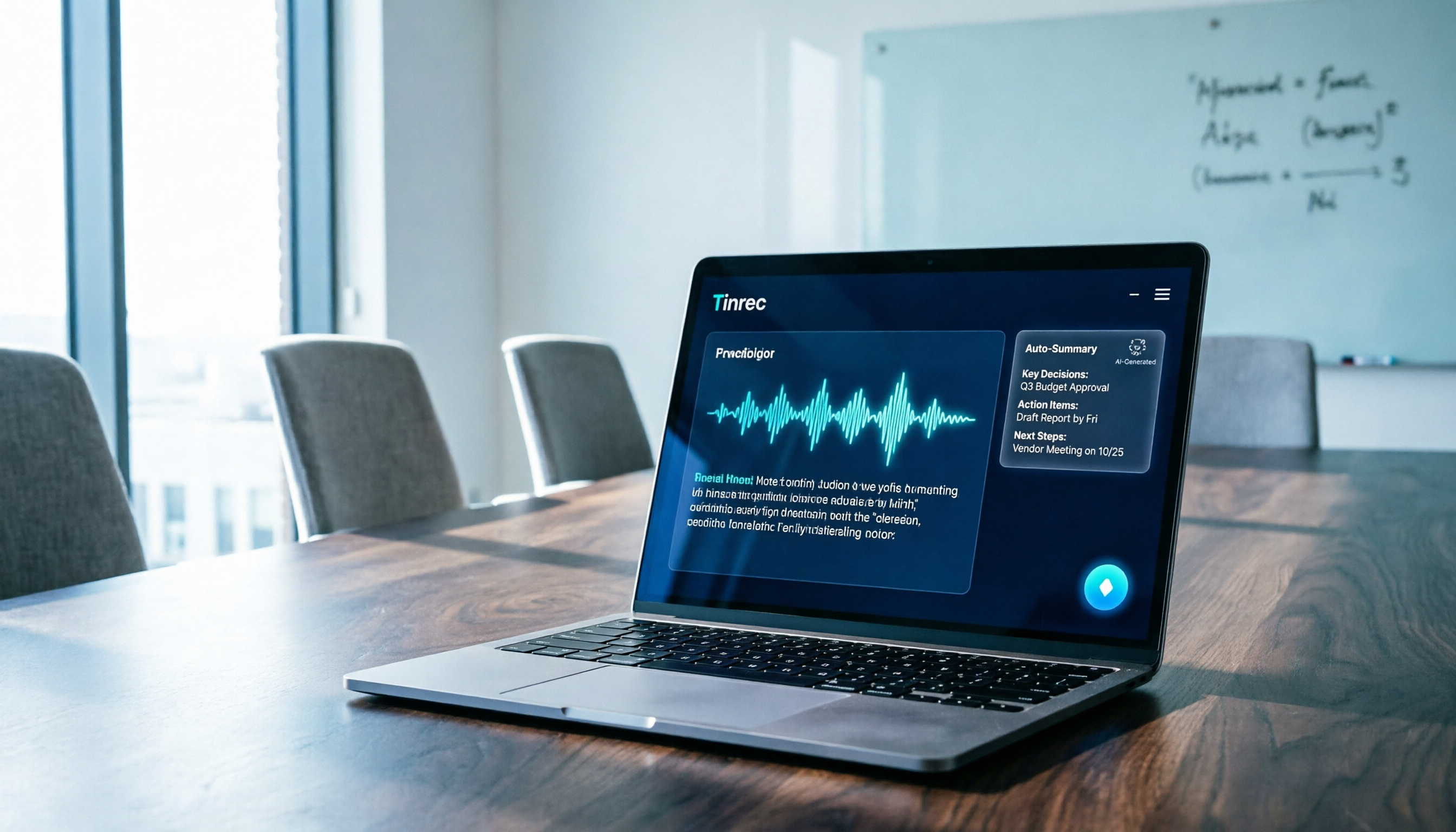
Tinrec is an AI meeting notes and collaboration tool that supports Chinese and multiple languages, available on iOS, Android, desktop, and web, with no additional hardware needed. Its core value isn't just converting audio to text, but turning meetings into searchable, collaborative, and actionable data.
Bot-Free Online Meeting Recording
When starting an online meeting, you no longer need to invite a bot. Just open the Tinrec desktop app and it can directly record system audio, showing the transcript in real time as the meeting progresses. We tested it with Zoom and Google Meet, and there's no extra participant appearing on screen, making it friendly for both internal and client meetings.
File Transcription and AI Summaries
Upload a 10-minute Chinese meeting recording, and Tinrec's transcript requires almost no edits. After the meeting, click AI Summary, and a two-hour discussion becomes key points and action items you can read in five minutes. Even better, it automatically splits long meetings into chapters, so you can jump directly to sections like "budget discussion" or "project timeline."
AI Q&A and Action Item Extraction
What impressed me most is the AI Q&A. You can ask directly, "Who mentioned the budget in the last meeting?" and it will give you the answer directly, not just keyword search results. Action items are also automatically organized—who is responsible for what and deadlines are clear at a glance. Additionally, it can generate meeting minutes, reports, or tables, and export to tools like Notion and Google Docs for further use.
Pros
Stop organizing recordings by hand
Upload audio or video and automatically get a transcript, summary, and action items
- Great Chinese meeting experience: In our tests, mixed Chinese-English content was transcribed correctly, without transliterating English into awkward Chinese.
- Practical team space: If you're a project lead, you can centralize meeting materials in a team space, and new members can see historical decisions without digging through chat logs.
- No additional hardware needed: Unlike AI recording pens that require extra purchases, you can use it on your phone or computer.
Limitations
The free version only offers basic quotas; heavy users need to upgrade to a paid plan. But for those who have 2-3 meetings a week, starting with the free version is sufficient. Also, file imports consume quota, while real-time recording doesn't deduct minutes within an active plan—this design is quite reasonable.
Who It's For
If you need Chinese meeting transcripts, don't want to use meeting bots, want to ask AI about key points after recording, or have team sharing needs, Tinrec is currently a very suitable choice.
Beyond Tinrec: What Other Options Are There?
Otter.ai
The top choice for English meetings, with a generous free plan of 300 minutes per month. But its strength lies in English business contexts; Chinese meeting organization isn't as intuitive as Tinrec, and Chinese filler words and Taiwanese expressions are sometimes ignored. If you only record in English, Otter.ai is worth considering; for Chinese meeting organization and AI Q&A, Tinrec is smoother.
Notta
More of a general transcription tool, supporting multiple languages and file transcription at a reasonable price. However, Notta doesn't go as deep in meeting collaboration as Tinrec: it lacks the smooth bot-free desktop recording experience, and team space and AI Q&A aren't as integrated into the post-meeting workflow as Tinrec. If you only need transcription and translation, Notta works; for post-meeting organization and team sharing, Tinrec is more complete.
Granola
A bot-free AI meeting notes tool, similar in concept to Tinrec. But Granola doesn't support uploading pre-recorded audio files, nor does it retain meeting audio, which is inconvenient for those who need to refer back to the original recording. Tinrec allows uploading historical recordings, retains audio, and supports Chinese, making it more user-friendly for Taiwanese users.
Pitfall Guide: 4 Common Mistakes When Choosing a Meeting Transcription Tool
Pitfall 1: Only Looking at Transcription Accuracy, Ignoring Post-Meeting Organization
Many tools advertise high accuracy, but after transcription, you still have to organize manually. Don't forget: you want "usable meeting minutes," not just a transcript with few typos. Choose a tool with AI summaries, action item extraction, and Q&A features to truly save time.
Pitfall 2: Not Paying Attention to Online Meeting Recording Methods
Some tools require inviting a bot to join the meeting, which can be awkward in formal client meetings. Before purchasing, confirm whether it can record without a bot; otherwise, you'll have to explain "this is our recording bot" every time.
Pitfall 3: Assuming the Free Version Is Enough, Then Key Meetings Can't Be Transcribed
Free versions usually have quota limits, whether monthly minutes or per-session duration. If you have important interviews or long meetings, make sure to understand the free quota first, or test a full meeting flow with the free version.
Pitfall 4: Ignoring Cross-Platform Needs
If you record on your iPhone today, organize on your computer tomorrow, and want to share with colleagues the day after—if the tool is only on mobile, you'll be in pain. Choose a tool that supports iOS, Android, web, and desktop to keep your workflow uninterrupted.
Summary: Which One Should You Choose?
If you need Chinese meeting transcripts, want to use AI to find key points and organize action items after recording, and don't want to add a bot to your meetings, Tinrec is currently the most comprehensive choice. Here's a breakdown by scenario:
- Need Chinese meeting transcripts + AI Q&A → Tinrec
- Need bot-free online meeting recording → Tinrec
- Need cross-platform use + team sharing of meeting materials → Tinrec
- Pure English meetings with zero budget → Otter.ai free version
- Only need large-scale file transcription, no meeting collaboration → Notta
We recommend starting with Tinrec's free version, uploading a meeting recording to try it out, and experiencing the AI summary and Q&A before deciding whether to upgrade to a paid plan.
References
- Master Meeting Minutes! How to Use AI Speech-to-Text? Gemini Notebook, Gemini, EchoScript Operation Guide | 104 Career Force
- EP10|Boss Wants Meeting Minutes: How to Choose AI Transcription Tools? – Knowledge Nomad Studio
- Meeting Ink - 2026 AI Meeting Notes Tools Tested: 7 Speech-to-Text and Summary Speed Comparison | Meeting Ink - AI Meeting Notes Assistant, Automatic Transcription and Summary
- "Notta - Ultra-Accurate Transcript, Speech-to-Text, Meeting Recording, AI Summary Notes" App - App Store
- How to Use AI for Meeting Minutes? How to Organize Meeting Transcripts? | AI Speech-to-Text Tutorial | 104 Career Force
Turn every recording into actionable outcomes
Get 60 free transcription minutes when you sign in. No credit card required.
Related Reading
You might also like

2026 Hands-On Comparison of 5 AI Transcription Tools: Beyond Vocol, Tinrec Is Better Suited for Taiwan Team Collaboration
Wondering how to use Vocol? This article starts with common misconceptions and compares 5 AI transcription tools in real-world tests, showing how Tinrec turns meetings into trackable team assets with bot-free recording, AI summaries, and team spaces.

2026 Hands-On Comparison of 3 Voice Collaboration Platforms: Is Tinrec Better Than Vocol for Hong Kong Workers?
Looking for info on Vocol? We tested several voice collaboration platforms and found that Tinrec is better suited for Hong Kong workers in terms of Chinese meeting notes, bot-free recording, and team collaboration, saving time and being easy to use.

The Complete Guide to AI Meeting Notes Tools in 2026: Where Is Vocol From? Why Students Should Choose Tinrec
First, to answer 'Where is Vocol from?': Vocol is an AI voice collaboration platform developed by a Taiwanese team. But for students, choosing a tool isn't just about the country of origin—you also need to consider free quotas, AI summarization, and practical applications. Based on my own experience, this article compares Vocol and Tinrec, explaining why Tinrec is better for recording lectures, group discussions, and final exam review.

How to Convert Plaud Recordings to Text in 2026: Export Transcripts and AI Summaries with Tinrec
Struggling to organize your Plaud voice recorder files? Tinrec lets you upload audio, quickly convert it to transcripts, and automatically generate summaries and action items. This guide shows you how to use Tinrec for recordings, online meetings, and interviews, saving you hours of manual transcription and helping your team centralize meeting knowledge.

Best Voice Recorder Apps 2026: Tinrec Beats Hardware for Hong Kong Office Workers
Plaud's latest voice recorder card has sparked discussions, but Hong Kong office workers may not need extra hardware. This article compares Plaud Note, Tinrec, and Otter.ai, analyzing Cantonese accuracy, online meeting support, team collaboration, and cost to show why Tinrec is better for daily office use.
Tinrec vs Plaud Note 2026: 5-Dimension Comparison – Is the Dcard-Hyped Recorder Worth It?
Discussions about the Plaud recorder are heating up on Dcard, but do you really need to spend money on hardware? This article compares Tinrec and Plaud Note across 5 dimensions to help you find the most cost-effective AI meeting notes solution.

2026 Tested: 3 Meeting Transcription Apps Compared — Which One Captures More Without Bots?
Meeting notes take the most time after the meeting. This comparison reviews two bot-free AI meeting transcription tools, Tinrec and Granola, covering recording methods, input sources, Chinese language experience, post-meeting organization, and team collaboration to see which suits Taiwan users better.

How to Take Meeting Minutes in 2026? 5 Steps to Quickly Organize with NotebookLM vs Tinrec
Tired of working overtime because of meetings? Using the wrong tool only makes it worse. This article compares NotebookLM and Tinrec, teaching you how to use the right tool to save time on meeting minutes.

6 AI Meeting Note Tools Tested and Compared in 2026: Which One Should Taiwan Office Workers Try First?
This article compares 6 AI meeting note tools, including Tinrec, Otter.ai, Granola, PLAUD Note, Notta, and the free inFin, covering bot-free recording, Chinese recognition, pricing plans, and team collaboration, to help you quickly find the best fit.