

Turn recordings into transcripts and summaries in minutes
Upload audio or video for multilingual transcription, AI notes, and action items
The most time-consuming part of meeting notes isn't the meeting itself—it's the follow-up. For a one-hour meeting, just converting the recording into a transcript and then extracting key points and action items can take another half hour. If the tool only generates a transcript, you still have to read it yourself; if the tool requires adding a bot to your online meeting, it can be a bit awkward.
In this article, I'll compare two AI meeting transcription tools that don't require meeting bots: Tinrec and Granola. We'll look at recording methods, input sources, Chinese language experience, post-meeting organization, and team collaboration to see which one is better for Taiwan users.
Tinrec vs Granola | Quick Overview
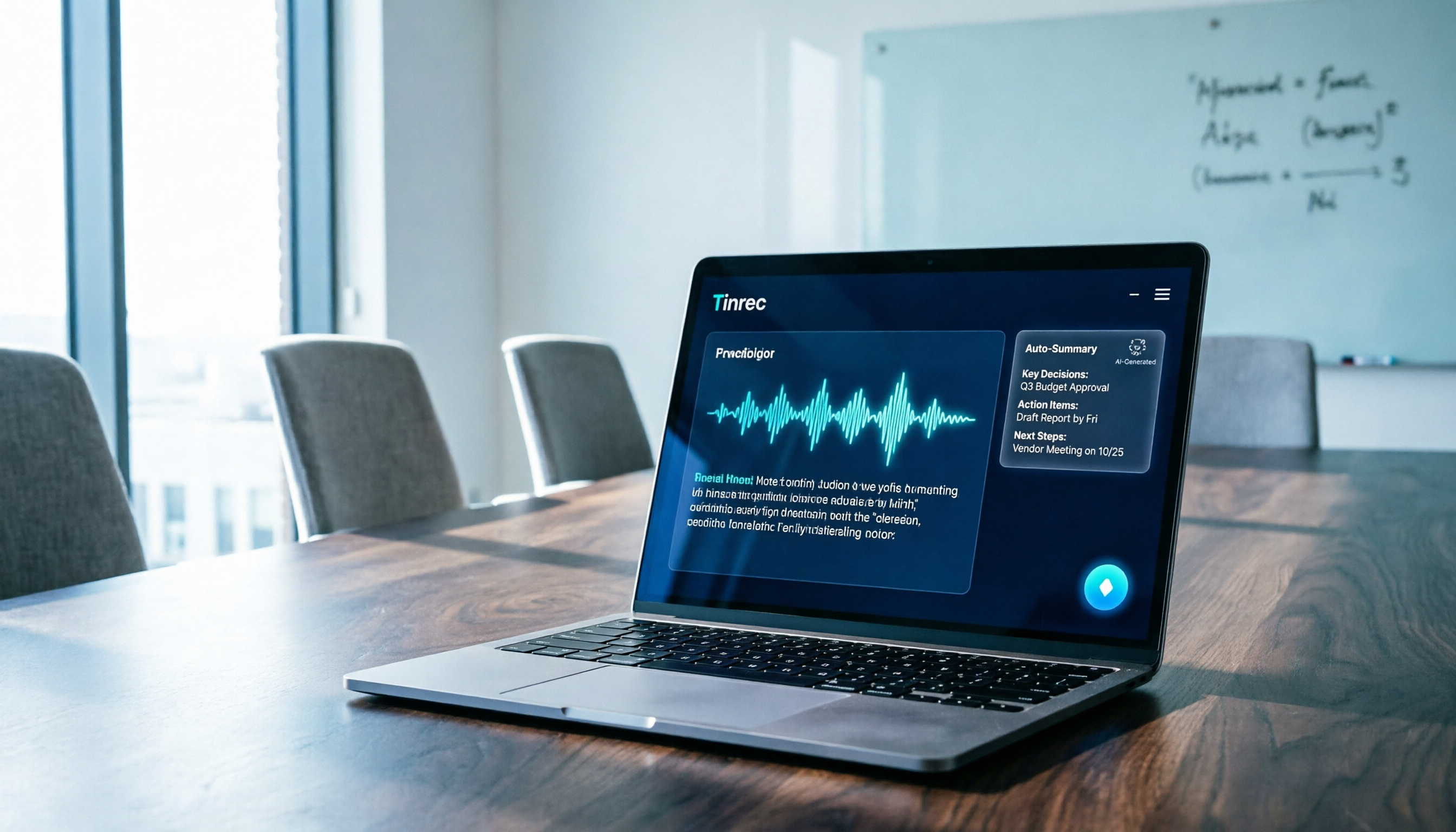
Tinrec is an AI meeting recording and collaboration tool designed for individuals and teams. It not only converts speech to text but also turns meeting recordings into searchable, summarizable, queryable, exportable, and further processable data.
Granola is a bot-free AI meeting notes tool that emphasizes "handwritten notes + AI enhancement." It uses desktop system audio and microphone for real-time transcription, then combines with user notes to generate meeting content.
| Item | Tinrec | Granola |
|---|---|---|
| Positioning | AI meeting recording and team collaboration | Bot-free AI meeting notes |
| Pricing | Free personal version / Pro monthly or annual; Team version USD 29.80 per paid seat/month (annual USD 199) | Basic free; Business USD 14/user/month; Enterprise USD 35 |
| Platform | Web, desktop, mobile | Desktop primarily |
| Key Differences | Retains audio files, supports file import, Chinese and multilingual, team spaces | Handwritten notes + AI enhancement, cross-meeting context, no audio retention, no pre-recorded file import |
Dimension 1 | Meeting Capture: Completeness of Bot-Free Recording
Granola captures system audio and microphone directly on the desktop, no extra bot needed. It offers real-time transcript viewing, copying, and search, but does not save meeting audio.
Tinrec also records on the desktop without bots—no need to add a bot to Zoom, Google Meet, Teams, or Webex. In addition to real-time transcripts, Tinrec retains meeting audio for later review and verification.
→ This dimension: Both can record without bots, but Tinrec adds audio retention, making records more complete.
Dimension 2 | Input Sources and Audio Retention
Granola is mainly for live meetings; it doesn't support uploading pre-recorded audio and doesn't save meeting audio. If you have historical recordings or interview files, Granola won't help.
Tinrec supports not only live recording and online meetings but also uploading audio files, video files, mobile recordings, and even some web links. Meeting data can be saved as searchable transcripts and summaries, and audio can be managed centrally in team spaces.
→ This dimension: Tinrec's input sources are much broader than Granola's, suitable for those who need to organize historical recordings.
Dimension 3 | Chinese and Multilingual Experience
Granola's strength is in English meeting notes; its product mindset leans toward English speakers, and Chinese content is not its focus.
Tinrec is specifically optimized for Chinese, Traditional Chinese, and mixed Chinese-English content, offering real-time translation, original/translated/bilingual views, and team glossary features to improve recognition of technical terms.
→ This dimension: For Taiwan users, Tinrec's Chinese experience is clearly more user-friendly.
Dimension 4 | Post-Meeting Organization and Export Capabilities
Granola combines AI transcription with user handwritten notes to generate meeting highlights and supports cross-meeting context. However, its post-meeting output is more note-oriented, with fewer export options.
Stop organizing recordings by hand
Upload audio or video and automatically get a transcript, summary, and action items
Tinrec not only generates transcripts but also automatically organizes summaries, chapters, key points, and action items. It supports AI Q&A, mind maps, multi-format export (Notion, Google Docs, OneNote, Dropbox, etc.), and can use Agents for post-processing to generate reports, tables, and meeting minutes.
→ This dimension: Tinrec's post-meeting organization and delivery capabilities are more complete, suitable for those who need to produce formal documents.
Dimension 5 | Team Collaboration and Data Management
Granola offers shared folders, user management, and enterprise management, but its team governance granularity is not as refined as Tinrec's.
Tinrec's team version is an independent collaboration space that supports creating multiple teams, inviting members, setting owner/admin/member roles, allocating seats, sharing meeting data, viewing usage trends, audit logs, audio recycle bin, and team glossary. When a member leaves or loses a seat, resources can be handed over, so meeting data doesn't disappear with the individual.
→ This dimension: Tinrec excels in team collaboration, governance, and knowledge accumulation.
What Unique Advantages Does Each Have?
Tinrec's Unique Advantages
- No extra hardware needed; works on computer, phone, and web; can record both online and offline meetings.
- Retains audio, supports importing historical recordings, turning old data into searchable assets.
- Great Chinese and multilingual experience; real-time translation and bilingual views suit cross-language meetings.
- Team spaces + role-based seats + usage audit turn meeting data into a collaborative team knowledge base.
- Multi-format export and Agent post-processing can directly produce reports, tables, and meeting minutes.
Granola's Unique Advantages
- Handwritten notes + AI enhancement aligns with personal thinking, ideal for those who like to annotate during meetings.
- Cross-meeting context capability can reference notes from previous meetings.
Summary: Which One Should You Choose?
- If you need to retain meeting audio and organize historical recordings → Tinrec (Granola doesn't save audio or support pre-recorded file import)
- If you have many Chinese meetings, need mixed Chinese-English transcription, or real-time translation → Tinrec (more complete Chinese experience)
- If you want team knowledge accumulation, role-based seat management, and usage audit → Tinrec (team version features are more comprehensive)
- If you only use English, don't need audio, and prefer handwritten notes combined with AI → Granola is worth considering
In a nutshell: For most Taiwan users and scenarios requiring team collaboration, Tinrec is the more complete choice. We recommend trying the free version first and testing it with your own recordings.
FAQ
Can Tinrec automatically join Zoom or Teams meetings?
No. Tinrec desktop version is bot-free recording; users need to manually open Tinrec to start recording. It directly captures the computer's system audio without needing an extra bot to join the meeting.
How much quota does Tinrec's free version have?
The free version provides basic quota to experience recording, import, summary, and transcription features. Actual quota is subject to the official page.
Which has higher transcription accuracy, Tinrec or Granola?
We cannot promise a specific accuracy rate. Actual results are affected by recording quality, noise, accents, overlapping speech, and technical terms. Both offer real-time transcripts, but Tinrec retains audio for easy review and verification.
Can team members without a seat view meeting data?
Yes. Active members without a seat can view, play, and read team data; but a seat is required for recording, uploading, editing, importing/exporting, etc.
Which tools does Tinrec support exporting to?
It supports exporting to third-party tools like Notion, Google Docs, OneNote, Dropbox, and can also export in various document formats.
What should I pay attention to when using such meeting recording tools?
You should comply with local laws and obtain consent from participants when necessary, especially in meetings involving privacy or confidentiality.
References
- Meeting Ink - AI Meeting Assistant: Automatic Transcription and Summary
- Meeting Ink - Transcript AI Meeting Summary Voice to Text - Google Play App
- Meeting Ink - Transcript AI Meeting Summary Voice to Text - App Store
- Master Meeting Minutes! How to Use AI Voice-to-Text? Gemini Notebook, Gemini, EchoScript Operation Guide | 104 Career Force
- Notta - Super Accurate Transcript, Voice to Text, Record Meetings, AI Summary - App Store
Turn every recording into actionable outcomes
Get 60 free transcription minutes when you sign in. No credit card required.
Related Reading
You might also like

2026 Hands-On Comparison of 5 AI Transcription Tools: Beyond Vocol, Tinrec Is Better Suited for Taiwan Team Collaboration
Wondering how to use Vocol? This article starts with common misconceptions and compares 5 AI transcription tools in real-world tests, showing how Tinrec turns meetings into trackable team assets with bot-free recording, AI summaries, and team spaces.

2026 Hands-On Comparison of 3 Voice Collaboration Platforms: Is Tinrec Better Than Vocol for Hong Kong Workers?
Looking for info on Vocol? We tested several voice collaboration platforms and found that Tinrec is better suited for Hong Kong workers in terms of Chinese meeting notes, bot-free recording, and team collaboration, saving time and being easy to use.

The Complete Guide to AI Meeting Notes Tools in 2026: Where Is Vocol From? Why Students Should Choose Tinrec
First, to answer 'Where is Vocol from?': Vocol is an AI voice collaboration platform developed by a Taiwanese team. But for students, choosing a tool isn't just about the country of origin—you also need to consider free quotas, AI summarization, and practical applications. Based on my own experience, this article compares Vocol and Tinrec, explaining why Tinrec is better for recording lectures, group discussions, and final exam review.

How to Convert Plaud Recordings to Text in 2026: Export Transcripts and AI Summaries with Tinrec
Struggling to organize your Plaud voice recorder files? Tinrec lets you upload audio, quickly convert it to transcripts, and automatically generate summaries and action items. This guide shows you how to use Tinrec for recordings, online meetings, and interviews, saving you hours of manual transcription and helping your team centralize meeting knowledge.

Best Voice Recorder Apps 2026: Tinrec Beats Hardware for Hong Kong Office Workers
Plaud's latest voice recorder card has sparked discussions, but Hong Kong office workers may not need extra hardware. This article compares Plaud Note, Tinrec, and Otter.ai, analyzing Cantonese accuracy, online meeting support, team collaboration, and cost to show why Tinrec is better for daily office use.
Tinrec vs Plaud Note 2026: 5-Dimension Comparison – Is the Dcard-Hyped Recorder Worth It?
Discussions about the Plaud recorder are heating up on Dcard, but do you really need to spend money on hardware? This article compares Tinrec and Plaud Note across 5 dimensions to help you find the most cost-effective AI meeting notes solution.

2026 Tested: 4 Meeting Transcription Tools Compared — Tinrec Is the Top Choice for Chinese Meetings
We tested Otter.ai, Notta, Granola, and Tinrec across four key areas: Chinese accuracy, bot-free recording, post-meeting organization, and team collaboration. Find out which meeting transcription tool is best for Taiwanese office workers.

How to Take Meeting Minutes in 2026? 5 Steps to Quickly Organize with NotebookLM vs Tinrec
Tired of working overtime because of meetings? Using the wrong tool only makes it worse. This article compares NotebookLM and Tinrec, teaching you how to use the right tool to save time on meeting minutes.

6 AI Meeting Note Tools Tested and Compared in 2026: Which One Should Taiwan Office Workers Try First?
This article compares 6 AI meeting note tools, including Tinrec, Otter.ai, Granola, PLAUD Note, Notta, and the free inFin, covering bot-free recording, Chinese recognition, pricing plans, and team collaboration, to help you quickly find the best fit.