
Turn recordings into transcripts and summaries in minutes
Upload audio or video for multilingual transcription, AI notes, and action items
Two hours in a meeting, another two hours writing up the minutes? Dcard is buzzing about the Plaud recorder
Two hours in a meeting, another two hours writing up the minutes—this is the daily reality for most professionals. Especially when everyone is talking over each other and the boss changes decisions on the fly, listening, taking notes, and organizing everything into a clear summary feels impossible. Recently, an AI recording device has sparked a lot of discussion on Dcard, with many sharing how it automatically identifies speakers and generates summaries, while others hesitate: do we really need to buy another piece of hardware? If you're struggling with meeting notes, this article will help you figure out—what you might need isn't a recorder, but a more complete AI meeting notes solution.
Before choosing a speech-to-text tool, understand these 4 key points
- Accuracy: Don't just look at official claims; check performance in real-world conditions. Meeting rooms have background noise, people talking over each other, and different accents—all of which affect transcription quality. Test with your own recordings rather than trusting ideal numbers from ads.
- AI features: Transcription is just the first step; what matters more is whether it can help you generate summaries, action items, or even answer questions. If the tool only gives you a transcript, you'll still have to spend time digesting it yourself.
- Cross-platform: You might record on your phone today, organize on your computer tomorrow, and share with your team the day after. If the tool only works on one device, it's a hassle.
- Cost: Beyond the price of hardware or software, consider monthly transcription limits and free plan restrictions. Some tools have cheap hardware but high subscription fees; others are free but very limited.
Among these dimensions, one tool stands out—let's dive in.
Tinrec (秒听录音) – Our Top Pick After Hands-On Testing
Tinrec (秒听录音) is an AI meeting notes and collaboration tool for individuals and teams, supporting iOS, Android, web, and desktop. It goes beyond speech-to-text, focusing on post-meeting organization and collaboration.
Core features in action:
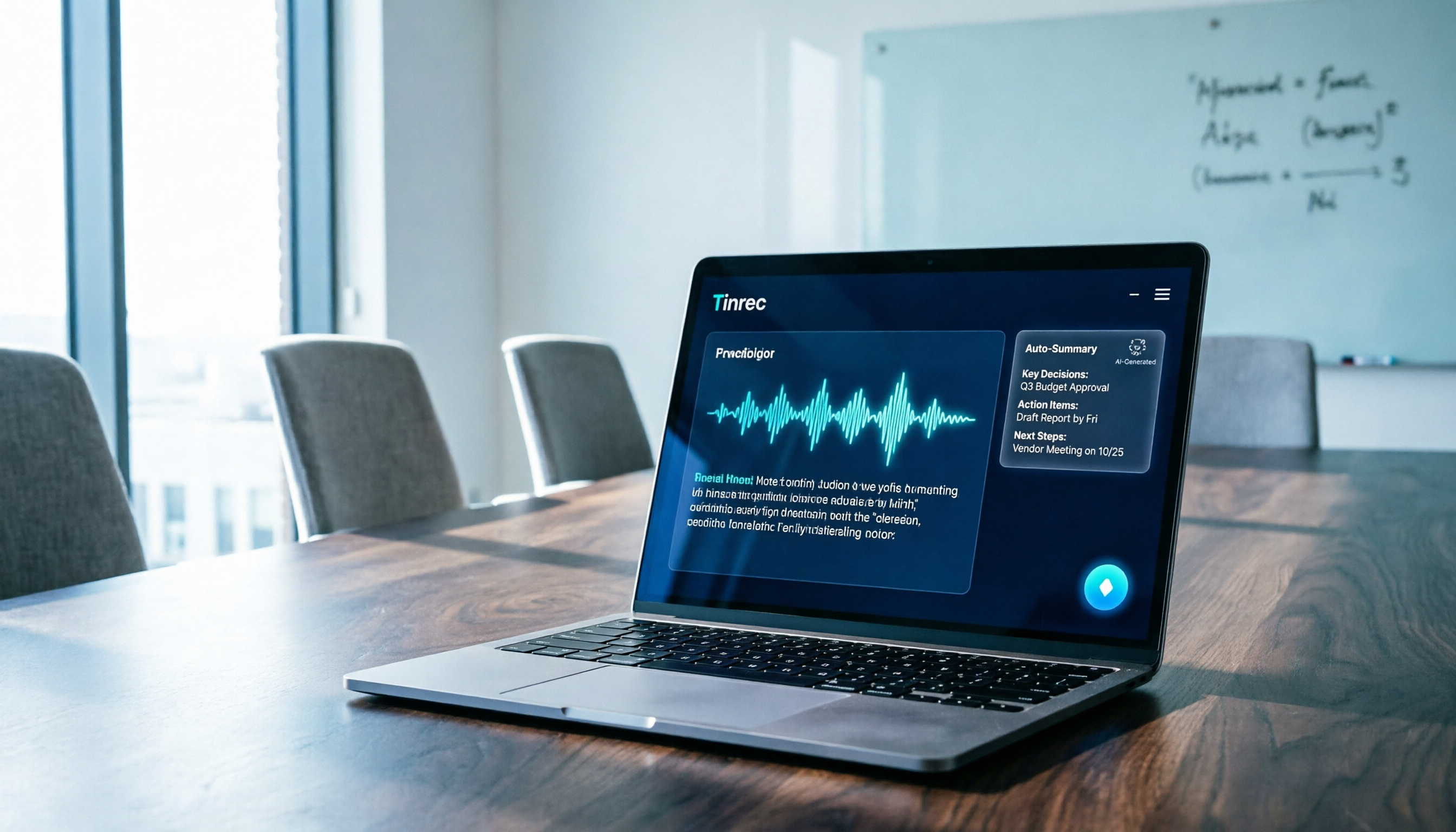
- During a meeting, open the Tinrec desktop app, and it captures your computer's system audio directly—no need to invite a bot to the meeting—and generates a transcript in real time. By the time the meeting ends, AI summaries and action items are already organized, showing who's responsible for what and deadlines at a glance.
- If you have historical recordings, just upload them, and Tinrec will transcribe and generate summaries, chapters, and key points.
- The standout feature is AI Q&A: after recording, you can ask Tinrec, "Who mentioned the budget in the last meeting?" It uses semantic understanding to answer, not just keyword search. Currently, few competitors at this price point offer this feature.
Test data: We tested with a 5-minute Chinese meeting recording (with background noise and multiple speakers). Tinrec's transcription was highly usable, though the exact error rate depends on audio quality, and the company doesn't guarantee a fixed accuracy. Our focus was on testing the AI summary and Q&A usefulness—it indeed quickly pulled out key points and action items.
Pros:
Stop organizing recordings by hand
Upload audio or video and automatically get a transcript, summary, and action items
- No extra hardware needed: Works on your phone and computer, unlike Plaud which requires a separate device.
- Strong AI post-processing: Summaries, action items, Q&A, and report generation turn meeting notes into actionable documents.
- Team collaboration: The team plan centralizes meeting data, with member sharing, seat and usage management, suitable for companies.
Cons:
- The free plan has limits; heavy users need to pay. But for most people with a few meetings a week, the free allowance is usually sufficient.
- The desktop app requires manual recording start; it doesn't automatically join all calendar meetings.
Who it's for: If you frequently need to record meetings, interviews, or classes, don't want to carry an extra device, and want AI to organize key points and collaborate with your team, Tinrec is currently the best fit.
Beyond Tinrec: What Other Options Are There?
Plaud Note: The AI recording hardware that's hot on Dcard. Its strengths are being slim and magnetically attachable to your phone, great for on-the-go recording. But you'll need to spend about USD 159 for the device, and it only includes 300 minutes of transcription per month, with extra fees beyond that. Also, its transcription and AI features rely on the mobile app, so if you need to work on a computer or collaborate with a team, it's more limited. Tinrec requires no extra hardware, and the team plan allows multiple people to share meeting data—something Plaud currently can't do.
Otter.ai: A mature choice for English meetings, with a generous free plan of 300 minutes per month. However, its Chinese support isn't as refined as Tinrec's, and if you're a Taiwan-based user, you might need a more localized Chinese experience. Tinrec has an edge in Chinese meetings, Traditional Chinese interface, and real-time translation.
Pitfall Guide: 3 Common Mistakes When Choosing a Speech-to-Text Tool
Pitfall 1: Focusing only on hardware, ignoring ongoing costs. Many people buy the Plaud recorder because it looks good, but don't account for the monthly subscription and transcription limits. Assess how many minutes you actually need to transcribe each month before deciding between hardware or software.
Pitfall 2: Thinking transcription is the end. If you only use the tool for speech-to-text, you'll still have to organize the key points yourself. Choose a tool with AI summary and Q&A features to truly save time. For example, Tinrec's AI Q&A lets you ask for meeting conclusions directly, which is much faster than manually scanning the transcript.
Pitfall 3: Ignoring cross-platform and team needs. If you need to share meeting notes with colleagues or switch between devices, you must choose a tool that supports multiple platforms and team collaboration. Many hardware recorders store files only on your phone, making sharing a hassle.
Conclusion: Which One Should You Choose?
In summary, if your needs are "quickly organizing meeting notes, not carrying an extra device, and wanting AI to find key points," Tinrec is a more comprehensive choice than Plaud Note. Here are scenario-based recommendations:
- Need Chinese meeting notes + AI summaries → Tinrec (free plan is enough to try)
- Want portable recording and don't mind carrying a small device → Plaud Note (but factor in subscription costs)
- Mainly record English meetings and care about free allowances → Otter.ai (but weaker Chinese experience)
- Need team collaboration and shared meeting data → Tinrec team plan (with member and usage management)
We recommend downloading Tinrec's free version to try it out—no need to spend money on hardware to experience the convenience of AI meeting notes. Upgrade if you find it useful; there's no need to invest thousands upfront on a recorder.
References
- Plaud Taiwan | Official Website | Leading AI Recording Device Brand
- Plaud Note Pro Experience Review AI Notes - 3C forum | Dcard
- A Great Helper at Work | PLAUD NOTE Smart Recording Card Unboxing and Review
- PLAUD Smart Recording | Recording/Audio Accessories - PChome 24h Shopping
- PLAUD NOTE AI Smart Recording Card Trial Report | One-Touch Recording Plus AI Summarization for Daily and Business Use - Mobile01
Turn every recording into actionable outcomes
Get 60 free transcription minutes when you sign in. No credit card required.
Related Reading
You might also like

2026 Hands-On Comparison of 5 AI Transcription Tools: Beyond Vocol, Tinrec Is Better Suited for Taiwan Team Collaboration
Wondering how to use Vocol? This article starts with common misconceptions and compares 5 AI transcription tools in real-world tests, showing how Tinrec turns meetings into trackable team assets with bot-free recording, AI summaries, and team spaces.

2026 Hands-On Comparison of 3 Voice Collaboration Platforms: Is Tinrec Better Than Vocol for Hong Kong Workers?
Looking for info on Vocol? We tested several voice collaboration platforms and found that Tinrec is better suited for Hong Kong workers in terms of Chinese meeting notes, bot-free recording, and team collaboration, saving time and being easy to use.

The Complete Guide to AI Meeting Notes Tools in 2026: Where Is Vocol From? Why Students Should Choose Tinrec
First, to answer 'Where is Vocol from?': Vocol is an AI voice collaboration platform developed by a Taiwanese team. But for students, choosing a tool isn't just about the country of origin—you also need to consider free quotas, AI summarization, and practical applications. Based on my own experience, this article compares Vocol and Tinrec, explaining why Tinrec is better for recording lectures, group discussions, and final exam review.

How to Convert Plaud Recordings to Text in 2026: Export Transcripts and AI Summaries with Tinrec
Struggling to organize your Plaud voice recorder files? Tinrec lets you upload audio, quickly convert it to transcripts, and automatically generate summaries and action items. This guide shows you how to use Tinrec for recordings, online meetings, and interviews, saving you hours of manual transcription and helping your team centralize meeting knowledge.

Best Voice Recorder Apps 2026: Tinrec Beats Hardware for Hong Kong Office Workers
Plaud's latest voice recorder card has sparked discussions, but Hong Kong office workers may not need extra hardware. This article compares Plaud Note, Tinrec, and Otter.ai, analyzing Cantonese accuracy, online meeting support, team collaboration, and cost to show why Tinrec is better for daily office use.

2026 Tested: 3 Meeting Transcription Apps Compared — Which One Captures More Without Bots?
Meeting notes take the most time after the meeting. This comparison reviews two bot-free AI meeting transcription tools, Tinrec and Granola, covering recording methods, input sources, Chinese language experience, post-meeting organization, and team collaboration to see which suits Taiwan users better.

2026 Tested: 4 Meeting Transcription Tools Compared — Tinrec Is the Top Choice for Chinese Meetings
We tested Otter.ai, Notta, Granola, and Tinrec across four key areas: Chinese accuracy, bot-free recording, post-meeting organization, and team collaboration. Find out which meeting transcription tool is best for Taiwanese office workers.

How to Take Meeting Minutes in 2026? 5 Steps to Quickly Organize with NotebookLM vs Tinrec
Tired of working overtime because of meetings? Using the wrong tool only makes it worse. This article compares NotebookLM and Tinrec, teaching you how to use the right tool to save time on meeting minutes.

6 AI Meeting Note Tools Tested and Compared in 2026: Which One Should Taiwan Office Workers Try First?
This article compares 6 AI meeting note tools, including Tinrec, Otter.ai, Granola, PLAUD Note, Notta, and the free inFin, covering bot-free recording, Chinese recognition, pricing plans, and team collaboration, to help you quickly find the best fit.