
Turn recordings into transcripts and summaries in minutes
Upload audio or video for multilingual transcription, AI notes, and action items
What is the VOCOlinc Smart Plug App? Quick Overview
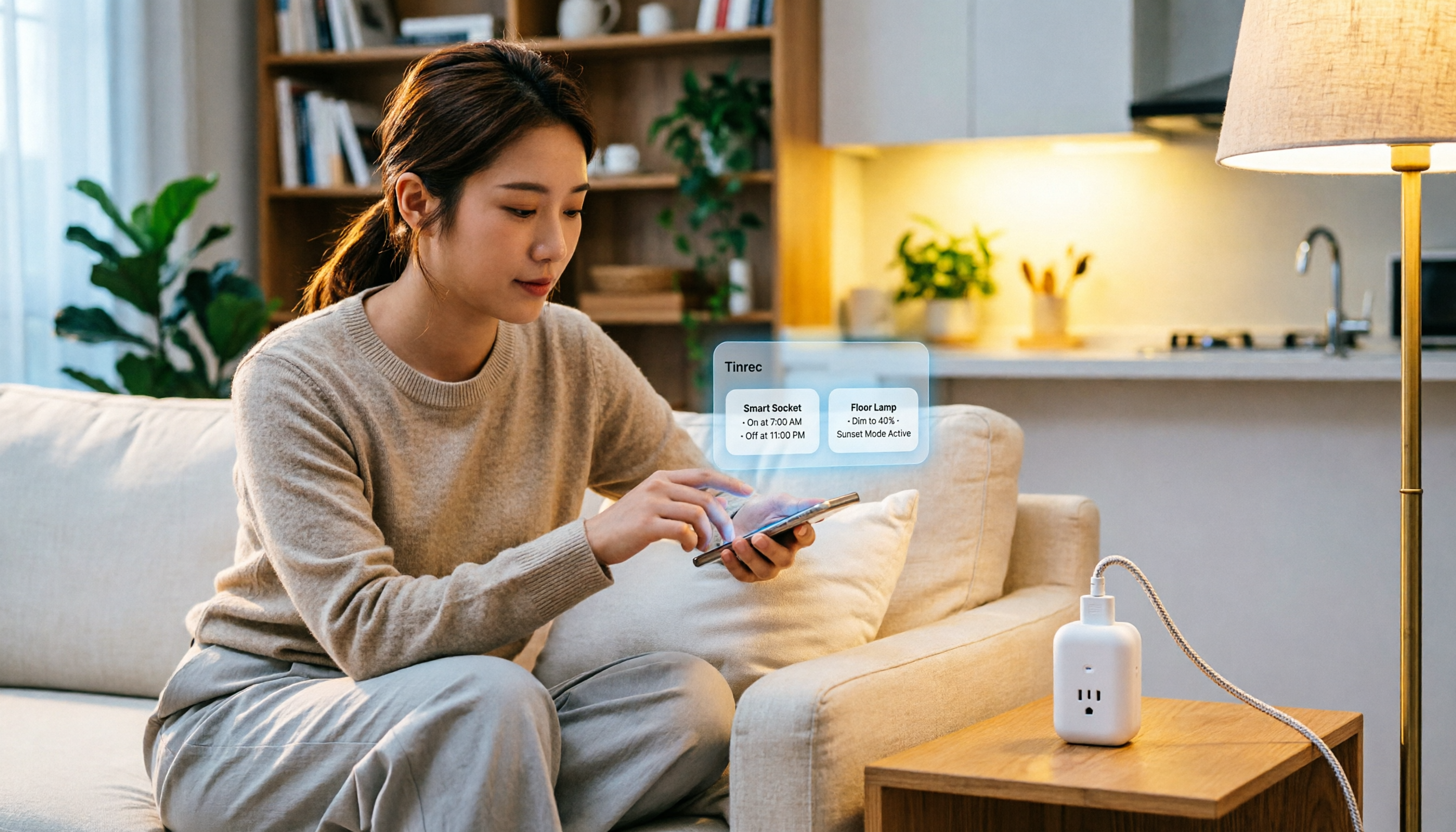
The VOCOlinc Smart Plug (VP5X) is a smart plug that supports Apple HomeKit, Amazon Alexa, and Google Assistant, with a maximum load of 1800W (15A) and TUV/FCC certification. Through the VOCOlinc App, you can control it remotely, set schedules, group control, and update firmware, and it also works with Apple Home.
Core Features and Highlights
- Remote Control: Turn appliances on/off from anywhere; HomeKit remote access requires an Apple TV or HomePod as a hub.
- Scheduling and Timers: Set timed on/off, auto-restart (e.g., for a router).
- Groups and Scenes: Group multiple plugs or bulbs together for one-tap control.
- Voice Control: Supports Siri, Alexa, and Google Assistant.
- Firmware Updates: Keep up to date via the VOCOlinc App.
VOCOlinc App vs Apple Home: Real-World Control Experience Comparison
| Feature | VOCOlinc App | Apple Home |
|---|---|---|
| Initial Setup | Must pair via VOCOlinc App first | Auto-added after pairing |
| Scheduling and Timers | Built-in schedules, countdown, auto-restart | Automations available, but more basic |
| Group Control | Can group multiple devices | Can group with other HomeKit accessories |
| Remote Control | Requires VOCOlinc account login | Requires Apple hub |
| Firmware Updates | Only via VOCOlinc App | Not supported |
| Voice Assistant | No direct voice; requires linking Alexa/Google | Native Siri integration |
Overall, initial setup and firmware updates must be done through the VOCOlinc App; for daily on/off, Siri voice, and home automations, Apple Home is more convenient. Using both together maximizes the plug's functionality.
Usage Guide: Setup and Scheduling Steps
Step 1: Download the VOCOlinc App
Search for "VOCOlinc" on the App Store or Google Play and install it. Android requires 4.3 or later; iOS recommends the latest version.
Stop organizing recordings by hand
Upload audio or video and automatically get a transcript, summary, and action items
Step 2: Connect to 2.4GHz Wi-Fi
Plug the smart plug into a power outlet and make sure your phone is connected to a 2.4GHz Wi-Fi network. Open the VOCOlinc App, tap "+" to add a device, and select Smart Plug.
Step 3: Pair and Name
Follow the in-app instructions to complete pairing, name the plug, and assign it to a room. If you want to integrate with other smart devices, you can set that up here as well.
Step 4: Add to Apple Home
If you use an iPhone, after pairing you can scan the HomeKit code or have the app guide you to add it to the Home app. Once added, you can control it with Siri.
Step 5: Set Schedules
In the VOCOlinc App, select the plug, go to "Schedule" or "Timer," and add time points and repeat rules. You can also set auto-restart, such as restarting your router every day at a specific time.
Step 6: Create Scenes and Groups
Add multiple VOCOlinc devices to the same group, or create scenes in Apple Home, such as "Good Night" to turn off all plugs at once.
FAQ
Q: Do I have to use the VOCOlinc App with the VOCOlinc Smart Plug? A: Initial setup and firmware updates require the VOCOlinc App, but after that you can control it via Apple Home, Alexa, or Google Home.
Q: Why does HomeKit remote control require an Apple TV or HomePod? A: HomeKit remote control requires an Apple hub at home to relay commands; without a hub, you can only control it within your home Wi-Fi range.
Q: Which voice assistants are supported? A: It supports Siri (via HomeKit), Amazon Alexa, and Google Assistant, allowing you to turn appliances on/off by voice.
Q: What is the maximum load? A: The maximum is 1800W (15A), suitable for most household appliances, but do not overload it.
Q: Does it only support 2.4GHz Wi-Fi? A: Yes, during pairing, your phone and the plug must be on a 2.4GHz Wi-Fi network; 5GHz is not supported.
Q: How do I update the firmware? A: In the VOCOlinc App, select the device; if a new firmware is available, a prompt will appear, and you can follow the steps to update.
References
- VOCOlinc Smart WiFi Plug- VP5X
- VOCOlinc Smart Plug review: Powerful HomeKit control at a fair price | AppleInsider
- VOCOlinc, a smart home devices brand. – © 2025 VOCOlinc
- HomeKit Weekly: Three reasons to consider VOCOlinc smart plugs - 9to5Mac
- Review: VOCOlinc SmartBar is best deal for a HomeKit smart plug | AppleInsider
Turn every recording into actionable outcomes
Get 60 free transcription minutes when you sign in. No credit card required.
Related Reading
You might also like

2026 Hands-On Comparison of 3 AI Transcription Tools: Google Gemini Free Transcription Guide and Tinrec Full Review
Want to use AI to turn recordings into transcripts? Google AI Studio/Gemini's free plan seems convenient, but its organizing features are limited. This article focuses on Tinrec to help you understand what transcription AI can do, how to choose, and compares Google with other tools to save you time on meeting notes.

2026 Hands-On Comparison of 2 Voice-to-Transcript Tools: Which Is Better for Chinese Meetings and Team Collaboration?
A hands-on comparison of Tinrec and Otter.ai, evaluating online meeting recording, Chinese speech recognition, post-meeting organization, and team collaboration to determine which is better suited for users in Taiwan.

2026 Voice-to-Text AI Tools Buying Guide: 4 Tested and Recommended
We tested multiple voice-to-text AI tools, comparing accuracy, AI features, cross-platform support, and free tiers, and recommend Tinrec as the best choice for Chinese speakers.

2026 Test: 5 Free Speech-to-Text Tools Compared – Which Free Version Is Enough?
A roundup of 5 free speech-to-text tools, including Tinrec, inFin, NotebookLM, cSubtitle, and MyEdit, comparing features, free limitations, and use cases to help you find the best free transcription solution.

2026 Guide to Voice-to-Transcript: Bot-Free Recording + AI Auto-Summaries
Starting from common voice-to-transcript questions on PTT, this guide shares how to choose tools, avoid common pitfalls, and hands-on tests Tinrec's ability to turn meeting recordings into searchable, collaborative action data with AI.

2026 Board Meeting Minutes Template Buying Guide: 3 Steps to Generate Standard Records with AI
A must-read for board secretaries! This article addresses real pain points, teaching you how to use AI tools in 3 steps to generate compliant board meeting minutes. Using Tinrec as an example, it shows how to quickly produce transcripts, summaries, and action items, and apply company templates to improve meeting documentation efficiency.

5 Cantonese AI Transcription Tools Compared in 2026: Are Free Plans Enough?
Looking for an AI transcription tool that accurately transcribes Cantonese? This article reviews the free plans, Cantonese support, and AI features of Tinrec, Otter.ai, Notta, TurboScribe, and Google Docs to help you choose the best option.

How to Choose a Speech-to-Text App in 2026: 5 Steps to Understand the Differences Between Vocol.ai and Tinrec
Looking for a speech-to-text tool? This article walks you through 5 steps to compare Vocol.ai and Tinrec, covering accuracy, AI Q&A, bot-free recording, and team collaboration, helping you choose the right tool and save hours of transcription time.

Best Online Transcription Tools in 2026: We Tested 5, and Tinrec Wins for Chinese Meetings
Still manually transcribing meeting recordings? This article tests 5 online transcription tools, including Tinrec, Vocol.ai, Otter.ai, and Notta, comparing Chinese meeting support, free tiers, AI summaries, and team collaboration to help you choose the best fit for your workflow.