

Turn recordings into transcripts and summaries in minutes
Upload audio or video for multilingual transcription, AI notes, and action items
The Complete Guide to AI Transcription in 2026: How Tinrec Replaces NotebookLM
Many people think that organizing transcripts is as simple as opening NotebookLM or ChatGPT and uploading the audio. But the result is either a summary without a full transcript, or a transcript so messy that you have to listen to the audio again to fix it. The problem lies in the workflow: these tools mix "transcription" and "organization" together, but what you need is to first turn the audio into a usable transcript, then let AI organize the key points. Tinrec was designed to solve this workflow issue.
Why Are People Looking for NotebookLM Alternatives?
NotebookLM is a free AI tool from Google that many students use to upload audio files and quickly generate summaries and answer questions. But it has several clear limitations: first, it requires manual upload of audio files and cannot transcribe in real time while recording; second, the transcript is hidden in the source section, requiring you to click in and copy it, and the AI may polish the text, so it's not a verbatim transcript; finally, it lacks the ability to automatically extract to-do items or action lists, so task assignments after group discussions still require manual organization. If you need to generate transcripts in real time during class, want more accurate verbatim records, or want AI to directly list action items, NotebookLM falls short. This is where Tinrec offers a more complete alternative.
Tinrec vs NotebookLM: What's Different in Core Experience?
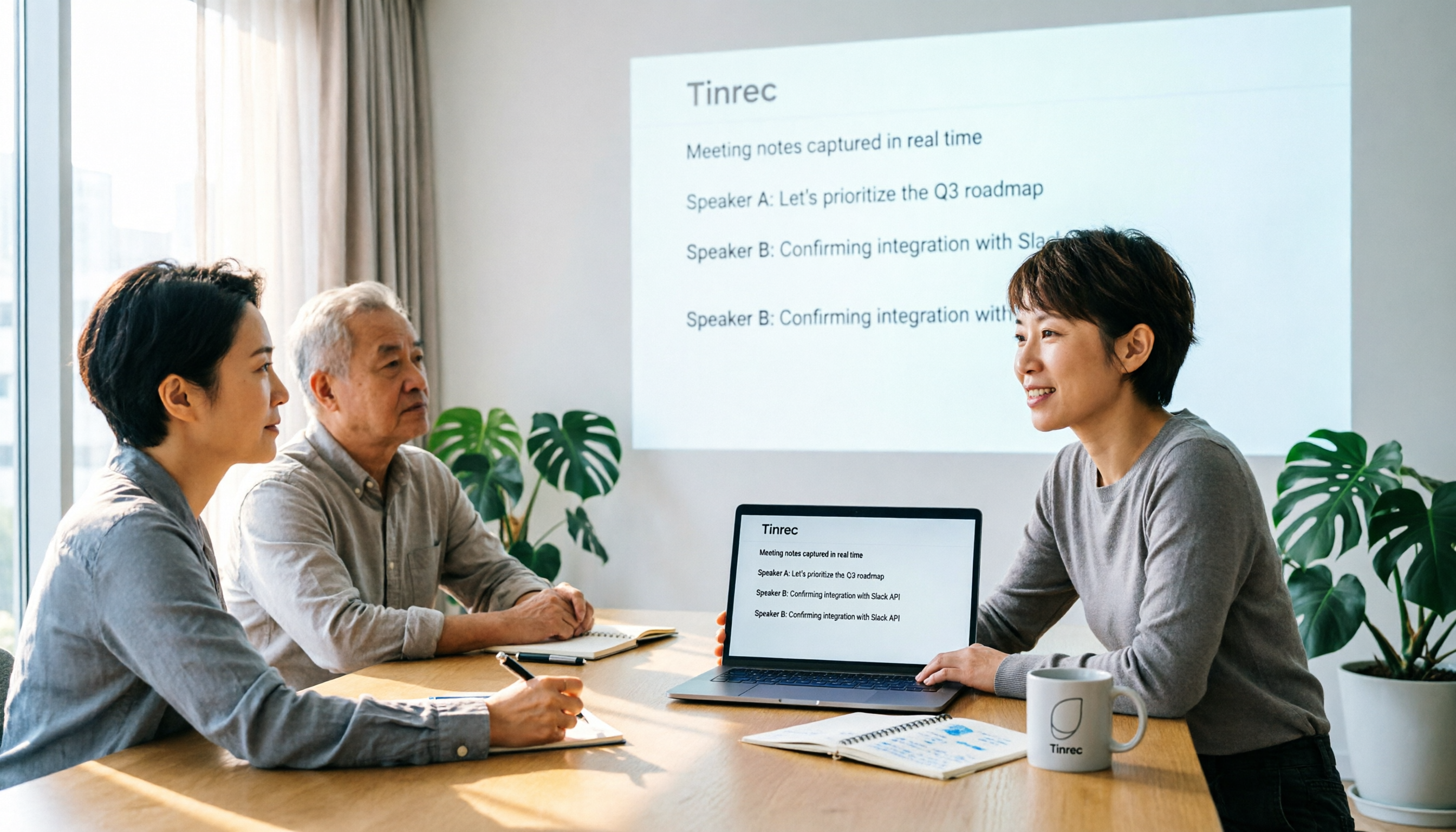
Real-time audio-to-text: With Tinrec, you can record and transcribe simultaneously during class or meetings, with text appearing on screen in real time, so the transcript is ready the moment class ends; NotebookLM requires you to save the file first and then upload it, making it unsuitable for real-time recording scenarios.
Transcript accuracy and searchability: Tinrec preserves the original speech content and supports clicking on text to play the corresponding audio for verification; NotebookLM's AI polishing may alter the original wording, which is risky for interviews or law courses that require precise quotes.
AI post-processing capabilities: Tinrec not only provides transcripts but also automatically generates summaries, chapters, key points, and to-do items, and allows you to ask follow-up questions about the meeting content; NotebookLM mainly offers summaries and Q&A, and you have to organize to-do items yourself.
Cross-platform and team collaboration: Tinrec has mobile apps, a web version, and a desktop version, and offers team spaces for group members to share meeting materials and manage permissions; NotebookLM is primarily web-based and lacks team management and usage analytics.
Overview of Tinrec's Core Features
Real-time recording to text: Open Tinrec, press the record button, and text appears in real time. During class, you can glance at the screen while listening to ensure you don't miss key points, and copy the transcript as soon as class ends.
AI chat queries: This is my most-used feature. After recording a two-hour lecture, I can ask Tinrec, "What were the professor's main points?" or "What formulas are likely to be on the exam?" It answers based on the transcript content, so I don't have to manually search through dozens of pages of text.
Stop organizing recordings by hand
Upload audio or video and automatically get a transcript, summary, and action items
To-do extraction: After group discussions, Tinrec automatically organizes "who is responsible for what and when it's due," which you can directly paste into the group chat, eliminating the need to assign tasks from memory after the meeting.
Multi-format export and third-party integrations: You can export organized meeting minutes to Word or PDF, or sync them to Google Docs or Notion, making it easy to cite in final reports.
Team spaces: Project groups can create a team space where all meeting recordings, transcripts, and to-dos are stored centrally, and new members can access historical data, preventing files from being scattered across individual phones.
Real-World Use Cases
Lecture recording: For a two-hour class, Tinrec instantly converts it to a transcript and generates a summary. Before finals, you only need to review the key points and search for keywords, without having to listen to the entire recording again.
Group discussions: For online meetings, use Tinrec's desktop version to record system audio directly, without needing to invite a bot to the meeting. After the meeting, it automatically generates a to-do list, making it clear who needs to do what.
Interviews or research: When conducting user or expert interviews, upload the audio file, and Tinrec quickly converts it to a transcript and uses AI Q&A to identify key insights, saving time on manual transcription.
Personal idea notes: When you suddenly think of a thesis topic or creative idea, record a quick voice memo, and Tinrec converts it to text that you can search later, so you don't have to worry about forgetting.
What to Look for When Choosing an Audio-to-Text Tool
Real-time transcription support: When choosing a tool, first check if it can transcribe while recording, because you don't have time to upload files after class or meetings. Tinrec's real-time transcription has a delay of less than one second, providing a smooth experience.
Depth of AI organization: Tools that only provide transcripts are not enough; ideally, they should automatically summarize, extract to-dos, and support Q&A. Tinrec excels in this area, acting like a tireless meeting assistant.
Cross-platform and team collaboration: If you often work in groups, it's important that the tool supports multi-user sharing and centralized management. Tinrec's team spaces allow members to share recordings and transcripts, and also provide usage and activity logs.
Pricing suitable for students: Tinrec offers a free plan with basic credits to experience all core features; the Pro plan has monthly and annual options, costing a bit more than a bubble tea, but the time saved is definitely worth it.
Language support and accuracy: Tinrec supports Chinese, mixed Chinese-English, and even real-time translation. In practice, as long as the recording is clear, the transcription quality is quite good; for accents or background noise, it's advisable to verify the original text.
Conclusion: Is Tinrec Worth Trying?
If you're looking for a tool that can automatically turn lecture recordings and group discussions into transcripts and key summaries, Tinrec is currently one of the few options that combines real-time transcription, AI post-processing, and team collaboration. Especially for students, the free plan lets you experience core features without spending money upfront. I recommend downloading the free version of Tinrec and recording a class to see how it saves you time. I've used it for an entire semester and have already recommended it to three classmates; it got me through midterms and finals.
References
- How to Use AI for Meeting Minutes? How to Organize Meeting Transcripts? | AI Voice-to-Text Tutorial | 104 Career Force
- Get Meeting Minutes Done! How to Use AI Voice-to-Text? Gemini Notebook, Gemini, EchoScript Operation Guide | 104 Career Force
- Meeting Ink - 2026 AI Meeting Minutes Tool Test | 7 Voice-to-Text and Summary Speed Comparison | Meeting Ink - AI Meeting Minutes Assistant, Automatic Transcription and Summary
- EP10 | Boss Wants Meeting Minutes: How to Choose AI Transcript Tools? – Knowledge Nomad Studio
- No Time Limit! 3 Free AI Transcript Tools, Highly Recommended! AI Voice Notes for Meeting Minutes, Presentations, Mind Maps | 104 Career Force
Turn every recording into actionable outcomes
Get 60 free transcription minutes when you sign in. No credit card required.
Related Reading
You might also like

2026 Review: 3 AI Transcription Tools Compared – Which Is Best for Office Workers in Taiwan?
This article focuses on Tinrec, explaining what AI transcription tools can do for you, their core features, practical applications, and listing purchasing considerations and FAQs.

Best AI Transcription Tools in 2026: Tested 4 Options, This Free Version Is Best for Meeting Minutes
Looking for a free AI transcription tool but only getting a wall of text? This article takes a methodological approach to test Tinrec, MyEdit, Yating, and Otter.ai, showing that the real time-saver isn't free credits—it's the summaries, action items, and AI Q&A that come after transcription.

Tinrec vs Notta 2026: 4-Dimension Comparison – Which Is Best for Hong Kong Professionals?
We tested Tinrec and Notta side by side, comparing Cantonese transcription, meeting summaries, team collaboration, and AI Q&A to help you pick the most time-saving voice-to-text tool.

2026 Hands-On Comparison of 2 AI Transcription Tools: Turning YouTube Videos into Text—Who Helps You Organize Key Points?
Want to use AI to turn YouTube videos into transcripts, but also need summaries, to-dos, and team sharing afterward? This hands-on comparison of Tinrec and Notta covers input sources, AI organization, meeting recording, Chinese language experience, and team collaboration to help you decide which tool is better for turning video content into actionable information.

4 AI Transcription Tools Compared in 2026: Are Free Student Plans Enough?
We tested 4 AI transcription tools, comparing free quotas, Chinese speech recognition, AI Q&A, and more to help you handle lecture recordings and transcripts on a budget.

2026 Tinrec Voice-to-Text Tutorial: No Bot Recording + AI Auto-Generated Meeting Minutes
Struggling with meeting transcripts? Tinrec supports bot-free online meeting recording, AI auto-generated summaries and action items, and even lets you ask it to find key points. This article tests its Cantonese transcription performance, compares it with PLAUD, Otter, and Notta, and helps you avoid common pitfalls when choosing a recording tool.

Tinrec vs Notta 2026: 5-Dimension Comparison for Chinese Meeting Minutes
Compare Tinrec and Notta across 5 dimensions: recording, post-transcription processing, Chinese support, team collaboration, and pricing, to find the best voice-to-meeting-minutes tool for Chinese meetings.

Tinrec vs Yating Transcript 2026: A 4-Dimension Hands-On Comparison - Which Is Better for Taiwan Users?
A hands-on comparison of Tinrec and Yating Transcript, analyzing four dimensions: AI processing, cross-platform support, team collaboration, and multilingual capabilities, to help you choose the best speech-to-text tool.
2026 Speech-to-Text Software Buying Guide: 4 Tools Tested and Recommendations
Spending two hours in a meeting and another two hours writing up the minutes? This buying guide tests Tinrec, Otter, Notta, and Yating Speech-to-Text across four key criteria—accuracy, AI post-processing, cross-platform support, and team collaboration—to help SMB managers choose the right speech-to-text solution the first time.