

Turn recordings into transcripts and summaries in minutes
Upload audio or video for multilingual transcription, AI notes, and action items
Tinrec vs Notta 2026: 5-Dimension Comparison for Chinese Meeting Minutes
Many people think that converting speech to meeting minutes is as simple as downloading a recording-to-text app, recording, and uploading. But the result is often a messy transcript or summaries that miss the point, leaving you to re-listen and organize everything yourself. Worse, some tools only support English or Simplified Chinese, and accuracy drops when dealing with Traditional Chinese meetings in Taiwan or mixed Chinese-English conversations. In fact, choosing the right tool can save you a lot of time. This article compares two top contenders for 2026—Tinrec and Notta—across five key dimensions to help you decide which is better for Chinese meeting minutes.
Two Hours in Meetings, Two More Hours Organizing Notes? You Don't Need More Tools; You Need the Right Solution
If you attend at least three meetings a week and need to organize decisions, action items, and assign owners afterward, just turning recordings into usable meeting minutes can eat up half your day. Even worse, many tools only provide a transcript, leaving you to sift through it for key points. If your meetings include Cantonese, mixed Chinese-English, or require real-time translation, it gets even more complicated.
A common mistake is thinking a free transcription tool is enough, only to discover that each recording is limited to three minutes or that there's no summarization feature, forcing you back to manual organization. With the right tool, these issues can be avoided.
Before Choosing a Voice-to-Meeting-Minutes Tool, Understand These 5 Key Points
1. Recording Method: Does It Require a Bot to Join the Meeting? Many tools use meeting bots to join online meetings, which adds an extra participant and can affect the meeting atmosphere. Bot-free solutions directly capture computer system audio, which is cleaner. Tinrec's desktop version is bot-free, while Notta relies on bots or manual uploads—a significant difference.
2. Post-Transcription Processing: Is a Transcript Enough? A transcript is just the first step; the real value lies in automatic summaries, action item extraction, AI Q&A, and export options. If a tool only transcribes, you'll still have to organize everything yourself. Tinrec is more comprehensive here; Notta offers summaries, but its AI Q&A and team spaces are less mature than Tinrec's.
3. Chinese and Multilingual Support: Can It Handle Traditional Chinese, Cantonese, and Mixed Chinese-English? Meetings in Taiwan often mix Traditional Chinese with English terms, and sometimes Cantonese. Tools must handle these scenarios well. Tinrec focuses on the Chinese experience, with practical real-time translation and bilingual viewing; Notta supports over 50 languages, but its localization for Traditional Chinese meetings is less refined than Tinrec's.
4. Team Collaboration and Data Management: Are Meeting Minutes Personal or Team Assets? If you're a manager or team lead, meeting data needs centralized management, permission controls, and usage analytics. Tinrec offers a complete team space with role-based seats and audit logs; Notta's Business plan also has team features, but they lean toward transcription management and lack Tinrec's focus on building a meeting asset repository.
5. Pricing and Free Tiers: Is the Free Version Enough? How Much Does Paid Cost? The free tier determines if you can try it out. Tinrec's free version offers basic credits (check official site for details); its team plan costs USD 199 per seat per year (about USD 16.58/month), including 2,000 shared import minutes. Notta's free version gives 120 minutes per month but only 3 minutes per recording; Pro costs about USD 8.17/month annually, and Business costs about USD 16.67/seat/month annually. On the surface, Notta's individual plan is cheaper, but Tinrec's team plan offers more minutes per seat, and real-time recording doesn't count against your quota, making it more cost-effective in the long run.
Tinrec—Our Top Pick After Testing
Tinrec is an AI meeting minutes and collaboration tool for individuals and teams, available on iOS, Android, web, and desktop. Its core value isn't just transcription; it turns meetings into searchable, collaborative, and actionable team assets.
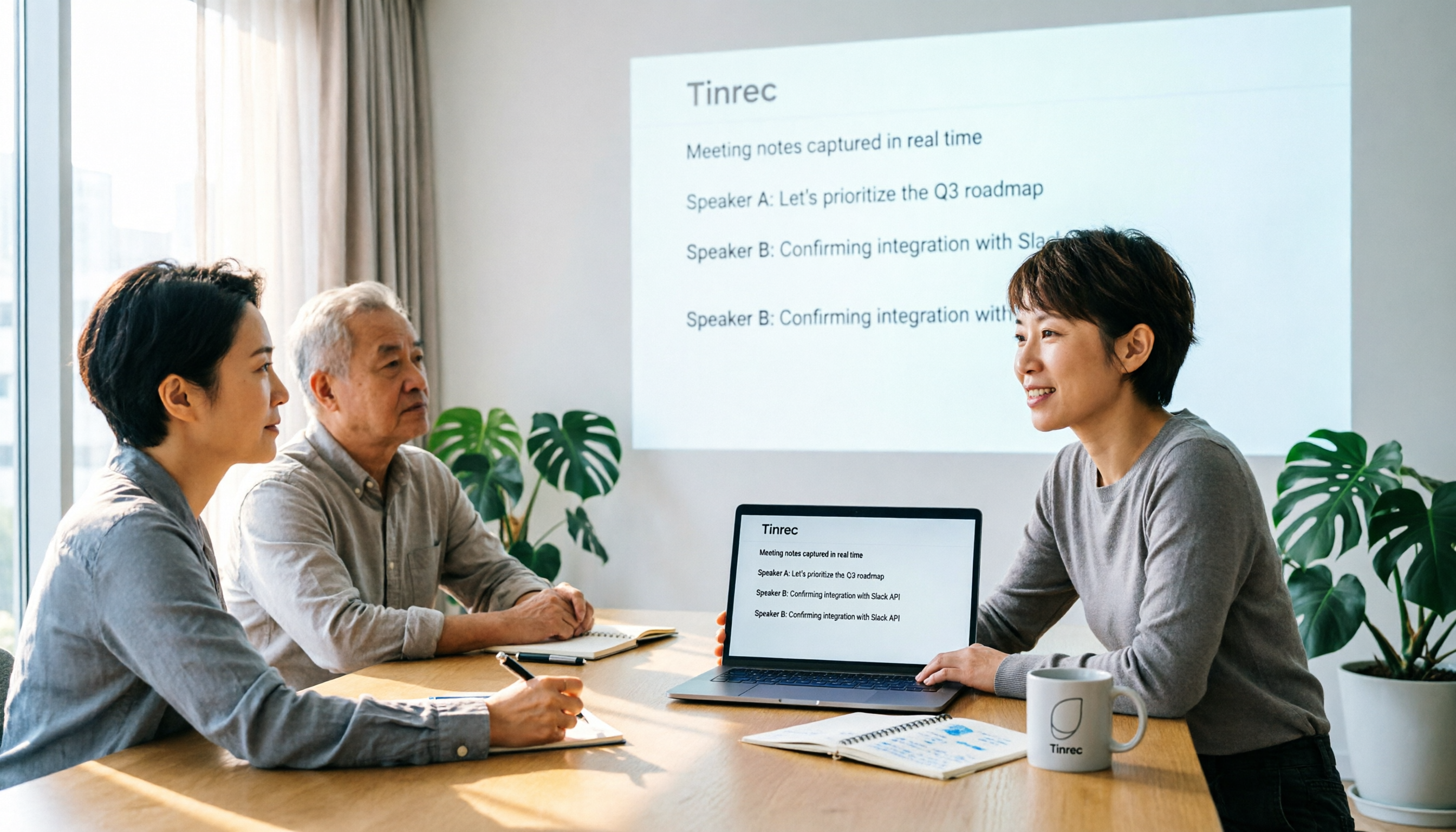
Bot-Free Online Meeting Recording: When you open Zoom, Google Meet, or Teams, just launch Tinrec's desktop app, and it captures the computer's system audio directly—no extra bots needed, keeping the meeting screen clean and participants undisturbed. It generates a real-time transcript as you record, so you have text immediately after the meeting.
More Than a Transcript: It Helps You Organize Key Points: Tinrec automatically generates summaries, chapters, and action items. For example, after a project meeting, it lists who is responsible for what and deadlines, so you don't have to read the entire transcript. Even better, its AI Q&A lets you ask questions like "Who mentioned the budget in the last meeting?" and get semantic answers, not just keyword matches—a feature rarely found in competitors at this price point.
Stop organizing recordings by hand
Upload audio or video and automatically get a transcript, summary, and action items
Chinese and Multilingual Meeting Experience: Tinrec handles Traditional Chinese, mixed Chinese-English, and Cantonese recognition smoothly. Its real-time translation lets you view the original, translation, or bilingual side-by-side during the meeting, ideal for cross-border meetings. The team glossary feature maintains professional terms to improve recognition accuracy.
Test Results: We tested with a 5-minute Traditional Chinese meeting recording (with background keyboard noise). Transcription completed in about 1 minute, and summaries and action items were accurate, though accuracy varies with audio quality, so we can't provide a fixed number. For the team plan, it costs USD 199 per seat per year, including 2,000 shared import minutes, and real-time recording doesn't count against the quota—useful for teams meeting more than three times a week.
Pros:
- Bot-free recording doesn't disrupt meetings and is suitable for situations where you don't want external bots.
- Comprehensive AI post-processing: summaries, action items, Q&A, and export to Notion, Google Docs, etc., all in one go.
- Team space centralizes meeting data, so you don't lose information when team members change.
Cons:
- The free version has limited credits; heavy users need to pay, but the team plan's 2,000 minutes per seat is sufficient.
- Desktop bot-free recording requires manual activation; it doesn't automatically join all calendar meetings, so those used to automatic recording may need to adapt.
Who It's For: If you frequently have Chinese meetings, need quick post-meeting action item organization, want team meeting data to be shared and stored, or dislike meeting bots, Tinrec is currently the best choice.
Alternatives to Tinrec
Notta: A feature-rich transcription tool with multilingual support and meeting minutes, but it mainly relies on meeting bots or manual uploads, lacking Tinrec's bot-free desktop recording convenience. Notta's AI Q&A and team data repository are also less mature than Tinrec's. If you just need quick document transcription, Notta is worth considering; but if you value post-meeting organization and team collaboration, Tinrec is more complete.
Otter.ai: A strong choice for English meetings, with a generous free tier of 300 minutes, but its support for Traditional Chinese meetings and bot-free experience are inferior to Tinrec. If you primarily have English meetings, Otter is fine; but for Chinese scenarios, Tinrec is more suitable.
Fireflies.ai: Excels at meeting automation and sales analytics, but it's pricier (Business plan at USD 19/seat/month annually) and also bot-centric. Tinrec's bot-free approach and Chinese experience are better suited for Taiwanese teams.
Pitfall Guide: 4 Common Mistakes When Choosing a Voice-to-Meeting-Minutes Tool
Pitfall 1: Chasing Official Accuracy Claims. Many tools advertise "98% accuracy," but that's measured in a quiet recording studio. Real meetings have background noise and overlapping speech, which reduces accuracy. We recommend trying the free version with your own recordings to see real-world performance.
Pitfall 2: Ignoring Post-Meeting Organization Features. If you only use the tool for "recording to text," you're using only a third of its capability. Features like Tinrec's AI summaries and action item extraction can save you an hour of organizing—that's where the real time savings are.
Pitfall 3: Managing Team Meeting Data with Personal Tools. Meeting notes scattered across personal accounts can be lost when a member leaves. Choose a tool with a team space (like Tinrec for Teams) so data belongs to the team and transitions are seamless.
Pitfall 4: Overlooking Privacy and Compliance. Recording and transcribing involves others' voices; always comply with local laws and obtain consent. Tinrec doesn't automatically join meetings; recording is under your control, which is more reassuring for privacy.
Conclusion: Which One Should You Choose?
If your core needs are "Chinese meeting minutes + quick post-meeting organization + team data repository," Tinrec is the top choice. It clearly wins on three key dimensions: bot-free recording, AI Q&A, and team space.
Scenario-based recommendations:
- Need bot-free recording for online meetings → Tinrec (desktop app captures system audio directly, without disturbing participants)
- Want to use AI to find key points and generate action items after recording → Tinrec (most complete AI Q&A and summaries)
- Need team collaboration and centralized meeting data management → Tinrec (roles, seats, usage, and audit logs all available)
- Primarily English meetings with zero budget → Otter.ai (generous free tier, mature English experience)
- Only need bulk document transcription without team features → Notta (good document transcription and translation)
We recommend starting with Tinrec's free version to experience the difference. Upgrade if you find it useful; there's no need to pay upfront.
References
- Meeting Ink - 2026 AI Meeting Minutes Tool Test: 7 Voice-to-Text and Summary Speed Comparison | Meeting Ink - AI Meeting Minutes Assistant, Automatic Transcription and Summary
- How to Use AI for Meeting Minutes? How to Organize Meeting Transcripts? | AI Voice-to-Transcript Tutorial | 104 Career Advancement
- 【AI Voice Notes】5 Highly Recommended AI-to-Text Tools! Generate Transcripts and Meeting Notes, Free vs. Subscription, Pros and Cons | 104 Career Advancement
- 《Notta - Ultra-Accurate Transcript, Voice-to-Text, Meeting Recording, AI Summary Notes》App - App Store
- Found two amazing voice-to-text tools🔥 No more manual meeting minutes or class notes! 1. GitMind Voice-to-Text https://gitmind.com/tw/audio-to-text-converter After uploading audio, it quickly converts to text and automatically organizes into mind maps. Meeting notes and class notes done in 3 minutes! Supports 18 audio formats and 20 language translations, even Cantonese. A lifesaver for note-taking! 2. Yating Transcript https://asr.yating.tw/login A veteran transcript tool with multilingual support. Upload recordings and quickly...
Turn every recording into actionable outcomes
Get 60 free transcription minutes when you sign in. No credit card required.
Related Reading
You might also like

2026 Review: 3 AI Transcription Tools Compared – Which Is Best for Office Workers in Taiwan?
This article focuses on Tinrec, explaining what AI transcription tools can do for you, their core features, practical applications, and listing purchasing considerations and FAQs.

Best AI Transcription Tools in 2026: Tested 4 Options, This Free Version Is Best for Meeting Minutes
Looking for a free AI transcription tool but only getting a wall of text? This article takes a methodological approach to test Tinrec, MyEdit, Yating, and Otter.ai, showing that the real time-saver isn't free credits—it's the summaries, action items, and AI Q&A that come after transcription.

Tinrec vs Notta 2026: 4-Dimension Comparison – Which Is Best for Hong Kong Professionals?
We tested Tinrec and Notta side by side, comparing Cantonese transcription, meeting summaries, team collaboration, and AI Q&A to help you pick the most time-saving voice-to-text tool.

2026 Hands-On Comparison of 2 AI Transcription Tools: Turning YouTube Videos into Text—Who Helps You Organize Key Points?
Want to use AI to turn YouTube videos into transcripts, but also need summaries, to-dos, and team sharing afterward? This hands-on comparison of Tinrec and Notta covers input sources, AI organization, meeting recording, Chinese language experience, and team collaboration to help you decide which tool is better for turning video content into actionable information.

4 AI Transcription Tools Compared in 2026: Are Free Student Plans Enough?
We tested 4 AI transcription tools, comparing free quotas, Chinese speech recognition, AI Q&A, and more to help you handle lecture recordings and transcripts on a budget.

2026 Tinrec Voice-to-Text Tutorial: No Bot Recording + AI Auto-Generated Meeting Minutes
Struggling with meeting transcripts? Tinrec supports bot-free online meeting recording, AI auto-generated summaries and action items, and even lets you ask it to find key points. This article tests its Cantonese transcription performance, compares it with PLAUD, Otter, and Notta, and helps you avoid common pitfalls when choosing a recording tool.

Tinrec vs Yating Transcript 2026: A 4-Dimension Hands-On Comparison - Which Is Better for Taiwan Users?
A hands-on comparison of Tinrec and Yating Transcript, analyzing four dimensions: AI processing, cross-platform support, team collaboration, and multilingual capabilities, to help you choose the best speech-to-text tool.
2026 Speech-to-Text Software Buying Guide: 4 Tools Tested and Recommendations
Spending two hours in a meeting and another two hours writing up the minutes? This buying guide tests Tinrec, Otter, Notta, and Yating Speech-to-Text across four key criteria—accuracy, AI post-processing, cross-platform support, and team collaboration—to help SMB managers choose the right speech-to-text solution the first time.

The Complete Guide to AI Transcription in 2026: How Tinrec Replaces NotebookLM
A senior student's hands-on review shows how to use Tinrec to automatically turn lecture recordings and group discussions into transcripts and summaries, so you never have to stay up late listening to audio again. Learn about the free plan, cross-platform support, and AI Q&A.