
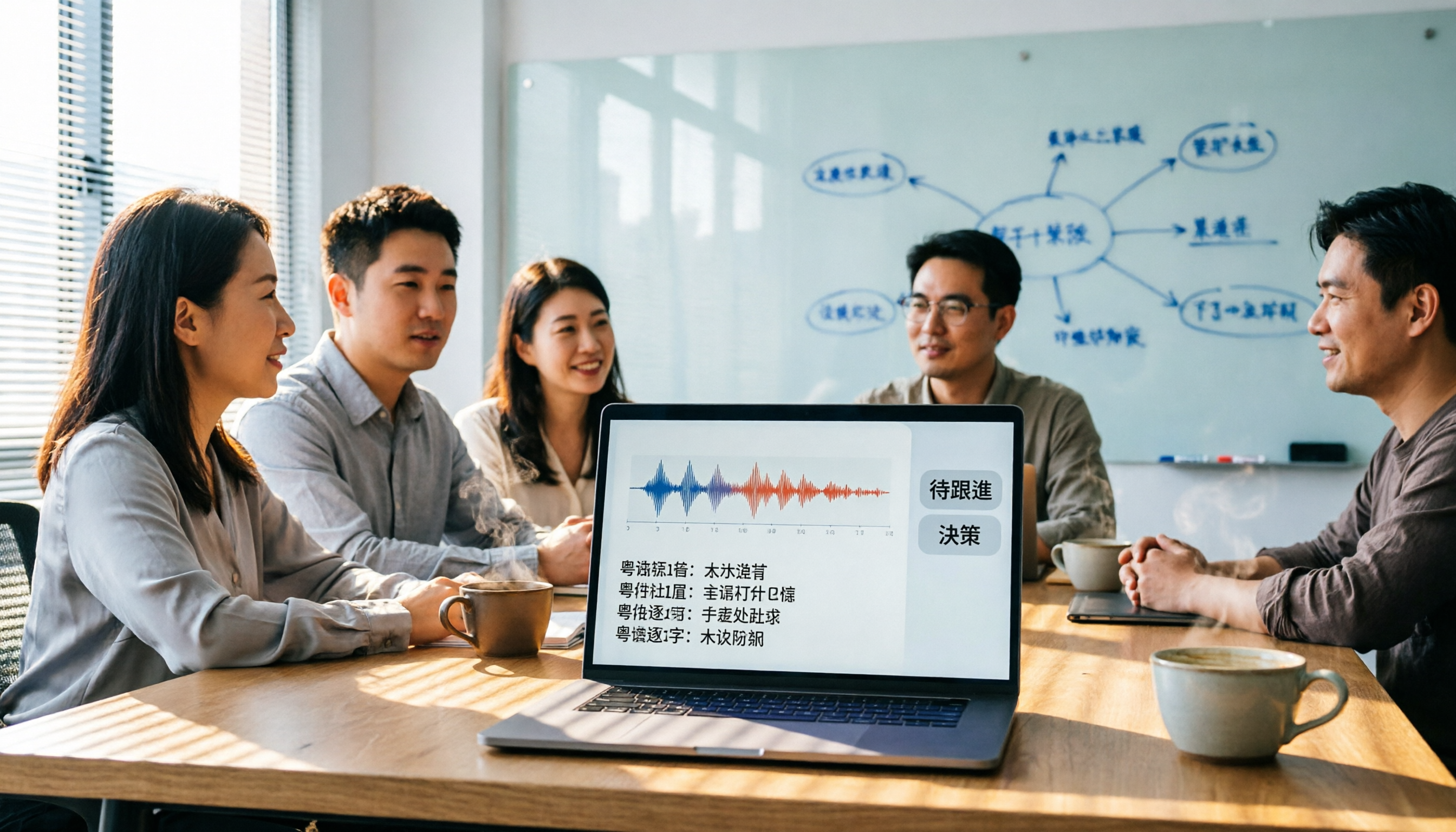
Turn recordings into transcripts and summaries in minutes
Upload audio or video for multilingual transcription, AI notes, and action items
4 Cantonese AI Transcription Tools Compared in 2026: From Recording to Post-Meeting Action
Many people make the first mistake when looking for a Cantonese transcription tool: they check which app has the highest accuracy rate. But what really holds you back is often not the recognition rate, but the fact that you haven't told the tool what you want to do next. Over the years, I've seen too many people convert recordings into tens of thousands of words, only to end up reading through the entire text themselves.
This article won't just list specifications. I want to walk you through a method to turn Cantonese recordings from "transcribe and forget" into data you can continue to query, archive, and collaborate on.
The Three Most Common Pitfalls with Cantonese Transcription: It's Not the Tool, It's the Method
Let's start with three mistakes I often see.
Pitfall 1: Thinking that "transcribing text" completes the task. You end up with a 10,000-word transcript that you still have to read slowly. What you really need are conclusions, action items, and timestamps you can refer back to.
Pitfall 2: Choosing a tool that "claims to support Cantonese" without testing it on your own recordings. Recordings have background noise, overlapping speech, and accent variations; official numbers are only a reference.
Pitfall 3: Treating online meetings and in-person recordings separately. After each meeting, you have to move the file to another tool for transcription and organization, breaking the workflow, and eventually you just stop doing it.
These three pitfalls all point to the same thing: you don't need a single feature; you need a workflow that takes you from recording to action.
Before Choosing a Cantonese Transcription Tool, Consider These 4 Key Points
Don't rush to download. Ask yourself these four questions first.
First, does it only give you a transcript?
Many tools stop after transcription. But you need summaries, highlights, action items, and even the ability to ask follow-up questions. If you only look at the transcript, you're only using a third of the tool's capability.
Second, can it handle your real recordings?
Is it background noise in a conference room, or an interview recorded with your phone on the table? Don't just look at official claims of Cantonese support; test it with your own recordings. My habit is to prepare a three-minute real recording and compare it across different tools.
Third, is it easy to record online meetings?
If you frequently use Zoom, Google Meet, or Teams, look for a method that doesn't require inviting a bot into the meeting. Besides saving the invitation step, it also avoids the hassle of having an extra "participant" in the meeting.
Fourth, what can you do after transcription?
Can you export to Notion or Google Docs? Can you ask follow-up questions about the recording content? Can team members view and add action items together? These are the key factors that determine whether a tool is worth using.
Tinrec (Miao Ting Lu Yin) — Our Top Pick After Testing
Tinrec is the option I currently recommend most often to knowledge workers.
Its positioning is clear: it's not just about converting recordings to text; it turns meetings into searchable, queryable, and actionable data.
Here's how I use it: I open the Tinrec desktop app during meetings, and it transcribes in real time. Because it captures the computer's system audio, there's no need to invite a meeting bot. It works with Zoom, Meet, and Teams.
(Screenshot: Tinrec desktop app recording an online meeting, with an arrow pointing to the system audio source)
After the meeting, Tinrec automatically generates a summary, chapters, and action items. I don't have to read through 10,000 words; I can start with the summary and confirm which sections need a second listen.
What really makes it indispensable for me is the AI Q&A feature. I can directly ask: "Which sentence did the client care most about regarding the quote? At what timestamp?" It answers based on the recording content, not just keyword search results.
Stop organizing recordings by hand
Upload audio or video and automatically get a transcript, summary, and action items
This is especially useful when organizing Cantonese meetings. Cantonese speech often mixes in English and has many tonal shifts, making transcripts hard to read. Having AI summarize and highlight key points first saves a tremendous amount of time.
Cross-platform support is also convenient: iPhone, Android, and web versions are available, so you're not tied to a single device.
To be honest about limitations: the free version has basic quotas, and heavy users need to pay. But if you want to experience the full workflow first, it's sufficient.
Who is Tinrec for? If you frequently handle Cantonese or mixed Chinese-English meetings and interviews, and want to be able to ask follow-up questions, export, and collaborate right after recording, this is the one to try first.
Beyond Tinrec: What Other Options Are There?
Otter.ai: A mature choice for English meetings, with a generous free monthly quota. But if you have Cantonese meetings, Otter's strength isn't there. It's more geared toward English business scenarios, and its Chinese organization isn't as refined as Tinrec's. If you mainly record English content, it's worth considering; otherwise, Tinrec is more suitable.
PLAUD Note: A hardware recording device, suitable for situations where you don't want to carry your phone and need one-touch recording. However, you need to buy extra hardware, and after recording, you still have to go back to the app to organize. Tinrec doesn't require additional equipment; you can complete the same workflow with your phone or computer, and its cloud and team spaces are more comprehensive.
Notta: It has good transcription and translation features, suitable for file-to-text conversion. But Tinrec emphasizes AI Q&A, action item extraction, and team spaces after transcription. If you only need bulk file transcription, Notta is worth a look; if you need to continue asking questions after meetings and have team collaboration, Tinrec is still more complete.
Avoidance Guide: 4 Common Mistakes with Cantonese Transcription
Mistake 1: Trusting official accuracy rates without testing your own recordings.
Many numbers are measured in quiet recording studios. Your meeting room has air conditioning, keyboard sounds, and overlapping speech, so accuracy will definitely differ. My advice is simple: upload a real recording to the free version first, then decide whether to pay.
Mistake 2: Thinking that having a transcript completes the task.
Transcription is just the starting point. If you still have to read the entire text yourself, the tool was a waste of money. Choose a tool with summaries, action items, and chapters, and let AI digest it for you first.
Mistake 3: Ignoring how online meetings are recorded.
Requiring you to add a bot to the meeting creates extra management hassle. Desktop solutions like Tinrec that capture system audio without a bot save steps and are closer to your usual meeting habits.
Mistake 4: Buying a tool but not using AI Q&A.
This is the biggest waste. After recording, don't just use Ctrl+F to find keywords; instead, ask directly: "What was the conclusion of this meeting?" "Who is responsible for which action?" Tinrec's AI Q&A is designed for this. Treat it as your meeting assistant, not a typewriter.
Summary: Which One Should You Choose?
Going back to the initial point: you don't lack a transcription tool; you lack a workflow from recording to action.
If you fall into these categories, I'd suggest trying Tinrec first:
- You need to handle Cantonese or mixed Chinese-English meetings or interviews
- You want to use AI to find key points and track action items right after recording
- You use iPhone, Android, and computer and want cross-platform support
- You want to put meeting data into a team space rather than scattered across personal devices
The only exception is if you only record English meetings and absolutely don't want to pay. In that case, Otter's free version might be more cost-effective.
Finally, here's a quick starter checklist:
- Prepare a 3-minute real Cantonese recording
- Download the Tinrec free version and upload the recording
- Don't just look at the transcript; first check the AI summary and action items
- Use AI Q&A to ask a specific question, such as: "What does the other party care most about?"
- Try exporting the results to Notion or Google Docs
- If you often meet with a team, create a team space to test sharing and handover
You don't need to understand all features at once. Start with one recording, and you'll gradually realize: the tool is just a supporting role; what truly changes your efficiency is how you use it.
References
- [2026 Edition] Free Cantonese Reading! Efficient Learning for Beginners with AI Voice | Text-to-Speech Software Ondoku
- 2026 Latest 5 Cantonese Speech-to-Text Software Recommendations: Solving Cantonese Meeting Notes and Mixed Language Pain Points - Miao Ting Lu Yin Blog
- SoundType AI - Ultra-Precise Transcription, Speech-to-Text, AI Dictation - Google Play App
- AI Speech-to-Text: Fast Audio-to-Text Online, Transcription and Video Subtitles - Free Trial - cSubtitle
- Hong Kong's Top 5 Speech-to-Text Tools: Accurate Cantonese Recognition, Boost Meeting and Interview Efficiency!
Turn every recording into actionable outcomes
Get 60 free transcription minutes when you sign in. No credit card required.
Related Reading
You might also like

2026 Free Transcription App Complete Guide: 6 Voice-to-Text Tools Tested and How to Choose
A roundup of 6 free or freemium transcription apps, including Tinrec, Yating, Atter, MyEdit, Otter, and Notta, comparing features, free limits, and ideal use cases.

Best Cantonese Transcription AI in 2026: We Tested 2 Tools, and This One Handles Cantonese Best
We compared Tinrec and Otter.ai for Cantonese transcription, covering recognition accuracy, recording methods, AI post-processing, cross-platform support, and pricing, to help you find the best tool for Cantonese meetings.

5 Best Transcription Software in 2026: Chinese Accuracy & AI Summaries Compared
This article tests 5 popular transcription and voice-to-text tools, including options frequently discussed on PTT, comparing Chinese transcription accuracy, AI summaries, and team collaboration features. Tinrec is recommended as the top choice.
2026 Hands-On Comparison of 4 Transcription and Translation Apps: Which One Handles Chinese Transcripts Most Effortlessly?
We tested Tinrec, Yating Transcript, SoundType AI, and Google Translate, comparing Chinese accuracy, translation features, free tiers, and cross-platform convenience to help you pick the best transcription and translation tool for meetings and interviews.

5 Best AI Transcription Tools in 2026: Free Plans, Chinese Accuracy, and Team Features Compared
A practical comparison of 5 AI transcription tools popular in Taiwan in 2026, covering free and paid plans, Chinese speech recognition accuracy, and team collaboration features, to help you avoid free-tier pitfalls and find the best fit.

Best Transcription Generator? 2026 Test of 5 Tools, This One Does More Than Text with Team Collaboration
Wondering which transcription generator is best? This article tests 5 tools including Tinrec, Otter.ai, Notta, TurboScribe, and Granola, comparing features, pricing, and use cases to help you find the most suitable AI transcription solution.

2026 iOS Transcription Apps: Tinrec Recording-to-Text + AI Meeting Summary Tested
Searching the App Store for transcription apps? Many claim free downloads but come with heavy restrictions. This article tests and compares Tinrec, Otter.ai, and Yating, helping you avoid common pitfalls and find the best iOS recording-to-text tool that truly saves you time.

2026 Hands-On Test: 4 Best Recording-to-Text Apps Compared—Which AI Transcription Really Helps You Clock Out on Time?
We tested Tinrec, Otter.ai, Plaud Note, and Notta to find the most time-saving AI transcription tool for Hong Kong professionals, focusing on Cantonese recognition and AI meeting summaries.

Tinrec vs Notta 2026: 5-Dimension Comparison, Tinrec Is the Top Pick for Free Transcription
This article compares Tinrec and Notta across five dimensions: free quota, Chinese language support, post-meeting organization, cross-platform availability, and team collaboration. It also briefly reviews Otter and PLAUD, helping you choose the right free AI transcription tool.