

Turn recordings into transcripts and summaries in minutes
Upload audio or video for multilingual transcription, AI notes, and action items
In the past, as a graduate student taking meeting minutes, a verbatim transcript alone could eat up an entire afternoon.
Now, there are plenty of speech-to-text tools available.
But many people are still using them the wrong way.
In Vocol's 2025 annual report, the voice collaboration platform emphasizes "improving team collaboration efficiency."
This highlights a key point: a verbatim transcript is just the starting point, not the finish line.
What truly saves you time is turning meeting content into actionable data you can continue to work with.
So, in this article, I want to share a more sensible workflow that I've tested and found effective.
The star is Tinrec Instant Recording.
I won't just talk about features; I'll discuss how to use it and why it works this way.
What Can Tinrec Do for You?
Many people assume speech-to-text is simply "recording → text."
But if that's all you do, you still have to go back and organize everything yourself.
Tinrec's value lies in covering the "using" part of meeting content as well.
Here are three scenarios I often encounter:
Scenario 1: Grasp the Key Points Within 5 Minutes After a Meeting
Previously, after a two-hour meeting, I might spend another hour organizing the meeting notes.
Now with Tinrec, the moment the meeting ends, the AI has already generated a summary, chapters, and action items.
Who is responsible for what, and what the deadlines are, is all clear at a glance.
(Screenshot placeholder: Tinrec meeting summary interface, arrow pointing to the "Action Items" section)
Scenario 2: Client Interviews Without Relying on Memory
For sales or researchers conducting interviews, the biggest fear is missing key client requirements.
Tinrec doesn't just provide a verbatim transcript; it also automatically lists the client's commitments and next steps.
You can directly search for "client mentioned budget" or "client's concerns."
Scenario 3: Real-Time Translation for Cross-Border Meetings
When collaborating with teams in other countries, language is often a barrier.
Tinrec's real-time translation can display the original text, translation, or a side-by-side bilingual view as you record.
I no longer have to ask colleagues to repeat themselves or guess what they mean.
So, the point isn't "whether you have a verbatim transcript," but "whether you've turned the meeting into something usable."
What Are Tinrec's Core Capabilities?
I've identified five truly practical features, each addressing a pitfall I've encountered.
1. Bot-Free Online Meeting Recording
Many meeting tools require inviting a bot to join the meeting, which can feel intrusive to clients.
Tinrec's desktop version directly captures your computer's system audio, so no extra bot is needed.
Just open Tinrec, start recording, and it will capture content from Zoom, Google Meet, and Teams.
(Screenshot placeholder: Tinrec desktop version's start recording button, arrow pointing to the "System Audio" option)
2. Not Just Verbatim Transcripts, but AI Semantic Summaries
Verbatim transcripts are long and tiring to read.
Tinrec's AI summary doesn't just condense the text into a paragraph; it organizes it structurally: meeting topic, discussion conclusions, action items, and owners are listed separately.
I can just look at the summary and then decide whether to revisit the full transcript.
3. AI Q&A: Treat Meetings Like a Database
This is my favorite feature.
After transcription, you can directly ask Tinrec questions.
For example: "Who mentioned the budget during the meeting?" "What was the client's feedback?"
It answers based on semantic understanding, so you don't have to search through the transcript yourself.
I often use this prompt template:
Based on this meeting's transcript, list all statements related to "budget," and mark the speaker and timestamp.
4. Action Item Extraction and Post-Meeting Generation
After a meeting, action items often go untracked.
Tinrec extracts action items from the discussion and can further generate meeting minutes, reports, or tables.
You can directly export to Notion or Google Docs to continue editing.
Stop organizing recordings by hand
Upload audio or video and automatically get a transcript, summary, and action items
(Screenshot placeholder: Tinrec export menu, arrow pointing to Notion and Google Docs icons)
5. Team Spaces: Turn Meetings into Team Assets
Individual use is great, but team collaboration is where the real time savings happen.
Tinrec's team version allows you to create dedicated spaces where members can share meeting materials.
New members can view historical meetings, and admins can allocate seats, monitor usage, and access audit logs.
Even if someone leaves the company, meeting data doesn't disappear.
Real-World Use Cases
I've used it in several areas with direct results.
Meeting Minutes
For weekly project meetings, I open Tinrec's desktop version, select "System Audio," and start recording.
When the meeting ends, the summary and action items are automatically generated.
I copy the action items into my project management tool and share the meeting materials in the team space.
Classes and Lectures
When listening to talks or attending classes, I record with my phone.
After Tinrec converts it to text, I use AI Q&A to organize the key points.
For example: "What are the three case studies the speaker mentioned?"
Interviews and Research
For user interviews, I record and upload to Tinrec.
It helps me list the interviewee's viewpoints and quotes.
Then I export these into my research notes.
Content Creation
Sometimes when inspiration strikes, I speak a few sentences into my phone.
After Tinrec converts it to text, I use the Agent post-processing to generate a draft.
Then I refine it, saving a lot of typing time.
5 Things to Watch When Choosing a Speech-to-Text Tool
Many people only look at price or accuracy, but I think there are more important criteria.
1. Does It Only Provide Verbatim Transcripts?
If the tool only gives you text, you still have to organize it yourself.
Tinrec's value lies in summaries, action items, Q&A, and export options—these are what truly save time.
2. Can It Record Online Meetings Without a Bot?
Some tools force you to add a bot, which can disrupt the meeting.
Tinrec's desktop version directly captures system audio, so no extra participant is needed.
3. How Good Is Team Collaboration?
If you're using it as a team, you can't just buy the personal version.
Tinrec's team version includes roles, seats, usage analytics, and audit logs for better governance.
4. Is the Chinese Experience Good?
Many international tools excel in English but often make mistakes with Chinese meetings.
Tinrec is optimized for Chinese and Traditional Chinese, and supports team-specific terms for better professional jargon recognition.
5. Can You Take Your Data with You?
Don't get locked into a single platform.
Tinrec supports multiple export formats and integrates with Notion, Google Docs, OneNote, and more, so you can continue using your existing workflow.
FAQ
Q: What's the difference between Tinrec and regular recording software?
Regular recording software only records audio. Tinrec goes further by converting to text, generating summaries and action items, and offering AI Q&A and export options.
Q: Do I need to install a meeting bot?
No. Tinrec's desktop version directly captures your computer's system audio, so it can record online meetings from Zoom, Meet, Teams, etc., without needing a bot to join.
Q: What's the difference between the team and personal versions?
The personal version keeps data under your personal account. The team version provides a dedicated team space where meeting data belongs to the team, and adds member management, seats, usage analytics, and audit logs.
Q: Can accuracy reach 100%?
It's not realistic to expect that. Any tool is affected by audio quality, accents, and overlapping speech. Tinrec can significantly reduce manual effort, but for important content, it's recommended to double-check against the recording.
Q: Is the free version sufficient?
You can start with the free version to test recording, transcription, and summaries. If you have meetings every week, consider the Pro or team version.
Conclusion
Speech-to-text is nothing new.
The real key is whether you turn meeting content into data that's actionable, searchable, and collaborative.
Tinrec's approach is simple: record or import → transcribe → summary/action items → Q&A/export → team sharing.
If you're tired of spending time organizing after meetings, give it a try.
Quick Start Checklist:
- Download Tinrec desktop or mobile app.
- Start an online meeting and record with system audio.
- After the meeting, review the AI summary and action items.
- Use AI Q&A to dig into key points.
- Export to your notes or project tool.
- Create a team space and invite members to share meeting materials.
Test it step by step, and you'll gradually master this method.
References
- Home | Vocol.ai Voice Collaboration Platform
- Vocol AI | Home
- Weike Technology Co., Ltd. 2025 Annual Report 1 / 240 Company Code: 600152 Company Abbreviation: Weike Technology Weike Technology Co., Ltd. 2025 Annual Report
- Note-Taking Tool & Speech-to-Text | Sales & Customer Success Solution
- Faculty & Student Solution | vocol.ai Note-Taking Tool & Speech-to-Text
Turn every recording into actionable outcomes
Get 60 free transcription minutes when you sign in. No credit card required.
Related Reading
You might also like
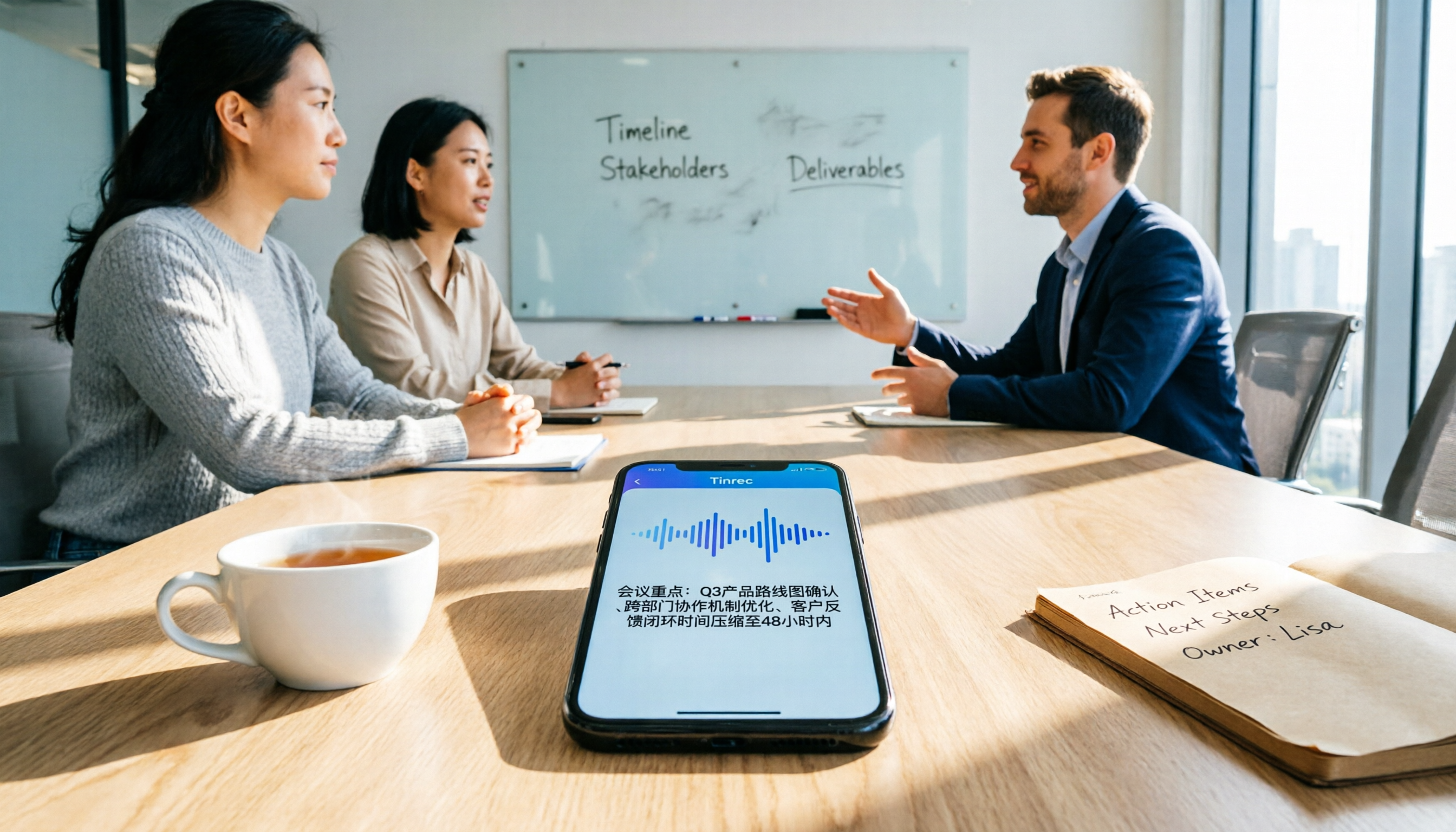
Are AI Meeting Note Apps Worth It in 2026? A 5-Step Guide to Choosing the Right Tool
Spending two hours in a meeting and another two organizing notes? This guide walks you through 5 steps to evaluate AI meeting note apps, with hands-on testing of Tinrec (Miao Ting Lu Yin) and comparisons with Otter, Notta, and PLAUD, helping you avoid wasted trial and error.
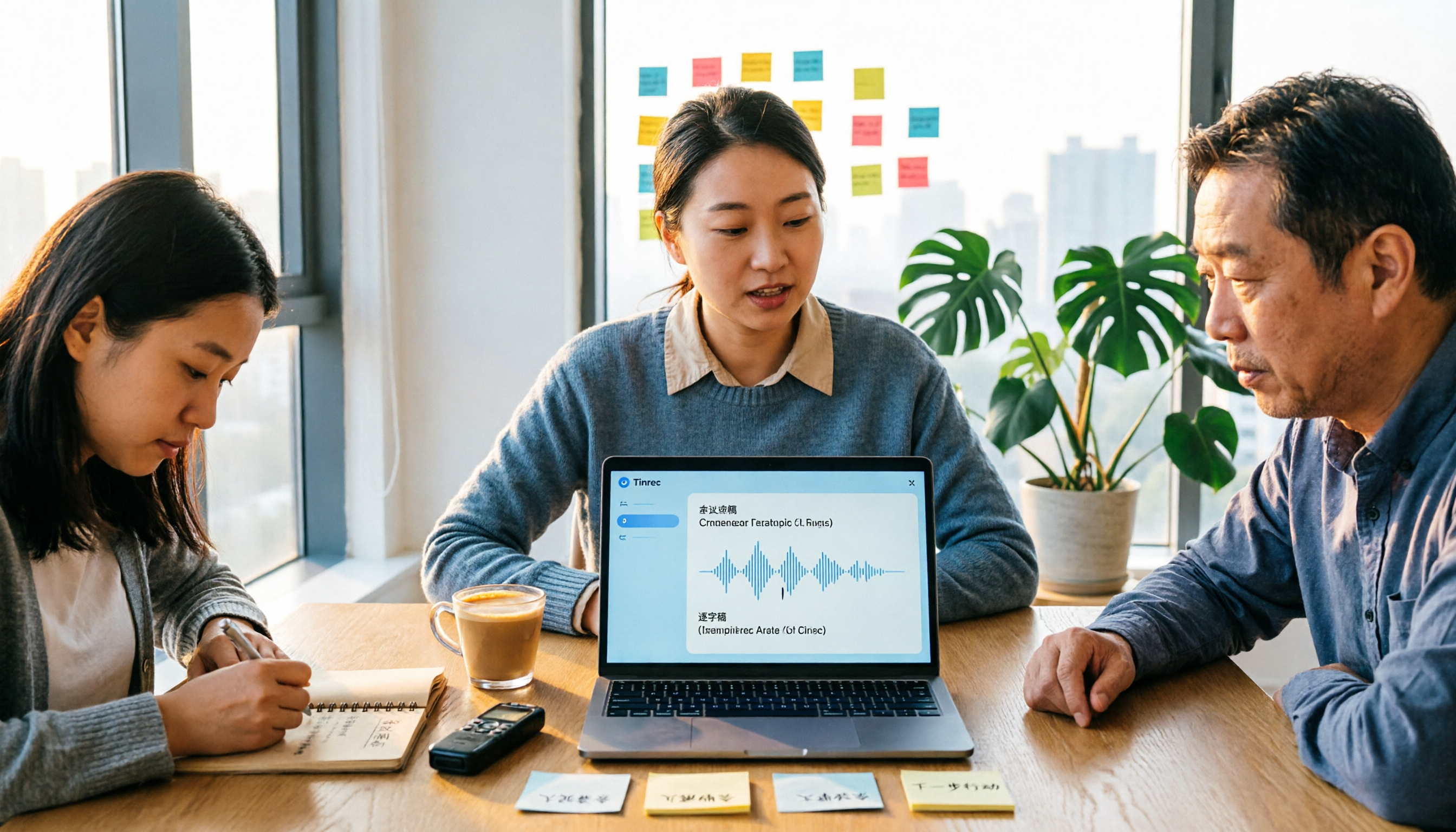
2026 Hands-On Comparison of 5 AI Speech-to-Text Tools: Vocol's Free Tier and Team Collaboration Stand Out
This article compares five AI speech-to-text tools—Vocol.ai, Yating, cSubtitle, Litok, and inFin—across free tier, transcription speed, team collaboration, and multilingual support, offering buying advice and pitfalls to avoid. Vocol.ai stands out with its 200-minute free tier and robust team collaboration features, making it ideal for professionals and small teams needing efficient meeting notes.

Best AI Meeting Notes Tools in 2026: Tested 5, This One Saves the Most Time on Action Items
A mid-level manager shares real-world testing insights, starting from the pain points of post-meeting cleanup, introducing the right way to write AI meeting notes, and using Tinrec as an example to show how to automatically generate summaries, action items, and team collaboration, so you never have to worry about meeting minutes again.

4 AI Meeting Note Tools Tested in 2026: Which One Handles Chinese Best?
Struggling with meeting notes? This hands-on review tests four AI meeting note tools—Tinrec, Otter.ai, Notta, and Granola—covering Chinese transcription, meeting summaries, and team collaboration, to help you decide which suits Taiwanese office workers best and whether the free plans are sufficient.

5 Best AI Meeting Note Tools Tested in 2026: How Tinrec Generates Chinese Meeting Minutes Without a Bot
We tested five AI meeting note tools, comparing everything from speech-to-text and AI summaries to cross-platform collaboration. This article details how Tinrec (秒听录音) generates Chinese meeting minutes without requiring a meeting bot, and provides a buyer's guide with common pitfalls to avoid.

2026 Free AI Meeting Minutes Tools Compared: 2 Options at a Glance
Not sure which AI meeting minutes tool is easy to learn? This article compares Tinrec and PLAUD Note across five dimensions: learning curve, meeting capture, Chinese recognition, post-meeting organization, team collaboration, and free plans, helping you find the most beginner-friendly option.

2026 Comparison of 2 Vocology Master's Programs: La Voce Artistica Master vs. University of Bologna Course
Want to pursue vocology studies but unsure which program to choose? This comparison of La Voce Artistica's Master (with dual tracks in arts and clinical practice) and the University of Bologna's Approfondimenti course helps you quickly determine which is better suited for medical or vocal professionals.

5 Best AI Meeting Notes Software in 2026: From Free to Paid, Explained
Struggling to choose an AI meeting notes app? This article starts with common pitfalls, walks you through 5 key criteria, and uses Tinrec as an example to help you pick a tool that truly saves you time.

6 Best Transcription Apps of 2026 Compared: Dcard Users' Top Picks for Recording-to-Text
A roundup of highly discussed transcription apps on Dcard, including Tinrec, Yating, Notta, Otter, and TurboScribe, comparing free plans, core features, and ideal users to help you find the most time-saving meeting notes tool.