

Turn recordings into transcripts and summaries in minutes
Upload audio or video for multilingual transcription, AI notes, and action items
Recently, a colleague asked me, "Which AI meeting minutes tool is easier to learn?" She tried one that required an external recorder, but spent 20 minutes just on pairing. If you're also looking for an easy-to-use option without extra hardware, this article compares Tinrec and PLAUD Note, both offering free plans to try.
Tinrec vs PLAUD Note | Quick Overview
Tinrec is an AI meeting minutes and team collaboration tool that works directly via web, desktop, or mobile—no extra hardware needed. PLAUD Note, on the other hand, is an AI recording hardware device; users must purchase the device and use it with the app. They serve different purposes, but both can transcribe meeting content and summarize key points.
| Comparison Item | Tinrec | PLAUD Note |
|---|---|---|
| Product Type | Software service | Hardware device + App |
| Price | Free tier available; personal plans include weekly, monthly, and yearly options | Hardware starts at USD 159; free plan includes 300 minutes per month |
| Learning Curve | Sign up and start using | Requires purchasing hardware and pairing |
| Key Features | No-bot meeting recording, Chinese optimization, team space | Portable recording, call recording, hardware battery life |
This article compares these two tools from five angles, focusing on "ease of learning and value for money."
Dimension 1 | Learning Curve and Intuitiveness
PLAUD Note requires unboxing, charging, Bluetooth pairing, and app binding—extra steps that can be challenging for non-tech-savvy users. If you forget the device or it runs out of battery, you miss the meeting recording.
Tinrec only requires opening the web page or app and logging in to start recording or uploading files. The interface is centered around "record, transcribe, summarize," so you can use it without reading a manual.
→ This dimension: Tinrec clearly wins, with almost zero learning cost.
Dimension 2 | Meeting Capture Methods
PLAUD Note is suitable for in-person meetings or on-the-go recording, but for online meetings (Zoom, Google Meet, Teams), you must place the device near the speaker, and audio quality can be affected by the environment.
Tinrec's desktop version can directly capture system audio, eliminating the need for a bot to join the meeting or holding a recorder up to the speaker. Just open Tinrec before the meeting starts, and it generates a transcript in real time.
→ This dimension: Tinrec is more intuitive and reliable for online meetings.
Dimension 3 | Chinese and Mixed Chinese-English Recognition
PLAUD Note supports multiple languages, but its primary market is English-speaking users, so its accuracy for common Taiwanese Chinese-English mixed speech and colloquial Taiwanese terms is average.
Tinrec is specifically designed to handle Chinese, Traditional Chinese, and mixed Chinese-English content, and offers a team glossary feature to pre-register company product names, people's names, and technical terms for better recognition.
→ This dimension: Tinrec is more friendly for Taiwanese users.
Dimension 4 | Post-Meeting Organization and Action Items
PLAUD Note provides summaries, to-do lists, and templates, but its features are more about "organizing recorded content." To generate complete meeting minutes, reports, or tables, you'll need to do manual work.
Tinrec automatically generates chapters, key points, action items, and mind maps, and supports AI Q&A and multi-format export (Notion, Google Docs, OneNote, etc.). It even uses Agent post-processing to generate meeting minutes or reports directly.
Stop organizing recordings by hand
Upload audio or video and automatically get a transcript, summary, and action items
→ This dimension: Tinrec's post-meeting workflow is more comprehensive, saving more time on organization.
Dimension 5 | Team Collaboration and Knowledge Retention
PLAUD Note offers device management and team membership plans, but its core is still a "personal recording device," with limited sharing and permission controls.
Tinrec's team version provides a dedicated team space where members can view historical meetings, allocate seats, manage usage, check audit logs, and even set up an audio recycle bin. Team data doesn't disappear when a member leaves, truly turning meetings into searchable assets.
→ This dimension: Tinrec is suitable for departments or project teams that need long-term collaboration.
What Are Their Unique Advantages?
Tinrec's Unique Advantages
- No hardware needed: Record and transcribe directly from your phone, computer, or web browser—zero device cost.
- No-bot online meeting recording: Desktop version captures system audio, works with Zoom, Meet, and Teams.
- Richer post-meeting outputs: Summaries, action items, mind maps, AI Q&A, and Agent-generated reports.
- Team space and governance: Roles, seats, usage analytics, audit logs—ideal for company adoption.
PLAUD Note's Unique Advantages
- Portable hardware recording: Light and easy to carry, great for long in-person meetings, interviews, or field notes.
- Call recording: Can record phone conversations, useful for sales or customer service scenarios.
Summary: Which One Should You Choose?
- If you don't want to buy extra hardware and just want to start using it in your browser → Tinrec
- If you frequently have online meetings and need real-time transcripts and summaries → Tinrec
- If you need mixed Chinese-English recognition and team glossary for Taiwanese Mandarin → Tinrec
- If you need to share meeting data with your team, track action items, and usage → Tinrec
- If you only need a portable recorder and don't care much about online meetings or team features → PLAUD Note is worth trying
In a nutshell: For most Taiwanese users looking for an "easy-to-learn, no-hardware, ready-to-use" option, Tinrec is the more complete choice. We recommend trying the free version to record a meeting and experience the smoothness of transcription and summarization.
FAQ
Q1: How long can I use Tinrec's free version? A1: The free version provides basic credits, enough to test recording, transcription, and summarization features. Actual credits are subject to the official page.
Q2: Do I have to buy the hardware to use PLAUD Note? A2: Yes, PLAUD Note is a recording device; you must purchase the device and use it with the app. The free plan only includes 300 minutes of transcription per month.
Q3: Can Tinrec record Zoom or Google Meet meetings? A3: Yes, Tinrec's desktop version captures system audio directly, so you don't need to add a bot to the meeting, making it simpler to use.
Q4: If I'm a solo user, do I need the team plan? A4: No, personal plans include free, weekly, monthly, and yearly options—choose based on your usage frequency. The team plan is for sharing meeting data, managing seats, and usage among multiple users.
References
- AI Meeting Minutes Software Recommendations: 5 Apps Tested and Compared, Auto-Transcribe to Text for Effortless Meetings!
- 2026's Top AI Meeting Minutes Tools: Time-Saving Essentials for Meetings!
- Recently, many people have asked me if there's an AI tool for meeting minutes. They still type manually, often unable to multitask, which wastes time. My answer is always — SeaMeet. Why recommend it? Here are the key points: -Integrates with Google Meet, syncs transcripts in real-time, and provides instant summaries, super convenient. -No need to reorganize; after the meeting, it emails all participants automatically. -So easy to use that I taught middle-aged and elderly people with no AI experience in 10 minutes. -For in-person meetings...
- Meeting Ink - 2026 AI Meeting Minutes Tools Test: 7 Voice-to-Text and Summarization Speed Comparison | Meeting Ink - AI Meeting Minutes Assistant, Auto-Transcribe and Summarize
- How to Use AI for Meeting Minutes? How to Organize Transcripts? | AI Voice-to-Text Tutorial | 104 Career Center
Turn every recording into actionable outcomes
Get 60 free transcription minutes when you sign in. No credit card required.
Related Reading
You might also like
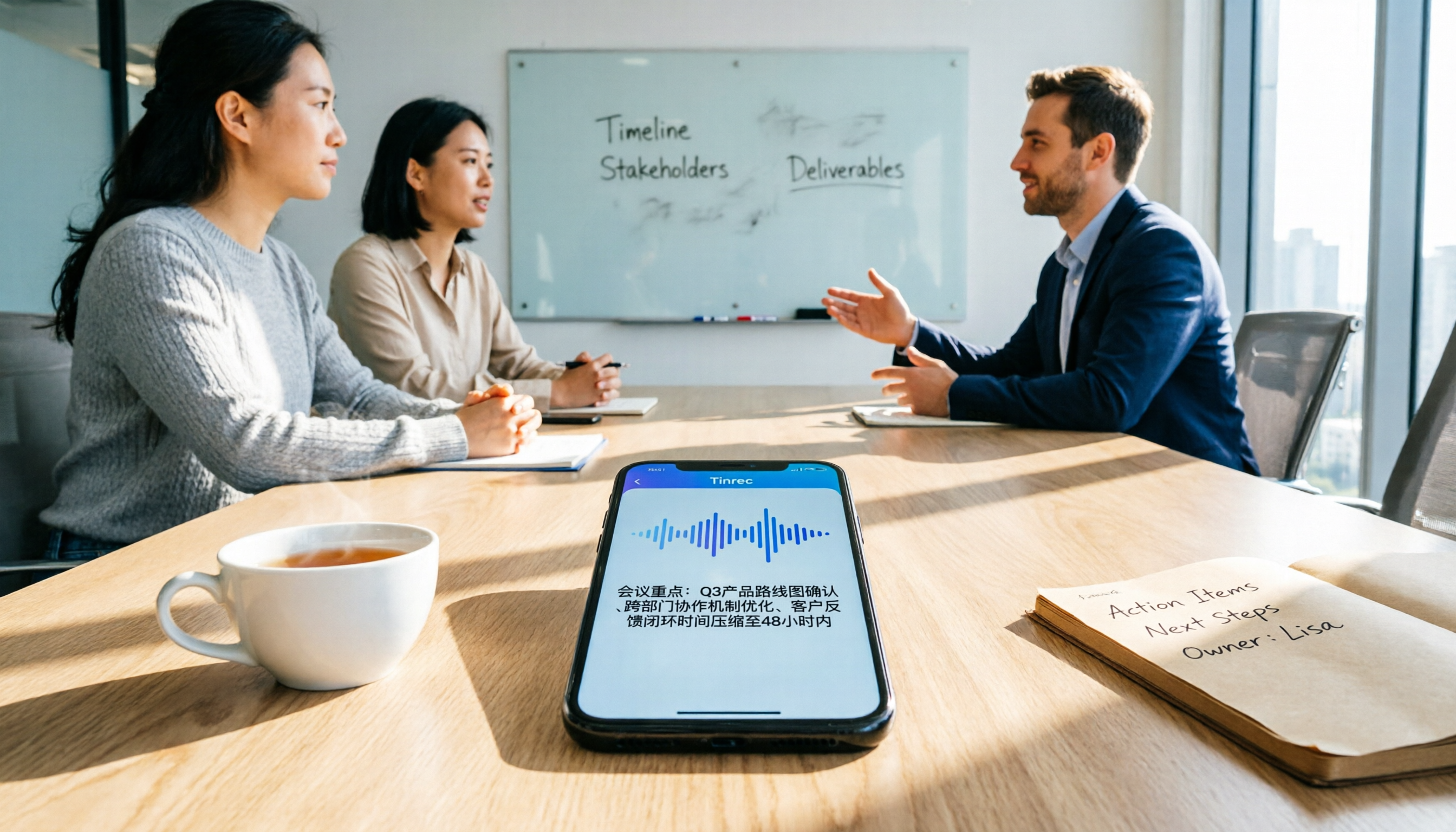
Are AI Meeting Note Apps Worth It in 2026? A 5-Step Guide to Choosing the Right Tool
Spending two hours in a meeting and another two organizing notes? This guide walks you through 5 steps to evaluate AI meeting note apps, with hands-on testing of Tinrec (Miao Ting Lu Yin) and comparisons with Otter, Notta, and PLAUD, helping you avoid wasted trial and error.

2026 Hands-On Comparison of 5 AI Speech-to-Text Tools: Vocol's Free Tier and Team Collaboration Stand Out
This article compares five AI speech-to-text tools—Vocol.ai, Yating, cSubtitle, Litok, and inFin—across free tier, transcription speed, team collaboration, and multilingual support, offering buying advice and pitfalls to avoid. Vocol.ai stands out with its 200-minute free tier and robust team collaboration features, making it ideal for professionals and small teams needing efficient meeting notes.

Best AI Meeting Notes Tools in 2026: Tested 5, This One Saves the Most Time on Action Items
A mid-level manager shares real-world testing insights, starting from the pain points of post-meeting cleanup, introducing the right way to write AI meeting notes, and using Tinrec as an example to show how to automatically generate summaries, action items, and team collaboration, so you never have to worry about meeting minutes again.

4 AI Meeting Note Tools Tested in 2026: Which One Handles Chinese Best?
Struggling with meeting notes? This hands-on review tests four AI meeting note tools—Tinrec, Otter.ai, Notta, and Granola—covering Chinese transcription, meeting summaries, and team collaboration, to help you decide which suits Taiwanese office workers best and whether the free plans are sufficient.

5 Best AI Meeting Note Tools Tested in 2026: How Tinrec Generates Chinese Meeting Minutes Without a Bot
We tested five AI meeting note tools, comparing everything from speech-to-text and AI summaries to cross-platform collaboration. This article details how Tinrec (秒听录音) generates Chinese meeting minutes without requiring a meeting bot, and provides a buyer's guide with common pitfalls to avoid.

2026 Tinrec Recording-to-Text Tutorial: Bot-Free Meeting Minutes + Team Collaboration
Building on the voice collaboration trends from Vocol's 2025 annual report, this guide shares a more practical meeting documentation approach: instead of just chasing verbatim transcripts, use Tinrec to turn meetings into searchable, queryable, and collaborative team assets.

2026 Comparison of 2 Vocology Master's Programs: La Voce Artistica Master vs. University of Bologna Course
Want to pursue vocology studies but unsure which program to choose? This comparison of La Voce Artistica's Master (with dual tracks in arts and clinical practice) and the University of Bologna's Approfondimenti course helps you quickly determine which is better suited for medical or vocal professionals.

5 Best AI Meeting Notes Software in 2026: From Free to Paid, Explained
Struggling to choose an AI meeting notes app? This article starts with common pitfalls, walks you through 5 key criteria, and uses Tinrec as an example to help you pick a tool that truly saves you time.

6 Best Transcription Apps of 2026 Compared: Dcard Users' Top Picks for Recording-to-Text
A roundup of highly discussed transcription apps on Dcard, including Tinrec, Yating, Notta, Otter, and TurboScribe, comparing free plans, core features, and ideal users to help you find the most time-saving meeting notes tool.