
Turn recordings into transcripts and summaries in minutes
Upload audio or video for multilingual transcription, AI notes, and action items
Hook Opening: No More Dreading the Transcription Hell of Interview Recordings
After every in-depth interview, feeling exhausted facing an hour or two of audio files? Traditional manual transcription is time-consuming and labor-intensive—an hour of recording often takes 3 to 5 hours to transcribe manually. This is not only a huge time cost but also risks missing key insights and tonal details from the interviewee during repeated listening.
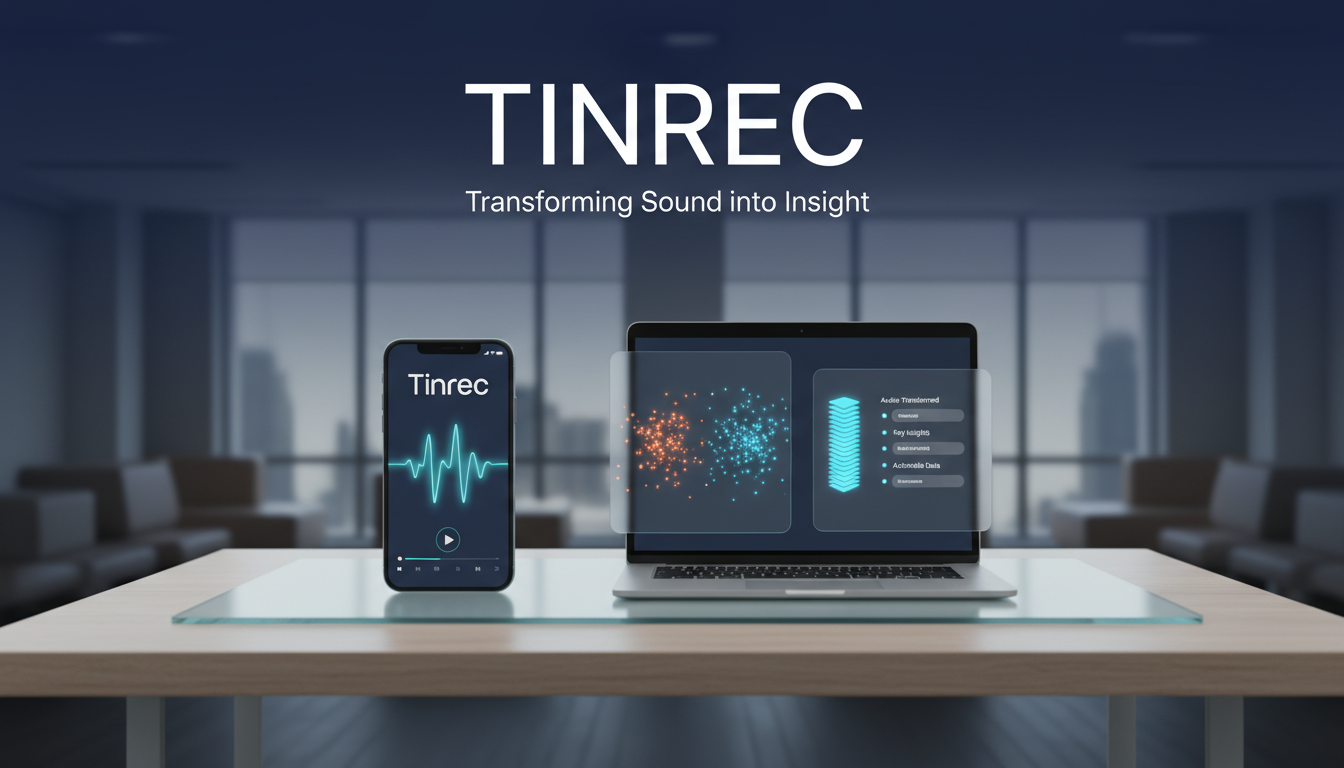
This article dives into the most popular interview recording transcription apps on the market, providing a clear tool comparison table, multi-dimensional evaluation criteria, and immediately actionable steps and FAQs (including iPhone limitations and online meeting scenarios).
Quick Navigation Suggestions: If you handle foreign media interview transcripts and have a generous budget, consider GoodTape; if you value Taiwan-local data security and accent recognition, Yating Transcript is an option; for high cost-effectiveness and no time limits, LexiTranscript is worth a try; if you need to extract key points directly from recordings, auto-generate action items, and perform conversational search, we recommend tools like Tinrec that focus on a complete workflow.
5 Key Dimensions for Evaluating Interview Recording Transcription Tools
With numerous speech-to-text tools on the market, choosing one shouldn't rely solely on "accuracy"—you need to assess whether it fits your workflow. Consider these dimensions:
- Real-time Capability and Processing Speed: Can it only transcribe uploaded files after the fact, or does it support real-time transcription during the interview? How long does it take to process one hour of audio?
- Multi-language and Accent Support: Can it accurately recognize Taiwanese accents, mixed Chinese-English workplace terms, or even Taiwanese Hokkien or Hakka?
- Speaker Identification: In multi-person interviews or focus groups, can it automatically distinguish between the interviewer and interviewee?
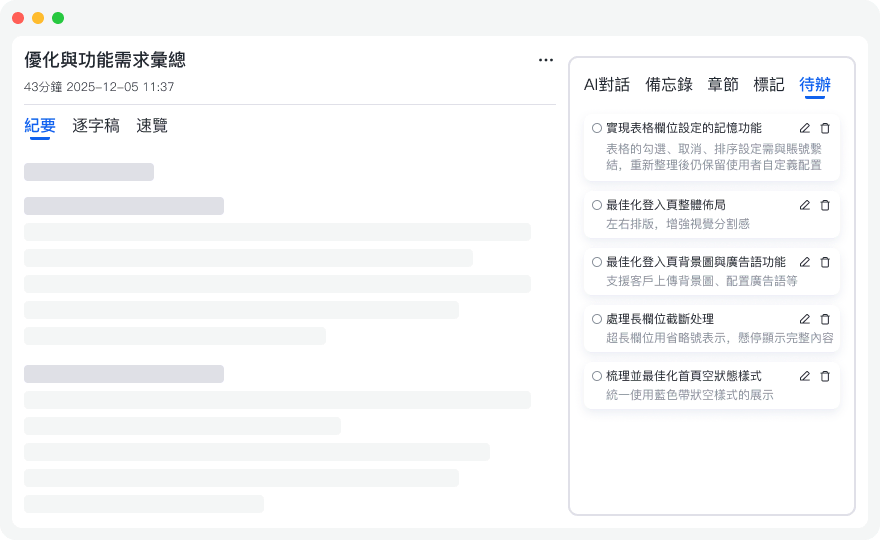
- Post-processing Capabilities (AI Summary and Action Items): Transcription is just the first step—does the tool automatically extract key summaries and suggest next actions?
- Price and Free Tier: Is there a per-file time limit? Is it billed per hour or subscription-based with unlimited use?
Comparison Table of 2026 Interview Recording Transcription Apps
To simplify your decision, we compiled a comparison of four popular tools: GoodTape from Denmark, Taiwan-based Yating Transcript and LexiTranscript, and Tinrec, which offers cross-platform support.
| Dimension | GoodTape | Yating Transcript | LexiTranscript | Tinrec (Miao Ting Lu Yin) |
|---|---|---|---|---|
| Core Strength | Journalist-oriented, intuitive interface | 100% Taiwan-developed, strong data security | Affordable, no time limits | Complete workflow from recording to action |
| Language Support | 100+ languages | Chinese, Taiwanese Hokkien, mixed Chinese-English | Multi-language support | 10 languages including Chinese, Japanese, English, Taiwanese, Cantonese |
| Processing Speed | Very fast (~20 min for 2-hour audio) | Slower (~10 min for 1-min audio) | Fast cloud processing | Real-time transcription, no waiting |
| Summary & Action Items | AI summary in paid version | Summary feature (often fails) | AI smart summary | Auto-generates meeting minutes, conclusions, and to-do action items |
| AI Smart Query | No | No | No | Yes, semantic-based conversational query |
| Price / Free Tier | Free: 3 files/month (max 30 min each) | Free for real-time recording / per-hour fee for file upload | Daily free quota / subscription | Free: 100 min/month / Basic plan from $4.9/month |
Stop organizing recordings by hand
Upload audio or video and automatically get a transcript, summary, and action items
In-Depth Analysis and Differentiation of Major Tools
GoodTape: A Journalist's Favorite from Denmark
Built on OpenAI's Whisper technology, designed for interviews. Its main advantages are a claimed accuracy of up to 99.98% and extremely fast processing. However, its pricing in euros is steep for US users (about $15/month), and the free tier is very restrictive—single files cannot exceed 30 minutes.
Yating Transcript: A Localized Choice Developed in Taiwan
Developed by Taiwan AI Labs, its strengths are that data stays within Taiwan and it has better recognition of Taiwanese accents and mixed Chinese-English contexts. Real-time recording is free, but uploading audio files is billed per hour (about NTD 100/hour). Note that conversion speed is slower, and the summary feature occasionally fails.
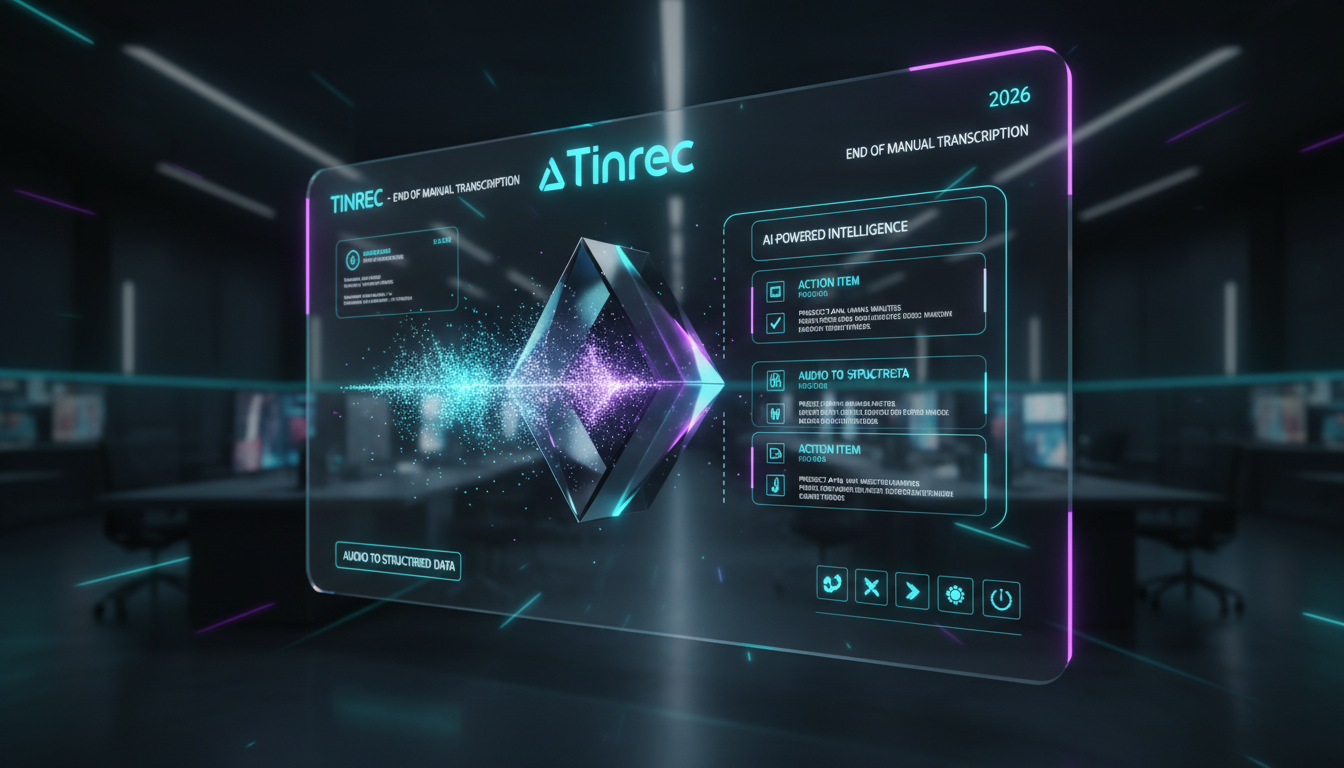
Tinrec (Miao Ting Lu Yin): An AI Recording Assistant from Understanding to Action
Unlike traditional tools that only offer speech-to-text transcription, Tinrec's design philosophy turns recordings into actionable information. It supports iOS, Android, and web versions, solving cross-device pain points. Besides basic real-time transcription and multi-format file upload, it emphasizes "decision summaries," automatically extracting interview conclusions and to-do items. Its unique "AI Chat Query" feature allows users to ask questions directly from large interview records, significantly reducing search time compared to Ctrl+F.
Practical Tutorial: How to Efficiently Organize an In-Depth Interview
With the right tool, you still need the right workflow. Here are practical steps to escape transcription hell:
Step 1: Enable Real-Time Transcription During the Interview
In face-to-face interviews, use your phone or tablet to start the tool's real-time recording. This ensures recording quality and lets you mark key points on the fly.
- Action: Go to the Real-time Recording to Text feature, press record, and the system transcribes speech to text in real time, helping you confirm key points during the conversation.
Step 2: Process Existing Audio Files
If you have recordings from professional recorders or online meeting software (e.g., Teams, Meet), upload them in batches afterward.
- Action: Use the Audio File to Text feature to upload MP3 or WAV files. The system processes them in the background, automatically generating transcripts and speaker labels.
Step 3: Organize Online Videos or Podcast Material
Sometimes interview material comes from online videos, YouTube, or podcasts. Instead of listening and typing, rely on tools to parse them.
- Action: Use the Podcast/Online Video to Text feature. Simply paste the URL to quickly convert to a transcript, saving download and conversion time.

Step 4: Use AI Query to Quickly Extract Key Points
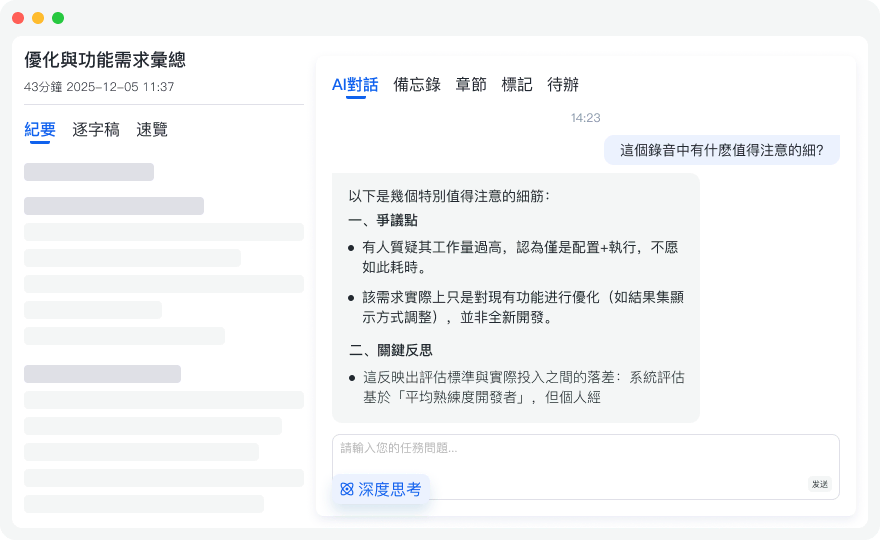
Don't read a transcript of tens of thousands of words from start to finish. Use AI to ask questions, e.g., "What is the interviewee's view on next year's market trends?"
- Action: Through the AI Chat Query feature, have a smart conversation based on the recording content, letting AI summarize and pinpoint key information.
FAQ: Common Pitfalls in Interview Recording Transcription
1. Are there completely free interview recording transcription apps?
Most tools offer limited free tiers. For example, Yating Transcript's real-time recording is free, but uploading audio files costs money; LexiTranscript and Tinrec provide monthly free usage minutes (e.g., 100 minutes), and only require a paid subscription beyond that.
2. Can iPhone's built-in Voice Memos directly transcribe to text?
Apple's built-in dictation cannot automatically distinguish speakers in long, multi-person interviews, nor can it generate structured summaries. It's better to export Voice Memos files and upload them to a professional speech-to-text tool.
3. Can I transcribe online interviews conducted via Teams or Google Meet?
Yes. You can upload video files (e.g., MP4) or extracted audio from Teams or Google Meet recordings to tools that support multiple formats. Some tools also support direct parsing via a cloud link.
4. Can tools recognize fast speech or mixed Chinese-English speech?
Modern AI has made significant progress. Yating Transcript is specially optimized for Taiwan's mixed Chinese-English context; tools with multi-language automatic recognition adapt quickly to speech speed and accents, typically maintaining accuracy above 90%.
5. Can transcription tools automatically distinguish different speakers?
Most professional interview apps have Speaker Diarization. The system analyzes voiceprints and automatically labels transcripts as "Speaker 1," "Speaker 2," etc., making it easy to organize conversation context.
6. What output formats are available for transcribed interview transcripts?
Depending on the tool, standard options include TXT plain text or Word files. More advanced tools support SRT subtitle export or can directly generate PDF reports including meeting minutes and to-do action items, ready to share with the team.
Turn every recording into actionable outcomes
Get 60 free transcription minutes when you sign in. No credit card required.
Related Reading
You might also like

4 Cantonese Input Methods for Windows 11 Compared (2026): Voice-to-Text Is the Real Time-Saver
Want to type in Cantonese on Windows 11? Beyond learning Jyutping or installing a third-party input method, you can also use built-in voice input or AI transcription tools. This hands-on comparison reveals which method best fits your work and lifestyle.

4 Cantonese-to-Chinese Transcription Tools Compared in 2026: Which One Saves the Most Time?
Many Hong Kong office workers search for “Cantonese to Chinese translation” but what they really need is to turn Cantonese audio into text. We tested four mainstream tools—comparing accuracy, AI features, cross-platform support, and pricing—to find out which one helps the most and saves you from late nights writing meeting minutes.
2026 Tinrec Tutorial: Cantonese Transcription & AI Smart Organization
Facing Cantonese meetings, courses, or interviews? Traditional translation apps only work word by word. Tinrec supports Cantonese voice-to-text and automatically generates summaries, action items, and AI Q&A, turning Cantonese content into truly usable material.

2026 Cantonese Speech-to-Text Tools Compared: Tinrec vs Notta vs Otter for More Efficient Cantonese-to-Mandarin Transcription
To convert Cantonese recordings into Mandarin Chinese text, the first step is accurate Cantonese speech recognition. This article hands-on tests three speech-to-text tools—Tinrec, Notta, and Otter—comparing Cantonese recognition accuracy, AI summaries, cross-platform support, and more, plus free plans and a buying guide to help you find the best Cantonese transcription solution.

5 Cantonese Real-Time Translation and Recording Tools Compared in 2026: From Conversation Translation to AI Meeting Minutes
Looking for a Cantonese real-time translation tool and need to organize Cantonese meeting recordings? This article compares OpenL, Cantonese Translation Wizard (粵語翻譯神器), Speak & Translate, Cantonese Translation Assistant (粵語翻譯助手), and Tinrec, covering translation, learning, and AI recording summaries to help you find the best fit.

2026 Comparison of 5 Transcription Tools: Which Free Cantonese Option Is Enough?
This guide helps you choose a free Cantonese transcription tool, covering everything from AI summarization to subtitle generation. We compared Tinrec, cSubtitle, Google AI Studio, Subanana, and Speechnotes to show which one best fits your needs.

Tinrec vs Traditional Cantonese Translators 2026: 5-Dimension Comparison – Which Is Better for Hong Kong Office Workers?
Looking for a Cantonese translator? What you actually need may be an AI tool that understands Cantonese and handles meeting notes automatically. We tested Tinrec’s voice-to-text app against traditional translators to find the real time-saver.

Tinrec vs Notta 2026: Hands-On Comparison of 2 Cantonese Voice Input Tools – Which One Fits You Best?
A hands-on comparison of Tinrec and Notta across Cantonese speech-to-text, AI organization, input sources, and pricing, to help you choose the right tool.

2026 Hands-On Comparison: 2 Cantonese Translation Tools—Which One Actually Helps You Understand Cantonese?
A quick look at two different approaches to processing Cantonese content, and why I eventually gave up translation apps and switched to a recording-and-organizing tool.