

Turn recordings into transcripts and summaries in minutes
Upload audio or video for multilingual transcription, AI notes, and action items
Think Merging Recordings Is the End? The Real Challenge Is What Comes After
When many people have several iPhone voice recordings, their first thought is, "How do I stitch them together?"
So they start looking for methods: some open GarageBand, some upload to online tools, and some download third-party apps.
But what happens after the merge?
You get one long audio file, and then you have to manually listen again, type up a transcript, find key points, and organize it into meeting minutes or interview summaries.
That's where the real time goes.
So instead of just asking "How do I merge?", think about this first: after merging, how do you plan to use the file?
This article will walk you through three common methods for merging iPhone recordings, and then show you a smarter way to handle what comes next.
Before Choosing a Merge Method, Understand These 3 Key Points
There are many tools for merging recordings, but when choosing one, don't just look at "can it merge?"—consider the entire workflow.
Key #1: Can you process the file directly after merging?
Some methods only stitch audio together, leaving you to figure out transcription and key point extraction on your own.
Others let you feed the merged file directly into an AI tool that automatically generates transcripts and summaries.
This can drastically affect your time costs downstream.
Key #2: Is the process too cumbersome?
GarageBand is feature-rich, but to merge two recordings, you may need to import, align, and adjust tracks.
Online tools are intuitive, but each time you have to upload and download, and your recordings may involve sensitive content.
Third-party apps are usually the simplest, but they're single-purpose—once the merge is done, that's it.
Key #3: Can the merged file be used across devices?
If you merge on your iPhone but later want to edit or share on your computer, the export format and cloud sync matter.
Some methods lock you into a single device or a specific format.
Tinrec (秒听录音) — The Go-To for Post-Merge Recording Organization
Tinrec isn't a merging tool, but it solves the "what now?" problem after merging.
It's positioned as an AI meeting notes and collaboration tool. You can upload your merged audio file directly, and it will transcribe it, then automatically generate summaries, chapters, and action items.
For example: you merge three customer interview recordings into one file and drop it into Tinrec.
Minutes later, you have a full transcript, bullet-point highlights, and you can even ask it directly: "What are the customer's concerns about pricing?"
It will answer based on semantic understanding, not just keyword search results.
This capability is something GarageBand, online merging tools, or simple merge apps simply don't have.
Additionally, Tinrec supports multiple input sources, including live recording, online meetings, and audio file import, and it offers both web and app versions.
So whether you merge recordings on your iPhone and then want to organize them on your computer or share with your team, it's seamless.
If you frequently need to organize interviews, meetings, or lecture recordings, merging is just the first step—Tinrec automates the most time-consuming parts that follow.
Stop organizing recordings by hand
Upload audio or video and automatically get a transcript, summary, and action items
Beyond Tinrec: Other Methods for Merging Recordings
GarageBand (Built-in, Free)
GarageBand can merge tracks, but it's fundamentally music production software, and the workflow isn't intuitive. You have to import audio files, create tracks, adjust positions, and then merge and export. After merging, it won't transcribe or summarize for you. If you only occasionally merge a recording and don't need further processing, GarageBand can handle it. But if you want transcripts and summaries right after merging, GarageBand can't do what Tinrec does.
Online Merging Tools (e.g., Audio Joiner)
Online tools are usually free and require no installation—just upload multiple audio files and merge. The downside is privacy risk: your recordings are uploaded to third-party servers. And after merging, you only get an audio file; transcription and key point extraction are still on you. Tinrec doesn't require you to upload confidential recordings to unknown websites, and it gives you organized results right after upload.
Third-Party Merge Apps (e.g., Merge Voice Memos)
These apps specialize in merging and are simple to use, but their functionality stops at merging. The merged file still needs separate processing. Moreover, many of these apps are iOS-only, so they won't work on a computer or Android. Tinrec is cross-platform, so you can seamlessly continue processing the merged file.
Pitfall Guide: 3 Common Mistakes When Merging iPhone Recordings
Pitfall 1: Focusing Only on Merging, Ignoring Post-Merge Organization
Many people spend time figuring out how to merge, only to realize afterward they still need to transcribe and listen for key points. My advice: before merging, think about where this recording will be used. If you need a text record, find a tool that can handle the next steps, saving you from re-listening.
Pitfall 2: Uploading Confidential Recordings to Unknown Online Tools to Save Effort
Free online merging tools are convenient, but your recordings may contain client data or internal discussions. Uploading to unfamiliar websites poses a leak risk. Professional tools like Tinrec typically have more robust privacy and security measures, and you can review their data handling policies.
Pitfall 3: Using GarageBand to Merge but Getting Stuck on Export Format
GarageBand's default output format may not suit all purposes. Some people merge and find the file is in a special format, requiring conversion. I recommend checking the export format before merging, or using a tool that supports common formats to avoid back-and-forth conversion.
Summary: What Should You Do?
My advice is simple:
- If you only occasionally merge a couple of recordings and don't need text organization, GarageBand or an online tool is fine.
- If you're merging recordings to later organize into transcripts, summaries, action items, or share with your team, then handing the merged file to Tinrec is the most efficient path.
Quick start:
- Select the recordings you want to merge on your iPhone.
- Merge them into one audio file using your preferred method.
- Open Tinrec and upload the merged audio file.
- Wait for it to generate the transcript, summary, and action items.
- If needed, ask Tinrec directly about key points in the recording.
Test it step by step, and you'll turn recording merging into a truly usable workflow.
References
- Merge tracks in GarageBand on iPhone - Apple Support (Taiwan)
- How to Combine Voice Memos: 3 Ways (iPhone, Online)
- iPhone Voice Memo Merge Tutorial: Combine Multiple iPhone Recordings into One - Tech Girlz
- 【iOS APP】Merge Voice Memos - Audio File Merging Tool
- iPhone Recording Merge + Editing Tutorial: Use Online Audio Merger to Combine Multiple Voice Memos
Turn every recording into actionable outcomes
Get 60 free transcription minutes when you sign in. No credit card required.
Related Reading
You might also like

2026 iPhone Recording Editing Free Plans: 1 AI Tool from Organizing to Collaboration
iPhone recording editing goes beyond trimming clips; it also involves converting content into text, summaries, and to-do lists. Using Tinrec as an example, this article demonstrates how to turn iPhone recordings into searchable, organized, and collaborative team assets, and highlights key points of the free plan.

2026 iPhone LINE Call Recording Tools Compared: Which One Saves You the Most Time on Chinese Transcription?
A student's hands-on comparison: After upgrading to iOS 26, you can record LINE calls using the built-in 'On-Device Capture' feature. But recording is just the first step; to quickly turn it into key points, you need AI tools. This article compares Tinrec and Otter for organizing Chinese LINE recordings, covering transcription accuracy, AI Q&A, cross-platform support, and free tiers, to help you decide which is better for students.
2026 iPhone Voice Memo Transcription Tools Compared: Why Tinrec Is the Top Notta Alternative
Struggling with large iPhone voice memos that won't transfer to your computer? This article compares iTunes transfer, Notta transcription, and Tinrec, showing how to get text transcripts on your computer without file transfer. It also covers Tinrec's AI summaries, to-dos, and team collaboration features.
How to Loop iPhone Voice Recordings in 2026: KMPlayer Loop Steps + Tinrec AI Transcription Alternative
The built-in Voice Memos app on iPhone doesn't support looping recordings. This article shows you how to use KMPlayer for looping and compares it with Tinrec, an AI transcription tool that's more efficient, so you don't have to listen to recordings repeatedly.
2026 iPhone Recording Apps Tested: Tinrec's Transcription & AI Summaries Save the Most Time
iPhone recording goes beyond the built-in Voice Memos. We tested 3 tools and found that Tinrec's transcription and AI organization save the most time. See which one is right for you.
The Complete Guide to Quick Recording on iPhone in 2026: One-Tap Start, Action Button, and AI Tools
How do you set up quick recording on iPhone? This article shows you how to use Voice Memos shortcuts, Back Tap, the Action button, and third-party AI recording tools (like Tinrec) to start recording with one tap at critical moments, and automatically transcribe and summarize.
Best iPhone Call Recording Apps in 2026: Built-in Recording + Tinrec Transcription Tested
iPhone's built-in call recording finally arrived with iOS 18.1, but what do you do after recording? This article tests 3 solutions, covering recording, transcription, and team collaboration.

2026 iPhone Voice Recording Apps Compared: Fix No-Sound Issues with Tinrec
Many iPhone users face the issue of recordings with no sound. In this article, I share the best solutions after hands-on testing and compare four transcription apps to help you find the right tool.
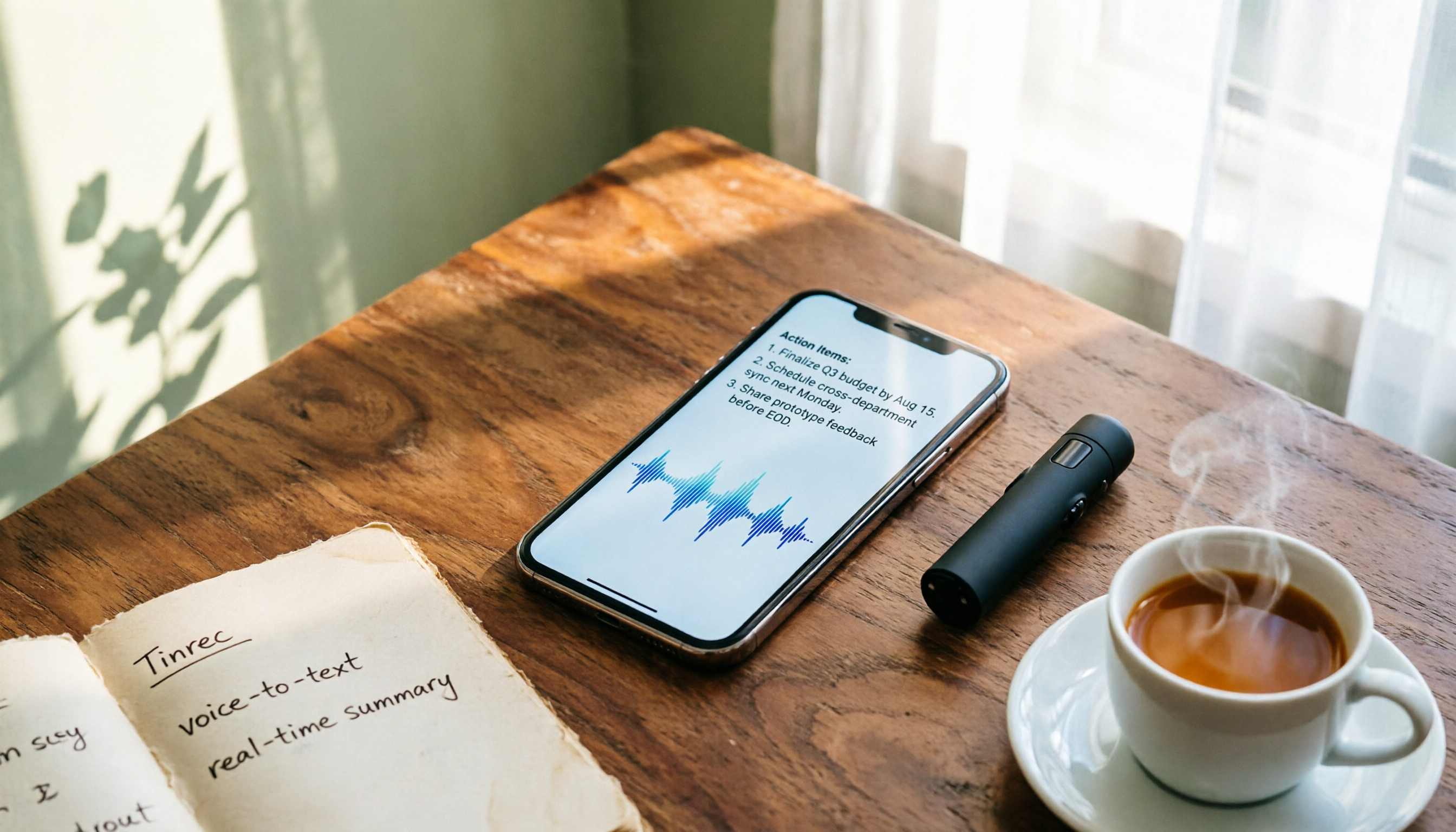
4 iPhone Recording Methods Compared in 2026: From Free Built-in Tools to AI Meeting Assistants
This hands-on comparison reviews 4 iPhone recording methods, including the built-in Voice Memos, quick recording shortcuts, hardware recorders, and the AI tool Tinrec, helping you choose the best option based on budget and needs.