
Turn recordings into transcripts and summaries in minutes
Upload audio or video for multilingual transcription, AI notes, and action items
Best iPhone Call Recording Apps in 2026: Built-in Recording + Tinrec Transcription Tested
iPhone users no longer have to envy Android. With iOS 18.1, the built-in call recording feature is finally available, but recording is just the first step. The real pain points are the transcripts, summaries, and follow-up tracking. This article compares 3 iPhone call recording solutions from a practical perspective to help you decide which is best for you.
Call Recording Needs and Pain Points: You Need a Solution, Not Just a Tool
Many people record meetings, interviews, and client calls for reference. But after recording, the files often sit in Notes or a recording app, never to be opened again. When you need to find a specific statement or confirm a decision, you have to listen from start to finish, wasting even more time.
That's why choosing the right solution matters: not just recording, but also quickly finding key points, converting to text, and even sharing with your team.
3 Key Points to Understand Before Choosing an iPhone Call Recording Solution
- Recording Legality and Consent: Most regions require both parties to consent to recording. The iPhone's built-in feature plays a voice prompt, which actually protects both parties. Secret recording may be illegal, so don't risk it to save time.
- Post-Recording Organization: Transcripts, summaries, to-dos, and searchable databases are where the value lies. If you only record without organizing, it's like not recording at all. Tinrec excels here: after importing a recording, it automatically transcribes, summarizes, and extracts to-dos.
- Cross-Device and Team Collaboration: Recorded files often need to be transferred from phone to computer and shared with colleagues. If the solution doesn't support cross-platform or team spaces, it'll be painful later. Tinrec offers web, desktop, and mobile versions, plus team spaces for sharing data.
Tinrec (秒听录音): The Top Choice for Organizing After Phone Calls
Tinrec is an AI meeting notes and collaboration tool. It doesn't directly record iPhone calls, but you can import audio files recorded on your iPhone, and it automatically transcribes, summarizes, extracts to-dos, and provides Q&A. In short, it turns recordings into usable data.
For example, you record a client call using the iPhone's built-in feature, then upload the audio file to Tinrec. Within minutes, you get a transcript, an AI summary highlighting key points, and a list of action items. You can even ask Tinrec, "What was the contract deadline the client mentioned?" and it will answer based on the content, saving you from searching manually.
We tested a clear 5-minute Chinese call recording (iPhone 15, quiet indoor environment). Tinrec's transcription quality was stable, and the summary and to-dos were accurate. Of course, if audio quality is poor, accents are heavy, or multiple people talk over each other, accuracy will suffer—this is a common limitation of all AI transcription tools.
Tinrec's advantages:
Stop organizing recordings by hand
Upload audio or video and automatically get a transcript, summary, and action items
- Supports multiple inputs, including audio files, meeting recordings, and online meetings.
- Not just transcription: provides AI summaries, chapters, to-dos, mind maps, and Q&A.
- Export to Notion, Google Docs, and other tools for further use.
- Team plans offer spaces, member management, usage analytics, and audit logs, suitable for departments.
Limitations: The free plan has basic quotas, and file imports consume quota; heavy users should consider Pro or Team plans. But for a few call transcriptions per week, the free plan is usually enough to try.
Beyond Tinrec: What Other Options Are There?
- iPhone Built-in Call Recording: This is the lowest-barrier option. After upgrading to iOS 18.1, tap the record button during a call, and the system will announce "This call will be recorded." The recording is saved in the "Call Recordings" folder in the Notes app, and you can view transcripts. However, it only provides basic transcription—no summaries, to-dos, or AI Q&A, and it's not suitable for team sharing. If you just need a simple record, the built-in feature is enough.
- Otter.ai: A well-established AI meeting assistant with mature English meeting experience; the free plan offers 300 minutes per month. However, for Chinese experience and team data accumulation, Tinrec is more tailored to users in Taiwan. If you mainly record English content, Otter is worth considering; but for Chinese transcripts and to-dos, Tinrec is more convenient.
- Notta: Features are similar to Tinrec, with multilingual transcription and team plans. But for governance features like no-bot meeting recording, audit logs in team spaces, and audio recycle bin, Tinrec is more complete. If you only occasionally transcribe a single file, Notta's free plan might suffice; for long-term team meeting organization, Tinrec's team spaces are more practical.
Pitfall Guide: 3 Common Mistakes When Choosing an iPhone Call Recording Solution
Pitfall 1: Recording without organizing. You record a bunch of files but can't find key points. We recommend importing recordings into Tinrec right after to get transcripts and summaries, making future searches and reviews much faster.
Pitfall 2: Ignoring legal and consent issues. Even in regions that allow one-party consent, secret recording can be risky and damages trust. The iPhone's voice prompt is a protective mechanism; don't use shady methods to hide recording.
Pitfall 3: Assuming the built-in feature is enough. Built-in recording is fine for simple records, but if you need summaries, to-dos, cross-device editing, or team sharing, it falls short. Tinrec fills the gap after recording, turning recordings into usable data.
Summary: Which One Should You Choose?
In short:
- Just need recording, no organization needed → iPhone built-in call recording.
- Need transcripts, summaries, and to-dos, and often organize calls or meetings → Tinrec, start with the free plan.
- Mainly record English meetings → Compare Otter.ai.
- Want a hardware recorder for on-the-go (including phone calls) → Consider devices like PLAUD NotePin.
We suggest starting with the iPhone's built-in recording, then uploading the file to Tinrec's free plan. The free quota is limited, but enough to experience transcription and AI summaries. If you like it, consider upgrading; there's no need to spend money upfront.
References
- Record and transcribe calls on iPhone - Apple Support (Taiwan)
- iPhone Call Recording Tutorial: Learn How to Record Phone Calls Step by Step
- How to Record iPhone Calls? 5 Methods Revealed!
- How to Use iPhone Call Recording? Full Analysis of Built-in iOS Call Recording and Transcription - Mr. Mad
- Upgrade to iOS 18 to Get 'iPhone Call Recording' Feature: Detailed Steps, Finally Can Record While Talking! - Dream & Hunter - Bonus Hunter
Turn every recording into actionable outcomes
Get 60 free transcription minutes when you sign in. No credit card required.
Related Reading
You might also like

2026 iPhone Recording Editing Free Plans: 1 AI Tool from Organizing to Collaboration
iPhone recording editing goes beyond trimming clips; it also involves converting content into text, summaries, and to-do lists. Using Tinrec as an example, this article demonstrates how to turn iPhone recordings into searchable, organized, and collaborative team assets, and highlights key points of the free plan.

2026 iPhone LINE Call Recording Tools Compared: Which One Saves You the Most Time on Chinese Transcription?
A student's hands-on comparison: After upgrading to iOS 26, you can record LINE calls using the built-in 'On-Device Capture' feature. But recording is just the first step; to quickly turn it into key points, you need AI tools. This article compares Tinrec and Otter for organizing Chinese LINE recordings, covering transcription accuracy, AI Q&A, cross-platform support, and free tiers, to help you decide which is better for students.
2026 iPhone Voice Memo Transcription Tools Compared: Why Tinrec Is the Top Notta Alternative
Struggling with large iPhone voice memos that won't transfer to your computer? This article compares iTunes transfer, Notta transcription, and Tinrec, showing how to get text transcripts on your computer without file transfer. It also covers Tinrec's AI summaries, to-dos, and team collaboration features.
How to Loop iPhone Voice Recordings in 2026: KMPlayer Loop Steps + Tinrec AI Transcription Alternative
The built-in Voice Memos app on iPhone doesn't support looping recordings. This article shows you how to use KMPlayer for looping and compares it with Tinrec, an AI transcription tool that's more efficient, so you don't have to listen to recordings repeatedly.
2026 iPhone Recording Apps Tested: Tinrec's Transcription & AI Summaries Save the Most Time
iPhone recording goes beyond the built-in Voice Memos. We tested 3 tools and found that Tinrec's transcription and AI organization save the most time. See which one is right for you.
The Complete Guide to Quick Recording on iPhone in 2026: One-Tap Start, Action Button, and AI Tools
How do you set up quick recording on iPhone? This article shows you how to use Voice Memos shortcuts, Back Tap, the Action button, and third-party AI recording tools (like Tinrec) to start recording with one tap at critical moments, and automatically transcribe and summarize.

3 Ways to Merge iPhone Voice Recordings in 2026: A Hands-On Comparison, and Why Tinrec Makes Post-Merge Organization Effortless
Merging iPhone voice recordings isn't hard, but the real challenge is turning the merged file into usable transcripts, summaries, and to-dos. This article compares built-in GarageBand, online tools, and third-party apps from a methodological perspective, then explains why handing the merged file to Tinrec saves the most effort.

2026 iPhone Voice Recording Apps Compared: Fix No-Sound Issues with Tinrec
Many iPhone users face the issue of recordings with no sound. In this article, I share the best solutions after hands-on testing and compare four transcription apps to help you find the right tool.
4 iPhone Recording Methods Compared in 2026: From Free Built-in Tools to AI Meeting Assistants
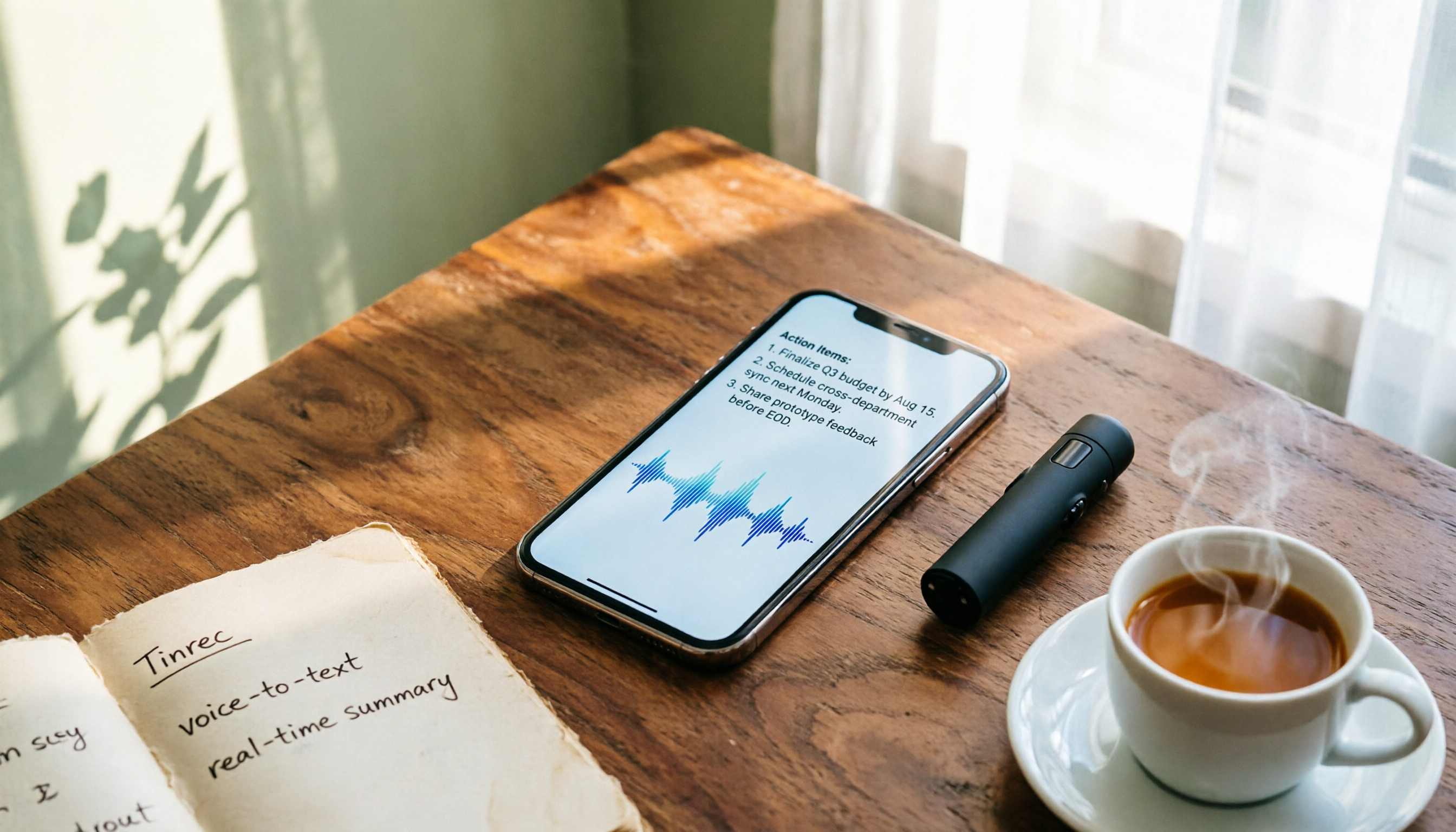
This hands-on comparison reviews 4 iPhone recording methods, including the built-in Voice Memos, quick recording shortcuts, hardware recorders, and the AI tool Tinrec, helping you choose the best option based on budget and needs.