

Turn recordings into transcripts and summaries in minutes
Upload audio or video for multilingual transcription, AI notes, and action items
The day before midterms, you open this semester's recordings and find 20 hours of audio—there's no way you can listen to it all. You start regretting not taking notes in every class. I was the same—until I discovered that using AI live transcription plus summaries can turn a two-hour lecture into a five-minute review.
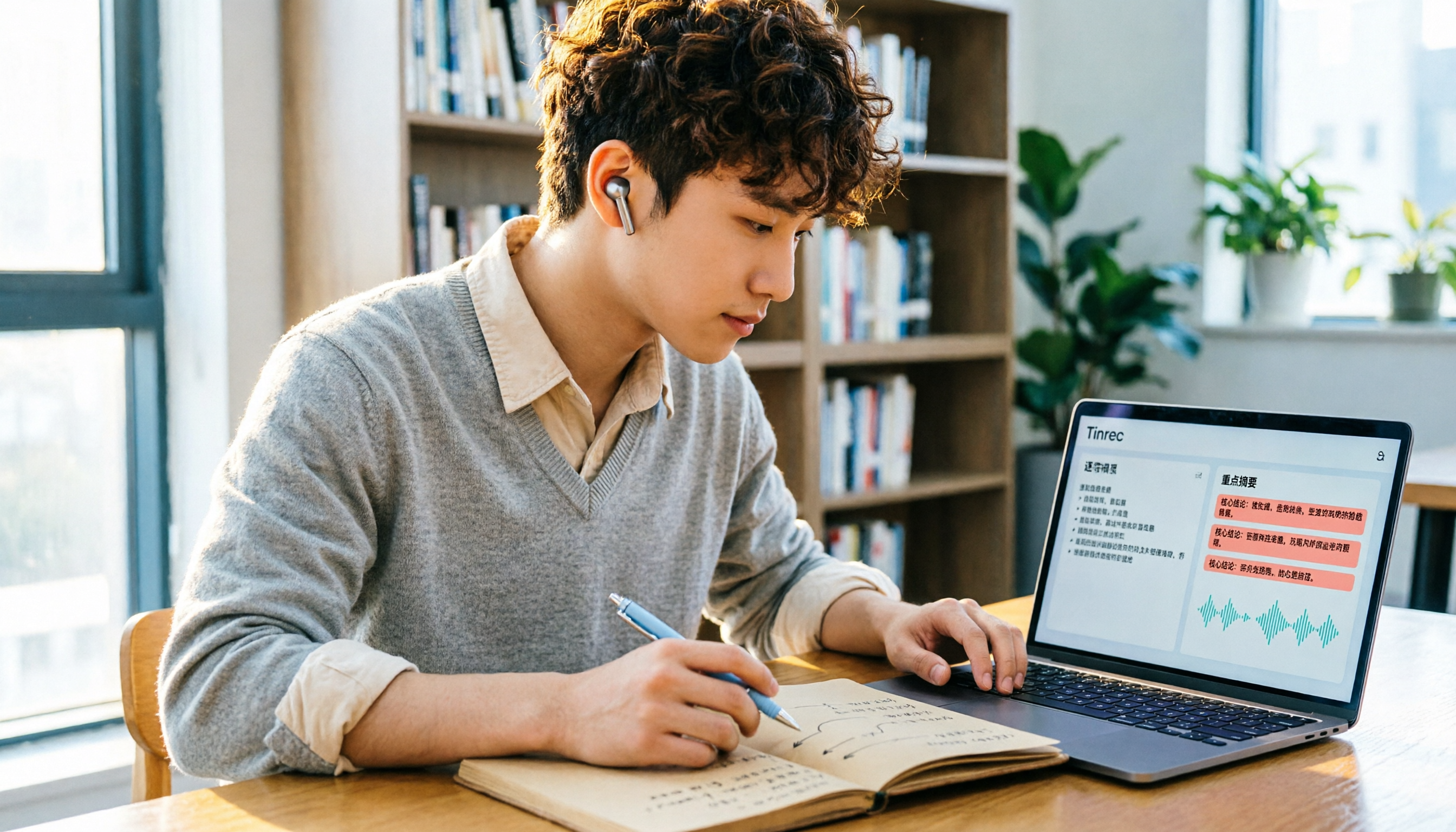
Now I use Tinrec for all my classes. It transcribes in real time as it records, and when the class ends, it automatically generates summaries and to-dos—no manual work needed. This article shares how I use Tinrec to turn lecture content into exam prep, plus what to watch out for when choosing a tool.
What Can Live Transcription Summaries Do for You?
Scenario 1: Record lectures, get key points 5 minutes after class
Before, I'd record lectures and then have to re-listen to two hours to catch the key points. Now with Tinrec, I open the live recording during class, and it transcribes as it goes—I can see the text as the professor speaks. After class, the AI has already generated a summary, organizing the topic, key concepts, and examples. All I need is 5 minutes to review.
Scenario 2: Group discussions, every person's input is captured
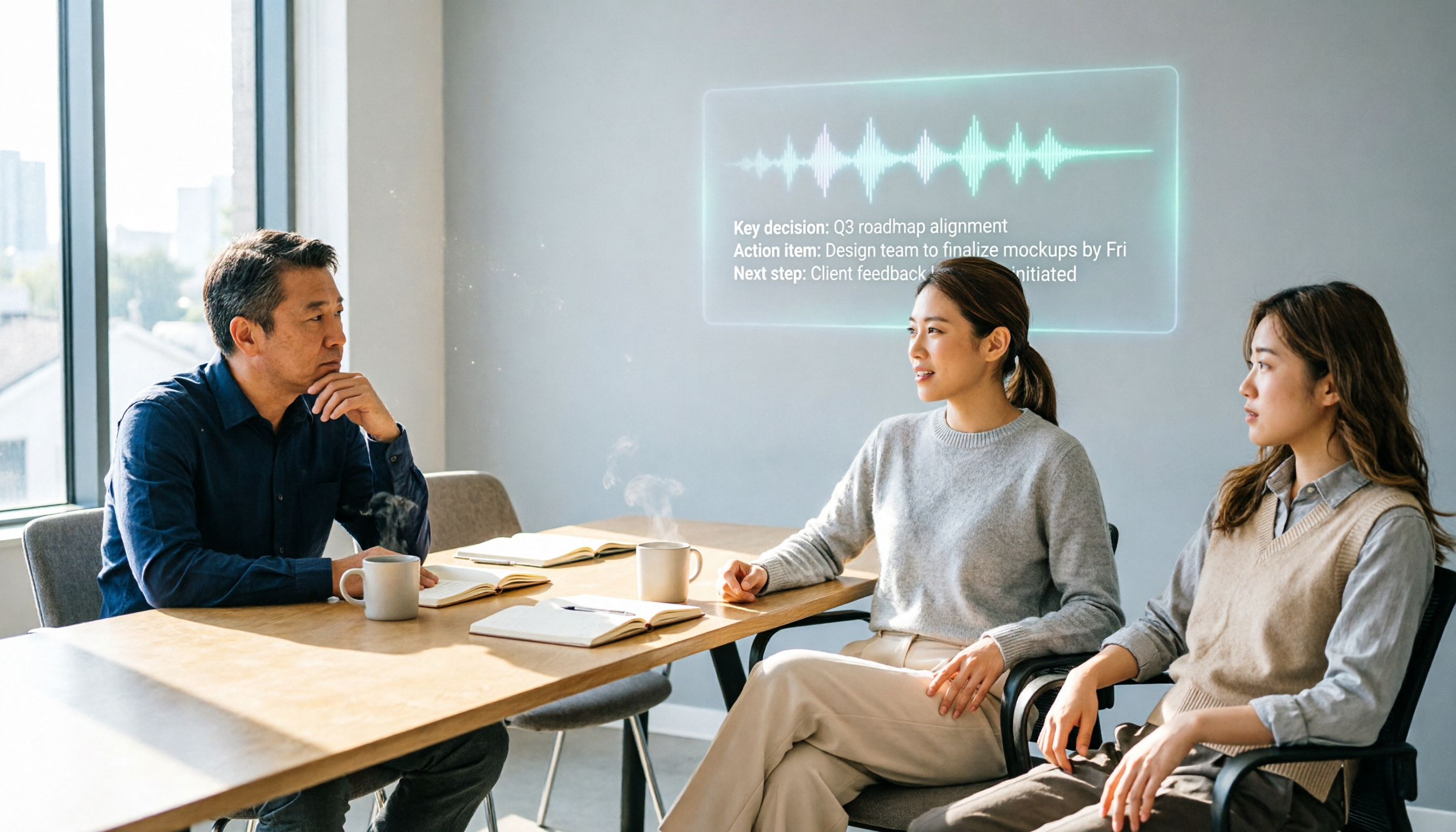
The worst part of group discussions is when someone speaks and everyone forgets, and no one remembers the conclusions afterward. I use Tinrec to record discussions. It doesn't just transcribe; it also automatically extracts action items—who's responsible for what, deadlines, all clear at a glance. After the meeting, I just share the summary in the group chat, and no one has to ask, "What was our conclusion again?"
Scenario 3: Finals review, use AI Q&A to find key points
Before finals, I no longer have to dig through a dozen recordings. I just open Tinrec and use the AI Q&A feature to ask: "What key points did the professor emphasize?" "What are the assignment submission rules?" It answers based on all the recordings, like having a personal teaching assistant.
What Are the Core Features of Live Transcription Summaries?
Live transcription: text appears as you record, not after
Tinrec's live transcription has less than 1 second of delay, so during class you can watch the text to make sure you don't miss anything. This is especially useful for fast-talking professors—even if you zone out, you can quickly refocus by reading the text.
AI semantic summaries: not just condensing, but structured organization
Many people think a summary is just shortening the transcript, but Tinrec's summaries break content into sections, key points, and action items. For a two-hour lecture, it automatically divides it into three sections, each with key takeaways, and ends with overall conclusions and action items.
AI chat query: ask directly, no need to search
After transcription, you can ask Tinrec in Chinese: "What exam topics did the professor mention?" "Which part did I not understand?" It answers based on semantic understanding and even provides timestamps for easy playback.
Real-time translation: no fear of cross-language courses
If you have English-taught courses or foreign professors, Tinrec supports real-time translation and bilingual comparison. You can see the original and translated text as you record, and look up unfamiliar terms immediately.
Multi-format export: bring key points to your note-taking app
Tinrec lets you export transcripts, summaries, and to-dos as PDF, Word, or even sync directly to Notion and Google Docs. I usually export each class's summary to Notion, so during finals, all the semester's key points are on one page.
Real-World Use Cases
Classroom recording: start recording as soon as you enter
I usually open Tinrec's live recording as soon as I enter the classroom and just leave my phone on the desk. It automatically converts speech to text without any special setup. After class, I check the summary to make sure I didn't miss any verbal announcements, like assignment extensions or exam scope.
Group discussions: multiple speakers automatically organized
Stop organizing recordings by hand
Upload audio or video and automatically get a transcript, summary, and action items
During group discussions, I use Tinrec on my phone to record, and everyone's contributions are captured. Afterward, the AI summary lists each person's key points and consensus, and action items are assigned to people. No need to designate a note-taker—everyone's life is easier.
Online courses: no bot needed for Zoom or Meet
For online classes, the Tinrec desktop app can capture system audio directly, so you don't need to add a bot. Just open the desktop app, start recording, and it captures both the instructor's voice and any shared screen audio. Afterward, you get the transcript and summary just like in-person classes.
Interviews or projects: quickly organize transcripts to find quotes
When doing project interviews, I use Tinrec to record and transcribe in real time. As soon as the interview ends, I can search for keywords to find the interviewee's exact words. The AI summary helps me quickly locate key points without re-listening to the entire recording.
4 Things to Watch Out for When Choosing a Live Transcription Summary Tool
1. Accuracy: don't just trust official claims
Many tools claim high accuracy, but real-world performance depends on the recording environment. I recommend testing with your own lecture recordings. Tinrec performs well with clear audio and common scenarios, and it handles mixed Chinese-English courses, but for important content, I still cross-check with the recording.
2. Real-time capability and latency: text as you record really matters
Some tools only transcribe after the recording ends, so you can't follow along during class. Tinrec's live transcription has very low latency, so I can read the text while the class is happening and catch up even if I zone out. For someone easily distracted like me, this is a lifesaver.
3. Summary quality: is it structured? Can it extract action items?
Transcription is just the first step; what matters is whether the tool helps you organize afterward. Tinrec doesn't just give you a transcript; it generates sections, key points, and to-dos, and you can even use AI Q&A to dig deeper. This is the biggest difference from ordinary transcription tools.
4. Pricing and free tier: student budgets matter
Tinrec has a free plan with basic credits to try recording, summaries, and transcription. If you only record key classes, the free plan might be enough. If you want to record every class, consider the Pro monthly or annual plan—check the official website for pricing. I personally used the free plan for a week, confirmed it saved me time, and then upgraded.
FAQ
Q: Is live transcription accurate?
A: In quiet environments with clear pronunciation, Tinrec's transcription quality is excellent and handles both Chinese and English courses. However, when multiple people speak at once or there's background noise, minor errors can occur. For important content, especially exam topics, I recommend replaying the recording to confirm.
Q: Is the free plan enough?
A: The free plan includes basic credits, suitable for trying it out and occasional use. If you record three or more classes a week, you might run out of credits and consider upgrading to Pro. I started with the free plan, confirmed it saved me time, and then paid—this way you don't waste money.
Q: Can I use it for online courses or Zoom meetings?
A: Yes. The Tinrec desktop app can capture system audio directly, so you don't need to add a bot. As long as the online meeting or class is on your computer, just open Tinrec and start recording and transcribing.
Q: How well does it work for group discussions?
A: In multi-person discussions, as long as people don't talk over each other, Tinrec can still distinguish clearly. It records each person's contributions, and the summary organizes consensus and action items. I recommend placing the phone in the center of the table for better results.
Q: Is my recording data secure?
A: For Tinrec's personal plan, your data is managed under your personal account, and you control sharing. The team plan offers more comprehensive permissions and audit logs. For individual student use, privacy is sufficiently protected.
Conclusion
Live transcription summaries are no longer futuristic tech—they're tools you can use now, and they genuinely save students time. I used Tinrec for a whole semester, from lecture recording and group discussions to final exam review, and it saved me tons of manual organization time. If you're tired of re-listening to recordings, I suggest starting with Tinrec's free plan. Use the basic credits to record one class and see how AI helps you organize key points. Who knows—you might not have to pull an all-nighter before finals again.
References
- Home | Vocol.ai Voice Collaboration Platform
- Live Transcription Service | Transcribe App & Web Editor
- Tired of Meeting Notes? ChatGPT+Whisper Does It All! Automatic Transcription, Summaries, and Emails | BusinessNext
- Meeting Ink - 2026 AI Meeting Notes Tool Test: 7 Voice-to-Text and Summary Speed Comparison | Meeting Ink - AI Meeting Notes Assistant
- Transcript Summary Generator for Long Meetings and Videos | HiNoter Blog
Turn every recording into actionable outcomes
Get 60 free transcription minutes when you sign in. No credit card required.
Related Reading
You might also like

2026 Tinrec AI Meeting Notes Tutorial: Chinese Recognition + Bot-Free Recording, a Lifesaver for Students During Finals
A senior student's hands-on comparison: Which is better for Taiwanese students, Tinrec or Otter.ai? From Chinese recognition, bot-free recording, post-transcription processing to student budgets, this complete five-dimension comparison teaches you how to use AI meeting notes to turn class recordings into finals study guides.
2026 Comparison of 4 AI Meeting Recorders: Real-World Test for Students—Recording to Text and Key Point Extraction
A senior student tested four AI meeting recorders—Tinrec, Otter.ai, Notta, and PLAUD Note—over a full semester, comparing free quotas, Chinese speech recognition, AI summaries and Q&A, and cross-platform recording to help you save time re-listening to recordings.

2026 Hands-On Comparison of 3 AI Meeting Note Tools: How Tinrec Saves 80% of Your Time with Transcripts
Tired of spending hours on meeting notes? This article tests three AI meeting note tools—Tinrec, Otter, and Notta—comparing transcript accuracy, Chinese language support, workflow, and pricing. Learn how to quickly generate transcripts and meeting summaries with Tinrec.
5 AI Meeting Note Tools Tested in 2026: Cost vs. Value at a Glance
After testing multiple AI meeting note tools, I found that most people overspend on features they don't need. This article uses Tinrec as a case study to help you understand pricing structures and truly time-saving usage.

Tinrec vs Otter 2026 Hands-On Comparison: How to Choose an AI Meeting Notes Tool for Chinese?
A hands-on comparison of Tinrec and Otter AI meeting notes tools, covering five key dimensions: bot-free recording, Chinese transcription accuracy, post-meeting summarization, export and post-processing, and team features, to help Chinese-speaking users find a more efficient meeting summary solution.

Best AI Meeting Note Tools in 2026: 5 Tested, This One Handles Chinese Best
We tested multiple AI meeting note tools, from recording and transcription to post-meeting summaries and team collaboration, to find the best fit for teams in Taiwan.

2026 Hands-On Comparison of 3 AI Meeting Note Tools: Tinrec's Chinese Summaries and Bot-Free Recording Are Most Practical
This article compares the summarization and action item capabilities of 3 AI meeting note tools, detailing Tinrec's core features, free plan, and a 6-step tutorial, while answering common questions to help you quickly decide which tool is worth using.

The Complete Guide to AI Meeting Notes Tools in 2026: Real-World Tests and 3 Key Buying Tips
This article tests several AI meeting notes tools, showing how Tinrec can automatically generate transcripts, summaries, and action items, and compares Notta, Plaud, Otter, and more to help you avoid common buying mistakes.

2026 Hands-On Comparison of 2 AI Meeting Note Tools: Which Is More Practical—Bot-Free Recording or Team Collaboration?
A methodology-based comparison of Tinrec and PLAUD NotePin across online meeting capture, ease of use, post-meeting organization, and team collaboration to help you choose the right AI meeting notes tool.