
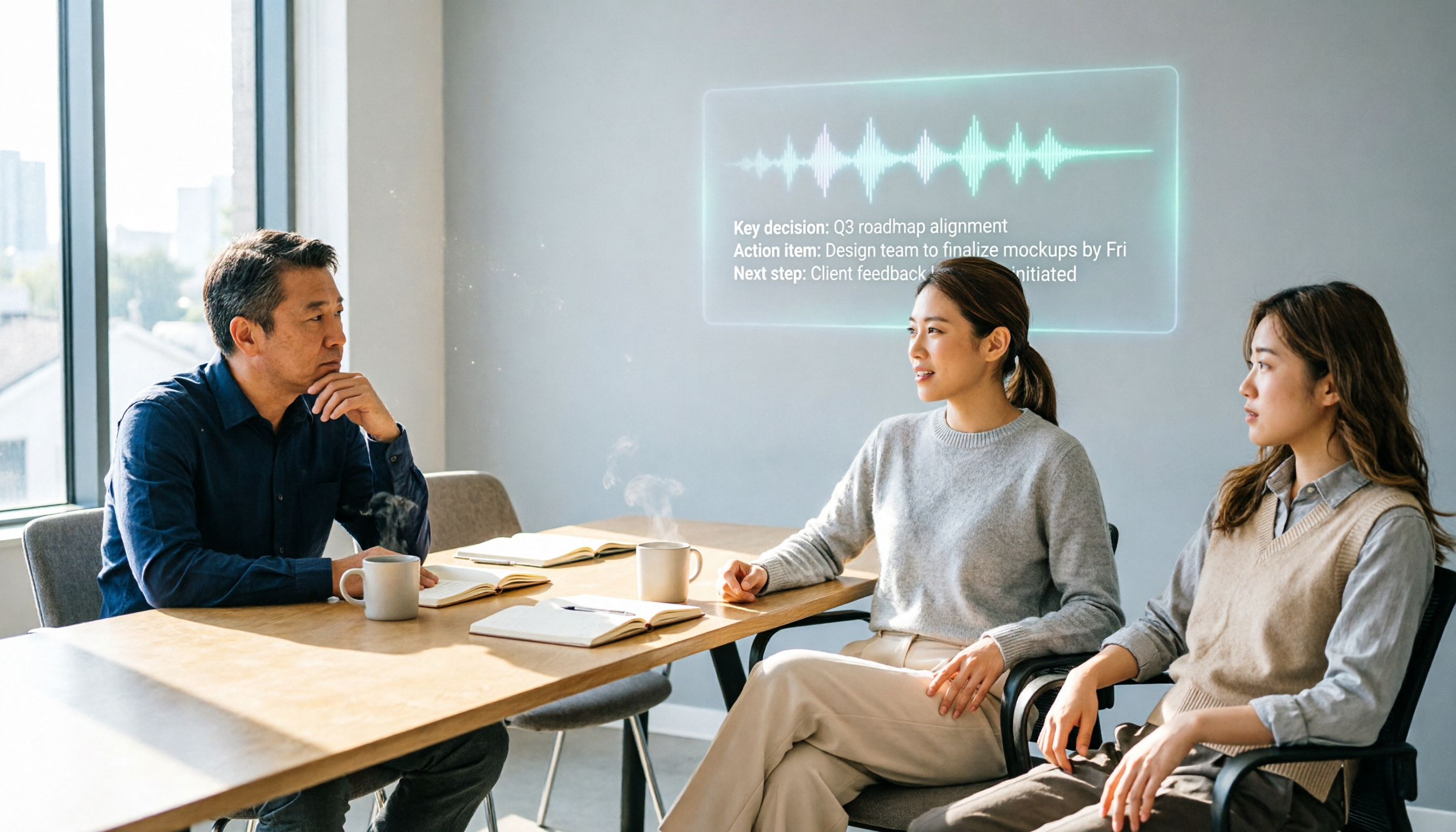
Turn recordings into transcripts and summaries in minutes
Upload audio or video for multilingual transcription, AI notes, and action items
I have a 2-hour interview recording on hand. If I were to transcribe it manually, it would take about 4 hours. And my deadline is tomorrow morning.
So I started comparing AI meeting note tools on the market to compress this process. But after testing, I found that choosing the wrong tool actually takes more time.
Many people only look at whether it can transcribe audio, but overlook the subsequent organization and cost structure. I first tried a solution that only requires hardware recording; the recording quality was great, but I had to carry an extra device every time. Then I tried a service that focuses on real-time meeting bots; although it automatically joins meetings, the Chinese transcription often had errors, and the subscription cost was not low. Finally, I went back to Tinrec, whose bot-free desktop recording and Chinese organization capabilities felt the most intuitive to me.
This article is not about promoting a specific tool, but rather sharing with you: how to evaluate AI meeting note tools so you don't waste money.
What Can AI Meeting Notes Do for You?
In the past, after a two-hour meeting, you might spend another hour organizing the meeting minutes. Now with AI meeting notes, the situation is different.
Take Tinrec as an example: it doesn't just convert audio to text; it turns meetings into usable data.
Scenario 1: Interview Research You have a user interview recording. After uploading, Tinrec produces a transcript, and the AI summary helps you extract key insights without listening to the entire recording.
Scenario 2: Online Meetings Open Tinrec on your desktop, and it captures the system audio directly, no need to invite a bot to join your Zoom, Meet, or Teams meetings. When the meeting ends, the summary and action items are already there.
Scenario 3: Client Communication After a call with a client, the recording is transcribed, and you can use AI Q&A to ask: "What are the client's concerns about pricing?" Tinrec finds the answer from the conversation.
Scenario 4: Classroom Notes When the teacher lectures quickly, you not only get a transcript but also a mind map to organize the structure, making review more efficient.
The common thread in these scenarios: the focus is not on "recording" but on "what you do after recording."
What Are the Core Capabilities of AI Meeting Notes?
A good AI meeting note tool should help you accomplish these tasks.
Real-Time Transcription Text appears as you record, not after. Tinrec's real-time transcription lets you confirm during the meeting that you haven't missed key points.
AI Semantic Summaries It's not just condensing the transcript into a paragraph; it's structured organization. Meeting topics, conclusions, action items, and assignees are listed separately. Tinrec automatically generates chapters and highlights, so even long meetings can be quickly reviewed.
Action Item Extraction and AI Q&A Automatically organizes follow-up actions from the discussion. After transcription, you can ask Tinrec directly: "Who mentioned the budget in the meeting?" "What was the client's feedback?" It answers based on semantic understanding, so you don't have to search manually.
Multi-Format Export and Further Processing The organized content can be exported to tools like Notion, Google Docs, OneNote, etc., to continue your workflow. Tinrec can also generate reports, tables, and documents from meeting content, saving you from staying up late to write notes.
Team Space and Knowledge Accumulation The personal plan is for individual use, while the team plan centralizes meeting data. Tinrec for Teams allows you to create team spaces, invite members, allocate seats, and turn historical meetings into searchable, collaborative assets for the team.
Practical Use Cases
Interview Research: Quickly Organize Transcripts and Insights Upload the interview recording to Tinrec. After transcription, use the AI summary to quickly grasp the interviewee's viewpoints. Then use the Q&A feature to ask: "What is the interviewee's biggest pain point?" Get the answer directly without replaying the entire recording.
Stop organizing recordings by hand
Upload audio or video and automatically get a transcript, summary, and action items
Online Meetings: Bot-Free Recording and Real-Time Translation Open the Tinrec desktop app and start recording. It captures system audio, so no extra bot joins and disrupts the meeting. Real-time translation lets you view in the original language or translation, so you won't miss anything in cross-language meetings.
Classroom Notes: Recording to Structured Notes After recording a lecture, Tinrec not only provides a transcript but also generates a mind map to visualize the chapter structure. When reviewing, look at the mind map first, then replay the recording for weak points—much more efficient.
Client Communication: Simultaneous Recording and Action Item Extraction After talking with a client, the recording is transcribed, and Tinrec automatically extracts action items like "Send a quote by Monday." Export these action items directly to your task management tool, no need to type them again.
5 Things to Watch When Choosing an AI Meeting Note Tool
1. Pricing Structure: Don't Just Look at the Monthly Fee Some tools have seemingly low monthly fees, but the free allowance is small, and overages are expensive. Tinrec has a free plan to try basic features, as well as weekly, Pro monthly, and annual plans. For long-term use, the annual plan offers a lower monthly equivalent. The team plan is priced per seat, suitable for multiple users.
2. Post-Transcription Processing: Transcript Is Just the Starting Point If a tool only provides a transcript, you still have to organize key points and action items yourself. Tinrec's summaries, chapters, action items, and Q&A handle the follow-up work for you, saving the most time.
3. Recording Method: Do You Need a Meeting Bot? Some tools require a bot to join the meeting as a participant, which others can see. Tinrec's desktop app captures system audio directly, no extra bot needed, and doesn't affect the meeting.
4. Chinese and Mixed-Language Support Many tools are strong in English but often make errors in Chinese transcription. Tinrec is specifically tuned for Chinese meetings and Traditional Chinese content, handles mixed Chinese-English, and supports team-specific terms to improve recognition of professional jargon.
5. Team Collaboration and Data Ownership Personal plan data belongs to the individual; team plan data belongs to the team. If you need members to share historical meetings, manage seats, and view usage, Tinrec's team spaces and audit logs are essential features.
Frequently Asked Questions
Can AI meeting notes achieve 100% accuracy? No. Any tool is affected by recording quality, accents, noise, and multiple speakers. Tinrec can significantly reduce manual work, but for important content, it's recommended to replay the recording to verify.
Is the free plan sufficient? If you just want to try it, Tinrec's free plan provides basic credits to upload a recording and test transcription and summaries. If you use it frequently, consider the Pro plan.
What's the difference between personal and team plans? Personal plan data is managed by you. The team plan has a dedicated space, meeting data belongs to the team, and adds governance features like members, roles, seats, usage analytics, and audit logs.
Do I need to buy additional recording hardware? No. Tinrec supports web, desktop, and mobile, so you can record directly with your phone or computer without buying a separate recorder.
How is pricing calculated? Personal plans include free, weekly, Pro monthly, and annual options. Team plans are billed per paid seat, with each seat providing shared import credits per month; real-time recording currently doesn't deduct minutes. Specific prices are subject to the official purchase page.
Conclusion
AI meeting notes are no longer futuristic technology; they are tools you can use now and that genuinely save time. But what you're really buying is not "transcription" but "the workflow after transcription."
Using Tinrec as an example, it connects recording, transcription, summaries, action items, Q&A, and team collaboration, turning meetings from one-time events into searchable, trackable assets. If you have more than 3 meetings a week, I strongly recommend starting with the free plan.
Quick Start Checklist:
- Download Tinrec's free plan and upload a meeting recording.
- Evaluate the quality of the transcript, summary, and action items.
- Use the AI Q&A feature to ask a specific question and see if the answer is accurate.
- Try recording an online meeting once with the desktop app without a bot.
- Export the results to your preferred note-taking or task tool.
- If you need team sharing, create a team space and invite members to test.
By testing step by step, you'll gradually master this approach.
References
- I spent 4 hours making an AI meeting note tool for less than $0.30 USD | WenHao Yu
- Meeting Ink - 2026 AI Meeting Note Tool Test: 7 Speech-to-Text and Summary Speed Comparison | Meeting Ink - AI Meeting Note Assistant, Automatic Transcription and Summarization
- AI Meeting Note Software Recommendations: 5 App Test Comparisons, Automatic Transcription Makes Meetings Easy!
- 2026's Top AI Meeting Note Tools: Time-Saving Essentials for Meetings!
- Meeting Note AI Tools: Real-Time Recording, Summary Organization! 3 Tools to Help You Focus on Meetings
Turn every recording into actionable outcomes
Get 60 free transcription minutes when you sign in. No credit card required.
Related Reading
You might also like

2026 Tinrec AI Meeting Notes Tutorial: Chinese Recognition + Bot-Free Recording, a Lifesaver for Students During Finals
A senior student's hands-on comparison: Which is better for Taiwanese students, Tinrec or Otter.ai? From Chinese recognition, bot-free recording, post-transcription processing to student budgets, this complete five-dimension comparison teaches you how to use AI meeting notes to turn class recordings into finals study guides.

2026 Comparison of 4 AI Meeting Recorders: Real-World Test for Students—Recording to Text and Key Point Extraction
A senior student tested four AI meeting recorders—Tinrec, Otter.ai, Notta, and PLAUD Note—over a full semester, comparing free quotas, Chinese speech recognition, AI summaries and Q&A, and cross-platform recording to help you save time re-listening to recordings.

2026 Hands-On Comparison of 3 AI Meeting Note Tools: How Tinrec Saves 80% of Your Time with Transcripts
Tired of spending hours on meeting notes? This article tests three AI meeting note tools—Tinrec, Otter, and Notta—comparing transcript accuracy, Chinese language support, workflow, and pricing. Learn how to quickly generate transcripts and meeting summaries with Tinrec.

Tinrec vs Otter 2026 Hands-On Comparison: How to Choose an AI Meeting Notes Tool for Chinese?
A hands-on comparison of Tinrec and Otter AI meeting notes tools, covering five key dimensions: bot-free recording, Chinese transcription accuracy, post-meeting summarization, export and post-processing, and team features, to help Chinese-speaking users find a more efficient meeting summary solution.

Best AI Meeting Note Tools in 2026: 5 Tested, This One Handles Chinese Best
We tested multiple AI meeting note tools, from recording and transcription to post-meeting summaries and team collaboration, to find the best fit for teams in Taiwan.

2026 Live Transcription Summary Guide: 3 Steps to Turn Classroom Recordings into Key Points
Tired of too many lecture recordings and not enough time to take notes? This student-tested guide shows you how to use Tinrec's live transcription and AI summaries to turn a two-hour class into a five-minute review, so you can stop cramming before finals.

2026 Hands-On Comparison of 3 AI Meeting Note Tools: Tinrec's Chinese Summaries and Bot-Free Recording Are Most Practical
This article compares the summarization and action item capabilities of 3 AI meeting note tools, detailing Tinrec's core features, free plan, and a 6-step tutorial, while answering common questions to help you quickly decide which tool is worth using.

The Complete Guide to AI Meeting Notes Tools in 2026: Real-World Tests and 3 Key Buying Tips
This article tests several AI meeting notes tools, showing how Tinrec can automatically generate transcripts, summaries, and action items, and compares Notta, Plaud, Otter, and more to help you avoid common buying mistakes.

2026 Hands-On Comparison of 2 AI Meeting Note Tools: Which Is More Practical—Bot-Free Recording or Team Collaboration?
A methodology-based comparison of Tinrec and PLAUD NotePin across online meeting capture, ease of use, post-meeting organization, and team collaboration to help you choose the right AI meeting notes tool.