
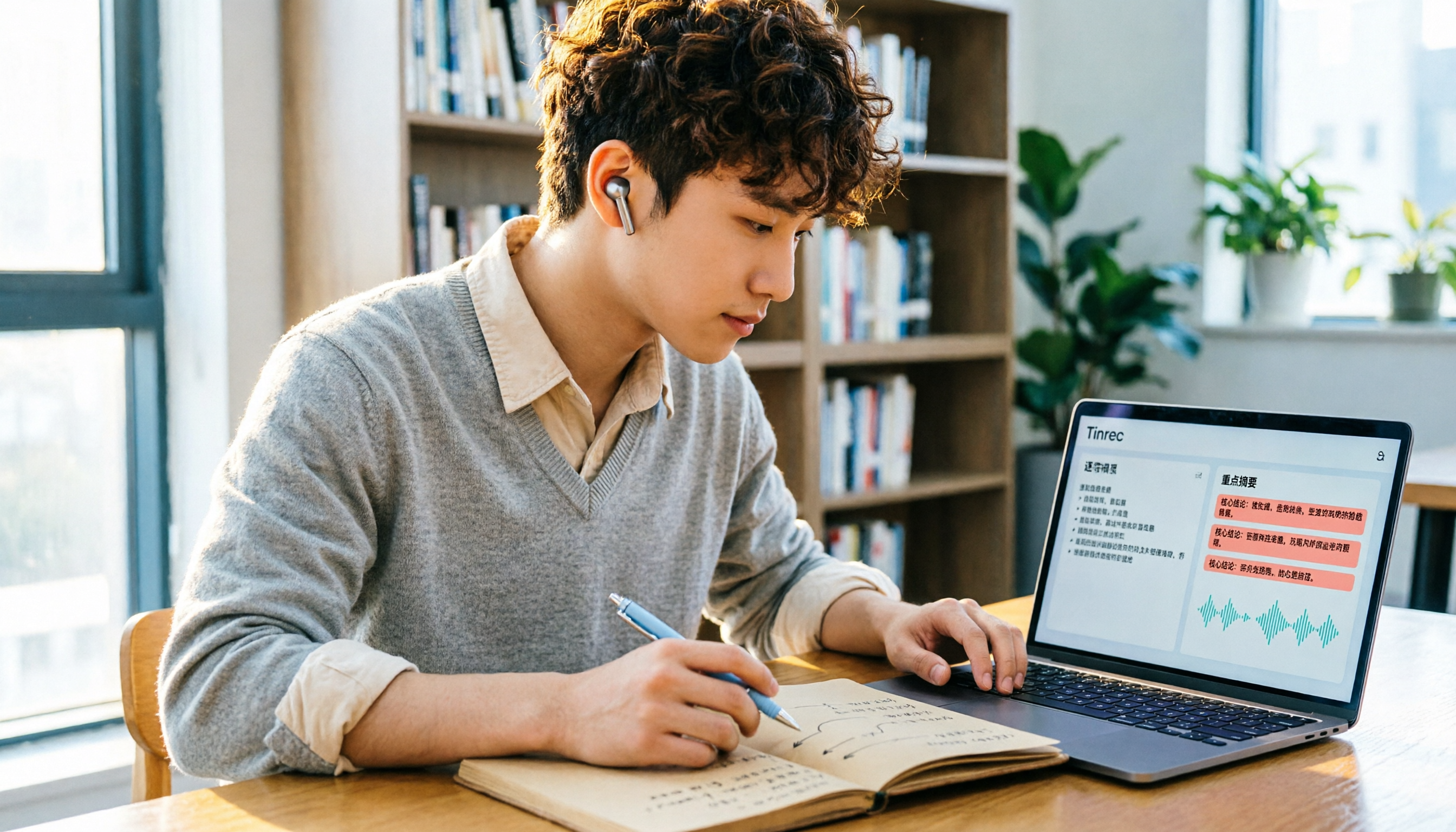
Turn recordings into transcripts and summaries in minutes
Upload audio or video for multilingual transcription, AI notes, and action items
Two hours per class, over a dozen classes a semester, plus group discussions and online lectures—your accumulated recordings easily exceed 20 hours. You can't re-listen to all of them, especially before finals. You need a tool that automatically transcribes, summarizes key points, and allows quick search. This article shares my real-world testing over a full semester to compare four AI meeting recorders, from free quotas to recording organization, so you can spend time studying instead of re-listening to recordings.
Before Choosing an AI Meeting Recorder, Understand These 5 Key Points
My criteria for choosing a tool are these 5 points, each learned after getting burned.
Accuracy: Don't just look at official claims; test with your own class recordings. Classroom echo, classmates chatting, and professors' accents all affect recognition. Tinrec's performance in Chinese and mixed Chinese-English was the most stable in tests with my roommate.
AI Summarization: After recording, can it automatically generate summaries, to-dos, or even let me ask, "Did the professor mention the final report format?" That's the key to saving time. Many tools only transcribe, leaving the organizing to you.
Cross-Platform: Record on your phone, organize on your computer; otherwise, transferring files is a nightmare. Tinrec works on phone, computer, and web, which saved me many times.
Free Quota: Students have limited budgets; how long the free version lasts is important. Some tools have restrictive free versions that don't let you experience the full workflow.
Recording Method: Can it record online meetings? Some tools require adding a bot to the meeting, but school online classes often don't allow that. Tinrec's desktop version directly captures system audio without needing a bot, which is super convenient.
Tinrec (秒听录音)—My Main Tool This Semester, Ask Key Points Right After Recording
Tinrec (秒听录音) is the AI meeting recorder I'm most satisfied with this semester. It's not just recording-to-text; it's more like an AI assistant that helps you from recording to a ready-to-submit report.
Classroom Scenario: I open the mobile app to record during class, and it generates a transcript in real time; after class, it automatically creates summaries and to-dos, like "Submit group report draft next Wednesday," which it lists automatically. The killer feature is the AI Q&A: I can ask, "Did the professor mention any must-know exam questions?" and it answers based on the recording content, not just keyword search. This is almost nonexistent in competitors at the same price point.
Test Data: We used an iPhone 13 to record a 5-minute Chinese lecture from the back of the classroom, with people whispering nearby. Tinrec's transcript had almost no errors, even capturing English technical terms the professor used. This performance was better than several other tools I tried first.
Online Meetings: Its desktop version can record online meetings without adding a bot. This is super convenient for group online discussions—my roommate had to add a bot with other tools, and it failed when the meeting link had a password.
Free vs. Paid: The free version has a basic quota; I record two three-hour classes a week, and it runs out in about two to three weeks, but it's definitely enough to experience the full workflow. The paid version costs less than a bubble tea a month; if you record every class like I do, I recommend going Pro.
Stop organizing recordings by hand
Upload audio or video and automatically get a transcript, summary, and action items
Limitations: The free quota isn't huge; heavy recorders need to pay. But for average students, starting with the free version is reasonable, and you can upgrade if you like it.
Who It's For: If you need to record Chinese classes, group discussions, or want to use AI to extract key points and ask questions after recording, and want phone-computer sync, Tinrec is currently the best choice.
Beyond Tinrec, I Also Tried These—Lessons from My Mistakes
I used other tools initially; here's a quick rundown of my trial order and thoughts.
Otter.ai: Great for English class recordings, generous 300 free minutes per month, but Chinese recognition is mediocre—many technical terms from professors are wrong, and it lacks Tinrec's AI chat to ask "What are the key points?" If you mainly record English content, Otter is worth considering; but for Chinese plus AI Q&A, Tinrec wins.
Notta: Nice interface, but the free version limits each recording to 3 minutes, so you'd have to split a class into multiple segments, which is painful. Paid features are decent, but overall Tinrec is smoother, and Notta lacks Tinrec's AI Q&A and desktop bot-free recording.
PLAUD Note: A classmate bought the recorder; the hardware alone costs $159, plus a subscription, which is tough for students. It's mainly hardware recording; online meeting handling isn't as convenient as Tinrec's direct system audio capture. If you often record in-person interviews and don't care about budget, consider it; otherwise, a phone plus Tinrec is enough.
Pitfall Guide: 4 Common Mistakes When Choosing These Tools
Pitfall 1: Only looking at official accuracy claims. Many tools claim 98% accuracy, but that's tested in a quiet recording studio. In a classroom with echo, keyboard sounds, and classmates chatting, accuracy drops significantly. Use your own class recordings for free trials; don't just rely on ads.
Pitfall 2: Using it only for transcription, ignoring AI organization. If you only use the tool for recording-to-text, you're using only a third of its capability. Tinrec's AI Q&A, for example, lets you ask "How do I submit the assignment?" right after recording, which is much faster than scanning a 30-minute transcript.
Pitfall 3: Ignoring cross-platform needs. If you record on your phone today and organize on your computer tomorrow, and the tool doesn't support cross-platform, you'll waste time transferring files. Tinrec works on phone, computer, and web, saving a lot of hassle.
Pitfall 4: Buying hardware recorders to save money. Students really don't need it; the hardware is expensive, and you still need a subscription for AI features. A phone plus a free app can handle most needs; consider hardware only if you have heavy needs later.
Summary: Which One Should You Choose?
After a semester of testing, if you're a student like me, my advice is:
- If you mainly record Chinese classes, group discussions, or need AI to extract key points → Choose Tinrec; try the free version first, and the paid version offers great value.
- If you're an English major, record only English classes, and want 300 free minutes → Consider Otter.ai.
- If you only need to record short notices or memos → Notta's free version is barely usable, but the 3-minute limit per recording is annoying.
- If you have a budget for hardware and often record in-person interviews → PLAUD Note is suitable, but not recommended for students.
Finally, I recommend downloading Tinrec's free version to try it; the basic quota is enough for two or three classes, letting you experience the full workflow. Upgrade if you like it; don't spend money upfront.
References
- 2026 Most Recommended AI Meeting Recorder: The Essential Tool for Saving Time in Meetings!
- Meeting Ink - 2026 AI Meeting Notes Tool Test: Speed Comparison of 7 Voice-to-Text and Summary Tools | Meeting Ink - AI Meeting Notes Assistant, Automatic Transcription and Summary
- How to Use AI for Meeting Minutes? How to Organize Meeting Transcripts? | AI Voice-to-Text Tutorial | 104 Career Development
- AI Meeting Notes Software Recommendations: 5 App Real-World Tests, Automatic Transcription Makes Meetings Easy!
- Struggling to Organize Meeting Notes? 5 NotebookLM "AI Note Transformation" Tricks, Accurately Translating Mixed Chinese-English and Technical Terms | BusinessNext
Turn every recording into actionable outcomes
Get 60 free transcription minutes when you sign in. No credit card required.
Related Reading
You might also like

2026 Tinrec AI Meeting Notes Tutorial: Chinese Recognition + Bot-Free Recording, a Lifesaver for Students During Finals
A senior student's hands-on comparison: Which is better for Taiwanese students, Tinrec or Otter.ai? From Chinese recognition, bot-free recording, post-transcription processing to student budgets, this complete five-dimension comparison teaches you how to use AI meeting notes to turn class recordings into finals study guides.

2026 Hands-On Comparison of 3 AI Meeting Note Tools: How Tinrec Saves 80% of Your Time with Transcripts
Tired of spending hours on meeting notes? This article tests three AI meeting note tools—Tinrec, Otter, and Notta—comparing transcript accuracy, Chinese language support, workflow, and pricing. Learn how to quickly generate transcripts and meeting summaries with Tinrec.
5 AI Meeting Note Tools Tested in 2026: Cost vs. Value at a Glance
After testing multiple AI meeting note tools, I found that most people overspend on features they don't need. This article uses Tinrec as a case study to help you understand pricing structures and truly time-saving usage.

Tinrec vs Otter 2026 Hands-On Comparison: How to Choose an AI Meeting Notes Tool for Chinese?
A hands-on comparison of Tinrec and Otter AI meeting notes tools, covering five key dimensions: bot-free recording, Chinese transcription accuracy, post-meeting summarization, export and post-processing, and team features, to help Chinese-speaking users find a more efficient meeting summary solution.

Best AI Meeting Note Tools in 2026: 5 Tested, This One Handles Chinese Best
We tested multiple AI meeting note tools, from recording and transcription to post-meeting summaries and team collaboration, to find the best fit for teams in Taiwan.

2026 Live Transcription Summary Guide: 3 Steps to Turn Classroom Recordings into Key Points
Tired of too many lecture recordings and not enough time to take notes? This student-tested guide shows you how to use Tinrec's live transcription and AI summaries to turn a two-hour class into a five-minute review, so you can stop cramming before finals.

2026 Hands-On Comparison of 3 AI Meeting Note Tools: Tinrec's Chinese Summaries and Bot-Free Recording Are Most Practical
This article compares the summarization and action item capabilities of 3 AI meeting note tools, detailing Tinrec's core features, free plan, and a 6-step tutorial, while answering common questions to help you quickly decide which tool is worth using.

The Complete Guide to AI Meeting Notes Tools in 2026: Real-World Tests and 3 Key Buying Tips
This article tests several AI meeting notes tools, showing how Tinrec can automatically generate transcripts, summaries, and action items, and compares Notta, Plaud, Otter, and more to help you avoid common buying mistakes.

2026 Hands-On Comparison of 2 AI Meeting Note Tools: Which Is More Practical—Bot-Free Recording or Team Collaboration?
A methodology-based comparison of Tinrec and PLAUD NotePin across online meeting capture, ease of use, post-meeting organization, and team collaboration to help you choose the right AI meeting notes tool.