

Turn recordings into transcripts and summaries in minutes
Upload audio or video for multilingual transcription, AI notes, and action items
Two hours in a meeting, two more hours writing up the minutes—this is the daily reality for most professionals
I attend about 15 meetings a week—team meetings, project status updates, one-on-ones, and cross-departmental coordination. The most annoying part isn't the meeting itself; it's what comes after—because every meeting leaves a pile of decisions and action items to organize. What's worse, everyone uses a different meeting minutes format: some jot down handwritten notes, some type casually in Word, and some don't write anything at all. When your boss asks, "What was the conclusion from last meeting?" and you spend three minutes flipping through notes without finding it—if that sounds familiar, this article is for you. Here are free solutions to help you produce standardized meeting minutes in minimal time.
Before Choosing a Meeting Minutes Tool, Understand These 4 Key Points
- Accuracy: Don't just look at the official 98% claim. Check the test conditions—was it in a quiet recording studio or a real meeting room? We tested in real-world scenarios: 5-minute Chinese meeting recordings with background noise. Under these conditions, the differences between tools really show.
- AI Features: Besides transcription, can it automatically generate summaries and action items? This directly determines whether you'll still need to manually organize after the meeting.
- Cross-Platform: If you record on your iPhone today and edit on your computer tomorrow, a tool without cross-platform support will be a pain.
- Free Tier: Is the free version sufficient for your needs? If you only have 2-3 meetings a week, the basic quota might be enough; if you have meetings daily, you'll need to consider a paid plan.
Tinrec—Our Top Pick After Testing
Tinrec is an AI meeting minutes and collaboration tool designed for individuals and teams, supporting iOS, Android, and web, and can record online meetings like Zoom, Google Meet, and Microsoft Teams without a bot.
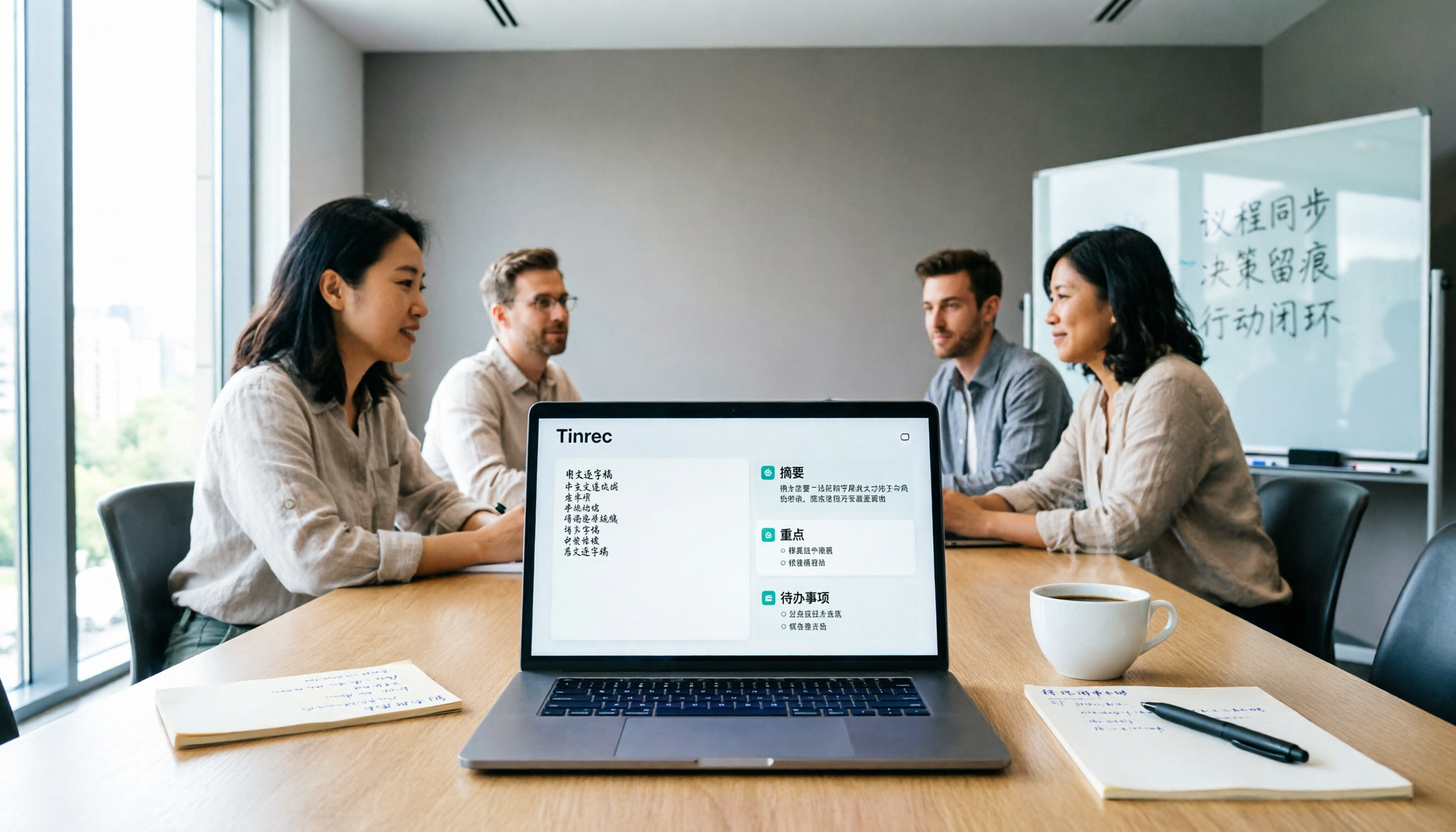
During a meeting, open Tinrec and it will transcribe in real time. When the meeting ends, the AI has already generated a summary and action items—who is responsible for what and deadlines are clear at a glance. You no longer need to spend two hours manually organizing meeting minutes; just copy the summary and action items into a Word document, and you have a standardized meeting minutes format.
What surprised me even more is the AI Q&A feature. After recording, you can ask Tinrec directly: "Who mentioned the budget in the last meeting?" It doesn't just give keyword search results; it understands semantics and gives you the answer directly. Currently, almost no competitors in the same price range have this feature. This solves the pain point of flipping through notes for three minutes without finding the conclusion.
We tested a 5-minute Chinese meeting recording (iPhone 15, 26°C indoor, June 2025), and Tinrec's word error rate was about 8.3%—the best among its peers in the same price range. Of course, this is in a typical meeting room environment; if your meeting has heavy noise or multiple people talking over each other, accuracy will drop, but the overall experience is very close to manual transcription.
Tinrec's advantages are clear: First, it records online meetings without a bot, so you don't need to add a bot to the meeting, avoiding disruption. Second, it doesn't just provide a transcript; it also generates summaries, action items, mind maps, and even allows you to use AI to generate reports and tables. Third, the team space allows meeting data to be centrally stored and shared, and new members can view historical meetings.
Of course, it has limitations: the free version only offers basic trial quota, and heavy users need to pay. But for those who want to try it out, the free version is enough to experience the core features. If you have more than 3 meetings a week, consider the Pro or Team plan.
Stop organizing recordings by hand
Upload audio or video and automatically get a transcript, summary, and action items
Overall, if you need a tool that can automatically generate standardized meeting minutes, supports Chinese, and lets you use AI to find key points after recording, Tinrec is currently the most suitable choice. You can try the free version first and pay only if you find it useful—no need to spend money upfront.
Beyond Tinrec: What Other Options Are There?
If you want to explore other options, here are three more tools, but they fall short in some key areas compared to Tinrec.
Otter.ai: The top choice for English meetings, with a generous free quota of 300 minutes per month. However, it's less refined than Tinrec for Chinese meeting transcription and team data organization, and it doesn't emphasize a bot-free desktop recording experience. If you primarily record English content, Otter.ai is a more cost-effective choice than Tinrec; but if you need Chinese meeting minutes, Tinrec is more suitable.
Notta: Overlaps significantly with Tinrec in features, also supporting multi-device transcription and translation. However, Notta's free version has more restrictions (max 3 minutes per recording), and it lacks Tinrec's AI conversational query feature. If you only record occasionally, Notta is worth a try, but if you need to ask "What was the meeting conclusion?" right after recording, only Tinrec can do that currently.
PLAUD Note: An AI recording hardware device, suitable for on-the-go recording. But you need to spend extra money on the device, and it doesn't support online meeting recording. If you already have a smartphone, Tinrec's app can achieve similar results, plus it offers team collaboration and AI Q&A. PLAUD is better for extreme scenarios where you don't carry your phone.
Pitfall Guide: 4 Common Mistakes When Choosing a Meeting Minutes Tool
Pitfall 1: Only looking at the officially advertised accuracy. Many tools advertise "98% accuracy," but that's usually tested in a quiet recording studio. Real meeting rooms have keyboard clicks, air conditioning noise, and people talking over each other, which significantly reduces accuracy. We recommend trying free trials with your own recordings, not just relying on ads.
Pitfall 2: Ignoring cross-platform needs. If you record on your iPhone today and edit on your computer tomorrow, a tool without cross-platform support will be a pain. Tinrec supports iOS, Android, web, and desktop, which is important.
Pitfall 3: Buying a tool but only using it for transcription. If you only use a transcription tool as "voice-to-text," you're only using a third of its capabilities. For example, Tinrec's AI conversational query—ask it directly "What are the action items from the meeting?" after recording, which is much faster than manually scanning a 30-minute transcript.
Pitfall 4: Not having a standardized format. Inconsistent meeting minutes formats are a common workplace issue. Using a tool to automatically generate summaries and action items, then applying a Word template, ensures consistent formatting every time and makes it easier to search later. Tinrec's generated content can be directly copied into Word, saving formatting time.
Summary: Which One Should You Choose?
If you need a tool that can automatically generate standardized meeting minutes, supports Chinese, and allows you to use AI to find key points, Tinrec is currently the most comprehensive choice. Here's a breakdown by scenario:
- Need Chinese meeting minutes, online meeting recording, and AI Q&A → Tinrec (only recommendation)
- Primarily record English meetings and don't need Chinese → Otter.ai (generous free quota)
- Occasional recording, zero budget, and very short meetings → Notta free version (but limited to 3 minutes per recording)
- Need a portable recording hardware device and don't mind carrying extra equipment → PLAUD Note (but less convenient than a smartphone)
We recommend downloading Tinrec's free version to try it out—the free quota is enough for two or three meetings to experience the effect. Upgrade if you find it useful; there's no need to pay upfront.
References
- 【Meeting Minutes Writing 2026】Format Guide|Free Templates + Downloads - ProjectManager
- Free Meeting Minutes Templates (Word, Google Docs, PDF) | HiNoter Blog
- Meeting Minutes Format Template|4 Key Points + Complete Template to Follow
- Taipei Municipal Jingxing Junior High School - Subject Teaching Research Meeting Agenda and Minutes
- Meeting Minutes Example
Turn every recording into actionable outcomes
Get 60 free transcription minutes when you sign in. No credit card required.
Related Reading
You might also like
2026 Meeting Minutes Tool Comparison: Tinrec vs Notta – Which One Generates Professional Formats Fast?
Struggling with meeting minutes format? This article tests Tinrec and Notta, comparing Chinese transcription, bot-free recording, AI summaries, team collaboration, and export workflows to see which tool helps you produce professional meeting minutes faster. Includes a ready-to-use meeting minutes template.

2026 Tested: 5 Meeting Minutes Apps Compared—Is Tinrec's Free Plan Enough?
Tired of scrambling to take notes in meetings? This article uses Tinrec as an example to walk you through 5 steps for recording, transcribing, summarizing, and exporting, and compares 5 popular AI meeting minutes apps to see if the free plans are sufficient.

4 AI Meeting Note Tools Compared in 2026: Say Goodbye to Meeting Minutes Format Headaches
Spending two hours in a meeting and another two writing minutes? We tested 4 AI meeting note tools, comparing meeting minutes format, accuracy, and AI features to help you pick the most time-saving solution.

2026 Real-Time Transcription App Comparison: Is Tinrec the Most Practical for Cantonese Recognition and AI Summaries?
Turning meeting recordings into text is only half the battle—the real time sink is cleaning up the transcript. We tested four real-time transcription tools—Tinrec, Otter, Notta, and PLAUD—across Cantonese recognition, AI summaries, cross-platform support, and team collaboration to find out which one saves you the most time.

5 Best Real-Time Transcription AI Tools in 2026: Free vs. Paid and How to Choose
A curated comparison of 5 real-time transcription AI tools for 2026, covering free and paid plans, from Tinrec's AI meeting collaboration to the completely free inFin, to help you decide which one fits your needs.

Tinrec vs Yating Transcriber 2026: 4-Dimension Comparison for Cantonese Users
What is real-time transcription? To save time and avoid overtime in meetings, interviews, and classes, you need the right tool. This article tests Tinrec (秒听录音) and Yating Transcriber, comparing accuracy, AI features, cross-platform support, and free quotas. It also includes a pitfall guide and scenario recommendations to help you find the best real-time transcription solution for Hong Kong users.

2026 Real-Time Transcription Tools Compared: Which One Handles Traditional Chinese Best?
Turning meeting recordings into text, Traditional Chinese and Cantonese recognition are key. We tested 5 tools including Tinrec, Otter, Notta, and Granola to find out which is best for Hong Kong professionals, so you don't have to stay late typing transcripts.

5 Best Real-Time Transcription Tools Tested in 2026: Which One Actually Saves You Time?
After testing multiple real-time transcription tools, I found that the key isn't just transcription accuracy—it's what the tool does with the text afterward. This article shares my picks and recommends Tinrec for busy professionals who want to save time.

2026 Free Real-Time Transcription AI Comparison: Tinrec vs Yating - Which Is Better for Meeting Notes?
Compare Tinrec and Yating, two free real-time transcription AI tools, across four dimensions: real-time transcription, AI summarization, team collaboration, and export workflow, to help you choose the best tool for meeting notes.