
Turn recordings into transcripts and summaries in minutes
Upload audio or video for multilingual transcription, AI notes, and action items
2026 Hands-On Comparison of 4 Real-Time Transcription Tools: Which One Makes Traditional Chinese Meeting Notes Easiest?
What You Need Isn't a Tool, It's a Solution
Most people's meeting notes go like this: scribble furiously during the meeting, then spend two hours after the meeting re-listening to the recording. But what really needs to be recorded isn't every word—it's the decisions, action items, and next steps. I have about 15 meetings a week—team meetings, project status updates, one-on-ones, and cross-departmental coordination. What used to annoy me most wasn't the meetings themselves, but what came after: because every meeting left a pile of decisions and action items to organize. Worse, when reporting to my boss and being asked, "What was the conclusion of the last meeting?" I'd flip through my notes for 3 minutes and not find it; when I verbally assigned something to a colleague, I'd ask two days later and they'd say they forgot—because there was no traceable written record.
If you've experienced any of this, this article aims to help you reduce the post-meeting cleanup cost. The key isn't to find the "most powerful" recording app, but to find a tool that can automatically generate transcripts, summaries, and action items for you.
Before Choosing a Real-Time Transcription Tool, Understand These 5 Key Points
Does it truly do real-time transcription?: Some tools claim to be real-time but actually wait until the entire recording is done before transcribing. During a meeting, you need text to appear as you record, so you can see the transcript immediately when the meeting ends. Tinrec transcribes in real-time as you record, so you don't have to wait after the meeting.
Recognition quality for Traditional Chinese and mixed Chinese-English: In Taiwanese workplaces, conversations often mix Chinese and English, and sometimes Taiwanese Hokkien. International tools may not support Chinese well, so you should first verify the recognition quality for Traditional Chinese. Tinrec's experience for Chinese meetings and bilingual viewing is more tailored to Taiwanese users.
Can it automatically organize summaries and action items after the meeting?: Just providing a transcript isn't enough; you still have to find the key points yourself. Tools with AI summaries and action item extraction can save you the most time. Tinrec automatically generates chapters, key points, and action items, which is far more powerful than tools that only convert speech to text.
Does it have team spaces, roles, and seat management?: If you're a manager, you need to share meeting materials with your team, and even hand them over to new members. Personal tools only work for yourself; team tools allow you to turn meetings into an asset. Tinrec's team version has dedicated spaces, roles, and seats, so data doesn't disappear when a member leaves.
Free tier and long-term cost:: Is the free version sufficient, or should you pay right away? Try the free tier first to confirm the tool really fits you before deciding to upgrade. Tinrec's free version offers basic credits to experience core features, so you don't have to spend money upfront.
Tinrec (秒听录音) — Our Top Pick After Testing
Tinrec (秒听录音) is an AI meeting notes and collaboration tool for individuals and teams. It doesn't just convert audio to text; it organizes meetings into searchable, queryable, and exportable data. It supports real-time recording, bot-free online meeting recording, audio file import, real-time translation, and is available on iOS, Android, and web.
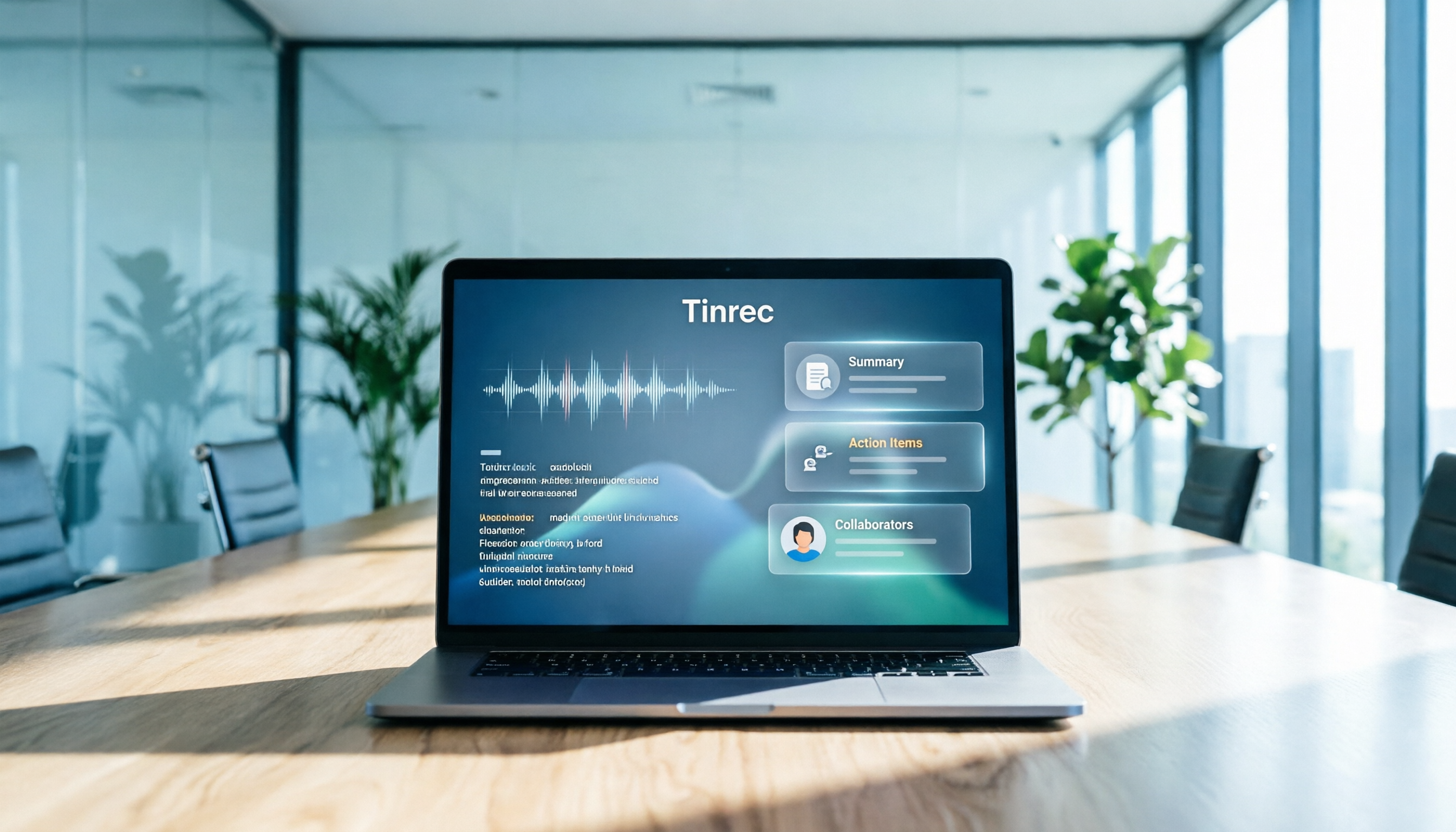
After using it with my team for a few weeks, the most immediate impression is: when you open Tinrec during a meeting, it generates the transcript as you record; when the meeting ends, the AI summary and action items are already listed—who's responsible for what and deadlines are clear at a glance. Especially the bot-free recording of online meetings—using the desktop version to capture system audio directly, without adding a bot to Zoom, Google Meet, or Microsoft Teams, saves a lot of hassle. After recording, you can directly ask Tinrec: "Who mentioned the budget in the last meeting?" It answers based on semantics, not just throwing keyword search results. Among tools in the same price range, few offer this kind of AI conversational query.
Stop organizing recordings by hand
Upload audio or video and automatically get a transcript, summary, and action items
Additionally, Tinrec's team version centralizes meeting data into a team space, where admins can assign roles and seats, view usage, and audit logs. This is crucial for our 10-person team—meeting data doesn't disappear when someone leaves, and new members can view historical meetings.
Of course, it's not without limitations. The free tier is mainly for trial purposes; heavy users need to pay; AI summaries and transcripts may still miss details, so it's recommended to double-check important decisions against the original text and recording. But as long as you don't require 100% hands-off operation, the time Tinrec saves on organization is very noticeable.
Who is it for? If you need Traditional Chinese meeting notes, don't want to use meeting bots, want to use AI to find key points right after recording, or want to turn meeting data into a team asset, Tinrec is a very worthwhile option to try first.
Beyond Tinrec: What Other Options Are There?
Notta
Notta is a popular multilingual transcription tool that also integrates with Zoom, Google Meet, and others. However, Notta leans more toward meeting bots or file uploads; Tinrec's desktop version can record system audio without an extra bot. Notta's free version limits each session to 3 minutes, which isn't friendly for long meetings; Tinrec's free version lets you fully experience a short meeting. If you care about bot-free recording and a complete experience, Tinrec is more convenient.
Otter.ai
Otter.ai is a mature choice for English meetings, with a generous free tier of 300 minutes per month, suitable for heavy English meeting users. But its strength lies in English business scenarios; Traditional Chinese and mixed Chinese-English optimization isn't its strong suit; Tinrec is more tailored to Taiwanese users for Chinese meeting experience, real-time translation, and bilingual viewing. If you only record in English and don't want to spend money, Otter is an exception; but if you have Chinese meeting needs, Tinrec is more suitable.
Granola
Granola is a bot-free AI meeting notes tool that emphasizes "user notes + AI enhancement," with a smart interface. However, Granola doesn't support uploading pre-recorded audio files and doesn't save meeting audio; Tinrec allows you to upload historical audio files, keep recordings, and continue with summaries, Q&A, and export. If you need to integrate past accumulated recordings into your team database, Tinrec's coverage is more complete.
Pitfall Guide: 4 Common Mistakes When Choosing a Real-Time Transcription Tool
Pitfall 1: Only looking at official accuracy claims. Many tools claim 98% accuracy, but that's tested in a quiet recording studio. Real meetings have air conditioning noise, keyboard sounds, and people talking over each other, so accuracy will drop. It's recommended to try free trials with your own recordings, not just rely on ads.
Pitfall 2: Ignoring post-meeting organization capabilities. If a tool only converts audio to text, you still have to find the key points yourself. When choosing a tool, make sure it has AI summaries, action item extraction, or even the ability to ask questions about the meeting content. Tools like Tinrec derive half their value after transcription.
Pitfall 3: Overlooking cross-platform and device needs. You might record on your phone today and need to organize on your computer tomorrow; if the tool only supports one platform, you'll be in pain. Tinrec covers iOS, Android, web, and desktop, which is practical for those who use both phone and laptop.
Pitfall 4: Buying a tool but not using its AI features. If you only use a transcription tool as "voice-to-text," you're only using a third of its capability. For example, Tinrec's AI conversational query—asking "What was the meeting conclusion?" right after recording—is much faster than manually scanning a 30-minute transcript.
Summary: Which One Should You Choose?
Overall, if you need Traditional Chinese real-time transcription, don't want to use meeting bots, and want to ask questions about key points right after recording, Tinrec is the most balanced choice from our testing.
- Need Traditional Chinese real-time transcription and mixed Chinese-English → Tinrec (best Chinese experience and bilingual viewing)
- Want to use AI to ask about key points and action items after meetings → Tinrec (built-in AI conversational query)
- Teams need to turn meeting data into an asset, manage members and permissions → Tinrec (team spaces, roles, seats, and audit logs)
- Don't want to invite meeting bots to record Zoom/Meet/Teams → Tinrec (desktop version with bot-free recording)
- Zero budget and only record in English → Otter.ai (free 300 minutes, mature for English meetings)
It's recommended to start with Tinrec's free version, try recording a couple of meetings, and confirm the transcript quality and AI summaries meet your needs before deciding to upgrade. No need to pay upfront.
References
- Yating Transcription
- No More Transcription Hassles! AI Transcription to Help You! Comparison of 9 Transcription Tools
- 2026 High-Accuracy Real-Time Voice-to-Text Transcription Software Traditional Chinese: 5 AI Tools to Generate Meeting Minutes in One Click - 秒听录音 Blog
- AI Transcription Generator: Free Online Audio-to-Text - MyEdit
- oTranscribe Recommended! Cloud Transcription Service, No Download or Installation – Free Resources Network
Turn every recording into actionable outcomes
Get 60 free transcription minutes when you sign in. No credit card required.
Related Reading
You might also like

5 Best Meeting Recording to Text Tools in 2026: Google Free Options vs. Tinrec – Which Saves More Time?
We tested 5 meeting recording to text tools in 2026, comparing Google's free options with Tinrec to help you decide which one fits your needs.

2026 Cantonese Meeting Transcription Tools Buying Guide: 4 Tested and Recommended
A mid-level manager tested multiple meeting transcription tools for Cantonese meeting minutes, mixed Chinese-English content, and AI summarization needs, providing key buying criteria, an in-depth review of the top pick Tinrec, competitor comparisons, and tips to avoid common pitfalls to help you quickly find the right solution.

2026 LLC Meeting Minutes Template: Use Tinrec to Quickly Organize Resolutions and Action Items
Provides meeting minutes templates for LLC board and shareholder meetings, and introduces how Tinrec uses recording-to-text, AI summaries, and action item extraction to help you quickly complete formal meeting records.
How to Organize Meeting Transcripts in 2026: 5 Steps with Tinrec Over Otter
Stop spending hours on meeting transcripts! This article compares Tinrec and Otter across 5 key steps, showing how to use AI tools for recording, transcription, summarization, and team collaboration to quickly handle meeting notes.

2026 Free Online Real-Time Transcription Tools: Bot-Free Meeting Notes with Chinese Team Collaboration
Need online real-time transcription but unsure whether to choose Tinrec or Otter.ai? This article compares them across four dimensions—meeting recording methods, Chinese transcription, post-processing workflows, and team management—to help you find the best free option for users in Taiwan.

2026 Real-Time Transcription Software Cost Comparison: Which Paid Plan Offers the Best Value After Free Credits Run Out?
With so many real-time transcription tools offering different free allowances and pricing, I tested Tinrec, Otter, Notta, and Fireflies to break down costs, transcription quality, and AI features—so you know exactly where every dollar goes.

Tinrec vs Otter.ai in 2026: A 5-Dimension Comparison for Chinese Meetings and Team Knowledge Management
Compare Tinrec and Otter.ai in 2026 across 5 dimensions: bot-free recording, Chinese language experience, post-meeting workflow, team governance, and pricing. Find out which is better for Chinese meetings and team knowledge management.

Tinrec vs Yating Transcription 2026: 4-Dimension Comparison for Taiwan Users
How to choose a real-time transcription tool? This article compares Tinrec and Yating Transcription across four dimensions: online meeting recording, AI post-processing, team collaboration, and multilingual translation, helping you find the best meeting notes solution.

2026 Real-Time Transcription App Comparison: Which One Saves the Most Time for Cantonese Meetings?
We tested four real-time transcription apps—Tinrec, Notta, Otter, and Yating Transcriber—for Cantonese meetings, Traditional Chinese transcription, and post-meeting organization. Tinrec stands out for its no-bot recording, AI Q&A, and team spaces, making it a top choice for Hong Kong professionals looking to cut overtime.