
Turn recordings into transcripts and summaries in minutes
Upload audio or video for multilingual transcription, AI notes, and action items
If you're on the fence about paying for real-time transcription software, or feeling overwhelmed by the variety of free allowances and monthly or annual fees, this article is for you.
Let's skip the tools for a moment and talk about the most practical decision: How do you determine whether a real-time transcription expense is worth it?
The answer isn't 'cheapest is best,' but rather 'after the free credits run out, are the features you truly need covered?'
So, I actually used several popular real-time transcription tools for a while, from pricing to real-world experience, and here are my observations.
Two Hours in a Meeting, Three Hours Organizing Transcripts—You Need More Than Just 'Speech-to-Text'
Meetings, interviews, classes—there's content you want to keep.
In the past, we could record audio, but then came the transcription grind—that was the real nightmare.
Now, many real-time transcription tools claim to transcribe as you record, delivering transcripts right after the meeting ends.
But here's the catch: free versions usually have usage limits, and once you hit them, you have to pay.
Paid plans vary widely—some are monthly, some annual, some tied to minute allowances, others to features.
If you only need it occasionally, the free version might suffice; but if you have meetings or interviews every week, you need to calculate the per-minute cost.
What's more, some tools are cheap but have poor Chinese transcription quality, so you still spend time correcting errors—essentially back to manual transcription.
So, choosing the right tool isn't just about price; it's about how much automation you get for your money.
Before Buying Real-Time Transcription Software, Understand These 4 Key Points
My own evaluation method breaks down 'cost' into four dimensions.
First, how long can the free allowance actually last?
Free allowances are for you to try, not for long-term use.
What you need to look at is: After the free allowance runs out, what's the cheapest paid plan? Does the minute allowance cover your monthly usage?
Some tools are generous with free credits but pricey on paid plans; others have minimal free credits but offer great value on paid plans.
Second, is transcription quality good enough in 'your real scenario'?
The 'high accuracy' touted by official marketing is usually tested in a quiet recording studio, but your meetings might have people talking nearby, keyboard sounds, or air conditioning noise.
What really matters is whether the transcript requires extensive editing in your typical environment.
Third, does the tool only do 'speech-to-text,' or does it offer post-processing?
If it just converts audio to text, it's no different from a recording file—you still have to read it yourself and find the key points.
A good real-time transcription tool should automatically generate summaries, capture action items, and even let you query meeting content via questions.
Fourth, will you only use it on your phone, or do you need multi-device sync across computer and tablet?
Cross-platform is important because meetings might happen on your computer, but you want to quickly review on your phone.
If the tool is locked to a single device, you'll be restricted.
Once you think through these four points, you won't be swayed by marketing hype.
Tinrec—My Top Pick After Real-World Testing
Tinrec is an AI meeting notes and collaboration tool, and real-time transcription is just the starting point.
My most common use case: I'm in an online meeting on my computer, open Tinrec's desktop app, and it directly captures system audio—no need to invite a bot to the meeting.
This 'no-bot' design is crucial.
Previously, with some tools, having a bot in the meeting made participants a bit uneasy; now I don't worry about that at all.
During the meeting, the transcript appears in real time on screen, so I can listen and read along, catching anything I missed with a quick glance.
When the meeting ends, the transcript is already done, and Tinrec also automatically generates summaries, chapters, and action items.
I don't have to re-listen to the recording; I just look at the summary to know the conclusions.
What I like even more is the 'AI Q&A' feature.
I can directly ask Tinrec, 'Who mentioned the budget in the last meeting?' It understands the semantics rather than just returning keyword search results.
This feature is missing from many tools in the same price range.
Stop organizing recordings by hand
Upload audio or video and automatically get a transcript, summary, and action items
My test environment: a typical office with light background conversation and keyboard sounds, conducting meetings in Chinese.
Tinrec's real-time transcription had very few errors; only occasional names or product names needed manual correction—much faster than manual transcription.
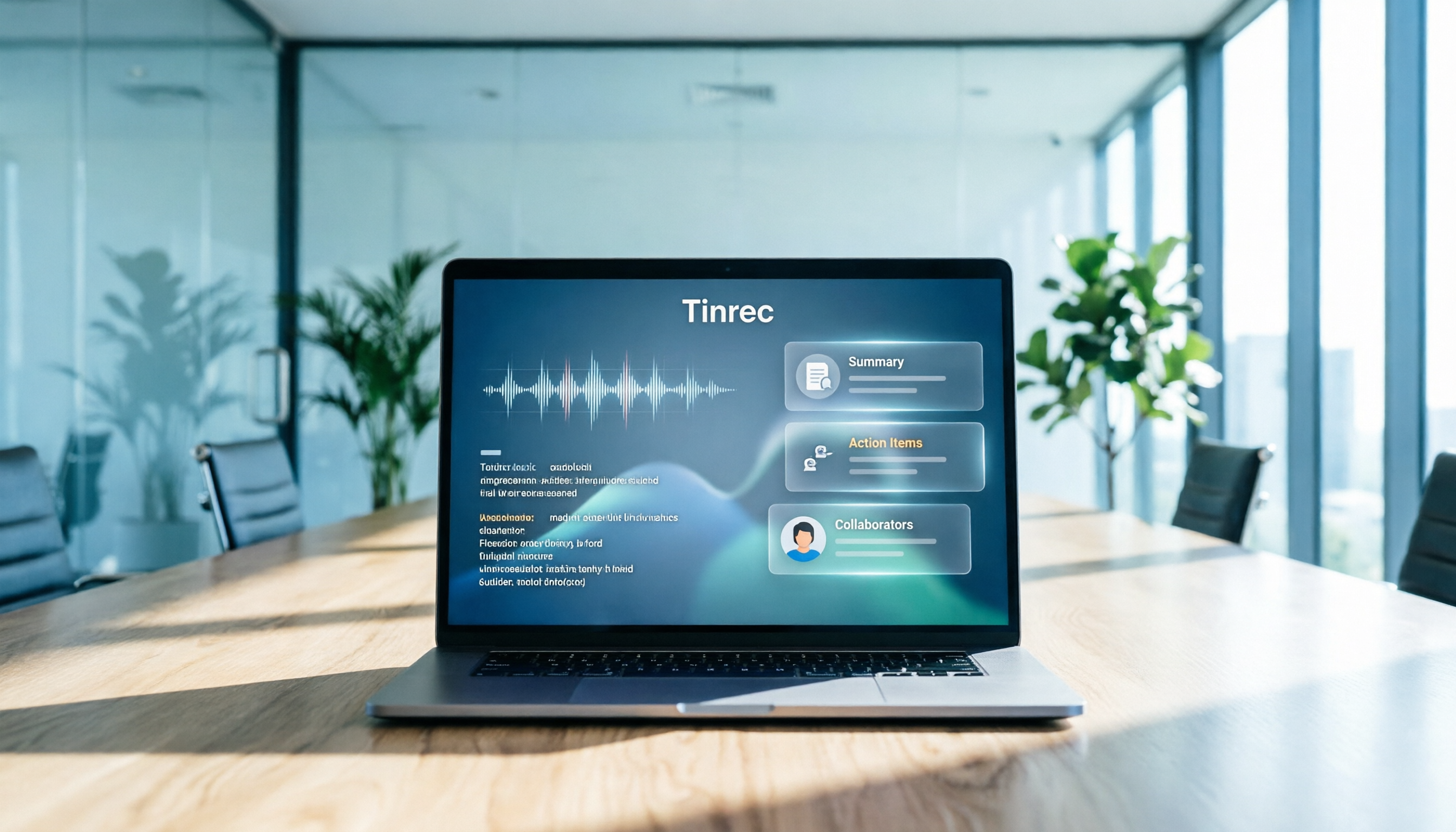
(Screenshot here: Tinrec real-time transcription screen, arrows pointing to the live text and the AI summary on the side)
As for pricing, Tinrec offers a free version with basic trial credits so you can try it out.
If you have regular meetings every week, consider the Pro plan; annual billing is more cost-effective than monthly.
For teams, Tinrec has a team plan with 2,000 shared minutes per paid seat per month, and real-time recording doesn't count against the minutes—perfect for department-wide use.
(Screenshot here: Tinrec team space interface, arrows pointing to member management and usage statistics)
Of course, the free version has limited credits, so heavy users will need to pay.
But based on my own usage, after trying the free version, upgrading to paid is worth it because the time saved far exceeds the monthly fee.
Who is it for?
If you need Chinese real-time transcription, don't want bots in your meetings, and want to use AI to find key points after recording, Tinrec is currently the best fit for my needs.
Beyond Tinrec: What Other Options Are There?
Otter.ai: A powerhouse for English meetings, with a generous free tier of 300 minutes per month.
However, in my testing, its Chinese transcription quality wasn't as stable as Tinrec's, occasionally producing awkward sentence breaks.
Also, Otter's AI Q&A is more basic, more like search, not as context-aware as Tinrec's.
If you primarily record English content, Otter is sufficient; but for mixed Chinese-English or Chinese-dominant content, Tinrec is smoother.
Notta: Feature-rich, with a free tier of 120 minutes per month and reasonably priced Pro plans.
However, Notta sometimes requires a bot to join online meetings for recording, unlike Tinrec which captures system audio directly.
Additionally, I found Notta's AI Q&A and team space management less in-depth than Tinrec's.
If you just want a quick transcription tool, Notta works; but if you need a team meeting database, Tinrec's team features are more complete.
Fireflies.ai: Focuses on meeting automation and has competitive pricing.
But Fireflies leans more toward the English market, and its Chinese real-time transcription quality, in my opinion, isn't as tailored to Taiwanese usage as Tinrec's.
Its strength lies in extensive integrations and sales analytics, not just transcript organization.
If you need strong CRM integrations, consider Fireflies; otherwise, for Chinese meetings, Tinrec offers a more direct experience.
Pitfall Guide: 4 Common Mistakes When Choosing Real-Time Transcription Software
Pitfall 1: Only looking at official accuracy claims.
Many tools claim '98% accuracy,' but that's tested in a quiet recording studio.
Real meetings have background noise and overlapping speech, so accuracy will drop.
The best approach is to test the free version with your own recordings, not just rely on ads.
Pitfall 2: Ignoring cross-platform needs.
You might have a meeting on your computer today and want to review on your phone tomorrow; if the tool doesn't support multiple devices, you'll be frustrated.
Tinrec has iOS, Android, and web versions, which gives me flexibility.
Pitfall 3: Buying a tool but only using it for 'audio-to-text.'
If you only use real-time transcription as a speech-to-text converter, you're wasting half your money.
With Tinrec's AI Q&A, you can ask 'What was the conclusion?' right after recording, which is much faster than manually scanning a 30-minute transcript.
Pitfall 4: Choosing a free version with poor transcription quality to save a few bucks.
Once your free credits run out, you find too many errors, and you still spend time correcting or even re-transcribing.
In the end, the time cost exceeds the monthly fee.
Better to choose a tool with good transcription quality and reasonable pricing from the start.
Conclusion: Which One Should You Choose?
Back to the original question: How do you choose cost-effective real-time transcription software?
My conclusion is simple: If you mainly handle Chinese meetings, dislike meeting bots, and want to use AI to organize key points after recording, Tinrec is the top choice.
Scenario recommendations:
- Need Chinese or mixed Chinese-English real-time transcription → Tinrec (best Chinese experience, no-bot recording)
- Want to use AI to ask key points and capture action items after recording → Tinrec (AI Q&A is more advanced than competitors)
- Team sharing meeting data, need member and usage management → Tinrec (team space, seat management complete)
- Zero budget, only recording English content → Otter.ai (most generous free 300 minutes)
I suggest you download Tinrec's free version to try it out; don't rush to pay.
Use the free credits for a few meetings, and you'll see if it can save you those late nights organizing transcripts.
If you like it, consider upgrading; if not, at least you'll know how to choose.
References
- Meeting voice-to-text and transcripts: Which AI tool should you use? Free vs. paid feature comparison | Manager Today
- 2026 Transcription Market Rates and Fees: Are Free AI Transcription Tools Any Good? | Tasker Articles
- Yating Transcription: Online Speech-to-Text Service, Fees at a Glance! | Future Commerce AI Tool Guide
- No More Transcript Worries! AI Transcription to the Rescue! 9 Transcription Tools Compared
- 2025 Transcription Rates from $500 | PRO360 Expert Network
Turn every recording into actionable outcomes
Get 60 free transcription minutes when you sign in. No credit card required.
Related Reading
You might also like

5 Best Meeting Recording to Text Tools in 2026: Google Free Options vs. Tinrec – Which Saves More Time?
We tested 5 meeting recording to text tools in 2026, comparing Google's free options with Tinrec to help you decide which one fits your needs.

2026 Cantonese Meeting Transcription Tools Buying Guide: 4 Tested and Recommended
A mid-level manager tested multiple meeting transcription tools for Cantonese meeting minutes, mixed Chinese-English content, and AI summarization needs, providing key buying criteria, an in-depth review of the top pick Tinrec, competitor comparisons, and tips to avoid common pitfalls to help you quickly find the right solution.

2026 LLC Meeting Minutes Template: Use Tinrec to Quickly Organize Resolutions and Action Items
Provides meeting minutes templates for LLC board and shareholder meetings, and introduces how Tinrec uses recording-to-text, AI summaries, and action item extraction to help you quickly complete formal meeting records.
How to Organize Meeting Transcripts in 2026: 5 Steps with Tinrec Over Otter
Stop spending hours on meeting transcripts! This article compares Tinrec and Otter across 5 key steps, showing how to use AI tools for recording, transcription, summarization, and team collaboration to quickly handle meeting notes.

2026 Free Online Real-Time Transcription Tools: Bot-Free Meeting Notes with Chinese Team Collaboration
Need online real-time transcription but unsure whether to choose Tinrec or Otter.ai? This article compares them across four dimensions—meeting recording methods, Chinese transcription, post-processing workflows, and team management—to help you find the best free option for users in Taiwan.

Tinrec vs Otter.ai in 2026: A 5-Dimension Comparison for Chinese Meetings and Team Knowledge Management
Compare Tinrec and Otter.ai in 2026 across 5 dimensions: bot-free recording, Chinese language experience, post-meeting workflow, team governance, and pricing. Find out which is better for Chinese meetings and team knowledge management.

2026 Hands-On Comparison of 4 Real-Time Transcription Tools: Which One Makes Traditional Chinese Meeting Notes Easiest?
A mid-level manager tests four real-time transcription tools—Tinrec, Notta, Otter, and Granola—evaluating Traditional Chinese recognition, bot-free recording, AI summaries, and team spaces to determine which is best for meeting notes and follow-up.

Tinrec vs Yating Transcription 2026: 4-Dimension Comparison for Taiwan Users
How to choose a real-time transcription tool? This article compares Tinrec and Yating Transcription across four dimensions: online meeting recording, AI post-processing, team collaboration, and multilingual translation, helping you find the best meeting notes solution.

2026 Real-Time Transcription App Comparison: Which One Saves the Most Time for Cantonese Meetings?
We tested four real-time transcription apps—Tinrec, Notta, Otter, and Yating Transcriber—for Cantonese meetings, Traditional Chinese transcription, and post-meeting organization. Tinrec stands out for its no-bot recording, AI Q&A, and team spaces, making it a top choice for Hong Kong professionals looking to cut overtime.