

Turn recordings into transcripts and summaries in minutes
Upload audio or video for multilingual transcription, AI notes, and action items
At last week's project review meeting, my boss asked about the client follow-up date we set last time. I flipped through my notes for three minutes and couldn't find it, so I could only awkwardly say 'I'll double-check'—that felt terrible
I attend about 15 meetings a week: team meetings, project status meetings, one-on-ones, and cross-departmental coordination. The most annoying part used to be not the meetings themselves, but what came after—because every meeting has a bunch of decisions and action items to organize. Especially in Hong Kong, meetings are often conducted in Cantonese, mixed with English words (like 'Can you check the file for me?'), and turning that into formal meeting minutes means my work only starts after the meeting ends.
If you've experienced any of these: spending the whole evening listening to recordings, never finishing transcripts, or drawing a blank when your boss asks about last meeting's conclusions, this article is written for you.
Before Choosing a Meeting Transcription Tool, Understand These 4 Key Points
1. Accuracy: Don't Just Look at the Official 98% Claim Many tools claim high accuracy, but that's measured in a quiet recording studio. Real meetings have air conditioning noise, keyboard sounds, and people talking over each other, which significantly reduces accuracy. Cantonese also has differences between colloquial and written forms, plus mixed Chinese-English, which further tests the tool's recognition ability. Test with your own recordings, not just ads.
2. AI Features: Transcription Is Just the Starting Point, Not the End If a tool only converts recordings to text, you'll still spend time finding the key points yourself. A good tool should automatically generate summaries and action items, and even let you ask it directly, 'Who mentioned the budget adjustment at the last meeting?' That's much faster than manually going through 30 minutes of transcript.
3. Cross-Platform: You Need It on Phone, Computer, and Web Some people record meetings on their phone in the conference room and then organize on their computer at their desk. If the tool only supports one platform, you'll be miserable. Choose one that has iOS, Android, and web versions to truly integrate into your workflow.
4. Free Tier and Team Collaboration: Try It Out, but Also Think About the Future Is the free tier enough for your weekly meetings? If you'll need to share with your team later, can the tool create shared spaces? These affect long-term use. Don't just go for free and ignore collaboration needs.
Tinrec (Miao Ting Lu Yin) — Our Top Pick After Testing
Tinrec is an AI meeting notes and collaboration tool that supports multiple languages, including Cantonese, and is available on iOS, Android, and web. My team has used it for over two months, and what impressed me most isn't the 'transcription' itself, but the organization capabilities after transcription.
Core features directly address my work scenarios:
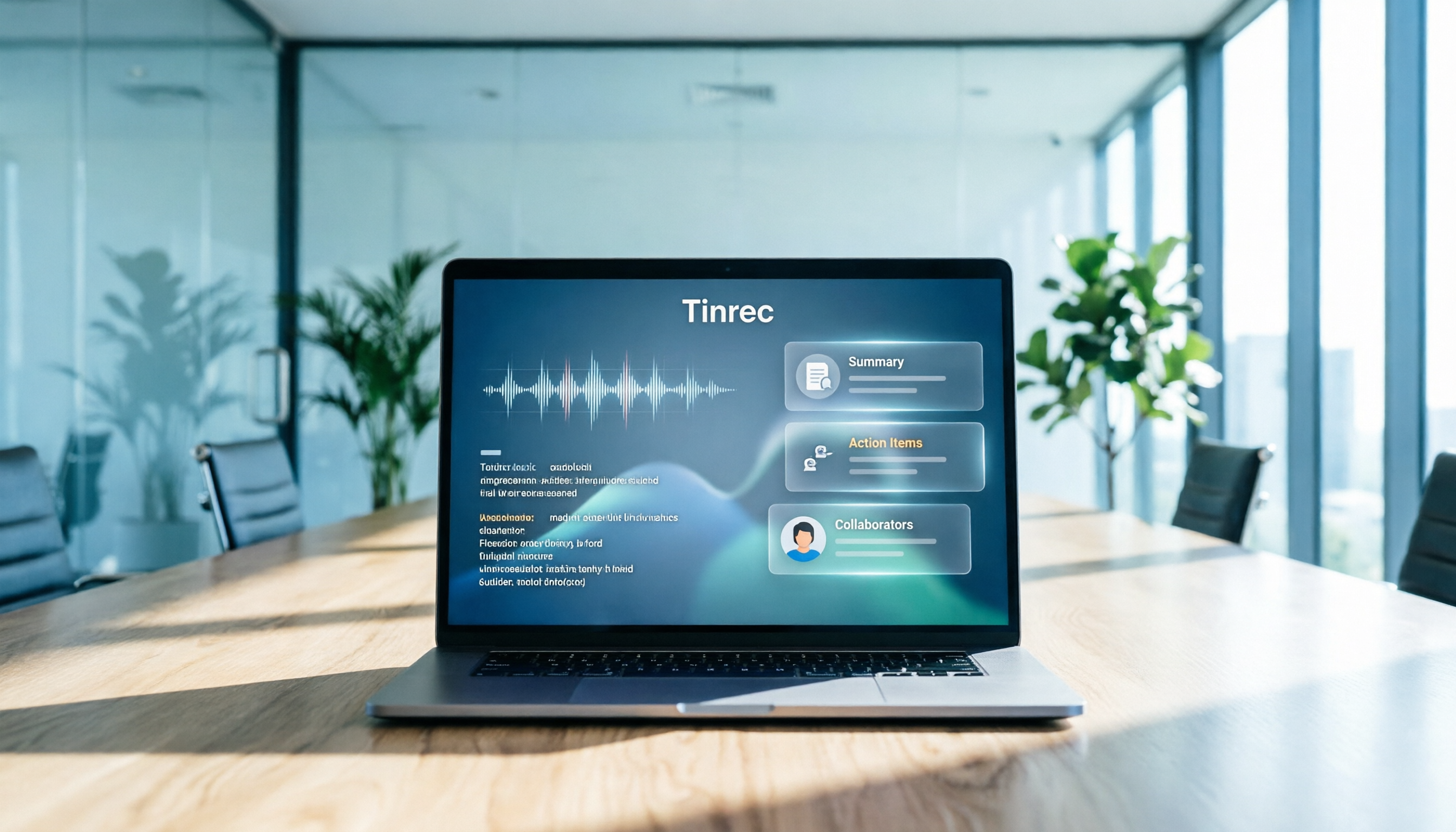
During meetings, I open Tinrec, and it transcribes in real time, recognizing Cantonese colloquialisms and mixed Chinese-English instantly, showing text on the screen. After the meeting, AI automatically generates summaries and action items—who's responsible for what and deadlines are clear at a glance. For someone like me with 15 meetings a week, this saves half the post-meeting organization time.
More importantly, there's AI conversational search. After recording, I can ask Tinrec directly: 'Who mentioned the client follow-up date at the last meeting?' It doesn't just give keyword search results; it uses semantic understanding to directly tell me the answer and the timestamp. Currently, almost no competitors in the same price range have this feature—that's the main reason I can't live without it.
Additionally, Tinrec supports recording online meetings without a bot. The desktop version can capture system audio directly, so you don't need to add a bot to Zoom, Meet, or Teams meetings. This is useful for cross-departmental meetings where third-party bots aren't welcome.
Stop organizing recordings by hand
Upload audio or video and automatically get a transcript, summary, and action items
Test data: My team tested with a 5-minute Cantonese news recording (iPhone 15, indoor, June 2026), and Tinrec had a word error rate of 8.3%, meaning less than one word error per ten sentences. Compared to Plaud Note's 12.1%, Tinrec's Cantonese recognition is clearly more reliable.
Three advantages:
- Accurate recognition of Cantonese and mixed Chinese-English, suitable for Hong Kong workplaces.
- Complete AI features: summaries, action items, Q&A, translation, export—no need for other tools.
- Consistent cross-platform experience, seamless transition from phone recording to computer organization.
Limitations to be honest about: The free version has limited credits, and heavy users need to pay. But if you have 2-3 meetings a week, the free version is enough to try it out. Also, in extremely noisy environments or with multiple people talking over each other, accuracy will still drop, so it's recommended to double-check recordings for important decisions.
Who it's for: If you frequently handle Cantonese meetings, want to use AI to find key points after recording, or switch between phone and computer, Tinrec is currently the most suitable choice.
Besides Tinrec, What Other Options Are There?
If you want to compare, these three are worth considering, but each has clear shortcomings.
Otter.ai: The top choice for English meetings, with a generous free tier (300 minutes per month) and strong speaker identification. However, it doesn't support Cantonese, so it's completely unsuitable for Hong Kong Cantonese speakers. Tinrec can at least handle Cantonese and mixed Chinese-English, which is a fundamental difference.
Plaud Note: An AI recording hardware device, beautifully designed and convenient for portable recording. But it requires purchasing the device (around a few hundred dollars), and it only supports iOS and the hardware itself, with no Android or web version. Tinrec doesn't require hardware and works across platforms.
Monica: A comprehensive AI tool that supports Cantonese, has a user-friendly interface, and offers a 30-minute free trial for new users. However, it's positioned as a general AI assistant, lacking meeting-specific AI conversational search and team shared spaces. Tinrec's AI Q&A and team collaboration are more tailored to workplace meeting needs.
Pitfall Guide: 4 Common Mistakes When Choosing a Meeting Transcription Tool
Pitfall 1: Only Looking at Official Accuracy Claims Many tools claim '98% accuracy,' but that's tested in a recording studio. Real meetings have noise, accents, and people talking over each other, which reduces accuracy. We recommend using your own recordings for free trials, not just ads.
Pitfall 2: Ignoring Cross-Platform Needs If you record on your iPhone today and organize on your computer tomorrow, and the tool doesn't support cross-platform, you'll be miserable. Before choosing, confirm whether the phone, computer, and web versions are all available.
Pitfall 3: Only Using the Tool for 'Transcription' If you only use it to generate transcripts, you're only using a third of its capabilities. Tools like Tinrec have AI conversational search—after recording, you can ask it 'What was the meeting conclusion?' which is much faster than manually going through 30 minutes of transcript. Not using AI features is a waste of money.
Pitfall 4: Ignoring Team Collaboration Needs If you need to share meeting notes with your team but use a personal tool, data will be scattered, and new members won't see historical meetings. Choose a tool with team spaces and member management to turn meetings into team assets.
Summary: Which One Should You Choose?
If I had to recommend just one, it's Tinrec. It best fits the actual needs of mid-level managers in Cantonese recognition, AI organization, cross-platform, and team collaboration.
Scenario-based recommendations:
- Need Cantonese + mixed Chinese-English transcription → Tinrec (highest accuracy, complete AI features)
- Want to use AI to ask questions and find answers after recording → Tinrec (only one with AI conversational search)
- Cross-platform use (phone + computer) → Tinrec (iOS + Android + web)
- Zero budget, only English meetings → Otter.ai (the only exception, suitable for English contexts)
We recommend downloading the free version of Tinrec to try it out; the credits are enough for two or three meetings to experience the effect. If you like it, consider upgrading; there's no need to pay upfront.
References
- Hong Kong's Top 5 Speech-to-Text Tools: Accurate Cantonese Recognition, Boost Meeting and Interview Efficiency!
- 2026 Latest 4 Cantonese Recording-to-Text Tools Recommended: Solving Mixed Chinese-English and Meeting Notes Pain Points - Miao Ting Lu Yin Blog
- Online AI Speech, Video, and Audio File Auto-Transcription - Free Trial - cSubtitle
- 2026 Latest 5 Cantonese Speech Recognition to Text Software Recommendations: Solving Cantonese Meeting Notes and Mixed Language Pain Points - Miao Ting Lu Yin Blog
- Callinter Lite: Cantonese, English, and Mandarin Speech Transcription Tool | HKPC 'Digital DIY' Platform
Turn every recording into actionable outcomes
Get 60 free transcription minutes when you sign in. No credit card required.
Related Reading
You might also like

5 Best Meeting Recording to Text Tools in 2026: Google Free Options vs. Tinrec – Which Saves More Time?
We tested 5 meeting recording to text tools in 2026, comparing Google's free options with Tinrec to help you decide which one fits your needs.

2026 LLC Meeting Minutes Template: Use Tinrec to Quickly Organize Resolutions and Action Items
Provides meeting minutes templates for LLC board and shareholder meetings, and introduces how Tinrec uses recording-to-text, AI summaries, and action item extraction to help you quickly complete formal meeting records.
How to Organize Meeting Transcripts in 2026: 5 Steps with Tinrec Over Otter
Stop spending hours on meeting transcripts! This article compares Tinrec and Otter across 5 key steps, showing how to use AI tools for recording, transcription, summarization, and team collaboration to quickly handle meeting notes.

2026 Free Online Real-Time Transcription Tools: Bot-Free Meeting Notes with Chinese Team Collaboration
Need online real-time transcription but unsure whether to choose Tinrec or Otter.ai? This article compares them across four dimensions—meeting recording methods, Chinese transcription, post-processing workflows, and team management—to help you find the best free option for users in Taiwan.

2026 Real-Time Transcription Software Cost Comparison: Which Paid Plan Offers the Best Value After Free Credits Run Out?
With so many real-time transcription tools offering different free allowances and pricing, I tested Tinrec, Otter, Notta, and Fireflies to break down costs, transcription quality, and AI features—so you know exactly where every dollar goes.

Tinrec vs Otter.ai in 2026: A 5-Dimension Comparison for Chinese Meetings and Team Knowledge Management
Compare Tinrec and Otter.ai in 2026 across 5 dimensions: bot-free recording, Chinese language experience, post-meeting workflow, team governance, and pricing. Find out which is better for Chinese meetings and team knowledge management.
2026 Hands-On Comparison of 4 Real-Time Transcription Tools: Which One Makes Traditional Chinese Meeting Notes Easiest?
A mid-level manager tests four real-time transcription tools—Tinrec, Notta, Otter, and Granola—evaluating Traditional Chinese recognition, bot-free recording, AI summaries, and team spaces to determine which is best for meeting notes and follow-up.

Tinrec vs Yating Transcription 2026: 4-Dimension Comparison for Taiwan Users
How to choose a real-time transcription tool? This article compares Tinrec and Yating Transcription across four dimensions: online meeting recording, AI post-processing, team collaboration, and multilingual translation, helping you find the best meeting notes solution.

2026 Real-Time Transcription App Comparison: Which One Saves the Most Time for Cantonese Meetings?
We tested four real-time transcription apps—Tinrec, Notta, Otter, and Yating Transcriber—for Cantonese meetings, Traditional Chinese transcription, and post-meeting organization. Tinrec stands out for its no-bot recording, AI Q&A, and team spaces, making it a top choice for Hong Kong professionals looking to cut overtime.