

Turn recordings into transcripts and summaries in minutes
Upload audio or video for multilingual transcription, AI notes, and action items
Common Misconception: Transcript Translation Isn't a "Post-Meeting Task"
Many people think "transcript translation" means uploading a recording and waiting for it to be translated. But the real need for real-time translation is understanding what the other party is saying while the meeting is still in progress.
In cross-border online meetings, foreign client presentations, and offline seminars, waiting until the meeting ends to translate the transcript often means missing the right moment to respond.
Inefficient approach: Record first, then use another translation tool to translate, and finally manually cross-reference the original and translated text, switching between windows and wasting a lot of time.
A more reasonable approach is to choose a tool that supports both "real-time transcription" and "real-time translation," so you can see bilingual transcripts as you record.
In this article, we'll compare four common real-time transcription and translation tools through hands-on testing to help you find the best fit.
Before Choosing a Real-Time Transcription & Translation Tool, Understand These 4 Key Points
Real-time performance: How low does the translation latency need to be to be usable? If the transcript and translation lag by several seconds, the meeting rhythm will be disrupted. Our testing standard: Can the translation follow within 2 seconds after the original text appears?
Language combinations: Which languages do you need? If it's just English to Chinese, there are many options; but if you need mixed Chinese-English or even multilingual meetings, you'll need to look at the tool's ability to recognize Chinese and mixed speech.
Cross-platform support: Can you use it on mobile, desktop, and web? Especially if meetings are held on Zoom, Meet, or Teams, can the tool record computer audio directly instead of requiring an external microphone or speakerphone?
Free quota sufficiency: Free versions usually have minute limits, so calculate your weekly meeting volume. Also, check whether the free version limits recording length or translation features.
Tinrec (秒听录音) — Our Top Pick After Testing
Tinrec (秒听录音) is an AI meeting notes and collaboration tool that supports multiple languages, covering iOS, Android, and web. The free plan offers basic recording and transcription quotas, making it suitable for professionals and teams needing real-time transcript translation.
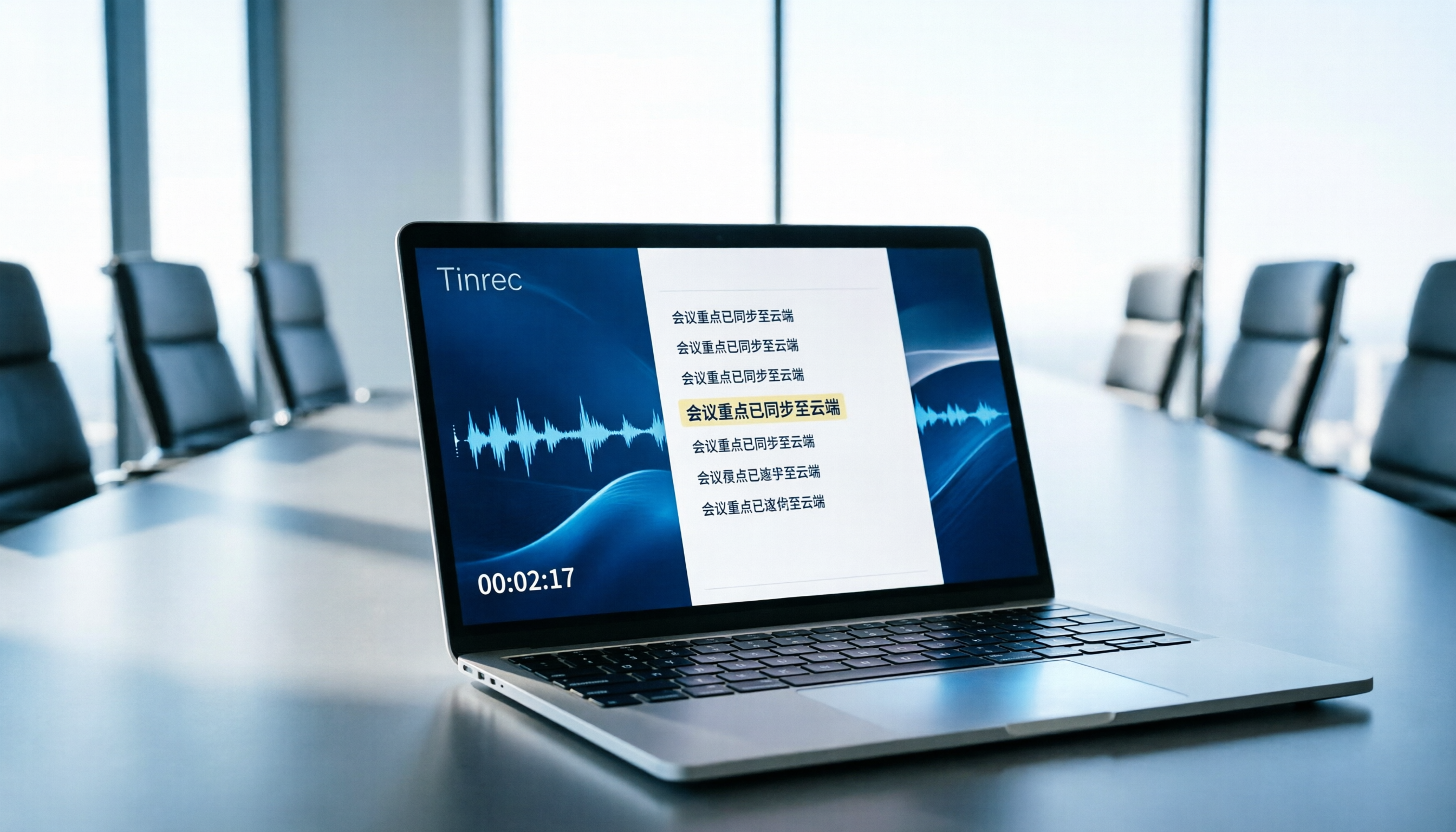
Real-time recording, transcription, and translation: In our actual test, we played an English meeting video on a laptop and opened the Tinrec desktop app. It directly captured system audio without needing to add a bot to the meeting. The left side of the screen showed the English transcript, and the right side could switch to Chinese translation, almost in sync. Mixed Chinese-English conversations were also correctly recognized without additional language settings.
Post-meeting organization features: After recording, Tinrec automatically generates summaries, chapters, and action items, and can even convert meeting content into documents or tables. What impressed me most was the AI Q&A feature: you can ask, "Who mentioned the budget deadline earlier?" and it will find the answer from the audio, rather than giving you a bunch of keyword search results.
Bot-free recording: If you often use Zoom, Meet, or Teams for meetings, the Tinrec desktop app can record computer audio, so participants won't see an extra bot join the meeting. This is friendly for clients or external partners who prefer not to be disturbed.
Stop organizing recordings by hand
Upload audio or video and automatically get a transcript, summary, and action items
Pros summary: Overall, Tinrec's real-time translation performs stably in Chinese-language scenarios. The free version lets you experience core features, and paid plans are affordable (check the official website for the latest pricing). It's suitable for those who need real-time Chinese-English translation, frequently have online meetings, and want quick post-meeting data organization.
Limitations: The free version has limited quotas, so heavy users will need to pay; also, real-time translation accuracy can be affected by background noise and accents, so it's advisable to replay and verify important content. However, for typical meeting scenarios, it can significantly reduce manual organization time.
Beyond Tinrec: What Other Options Are There?
Notta: Notta is a tool that emphasizes multilingual transcription and translation, with features similar to Tinrec and team plans. However, its meeting recording often requires adding a bot or is primarily file-upload based; Tinrec's desktop bot-free recording is better for situations where you don't want to disturb the meeting. If you only use your phone for recording and don't need real-time translation, Notta is worth considering; but if you need to record system audio and view bilingual transcripts simultaneously, Tinrec is more convenient.
Otter.ai: Otter is a popular choice for English meetings, with a generous free quota (300 minutes per month) and mature English recognition. However, its real-time Chinese translation is not a strong suit, especially with mixed Chinese-English or Taiwanese accents, where accuracy drops; Tinrec offers more stable recognition for Chinese and mixed speech. If you primarily record English meetings and don't need much Chinese translation, Otter is a reasonable choice; but if you need both Chinese and English, Tinrec is more suitable.
TurboScribe: TurboScribe focuses on high-cost-performance file transcription, suitable for batch processing large audio files, with single files up to 10 hours. However, it is not a real-time translation tool and lacks "record and translate simultaneously" functionality. You have to upload after recording and wait for translation, which is not suitable for scenarios requiring real-time understanding during meetings. If you only occasionally need to translate pre-recorded interview recordings, TurboScribe is cheap and effective; but for real-time transcript translation, Tinrec is the way to go.
Pitfall Guide: 3 Common Mistakes When Choosing Real-Time Transcription & Translation Tools
Pitfall 1: Only looking at the number of supported languages, ignoring "mixed Chinese-English" recognition. Many tools claim to support over 100 languages, but they stumble when a sentence mixes Chinese and English. We recommend testing the free version with your actual meeting recordings, not just relying on official specs.
Pitfall 2: Assuming that having a translation feature means "real-time". Some tools only translate after the recording ends and is uploaded, which is too late during a meeting. Make sure to confirm whether "real-time" means the transcript is displayed synchronously or if translation happens afterward.
Pitfall 3: Ignoring the recording method. If you frequently use video conferencing but choose a tool that can only record via microphone, you'll have to use speakerphone or additional wiring, resulting in poor audio quality and hassle. The Tinrec desktop app can directly record computer system audio, which was a big plus in our testing.
Summary: Which One Should You Choose?
- Need real-time Chinese-English translation, frequently use online meetings, and don't want an extra bot joining → Tinrec (free version available for testing).
- Pure English meetings with a limited budget → Otter.ai (free quota of 300 minutes/month).
- Large volumes of pre-recorded audio needing translation, no real-time requirement → TurboScribe.
- Need multiple languages but can accept a meeting bot → Notta.
Final reminder: We recommend testing the free version over a couple of meetings to confirm that recognition and translation quality meet your needs before considering a paid plan. Tinrec's free quota may be limited, but it's enough to experience core features, so give it a try.
References
Turn every recording into actionable outcomes
Get 60 free transcription minutes when you sign in. No credit card required.
Related Reading
You might also like

2026 Real-Time Transcription Comparison Chart: 3 Key Differences to Help You Decide If Tinrec Is Worth It
A real-time transcription tool isn't just about accurate conversion—what matters is whether you can organize, track, and collaborate on the text afterward. Using Tinrec as an example, this article walks you through the core capabilities, use cases, and buying considerations for real-time transcription tools, and provides a simple comparison chart to help you quickly decide.

2026 Real-Time Transcription Tools Compared: Why Tinrec Beats Yating for Team Meetings?
This article addresses the common meeting documentation needs of users in Taiwan, comparing real-time transcription tools such as Tinrec and Yating. It analyzes aspects like bot-free online meeting recording, team collaboration, and AI post-processing to help you decide which is more suitable for individuals and teams.
2026 Comparison of 3 Real-Time Transcription Tools: Tinrec's Bot-Free Recording + AI Q&A Saves the Most Time
We tested three real-time transcription AI tools—Otter, Notta, and Tinrec—comparing meeting recording, AI summaries, Q&A features, and free tiers. Tinrec records online meetings without a bot, and its Chinese transcription and AI Q&A best fit the needs of users in the US. This guide helps you choose without pitfalls.
2026 Real-Time Transcription Cost Comparison: AI Tools, Human Transcription, and Tinrec – Which Saves You the Most?
How much does real-time transcription cost? This article compares the cost structures of human transcription, general AI tools, and Tinrec, analyzing which option offers the best value in real-world scenarios.

2026 Real-World Test of 3 Real-Time Transcription Tools: Beyond Yating Transcriber, Is Tinrec Better for Workplace Teams?
After testing three real-time transcription tools, a mid-level manager found that Tinrec better meets workplace needs with bot-free online meeting recording, AI summaries and action item extraction, and team collaboration spaces. This article uses real meeting scenarios to show how Tinrec saves time on meeting notes, compares it with Yating Transcriber, and helps you choose the right tool.
Best Real-Time Transcription Platforms in 2026: We Tested 3, and This One Offers the Best Value for Chinese Meetings
Looking for a real-time transcription platform but unsure about the costs? This article tests Tinrec, Otter.ai, and Notta, comparing pricing, accuracy, AI features, and team collaboration to help you find the most cost-effective option.

7 Real-Time Transcription Tools Tested in 2026: Which One Really Turns Your Meetings into Searchable Data?
Real-time transcription isn't just about converting speech to text—it's about what you do afterward: organizing, searching, and collaborating. This hands-on review rethinks how to choose a transcription tool, comparing 7 options including Tinrec, Otter, and Notta to help you find the one that truly fits your workflow.

Tinrec vs Yating Live Transcription in 2026: A 5-Dimension Showdown—Which Real-Time Transcription Tool Wins?
We tested Tinrec and Yating Live Transcription across five dimensions—accuracy, real-time performance, post-processing, cross-platform support, and free tier—to help you decide which real-time transcription tool is best for users in Taiwan. Includes sample live transcripts and a guide to common pitfalls.
2026 Online Real-Time Transcription: Free Options + Instant Transcription
Looking for truly free online real-time transcription tools? This guide uses Tinrec to demonstrate the complete workflow, from recording to organizing meeting notes, covering key selection criteria and common questions.