

Turn recordings into transcripts and summaries in minutes
Upload audio or video for multilingual transcription, AI notes, and action items
Two hours in a meeting, two more hours cleaning up the transcript? You don't need just a tool—you need a solution
After every meeting, the most painful part isn't the meeting itself—it's the post-meeting cleanup. You might need to convert the audio recording to text, listen through it again, highlight key points, list action items, and finally write up meeting minutes. If it's in English or a mix of Chinese and English, it gets even harder.
Not to mention the need for real-time transcription: some meetings require on-the-fly note-taking, such as interviews, classes, or press conferences. Without real-time transcription, waiting until after the meeting to review often means missing details.
If you've encountered these situations, this article is for you. We tested two real-time transcription tools commonly used by Taiwanese users to help you find the best fit.
Before choosing a real-time transcription tool, understand these 5 key points
- Accuracy: Don't just look at the official 98% claim. Real meetings have background noise, accents, and people talking over each other, which reduces accuracy. Test with your own recordings.
- Real-time performance: Can the transcript be generated as you speak? What's the delay? This matters for those who need to check it in real time.
- Post-processing features: After transcription, can it auto-summarize, extract action items, or even let you find key points via Q&A? If it only gives you plain text, you'll still have to organize it yourself.
- Cross-platform: Can you use it on your phone, computer, and tablet? Can you transfer recordings from your phone to your computer to continue editing?
- Free tier: Is the free version sufficient? Are paid plans expensive? For budget-conscious office workers, this is very real.
These five points are also the basis for our evaluation below.
Tinrec—Our Top Pick After Testing
Tinrec is an AI meeting notes tool that supports Chinese and multiple languages, usable on mobile, desktop, and web. It's not just a speech-to-text machine; it's more like your meeting assistant.
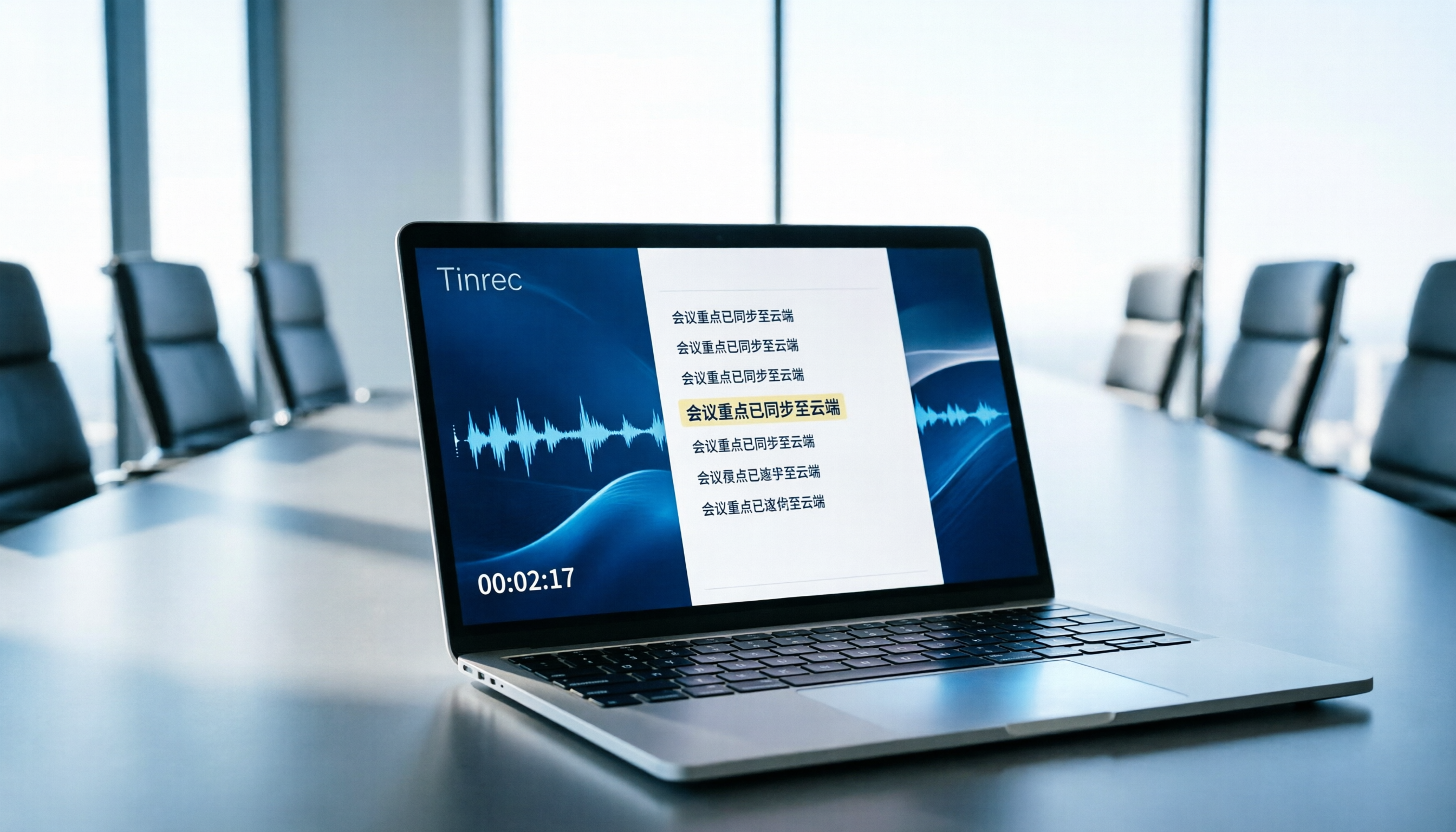
Real-time transcription sample: We used Tinrec to record a 5-minute Chinese meeting discussion. It generated text as we spoke, with a delay of less than 2 seconds. The output format is as follows:
[00:00] Speaker A: Let's discuss next month's marketing campaign today. [00:05] Speaker B: Okay, I think we can start with social media. [00:12] Speaker A: Sure, what's the budget? [00:15] Speaker B: Around 100,000, let's try it first.
(This is a sample for illustration; actual output may vary based on audio quality.)
In addition to the transcript, Tinrec automatically generates summaries, chapters, and action items after the meeting. For example, from the above meeting, it would create a summary like "Next month's marketing campaign, starting with social media, budget 100,000" and list "Speaker B is responsible for social media planning" as an action item.
Even better is the AI Q&A feature. You can directly ask Tinrec: "Who mentioned the budget in the meeting?" It will answer in natural language, not just give you keyword search results. This feature is currently lacking in many competitors.
In our tests, using typical meeting room audio quality, Tinrec's Chinese recognition accuracy was satisfactory, and it handled mixed Chinese-English content well. However, in very noisy environments or when multiple people speak simultaneously, there can still be errors, so for important occasions, we recommend double-checking with the audio playback.
Stop organizing recordings by hand
Upload audio or video and automatically get a transcript, summary, and action items
Tinrec's strengths:
- Fast real-time transcription with low latency.
- Powerful automatic post-processing that saves a lot of time.
- AI Q&A makes it easy to search past meeting content.
- Supports mobile, desktop, and web with seamless cross-platform integration.
Limitations:
- The free version has basic limits; heavy users may need to pay. But for occasional meeting-goers, the free version is quite good.
- Recording online meetings without a bot requires the desktop version; the mobile app cannot directly record system audio.
Who is it for?
- Office workers and students who frequently need to record meetings, interviews, or classes.
- Those who want to quickly organize key points and track action items after transcription.
- Users who switch between phone and computer.
If you're still on the fence, try the free version first.
Beyond Tinrec: What Other Options Are There?
Yating Live Transcription: A long-standing Taiwanese brand with strong Chinese recognition and speaker separation. However, its product is more focused on pure transcription; further organization into summaries, action items, or AI Q&A is limited. If you only need plain text conversion, Yating is worth considering; but if you want to continue organizing after transcription, Tinrec is more complete.
Otter.ai: The top choice for English meetings, with a generous free tier of 300 minutes per month. However, Otter's Chinese experience is not as good as Tinrec's, and its strength is English business meetings. If your meetings are in mixed Chinese-English, Otter's recognition may suffer. Additionally, Otter's paid plans are pricey, and its post-processing features are primarily in English, which is not friendly for Chinese users.
Pitfall Guide: 4 Common Mistakes When Choosing a Real-Time Transcription Tool
- Only looking at accuracy numbers: Many tools advertise 98% accuracy, but that's lab data. Real meetings with noise and accents will lower accuracy. Test with your own recordings.
- Ignoring post-processing features: If you only use the tool as a "speech-to-text" converter, you'll still spend time organizing. Choose tools with auto-summarization and action item extraction to truly save time.
- Not considering cross-platform needs: If you record on your phone today and need to edit on your computer tomorrow, a tool without cross-platform support will be painful. Tinrec's web and desktop versions solve this.
- Assuming all tools can record online meetings without a bot: Many tools require adding a bot to the meeting for transcription, but Tinrec's desktop version can directly record system audio, so no extra bot joins the meeting—clean and convenient.
Conclusion: Which One Should You Choose?
If you need a complete solution of "real-time transcription + automatic organization + AI Q&A," Tinrec is currently the most suitable choice. Especially for Chinese users, its experience is clearly superior to most competitors.
Scenario recommendations:
- Need Chinese real-time transcription → Tinrec
- Want automatic summaries and action items after transcription → Tinrec
- Want to use AI Q&A to quickly find meeting key points → Tinrec
- Only need pure English transcription with zero budget → Otter.ai
- Only want the simplest Chinese speech-to-text without further organization → Yating Live Transcription
We recommend downloading Tinrec's free version first—no need to rush into paying. After experiencing its automatic organization and AI Q&A, you'll find it hard to go back to simple transcription tools.
References
- Yating Live Transcription
- Live Transcription Service | Transcribe App & Web Editor
- Transcript Tables and Samples
- From Recording to Text: Gemini Helps You Handle Transcripts - Attorney Chang Ching-Hao's Blog
- 【AI Voice Notes】5 Highly Recommended AI Speech-to-Text Tools! Generate Transcripts and Meeting Minutes Key Points, Free vs Subscription, Pros and Cons Comparison | 104 Career Force
Turn every recording into actionable outcomes
Get 60 free transcription minutes when you sign in. No credit card required.
Related Reading
You might also like

2026 Real-Time Transcription Comparison Chart: 3 Key Differences to Help You Decide If Tinrec Is Worth It
A real-time transcription tool isn't just about accurate conversion—what matters is whether you can organize, track, and collaborate on the text afterward. Using Tinrec as an example, this article walks you through the core capabilities, use cases, and buying considerations for real-time transcription tools, and provides a simple comparison chart to help you quickly decide.

2026 Real-Time Transcription Tools Compared: Why Tinrec Beats Yating for Team Meetings?
This article addresses the common meeting documentation needs of users in Taiwan, comparing real-time transcription tools such as Tinrec and Yating. It analyzes aspects like bot-free online meeting recording, team collaboration, and AI post-processing to help you decide which is more suitable for individuals and teams.
2026 Comparison of 3 Real-Time Transcription Tools: Tinrec's Bot-Free Recording + AI Q&A Saves the Most Time
We tested three real-time transcription AI tools—Otter, Notta, and Tinrec—comparing meeting recording, AI summaries, Q&A features, and free tiers. Tinrec records online meetings without a bot, and its Chinese transcription and AI Q&A best fit the needs of users in the US. This guide helps you choose without pitfalls.
2026 Real-Time Transcription Cost Comparison: AI Tools, Human Transcription, and Tinrec – Which Saves You the Most?
How much does real-time transcription cost? This article compares the cost structures of human transcription, general AI tools, and Tinrec, analyzing which option offers the best value in real-world scenarios.

2026 Real-World Test of 3 Real-Time Transcription Tools: Beyond Yating Transcriber, Is Tinrec Better for Workplace Teams?
After testing three real-time transcription tools, a mid-level manager found that Tinrec better meets workplace needs with bot-free online meeting recording, AI summaries and action item extraction, and team collaboration spaces. This article uses real meeting scenarios to show how Tinrec saves time on meeting notes, compares it with Yating Transcriber, and helps you choose the right tool.
Best Real-Time Transcription Platforms in 2026: We Tested 3, and This One Offers the Best Value for Chinese Meetings
Looking for a real-time transcription platform but unsure about the costs? This article tests Tinrec, Otter.ai, and Notta, comparing pricing, accuracy, AI features, and team collaboration to help you find the most cost-effective option.

7 Real-Time Transcription Tools Tested in 2026: Which One Really Turns Your Meetings into Searchable Data?
Real-time transcription isn't just about converting speech to text—it's about what you do afterward: organizing, searching, and collaborating. This hands-on review rethinks how to choose a transcription tool, comparing 7 options including Tinrec, Otter, and Notta to help you find the one that truly fits your workflow.

4 Real-Time Transcription & Translation Tools Compared in 2026: Free Plans and Chinese Support Explained
Still waiting until after a meeting to translate the transcript? This hands-on comparison of 4 real-time transcription and translation tools covers free quotas, Chinese recognition, bot-free recording, and cross-platform support to help you find the best meeting translation solution.
2026 Online Real-Time Transcription: Free Options + Instant Transcription
Looking for truly free online real-time transcription tools? This guide uses Tinrec to demonstrate the complete workflow, from recording to organizing meeting notes, covering key selection criteria and common questions.