

Turn recordings into transcripts and summaries in minutes
Upload audio or video for multilingual transcription, AI notes, and action items
Many people think that "real-time transcription" simply means throwing an audio file into a tool and waiting for it to spit out text. But the real challenge is that after you get a long transcript, you still can't find the key points or integrate it back into your workflow.
I recently re-tested several mainstream real-time transcription solutions and found that the problem isn't "accuracy of recognition," but "what you do with the transcript afterward."
So this article doesn't talk about spec sheets; instead, I share my hands-on judgments: which tools can truly turn your meeting content into searchable, actionable data.
Why Do You Need Real-Time Transcription?
Meetings, interviews, classes—if they last more than half an hour, recalling details afterward is painful. Transcripts aren't just records; more importantly, they make content searchable, quotable, and organizable into next steps.
But most people treat transcripts as "save and forget" files, which is a waste. You need a tool that can continue processing that text.
Here are 7 solutions I've compiled that are worth trying.
Option 1 | Tinrec (Miao Ting Lu Yin)—Turning Meetings into Searchable Team Knowledge
Tinrec is currently my top recommendation for knowledge workers. It's not just audio-to-text; it's a complete flow that moves meetings from "recording" to "usage."
For example, you can record online meetings directly from the desktop app without inviting a bot. It works with Zoom, Google Meet, and Teams. After recording, you get the transcript, summary, chapters, and action items all at once.
My favorite feature is its AI Q&A: you can ask, "What budget constraints did the client mention in this meeting?" and the system will pull out the relevant sections from the transcript—no need to flip through dozens of pages.
Additionally, it supports Chinese and multilingual mixing, plus real-time translation. This is especially useful for teams in Taiwan, where we often mix Chinese and English, and occasionally throw in some Taiwanese Hokkien.
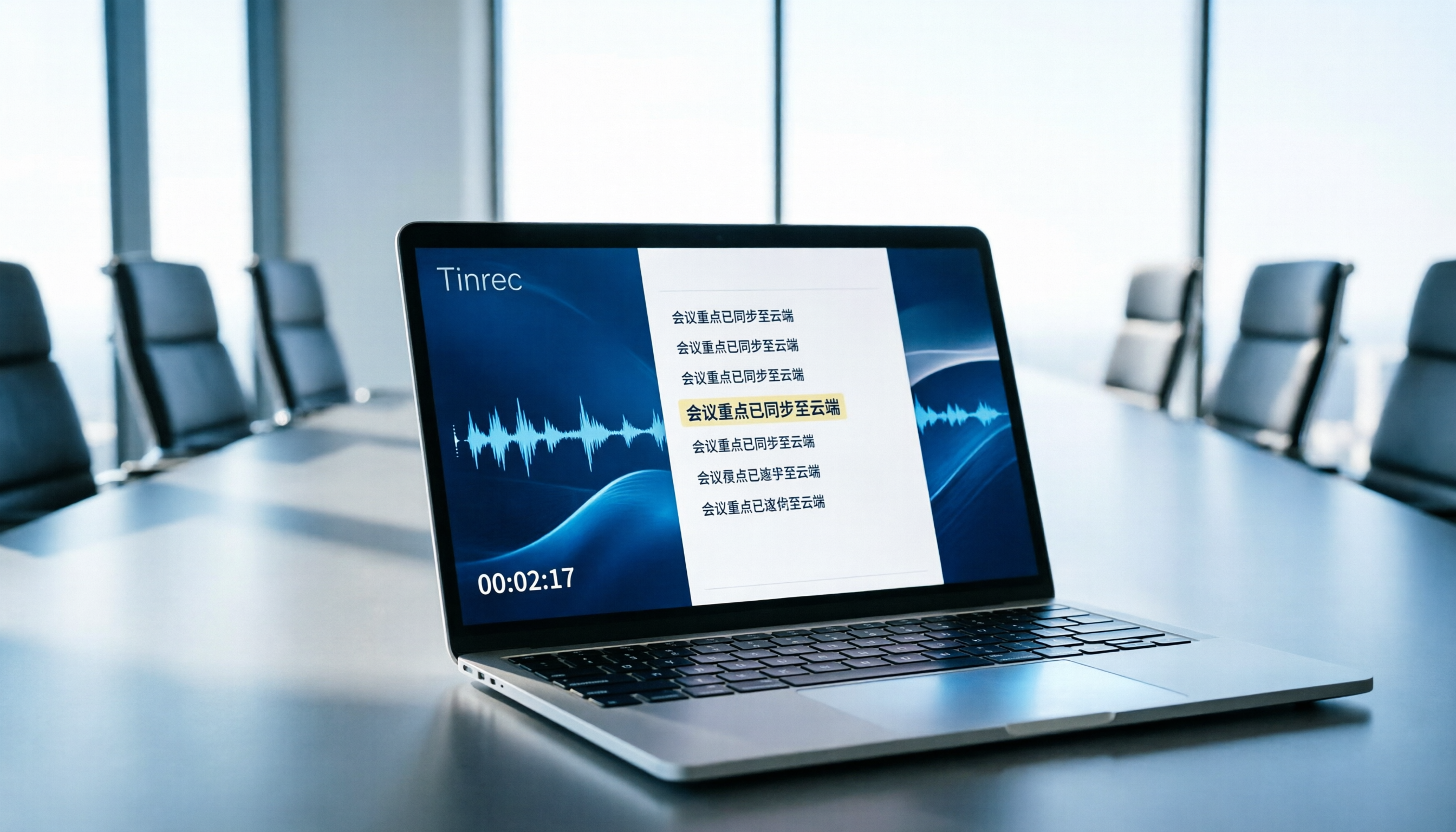
(Screenshot here: Tinrec desktop app recording an online meeting, with an arrow pointing to the "System Audio" toggle, indicating no meeting bot is needed)
The free plan offers basic credits, suitable for light testing. Those with occasional heavy meeting loads can buy a weekly pass; regular users can choose Pro monthly or annual billing; teams get a dedicated space with seat management. Overall, if you want meeting data to be centrally stored, shared, and searchable by your team, Tinrec is currently the most complete option.
Option 2 | Otter—A Mature Choice for English Meetings
Otter is a veteran AI meeting assistant, especially suited for English business meetings. Its speaker identification and summarization are stable, and team collaboration is mature.
The free plan offers a certain number of minutes per month; Pro annual billing works out to about $8.49 per month. But if you need deep Chinese content organization or want data to flow directly into a Chinese workflow, Otter's advantages are less obvious.
It's best for teams that primarily meet in English and are already accustomed to the Otter ecosystem.
Option 3 | Notta—A General-Purpose Tool for Multilingual Transcription and Translation
Notta is more focused on file transcription, subtitles, and translation, supporting multiple languages. The free plan gives 120 minutes per month, with a max of 3 minutes per upload; Pro annual billing is about $8.17 per month, and Business plans offer team features.
If you mainly handle pre-recorded audio files and need quick subtitles or translation, Notta is sufficient. But its post-meeting processing (like AI Q&A, action item extraction) is relatively lightweight, and team space governance isn't as complete as Tinrec.
It's suitable for users who do a lot of file transcription and fewer live meetings.
Option 4 | Fireflies—An Automated Meeting Notes Bot Solution
Fireflies excels at meeting automation: a bot joins your online meetings, automatically records, and provides AI summaries, action items, and sales analytics. Pro is $10 per seat per month; Business is $19 per seat.
However, it requires a bot to join meetings, which some companies or clients may not like. Plus, its Chinese experience isn't a core strength. If you care about privacy or don't want an extra attendee in meetings, this model may not be ideal.
It's best for teams with lots of online sales meetings that need automated recording.
Stop organizing recordings by hand
Upload audio or video and automatically get a transcript, summary, and action items
Option 5 | Granola—A Bot-Free Tool Emphasizing "Handwritten Notes + AI Enhancement"
Granola, like Tinrec, takes a bot-free approach, recording directly from your desktop. But its core concept is "you take handwritten notes, AI fills in the context."
The free plan is available; Business is $14 per person per month. However, Granola doesn't support uploading pre-recorded audio files and doesn't retain meeting audio, which is a drawback for those who need to listen back or organize historical recordings.
It's suitable for users who like taking notes during meetings and don't need to keep audio files.
Option 6 | TurboScribe—A High-Value Tool for Long File Transcription
TurboScribe is a great helper for file transcription. The free plan allows 3 files per day, each up to 30 minutes. The paid plan is $120 per year, with single files up to 10 hours.
If you have a bunch of long interview recordings that need quick text conversion, TurboScribe is cost-effective. But it lacks live meeting recording and team collaboration features; after transcription, you'll have to move the text to other tools for organization.
It's suitable for those who need to process a large number of audio files at once and don't need live meeting support.
Option 7 | Built-in Transcription in Zoom / Google Meet / Teams—The Last Resort for Those Who Don't Want Extra Tools
If you occasionally have meetings and don't want to install any additional software, the built-in transcription features of your platform can be a quick fix. They're usually free or included in your subscription, and the simplest to use.
But the downside is that each platform's transcription is separate, so you can't search across meetings, and there's almost no post-processing or Q&A functionality. You might save on installation, but you'll spend more time manually finding key points later.
It's suitable for those who use it very infrequently and only need a rough text record.
With So Many Options, How Do You Choose?
When choosing a real-time transcription tool, first ask yourself three questions: Are your meetings online or offline? Do you need Chinese or English? What do you plan to do with the text after transcription?
If your answer leans toward "I need to turn meeting content into searchable, trackable, task-assignable team assets," then Tinrec is currently the most direct match.
• Want bot-free recording of online meetings, plus Chinese summaries and AI Q&A → Tinrec (desktop app captures system audio directly; you can ask follow-up questions after the meeting)
• Meetings are primarily in English, and your team already uses Otter → Stick with Otter
• Mainly handling pre-recorded audio files, needing lots of translation and subtitles → Notta or TurboScribe are lighter
• Need automatic meeting joining and sales analytics → Fireflies' bot mode is for you
• Like handwritten notes + AI enhancement, don't care about keeping audio → Try Granola
• Zero budget, occasional transcription → Use built-in platform transcription for now
My principle: don't save a little money and waste time on manual post-processing. Tools should save you time understanding content, not just typing.
4 Things to Know Before Using Real-Time Transcription
First, recording quality determines recognition quality. No matter how powerful the real-time transcription tool, it can't fix recordings with heavy echo or a microphone that's too far away. When I use Tinrec, I first check the meeting software's audio settings and use an external mic if necessary.
Second, a transcript is not meeting minutes. A transcript is raw material; summaries and action items are the finished product. Tinrec's advantage is that it automatically organizes, but if you're doing it manually, immediately mark key points as action items—don't leave them buried in a text file.
Third, ensure speaker identification in multi-person meetings. If speakers aren't distinguished, follow-up questions get messy. Tinrec's chapter feature helps you jump quickly, and when using AI Q&A, specify the speaker or topic for more accurate answers.
Fourth, manage team permissions. If meeting content involves clients or sensitive data, don't transcribe with a personal account. Tinrec's team version has role and seat management, allowing admins to control who can upload and who can only view—this is crucial for companies.
Summary
Real-time transcription isn't new, but "how to use it" is the key. If you just want text, many free tools can do it; but if you want to turn meeting content into an asset your team can repeatedly search, track, and reprocess, Tinrec is currently the most seamlessly integrated choice.
Here's a quick start guide:
- First, identify the platform where your meetings most often occur.
- Download the Tinrec desktop app and record an online meeting to try the bot-free mode.
- After getting the transcript, ask a specific question using AI Q&A to experience the difference of "not having to search manually."
- Export the summary and action items to your note-taking app to integrate back into your daily workflow.
- If you have a team, create a space and share meeting data there.
- Use the same process for every meeting to build your own meeting database.
Test step by step, and you'll gradually master turning meetings into data.
References
- Meeting speech-to-text and transcription: Which AI tool should you use? Free vs. paid feature comparison | Manager Today
- Tested: 4 Best Speech-to-Text Online Tools Recommended, Free Instant Audio-to-Text Transcription
- Home | Vocol.ai Voice Collaboration Platform
- Want to Convert Audio to Text for Free? 5 Must-Recommend Transcription Tools to Get It Done Fast
- Yating Transcription
Turn every recording into actionable outcomes
Get 60 free transcription minutes when you sign in. No credit card required.
Related Reading
You might also like

2026 Real-Time Transcription Comparison Chart: 3 Key Differences to Help You Decide If Tinrec Is Worth It
A real-time transcription tool isn't just about accurate conversion—what matters is whether you can organize, track, and collaborate on the text afterward. Using Tinrec as an example, this article walks you through the core capabilities, use cases, and buying considerations for real-time transcription tools, and provides a simple comparison chart to help you quickly decide.

2026 Real-Time Transcription Tools Compared: Why Tinrec Beats Yating for Team Meetings?
This article addresses the common meeting documentation needs of users in Taiwan, comparing real-time transcription tools such as Tinrec and Yating. It analyzes aspects like bot-free online meeting recording, team collaboration, and AI post-processing to help you decide which is more suitable for individuals and teams.
2026 Comparison of 3 Real-Time Transcription Tools: Tinrec's Bot-Free Recording + AI Q&A Saves the Most Time
We tested three real-time transcription AI tools—Otter, Notta, and Tinrec—comparing meeting recording, AI summaries, Q&A features, and free tiers. Tinrec records online meetings without a bot, and its Chinese transcription and AI Q&A best fit the needs of users in the US. This guide helps you choose without pitfalls.
2026 Real-Time Transcription Cost Comparison: AI Tools, Human Transcription, and Tinrec – Which Saves You the Most?
How much does real-time transcription cost? This article compares the cost structures of human transcription, general AI tools, and Tinrec, analyzing which option offers the best value in real-world scenarios.

2026 Real-World Test of 3 Real-Time Transcription Tools: Beyond Yating Transcriber, Is Tinrec Better for Workplace Teams?
After testing three real-time transcription tools, a mid-level manager found that Tinrec better meets workplace needs with bot-free online meeting recording, AI summaries and action item extraction, and team collaboration spaces. This article uses real meeting scenarios to show how Tinrec saves time on meeting notes, compares it with Yating Transcriber, and helps you choose the right tool.
Best Real-Time Transcription Platforms in 2026: We Tested 3, and This One Offers the Best Value for Chinese Meetings
Looking for a real-time transcription platform but unsure about the costs? This article tests Tinrec, Otter.ai, and Notta, comparing pricing, accuracy, AI features, and team collaboration to help you find the most cost-effective option.

Tinrec vs Yating Live Transcription in 2026: A 5-Dimension Showdown—Which Real-Time Transcription Tool Wins?
We tested Tinrec and Yating Live Transcription across five dimensions—accuracy, real-time performance, post-processing, cross-platform support, and free tier—to help you decide which real-time transcription tool is best for users in Taiwan. Includes sample live transcripts and a guide to common pitfalls.

4 Real-Time Transcription & Translation Tools Compared in 2026: Free Plans and Chinese Support Explained
Still waiting until after a meeting to translate the transcript? This hands-on comparison of 4 real-time transcription and translation tools covers free quotas, Chinese recognition, bot-free recording, and cross-platform support to help you find the best meeting translation solution.
2026 Online Real-Time Transcription: Free Options + Instant Transcription
Looking for truly free online real-time transcription tools? This guide uses Tinrec to demonstrate the complete workflow, from recording to organizing meeting notes, covering key selection criteria and common questions.