

Turn recordings into transcripts and summaries in minutes
Upload audio or video for multilingual transcription, AI notes, and action items
2026 Real-World Test of 3 Real-Time Transcription Tools: Beyond Yating Transcriber, Is Tinrec Better for Workplace Teams?
Let me ask you a question: How many action items came out of last week's meetings? If you can't answer that—it might be time to change how you take meeting notes.
I'm a mid-level manager leading a team of 10, with at least 15 meetings a week: weekly syncs, project status updates, one-on-ones, and cross-departmental coordination. What I used to dread wasn't the meetings themselves, but what came after—because every meeting generated a pile of decisions and action items to organize. Handwritten notes were too slow, and listening back to recordings took too long. So I started using real-time transcription tools, trying three in total (including Yating Transcriber, which many people recommend), and I ended up sticking with Tinrec. This article is based on my actual usage, explaining why Tinrec fits better for working professionals.
Why Are People Looking for Alternatives to Yating Transcriber?
Yating Transcriber is very popular in Taiwan, known for its support of Taiwanese accents, mixed Chinese-English, and even Taiwanese Hokkien. Many college and graduate students use it for class notes, and some office workers use it to organize interviews or meetings. Its app and web version can transcribe speech to text in real time, which is sufficient for light users.
However, some of my colleagues who used it reported several issues: the Windows version fails to import AAC audio files, the editor frequently shows "idle too long, please refresh" notifications, and converting audio files longer than an hour takes over ten minutes. These might not bother occasional users, but if you're like me—meeting every day and needing to produce records quickly—these small annoyances add up to a significant time cost. If you have similar frustrations, Tinrec is worth checking out.
Tinrec vs. Yating Transcriber: What's Different in Core Experience?
Here are the differences I've noticed in key workplace scenarios after actually using both. I'll focus on the dimensions that matter most to meeting-heavy professionals like us:
Bot-Free Online Meeting Recording: Yating Transcriber mainly relies on phone or computer recording; for online meetings, you need to connect externally or play manually, and sometimes you have to invite a bot into the meeting. Tinrec's desktop app directly captures system audio, so you can record Zoom, Google Meet, Teams, and Webex right away without adding extra participants. For those who frequently have online meetings, this saves a lot of upfront hassle.
AI Summaries and Action Item Extraction: Yating Transcriber gives you a transcript, and you have to read through it to extract key points. Tinrec doesn't just transcribe; it automatically generates summaries, chapters, key points, and action items. Now after a meeting, I just look at Tinrec's action item list and assign tasks to my team, without spending half an hour manually organizing.
Team Collaboration and Knowledge Management: Yating Transcriber is more geared toward individual use; sharing transcripts requires a link. Tinrec has team spaces where meeting recordings, transcripts, and action items belong to the team. Members can view and search past meetings, and admins can allocate seats, monitor usage, and access audit logs. For teams that need to share information across departments, this is a key differentiator.
Traditional Chinese and Multilingual Experience: Yating Transcriber does well with Taiwanese accents, but Tinrec supports not only Traditional Chinese but also multilingual meetings and real-time translation, automatically organizing mixed Chinese-English content. In my test, I deliberately spoke in "Chinglish" during a meeting, and Tinrec's recognition and summaries were impressive.
Stability and Editing Experience: As mentioned, Yating has issues with editor disconnections and file imports. Tinrec's web and desktop editors are stable, and long recordings convert much faster. However, I have to be honest: any tool has its limits. Tinrec's accuracy drops in extremely noisy environments, so you should still double-check important content by replaying.
Tinrec's Core Features at a Glance
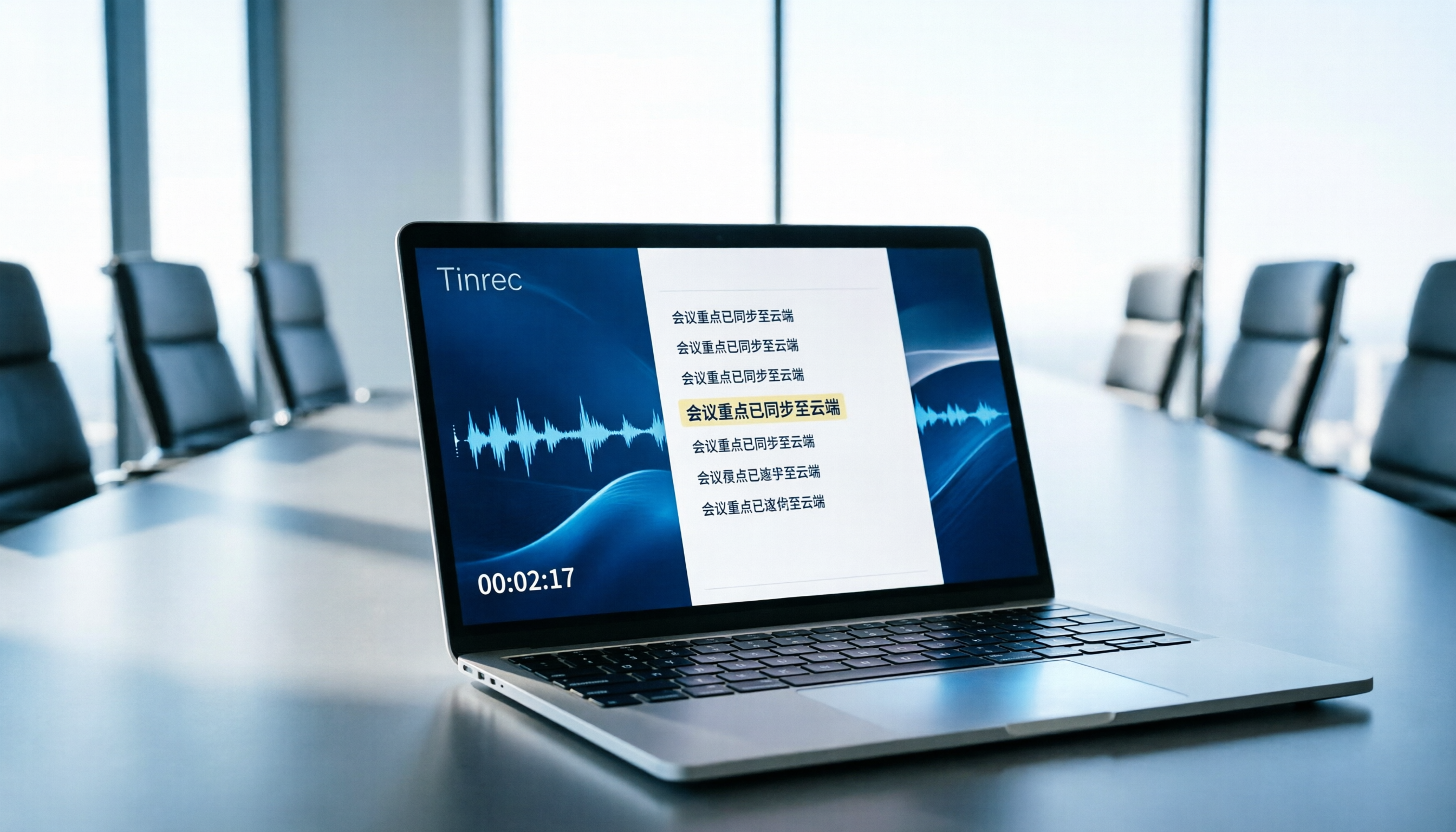
Real-Time Speech-to-Text: When you open Tinrec, the text appears as you speak, with less than a second delay. During meetings, you can watch the text in real time to ensure nothing is missed, and by the time the meeting ends, the transcript is already done—no waiting for conversion.
Stop organizing recordings by hand
Upload audio or video and automatically get a transcript, summary, and action items
AI Summaries and Chapters: For a one-hour meeting, Tinrec automatically splits it into chapters, each with a summary. After my weekly sync, I just look at the summaries to quickly review what topics were discussed, without listening to the whole recording.
Action Item Extraction: This is the feature I rely on most. Tinrec extracts "who is responsible for what and by when" from the meeting content and generates an action item list. Now when I report progress to my boss, I just copy and paste from Tinrec's action items, saving me from having to recall everything manually.
AI Q&A: After recording, you can ask Tinrec directly: "What was the conclusion of the meeting?" "What requirements did the client mention?" It provides answers based on semantic understanding, so you don't have to manually search through 30 pages of transcript. This is super useful for tracking past meetings.
Team Spaces and Member Management: Tinrec's team version centralizes meeting data, allowing members to share and view, and only those with seats can record, upload, and edit. Admins can set roles, allocate seats, view usage trends, and even check audit logs. For mid-level managers, this is like having a management backend for meeting data.
Real-World Use Cases
Weekly Team Meeting: Every Monday, I host a one-hour department sync. Previously, I spent 40 minutes after the meeting organizing notes. Now, with Tinrec's real-time transcription, I check the AI summary and action items right after the meeting, assign tasks to team members, and it's done in under 10 minutes.
One-on-One Meetings: When discussing performance or career development with my direct reports, I use Tinrec to record and transcribe in real time. After the conversation, I can search for keywords to find commitments or goals, so I don't forget later. The AI Q&A also helps me quickly recall "what skills he mentioned wanting to learn last time."
Cross-Departmental Coordination Meetings: The most time-consuming part of cross-departmental communication is follow-up and confirmation. Tinrec puts meeting recordings and action items in a team space, so all relevant members can see them, reducing the "I thought you were responsible" misunderstandings. I also export action items to Notion or Google Docs to continue my existing workflow.
Client Interviews or Requirements Meetings: When sales or product teams meet with clients, they use Tinrec to record in real time. After the meeting, they can ask the AI "What's the client's budget range?" "Which features matter most to them?" and quickly compile quotes or requirement documents without replaying the recording.
Key Considerations When Choosing a Speech-to-Text Tool
Does it support bot-free online meeting recording? If you frequently use Zoom, Meet, or Teams, choose a tool that can directly capture system audio to avoid the hassle of inviting a bot. Tinrec's desktop app does this without requiring additional plugins.
Is the AI post-processing sufficient? A transcript alone isn't enough; you need to confirm the tool can automatically generate summaries, action items, and even allow you to extract key points via Q&A. Tinrec's AI Q&A and action item extraction turn meeting notes directly into action lists.
Does it have team collaboration features? Personal use and team use are different. If you need to share meeting data with colleagues or require member permission management, choose a tool with team spaces. Tinrec's team version offers roles, seats, usage, and audit logs, suitable for departments or project groups.
How good is Traditional Chinese recognition? Taiwanese workplaces often have mixed Chinese-English, Taiwanese Mandarin, and even Hokkien terms. Tinrec supports Traditional Chinese and multiple languages, and its recognition and summaries for mixed Chinese-English content are quite natural, which is a big plus for users in Taiwan.
Is the free tier enough for you to try? You should always try a tool before committing. Tinrec has a free version with basic credits for recording, importing, and experiencing summary features. If you're like me and meet daily, consider upgrading to Pro or Team later; don't lock into an annual plan right away.
Conclusion: Is Tinrec Worth Trying?
If you're looking for a real-time transcription tool that supports Traditional Chinese, can record online meetings without a bot, and lets you use AI to find key points after recording—Tinrec is one of the few options on the market that meets all three. Especially for mid-level managers or team leads, the team spaces, action item extraction, and usage management are features that other similar tools often struggle to provide all at once.
I recommend downloading Tinrec's free version and testing it with your own real meeting recordings. The free credits are enough to experience the core workflow, and if you find it suitable, you can consider upgrading. Tools are just aids, but choosing the right one can save you time every day that you can spend with family or on more important things.
References
Turn every recording into actionable outcomes
Get 60 free transcription minutes when you sign in. No credit card required.
Related Reading
You might also like

2026 Real-Time Transcription Comparison Chart: 3 Key Differences to Help You Decide If Tinrec Is Worth It
A real-time transcription tool isn't just about accurate conversion—what matters is whether you can organize, track, and collaborate on the text afterward. Using Tinrec as an example, this article walks you through the core capabilities, use cases, and buying considerations for real-time transcription tools, and provides a simple comparison chart to help you quickly decide.

2026 Real-Time Transcription Tools Compared: Why Tinrec Beats Yating for Team Meetings?
This article addresses the common meeting documentation needs of users in Taiwan, comparing real-time transcription tools such as Tinrec and Yating. It analyzes aspects like bot-free online meeting recording, team collaboration, and AI post-processing to help you decide which is more suitable for individuals and teams.
2026 Comparison of 3 Real-Time Transcription Tools: Tinrec's Bot-Free Recording + AI Q&A Saves the Most Time
We tested three real-time transcription AI tools—Otter, Notta, and Tinrec—comparing meeting recording, AI summaries, Q&A features, and free tiers. Tinrec records online meetings without a bot, and its Chinese transcription and AI Q&A best fit the needs of users in the US. This guide helps you choose without pitfalls.
2026 Real-Time Transcription Cost Comparison: AI Tools, Human Transcription, and Tinrec – Which Saves You the Most?
How much does real-time transcription cost? This article compares the cost structures of human transcription, general AI tools, and Tinrec, analyzing which option offers the best value in real-world scenarios.
Best Real-Time Transcription Platforms in 2026: We Tested 3, and This One Offers the Best Value for Chinese Meetings
Looking for a real-time transcription platform but unsure about the costs? This article tests Tinrec, Otter.ai, and Notta, comparing pricing, accuracy, AI features, and team collaboration to help you find the most cost-effective option.

7 Real-Time Transcription Tools Tested in 2026: Which One Really Turns Your Meetings into Searchable Data?
Real-time transcription isn't just about converting speech to text—it's about what you do afterward: organizing, searching, and collaborating. This hands-on review rethinks how to choose a transcription tool, comparing 7 options including Tinrec, Otter, and Notta to help you find the one that truly fits your workflow.

Tinrec vs Yating Live Transcription in 2026: A 5-Dimension Showdown—Which Real-Time Transcription Tool Wins?
We tested Tinrec and Yating Live Transcription across five dimensions—accuracy, real-time performance, post-processing, cross-platform support, and free tier—to help you decide which real-time transcription tool is best for users in Taiwan. Includes sample live transcripts and a guide to common pitfalls.

4 Real-Time Transcription & Translation Tools Compared in 2026: Free Plans and Chinese Support Explained
Still waiting until after a meeting to translate the transcript? This hands-on comparison of 4 real-time transcription and translation tools covers free quotas, Chinese recognition, bot-free recording, and cross-platform support to help you find the best meeting translation solution.
2026 Online Real-Time Transcription: Free Options + Instant Transcription
Looking for truly free online real-time transcription tools? This guide uses Tinrec to demonstrate the complete workflow, from recording to organizing meeting notes, covering key selection criteria and common questions.