
Turn recordings into transcripts and summaries in minutes
Upload audio or video for multilingual transcription, AI notes, and action items
Have you ever calculated: for a one-hour meeting, you spend 30 minutes transcribing and another 20 minutes finding key points—only to miss a to-do item? If every meeting goes like this, with 5 meetings a week, you're spending at least 4 extra hours on "organizing" instead of "acting." The value of real-time transcription tools is to give that time back to you.
Tinrec is an AI meeting notes and collaboration tool for individuals and teams. It doesn't just convert speech to text; it also organizes meeting content into searchable, summarizable, queryable, and exportable data. Yating Transcription, on the other hand, is a well-established speech recognition software developed by Taiwan AI Labs, with many users in Taiwan. In this article, I'll compare the two in real-world usage scenarios, focusing on their real-time transcription features, to help you decide which one suits you better.
Why Are People Looking for Alternatives to Yating Transcription?
Yating Transcription is indeed widely used in Taiwan, especially for its "speaker identification" and "punctuation segmentation," and it also supports Taiwanese Hokkien recognition. However, after actual use, some users start to wonder if there's a more complete meeting documentation solution.
Common pain points include: it can only process audio files, not directly record online meetings; after transcription, you still need to manually organize summaries and to-dos; and sharing transcripts among team members requires sending files back and forth, with no unified space. If you're facing similar issues, Tinrec is worth checking out.
Tinrec vs. Yating Transcription: What's Different in Core Experience?
Bot-Free Online Meeting Recording
Recording online meetings is a major headache for many. Yating Transcription mainly processes uploaded audio files. To record Zoom, Google Meet, or Teams meetings, you have to figure out how to record the audio yourself and then upload it.
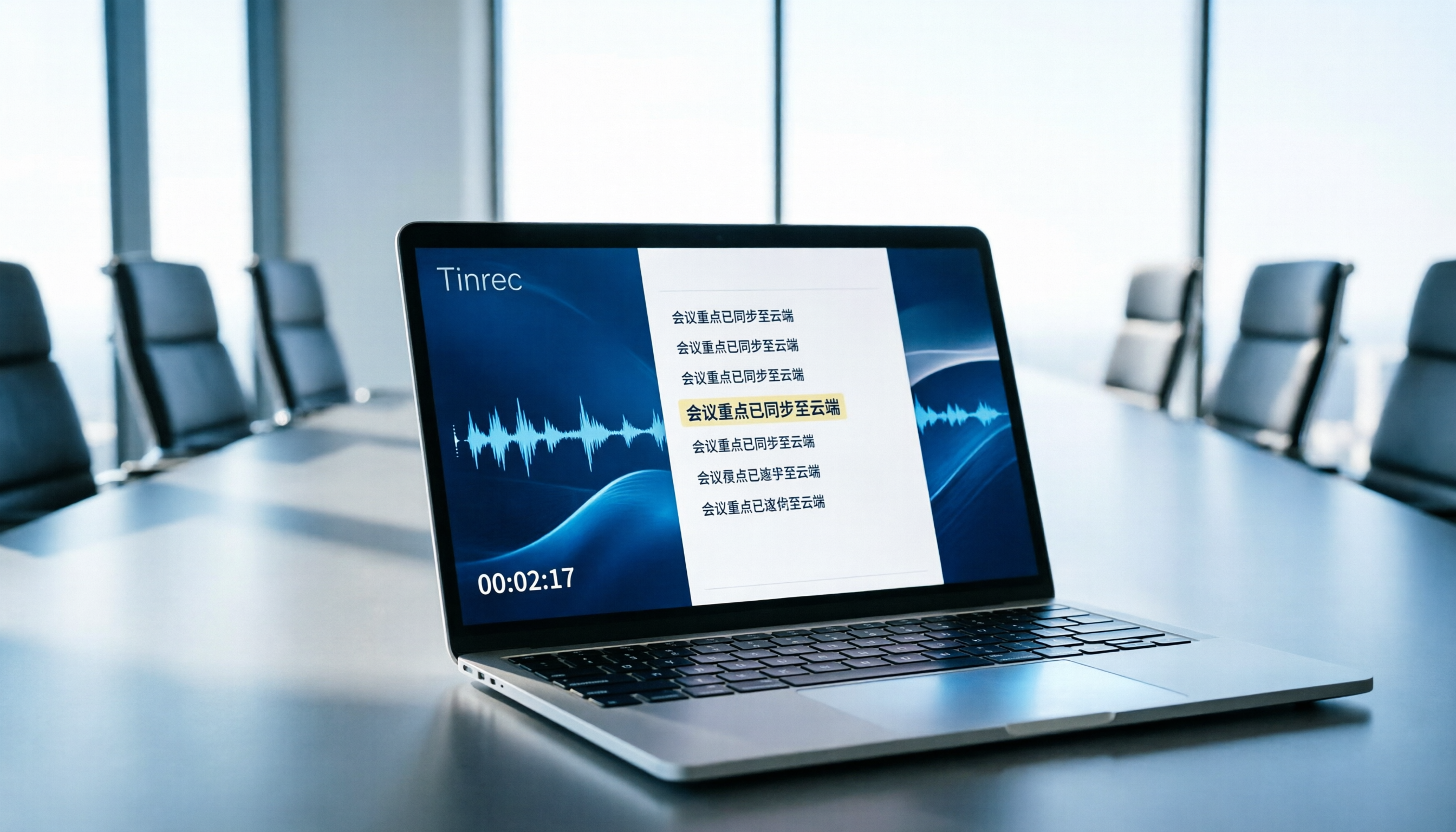
Tinrec's desktop app can directly capture your computer's system audio without needing to invite a meeting bot. Just open Tinrec, and it generates the transcript in real time as you meet. By the end of the meeting, the transcript, summary, and to-dos are already prepared. If you have online meetings every week, this difference will be very noticeable.
More Than Just Transcription: A Complete Post-Meeting Workflow
Yating Transcription's core is "turning speech into text," but the work after transcription is still up to you. Tinrec, on the other hand, emphasizes post-transcription processing: it automatically generates summaries, chapters, key points, and to-dos, and you can use AI Q&A to ask directly, "What was the meeting's conclusion?" or "Who is responsible for what?"
For example, in a 40-minute project meeting, Tinrec will automatically organize it into 5 chapters and 8 to-dos. You just click to see the key points, without having to read the entire transcript from start to finish.
Team Space and Member Management
Yating Transcription is more of a personal tool, making it cumbersome for multiple users. Tinrec's team version provides a dedicated team space where meeting data belongs to the team. Admins can allocate seats, view usage, and access audit logs.
For departments or project teams, this means new members can directly access historical meeting data without asking colleagues to send files. When a member leaves, the data doesn't disappear; it's handed over to other active members.
Real-Time Translation and Multilingual Meetings
Yating Transcription's Taiwanese Hokkien recognition is a highlight, but its support for cross-language meetings is relatively limited. Tinrec can provide real-time translation during recording, allowing you to view the original text, translation, or both side by side. This is convenient for users with foreign clients or multinational teams.
Moreover, Tinrec supports Chinese, Traditional Chinese, and multilingual transcription. The actual performance depends on audio quality, but for meetings with mixed Chinese and English content, its organization capabilities are more practical than simple text conversion.
Multi-Device Use and Historical Audio Processing
Yating Transcription has an app and web version, but the main workflow is to record first and then upload. Tinrec not only supports real-time recording but also allows uploading existing audio and video files, and you can record directly from your mobile device.
If you have a bunch of past interview recordings or course audio files, Tinrec can quickly convert them to text and then use AI Q&A to find key points. No need to listen to each one individually.
Tinrec's Core Features at a Glance
Real-Time Speech-to-Text
Open Tinrec, and the text appears as you record. During meetings, you can watch the text in real time to ensure you don't miss key points. By the time the meeting ends, the transcript is already complete. No more waiting for uploads or conversions.
Stop organizing recordings by hand
Upload audio or video and automatically get a transcript, summary, and action items
AI Summaries and Chapters
Long meetings are the most troublesome to review. Tinrec automatically splits the meeting content into chapters and generates a summary, letting you see the structure first and then the details. For those who attend multiple meetings a week, this saves a huge amount of time.
To-Do Item Extraction
Action items discussed in meetings are automatically extracted by Tinrec. For example, "Submit the design draft by next Friday" or "Ask sales for a quote"—these are listed as to-dos, so you don't have to search through the transcript manually.
AI Q&A
This is my personal favorite feature. After recording a one-hour meeting, I can directly ask Tinrec, "What was the client's attitude toward pricing?" or "How many options were discussed last time?" It provides answers based on the meeting content, not just keyword search.
Multi-Format Export and Third-Party Integrations
Tinrec supports exporting in various formats and can send results to tools like Notion, Google Docs, OneNote, and Dropbox. If you manage projects in Notion, you can directly export meeting minutes there, keeping your workflow seamless.
Real-World Use Cases
Online Meetings
When using Zoom or Google Meet, open Tinrec's desktop app, select "Record System Audio," and the transcript and summary will be generated in real time. After the meeting, copy the to-dos to your project management tool—no need to organize meeting notes separately.
Client Interviews and Requirements Gathering
During client meetings or user interviews, use Tinrec to record. Afterward, use AI Q&A to quickly identify pain points, budget, and timelines mentioned by the client. Both the transcript and recording are preserved for future reference.
Classes and Lectures
When attending classes or lectures, use Tinrec to record. Later, you can search the transcript and generate key summaries. For English courses, you can enable real-time translation to aid comprehension.
Personal Notes and Idea Capture
For spontaneous ideas or post-meeting reflections, record them with Tinrec and convert them to text for later organization. Over time, these become a searchable, queryable personal knowledge base.
Key Considerations When Choosing a Speech-to-Text Tool
Does It Support Real-Time Recording of Online Meetings?
Many tools can only process uploaded audio files, but Tinrec can directly record your computer's system audio without needing a separate meeting bot. If you frequently have online meetings, this feature can be a decisive difference.
Can You Quickly Find Key Points After Transcription?
Having just a transcript isn't enough; the key is whether you can quickly summarize and extract to-dos. Tinrec's AI summaries and Q&A can save you from reading the entire transcript from start to finish.
Is Team Collaboration Convenient?
If your meeting notes need to be shared and handed over to colleagues, it's better to choose a tool with a team space. Tinrec's team version allows centralized management of meeting data, member permissions, and usage.
Supported Languages and Content Types
Check the tool's recognition quality for Chinese and mixed Chinese-English content, and whether it supports the export formats you need. Tinrec covers Chinese, Traditional Chinese, and multiple languages, and can export to common tools.
Is the Free Version Sufficient?
Tinrec offers a free version with basic quotas to experience recording, importing, summaries, and transcription. Actual quotas are subject to the official page; it's recommended to test the free version to see your usage frequency.
Conclusion: Is Tinrec Worth Trying?
If you're looking for a tool that can generate real-time transcripts and turn meeting content into actionable data, Tinrec is one of the few options on the market that can do both. Especially for users who need bot-free online meeting recording, team collaboration spaces, and post-processing of Chinese meetings, you'll notice a significant difference.
I recommend downloading Tinrec's free version and testing it with your own meeting recordings. Rather than relying on reviews, trying it yourself is the most accurate. If you find your weekly usage is high, then consider the personal or team plan.
Frequently Asked Questions
What Are the Limitations of Tinrec's Free Version?
The free version provides basic quotas to experience real-time recording, audio import, AI summaries, and transcription. Specific quotas are subject to the official page; it's recommended to try it before deciding to upgrade.
Which Online Meeting Platforms Does Tinrec Support?
Tinrec's desktop app can handle meeting audio played on your computer from platforms like Zoom, Google Meet, Microsoft Teams, and Webex, without needing to invite a bot to the meeting.
What's the Difference Between Tinrec's Team and Personal Plans?
In the personal plan, data is managed by the individual. The team plan provides a dedicated team space where meeting data belongs to the team, and adds features like members, roles, seats, usage analytics, audit logs, and a recycle bin.
Can Team Members Without a Seat See Data?
Yes. Active members can view, play, and read team data even without a seat; they need a seat to record, upload, edit, and export.
How Accurate Is Tinrec?
Actual performance is affected by recording quality, noise, accents, overlapping speech, and technical jargon, so no fixed accuracy rate can be guaranteed. It's recommended to test with clear audio and use the transcript alongside the recording to verify important content.
What Should I Be Aware of When Recording with Tinrec?
Before recording, make sure you have obtained consent from participants and comply with local laws. Tinrec's desktop app captures system audio; users must start recording themselves, and it won't automatically join meetings.
References
- Meeting Ink - 2026 AI Meeting Notes Tools Test: 7 Speech-to-Text and Summary Speed Comparison | Meeting Ink - AI Meeting Notes Assistant, Automatic Transcription and Summary
- Real-Time Transcription Service | Transcribe App & Web Editor
- Yating Transcription
- Complete Guide to Transcription Features: 2026 Speech-to-Text, AI Transcription, and Buying Guide
- Meeting Speech-to-Text and Transcription: Which AI Tool Should You Use? Free vs. Paid Feature Comparison | Manager Today
Turn every recording into actionable outcomes
Get 60 free transcription minutes when you sign in. No credit card required.
Related Reading
You might also like

2026 Real-Time Transcription Comparison Chart: 3 Key Differences to Help You Decide If Tinrec Is Worth It
A real-time transcription tool isn't just about accurate conversion—what matters is whether you can organize, track, and collaborate on the text afterward. Using Tinrec as an example, this article walks you through the core capabilities, use cases, and buying considerations for real-time transcription tools, and provides a simple comparison chart to help you quickly decide.

2026 Comparison of 3 Real-Time Transcription Tools: Tinrec's Bot-Free Recording + AI Q&A Saves the Most Time
We tested three real-time transcription AI tools—Otter, Notta, and Tinrec—comparing meeting recording, AI summaries, Q&A features, and free tiers. Tinrec records online meetings without a bot, and its Chinese transcription and AI Q&A best fit the needs of users in the US. This guide helps you choose without pitfalls.
2026 Real-Time Transcription Cost Comparison: AI Tools, Human Transcription, and Tinrec – Which Saves You the Most?
How much does real-time transcription cost? This article compares the cost structures of human transcription, general AI tools, and Tinrec, analyzing which option offers the best value in real-world scenarios.

2026 Real-World Test of 3 Real-Time Transcription Tools: Beyond Yating Transcriber, Is Tinrec Better for Workplace Teams?
After testing three real-time transcription tools, a mid-level manager found that Tinrec better meets workplace needs with bot-free online meeting recording, AI summaries and action item extraction, and team collaboration spaces. This article uses real meeting scenarios to show how Tinrec saves time on meeting notes, compares it with Yating Transcriber, and helps you choose the right tool.
Best Real-Time Transcription Platforms in 2026: We Tested 3, and This One Offers the Best Value for Chinese Meetings
Looking for a real-time transcription platform but unsure about the costs? This article tests Tinrec, Otter.ai, and Notta, comparing pricing, accuracy, AI features, and team collaboration to help you find the most cost-effective option.

7 Real-Time Transcription Tools Tested in 2026: Which One Really Turns Your Meetings into Searchable Data?
Real-time transcription isn't just about converting speech to text—it's about what you do afterward: organizing, searching, and collaborating. This hands-on review rethinks how to choose a transcription tool, comparing 7 options including Tinrec, Otter, and Notta to help you find the one that truly fits your workflow.

Tinrec vs Yating Live Transcription in 2026: A 5-Dimension Showdown—Which Real-Time Transcription Tool Wins?
We tested Tinrec and Yating Live Transcription across five dimensions—accuracy, real-time performance, post-processing, cross-platform support, and free tier—to help you decide which real-time transcription tool is best for users in Taiwan. Includes sample live transcripts and a guide to common pitfalls.

4 Real-Time Transcription & Translation Tools Compared in 2026: Free Plans and Chinese Support Explained
Still waiting until after a meeting to translate the transcript? This hands-on comparison of 4 real-time transcription and translation tools covers free quotas, Chinese recognition, bot-free recording, and cross-platform support to help you find the best meeting translation solution.
2026 Online Real-Time Transcription: Free Options + Instant Transcription
Looking for truly free online real-time transcription tools? This guide uses Tinrec to demonstrate the complete workflow, from recording to organizing meeting notes, covering key selection criteria and common questions.