

Turn recordings into transcripts and summaries in minutes
Upload audio or video for multilingual transcription, AI notes, and action items
When the same 5-minute Cantonese meeting recording is fed into several AI tools touting "real-time transcription," the results can vary drastically: some turn "唔該" into "唔知," some take over ten seconds to produce text, and others only transcribe after the recording ends—hardly real-time. If you're in meetings all day and still have to listen to recordings to write minutes during overtime, choosing the wrong tool wastes both time and energy. This hands-on comparison helps you find which one truly saves time as a real-time transcription AI.
What Can Real-Time Transcription AI Do for You?
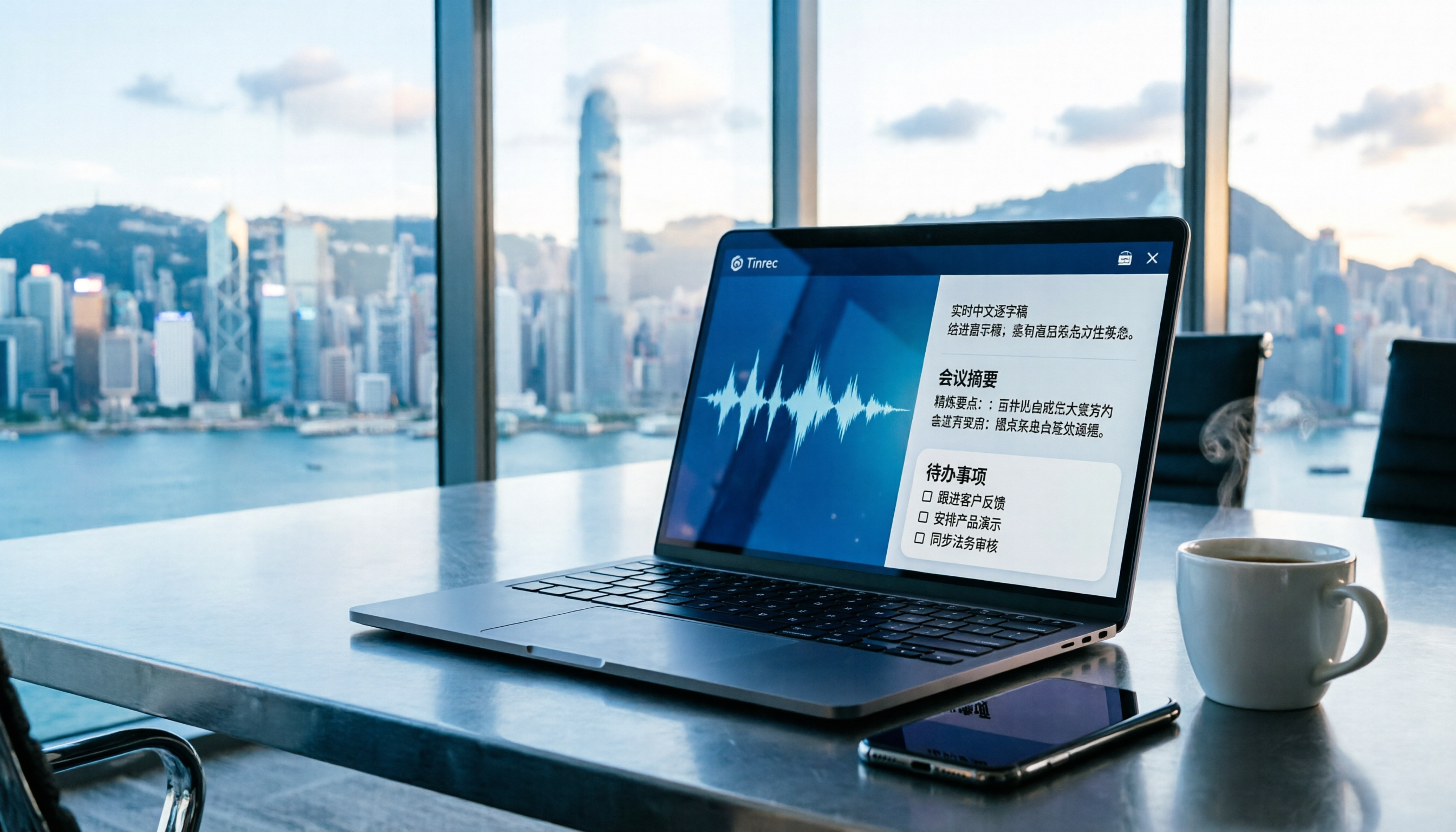
Many Hong Kong professionals think real-time transcription just converts speech to text, but the real time-saver is the subsequent organization. Take Tinrec, for example: it not only generates text in real time but also simultaneously creates summaries, action items, and even lets you ask AI about key points. Check out these three scenarios to see if they resonate:
Scenario 1: Meeting minutes ready 5 minutes after the meeting ends Previously, after a two-hour meeting, you might spend another hour listening to the recording and jotting down key points. With Tinrec's real-time transcription, text appears as the meeting progresses, and the moment it ends, AI summaries, conclusions, and action items are auto-generated—who's responsible for what and deadlines are all clear at a glance. You just review once and send it straight to your boss.
Scenario 2: Never miss key points in international meetings When meeting with foreign clients, fast English with accents often leads to missed details. Tinrec supports real-time translation, letting you view the original, translation, or bilingual side-by-side. You can follow along with Chinese subtitles during the meeting and never miss a beat. Some tools offer translation too, but they often mistranslate—like outputting Japanese when you need Chinese—whereas Tinrec is much more stable.
Scenario 3: Boss suddenly asks about last week's meeting You no longer need to dig through recordings and listen for half an hour. Tinrec stores all meeting data and supports AI Q&A, so you can ask directly: "What concerns did the client have about the quote in last week's meeting?" Tinrec understands the semantics and gives you the answer, complete with timestamps—one click jumps to that part of the recording. This feature is rare among the tools we tested.
How Strong Are Tinrec's Core Capabilities?
We tested with the same 5-minute Cantonese meeting recording (two speakers, slight air-conditioning noise, mixed Chinese-English) focusing on five capabilities.
1. Real-time transcription speed Tinrec's latency is under 1 second—basically, as soon as you finish speaking, the text pops up. Some tools take several seconds or even over ten seconds to respond, making it hard to keep up during meetings. Tinrec achieves true "transcribe as you speak," not post-recording conversion.
2. Cantonese recognition accuracy We don't promise a fixed accuracy rate because recording quality, accents, and background noise all affect it. But in our tests, Tinrec's recognition of Cantonese colloquialisms and mixed Chinese-English was noticeably better than some tools; everyday words like "唔該," "仲有," and "傾掂數" rarely got errors. Some tools often convert Cantonese colloquial speech into written Chinese, changing the meaning.
3. AI organization capability Transcription is just the first step. Tinrec auto-generates structured summaries: meeting topic, conclusions, action items, and owners are all listed separately. It also has an AI Q&A feature—you can ask "Did anyone mention the budget in the meeting?" and it answers directly, rather than just shortening the transcript. Some tools really can't do this.
4. No bot needed for online meetings Tinrec's desktop version directly captures your computer's system audio, so you don't need to invite a meeting bot to Zoom, Google Meet, or Teams. Just run Tinrec—no worries about an "unexpected guest" in the meeting. Some tools still use bot mode and often get flagged as unknown participants.
Stop organizing recordings by hand
Upload audio or video and automatically get a transcript, summary, and action items
5. Team collaboration and data retention For team use, Tinrec offers team spaces: all meeting data belongs to the team, members can search past meetings, and admins can allocate seats, monitor usage, and check audit logs. Even if a colleague leaves, the meeting data doesn't disappear with them. This kind of collaboration capability is absent in many personal tools.
Practical Use Cases: How Tinrec Saves You Time
Meetings: Use Tinrec to record in real time, get transcripts and summaries as the meeting happens, and have a ready-to-submit record the moment it ends. If you use Zoom or Teams, just run the desktop version of Tinrec—no extra plugins needed.
Interviews: Journalists or researchers can use Tinrec for instant transcription, allowing you to mark key points immediately. After the interview, use AI Q&A to find specific quotes from the interviewee without listening to the whole recording.
Classes/Lectures: Students or self-learners can record lectures with Tinrec; real-time transcripts help you keep up, and after class, use AI summaries to organize notes. You can also ask AI about key points, boosting study efficiency.
Content creation: For YouTubers or podcasters, Tinrec converts recordings into text, then generates summaries and chapters, making it easy to produce show notes or articles. AI Q&A can also help you find inspiration.
4 Things to Consider When Choosing a Real-Time Transcription Tool
1. Don't just trust advertised accuracy Some tools claim 98% accuracy, but real-world results differ greatly from the hype. We recommend testing with your own recordings. Tinrec performs consistently with clear audio and common meeting scenarios, but it doesn't boast a fixed accuracy rate—which is more honest.
2. Are the AI features actually helpful? Transcription is just the basics; what matters is whether it helps you organize afterward. Tinrec's AI summaries, action item extraction, and Q&A are all practical, especially the Q&A, which saves tons of time searching for information. Some tools even generate unstable summaries that require manual fixes.
3. Does language support fit your needs? If you need Cantonese transcription, test it thoroughly. Many tools focus on English or Mandarin, with poor Cantonese support. Tinrec covers Chinese, Traditional Chinese, and multilingual meeting scenarios, plus real-time translation—perfect for Hong Kong users.
4. Cross-platform and team features Check if the tool supports your usual devices. Tinrec has iOS, Android, desktop, and web versions, so you can use it on phone or computer. For team use, look for team spaces, member management, usage analytics, etc. Tinrec's team version is quite comprehensive in this regard.
FAQ
Q: Is Tinrec's free version sufficient? A: It's enough for a trial. The free version provides basic credits to experience recording, import, summarization, and transcription. If you only organize a couple of recordings occasionally, the free version might suffice; for daily meetings, we recommend upgrading to Pro or Team.
Q: What's the difference between Tinrec and a regular recording app? A: A regular recording app just captures audio. Tinrec not only records but also transcribes in real time, generates summaries and action items, supports AI Q&A, and can export to tools like Notion and Google Docs. In short, it turns recordings into usable data.
Q: Do I need to invite a bot for online meetings with Tinrec? A: No. Tinrec's desktop version captures your computer's system audio directly, so no extra participant joins the meeting. Just run Tinrec and start recording—works with Zoom, Meet, and Teams.
Q: Is Tinrec suitable for teams? A: Yes. Tinrec's team version includes a dedicated team space where meeting data belongs to the team, members can share and view, and admins can allocate seats, manage usage, and check audit logs. Even if a colleague leaves, data can be handed over without loss.
Q: Does Tinrec support Cantonese? A: Yes. Tinrec covers Chinese, Traditional Chinese, and multilingual meeting scenarios, and our tests showed good Cantonese colloquial recognition. Of course, recording quality affects performance, but overall it's sufficient for daily use.
Conclusion
Real-time transcription AI isn't new, but choosing the wrong tool can waste your time. After thorough testing, Tinrec stands out in real-time speed, Cantonese recognition, AI organization, and team collaboration, especially for Hong Kong professionals who have meetings daily and want to skip overtime. If you're still using traditional recording or tools that only provide transcripts, we recommend downloading Tinrec's free version—it comes with monthly credits enough for two or three meetings, so you can see how AI-assisted meeting minutes feel.
References
- Meeting Ink - 2026 AI Meeting Minutes Tool Test: 7 Speech-to-Text and Summary Speed Comparison | Meeting Ink - AI Meeting Minutes Assistant, Auto-Transcribe and Summarize
- Meeting Ink - Transcription AI Meeting Summary Speech-to-Text - Google Play App
- 2026 Test of 3 Real-Time Transcription Tools: Who Has the Strongest AI Organization? - Seconds Audio Blog
- Want to Convert Audio Files to Transcripts for Free? 5 Must-Recommend Transcription Tools to Get It Done Fast
- No Time Limit! 3 Free AI Transcription Tools, Highly Recommended! AI Voice Notes for Meeting Minutes, Slides, Mind Maps | 104 Career Force
Turn every recording into actionable outcomes
Get 60 free transcription minutes when you sign in. No credit card required.
Related Reading
You might also like

2026 Hands-On Comparison of 3 Meeting Note Tools: Why I Switched from Google's Built-in to Tinrec
A senior student tests Google Calendar, Google Meet, and Tinrec for meeting notes, sharing why Tinrec is better for organizing lecture recordings, group discussions, and online meetings. Learn about free tier limits and AI summarization capabilities.

5 Best Meeting Minutes Apps in 2026: Real-World Comparison to Save Your Post-Meeting Time
Starting from meeting minutes apps trending on PTT, we tested 5 AI voice-to-text tools, comparing Chinese recognition, AI summaries, free tiers, and team collaboration features to help busy managers find the best fit.

5 Best Free AI Meeting Note Tools Tested in 2026: Generate Transcripts and Action Items Without Spending a Dime
This article tests 5 free AI meeting note tools, comparing free quotas, accuracy, online meeting support, and post-meeting organization features. Tinrec is recommended as the top choice, helping office workers automatically generate meeting transcripts and action items for free.
2026 Tinrec Recording-to-Text Tutorial: Chinese Support, Auto Meeting Minutes
Hong Kong office workers spend too much time on meeting minutes. This article tests Tinrec's real-time recording-to-text feature, showing how AI automatically generates transcripts, summaries, and action items—complete minutes in 5 minutes without writing prompts.

Best Real-Time Transcription Tools in 2026: 4 Tested, This One Is Most Practical for Chinese Meetings
A 2026 hands-on comparison of real-time transcription tools, evaluating latency, accuracy, AI post-processing, and cross-platform support to help you choose the best solution for Chinese-language meetings.

2026 Real-Time Transcription Alternative Test: Tinrec Beats Yating for Thesis Interview Notes
In thesis writing, organizing interview transcripts often takes more time than originality checks. This article tests Tinrec and Yating Transcription, comparing post-processing, online meeting recording, and team collaboration to show why Tinrec is better suited for thesis interviews and research records.

3 Best Real-Time Transcription Tools Worth Recommending in 2026: Cost and Feature Comparison
With so many real-time transcription tools on the market, how do you choose between free and paid options? This article tests tools like Tinrec, comparing costs, accuracy, and AI features to help you save time and money.

2026 Real-Time Transcription Tools Compared: How Much Can You Save on Teaching Recordings?
We tested several real-time transcription tools to answer how much it costs to convert teaching recordings to text and why Tinrec is the best choice for Hong Kong users to save money and time.

2026 Real-Time Transcription Complete Guide: Pricing Trends and Hands-On Reviews of 4 Tools
Struggling with real-time transcription costs and tool choices? This article compiles 2026 pricing for human and AI transcription services, tests four tools—Tinrec, Otter, Notta, and Granola—and provides insights on cost, accuracy, real-time performance, and buying advice to help you find the best meeting notes solution.