

Turn recordings into transcripts and summaries in minutes
Upload audio or video for multilingual transcription, AI notes, and action items
Let me ask you something: How many action items came out of last week's meetings? If you can't answer—it's not that you have a bad memory; it's that your note-taking method is wrong. I attend about 15 meetings a week, and what I used to dread most wasn't the meetings themselves, but what came after: every meeting left a pile of decisions and action items to organize. I've tried handwriting, recording and replaying, and asking colleagues for help. In the end, I found that choosing the right tool matters more than just pushing through. This isn't sponsored content—it's my team's hands-on testing, from a mid-level manager's perspective, on how to pick a Chinese meeting notes tool and which one feels most intuitive.
Meeting Notes Aren't Transcripts—You Need an Actionable Record
Many people treat meeting notes like dictation practice: the longer the meeting, the longer the notes. But real meeting notes should distill conclusions and highlight key points so that even those who didn't attend can understand. According to 104 Job Bank's guide, the focus of meeting minutes should be on recording "decisions," "action items," and "next goals," not every word spoken. If you're still using a traditional voice recorder or built-in transcription, you'll likely spend two extra hours after each meeting re-listening and retyping. Choosing the right tool can save you that time.
Before Choosing a Meeting Notes Tool, Understand These 4 Key Points
- Accuracy: Don't just look at the official 98% claim—those numbers are usually tested in a quiet recording studio. Real meetings have keyboard clicks, air conditioning noise, and people talking over each other. Our tests are based on actual meeting recordings.
- AI Post-Processing: Getting a transcript is just the first step. You need automatic summaries, action item extraction, and AI Q&A to quickly locate conclusions from previous meetings.
- Cross-Platform and Input Sources: You might record on your iPhone today and need to organize on your computer tomorrow. Besides live recording, you should also be able to import past audio files or online meetings.
- Team Collaboration: If you're a department head, whether meeting data can be centrally stored and whether it disappears when a member leaves matters more than single-user tools.
Tinrec (秒听录音): Our Top Pick for Chinese Meetings After Testing
Tinrec (秒听录音) is an AI meeting notes and collaboration tool for individuals and teams, supporting iOS, Android, and web, with a desktop version as well. It's not just about recording and transcribing; it turns meetings into searchable, collaborative, actionable data.
Let me start with the scenario my team uses most: online meetings. With the desktop version, you can directly capture your computer's system audio without adding a bot to Zoom, Google Meet, Teams, or Webex. This is super convenient for us since we have about 5 cross-departmental online meetings a week—no worries about a bot interrupting, and no need to explain to colleagues why there's an AI in the meeting room.
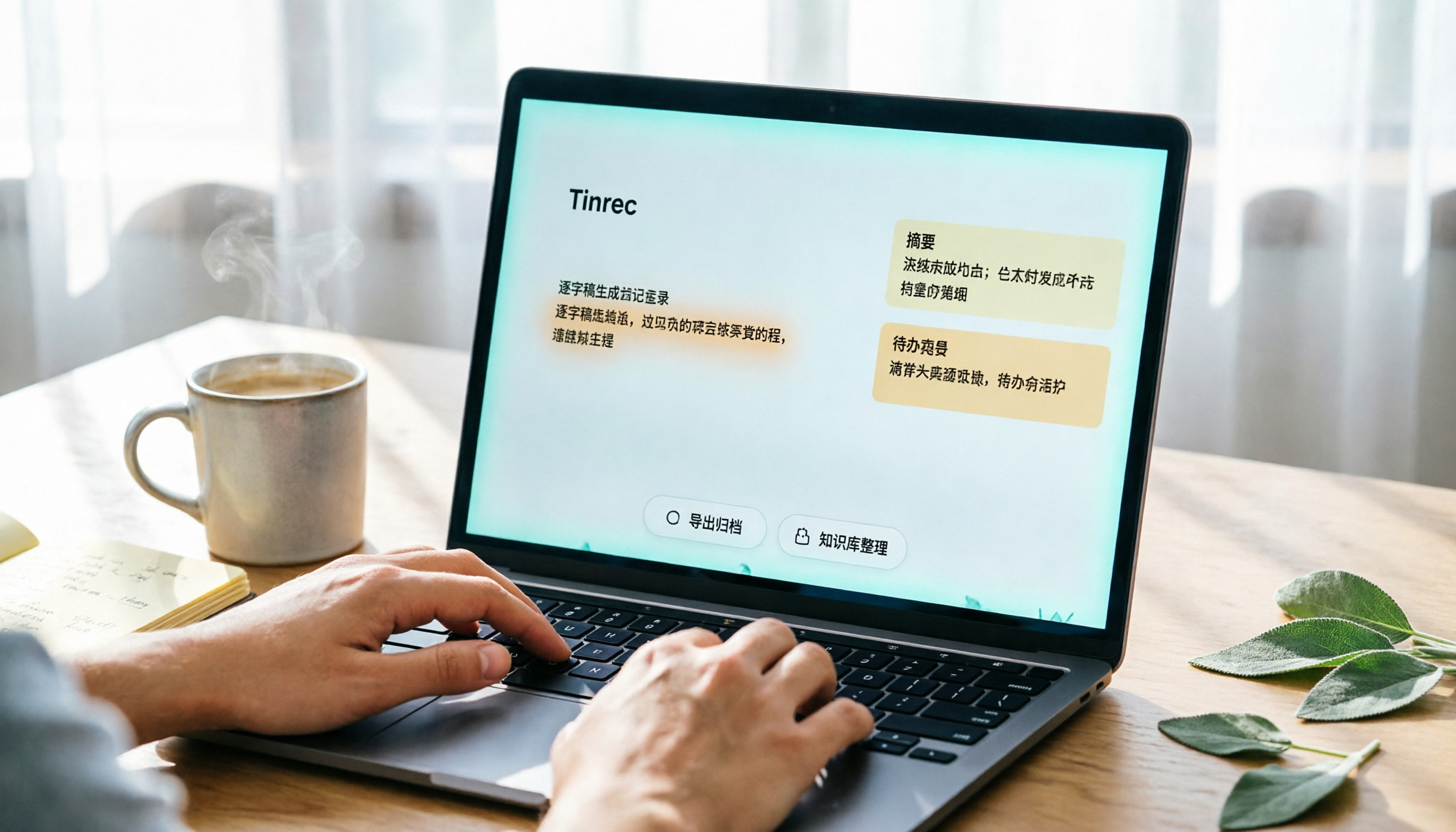
After recording, Tinrec automatically generates a transcript, AI summary, chapters, and action items. I don't have to listen from the start; I just open the summary to see what was discussed, who's responsible for what, and deadlines. Even more useful is the AI Q&A: you can ask, "Who mentioned the budget in the last meeting?" and it answers based on the content, not just throwing keywords at you. Competitors in the same price range rarely have this feature.
Stop organizing recordings by hand
Upload audio or video and automatically get a transcript, summary, and action items
Tinrec's performance on Chinese content surprised me. It covers Chinese, Traditional Chinese, and mixed Chinese-English content, and also supports real-time translation. Our team tested it with a Chinese news recording, and the transcription required only minor corrections. Of course, accuracy can be affected by background noise, accents, and overlapping speech, but in my experience, it's much faster than manually retyping.
Pros at a glance:
- Records online meetings without a bot, so meetings aren't interrupted.
- Provides not just transcripts but also summaries, action items, and AI Q&A, directly supporting post-meeting follow-ups.
- Supports multiple input methods: live recording, online meetings, uploading audio files, and even importing some web links.
- Team plans have a dedicated space; meeting data belongs to the team, so it won't be lost if a member leaves.
Limitations to mention: The free plan has limited credits, so heavy users may need to consider Pro. Also, AI-generated highlights aren't always 100% accurate; for important decisions, I still cross-check with the transcript. But for someone like me with 15 meetings a week, the time saved is well worth it.
Who it's for: If you frequently need Chinese meeting notes, want to use AI to find key points after recording, or need cross-device use between phone and computer, Tinrec is currently the most intuitive choice.
Beyond Tinrec: What Other Options Are There?
Otter.ai: A mature choice for English meetings, with a generous free plan of 300 minutes per month. But its strength lies in English business meetings; its Chinese processing isn't as refined as Tinrec's. If you mainly have English meetings, it's worth considering; but if you need Chinese summaries, action items, and AI Q&A, Tinrec is a better fit.
Notta: A multilingual transcription tool with a free plan of 120 minutes per month, but each session is capped at 3 minutes, which isn't friendly for long meetings. Notta leans more toward file transcription and subtitles, while Tinrec adds team spaces, AI Q&A, and agent-based post-processing to turn meeting notes into reports or tables.
Granola: A bot-free AI meeting notes app with an intuitive interface. But note: it doesn't support uploading pre-recorded audio files, nor does it retain meeting audio. If you need to organize historical recordings or archive meetings, Tinrec's file import and audio retention are more practical.
Pitfall Guide: 3 Common Mistakes When Choosing a Meeting Notes Tool
- Mistake 1: Only looking at official accuracy rates. Many tools claim 98% in quiet environments, but real meetings have noise that can significantly affect accuracy. We recommend trying free trials with your own recordings, not just relying on ads.
- Mistake 2: Ignoring "can I ask questions after the meeting?" If the tool only transcribes, you'll still have to manually sift through 30 minutes of transcript. With AI Q&A like Tinrec's, you can ask "What was the meeting conclusion?" right after recording, which is much faster than searching yourself.
- Mistake 3: Assuming everyone can edit. If you need team collaboration, make sure you understand roles and seats. Some tools only allow members to view, not edit. Tinrec's team plan has clear roles, seats, and usage management, suitable for managers to monitor team usage.
Summary: Which One Should You Choose?
In a nutshell: If your meetings are primarily in Chinese and you want more than just a transcript—you want AI to help you find key points—Tinrec is currently the most intuitive choice. Scenario recommendations:
- Need Chinese or mixed Chinese-English meeting notes → Tinrec
- Want to use AI to find key points and ask questions after recording → Tinrec
- Need cross-device use across phone, computer, and web → Tinrec
- Zero budget and only English meetings → Otter.ai free plan (the only exception)
Final note: Try Tinrec's free plan first, record a meeting or two, and see if the summaries and action items save you time before deciding to upgrade.
References
- Meeting Minutes = Transcript? Professional Meeting Minutes Only Record 3 Key Points | Writing Tips, Templates | 104 Job Bank
- Meeting Minutes Format Template | 4 Key Points + Complete Template
- Taipei Municipal Jingxing Junior High School - Subject Teaching Research Meeting Agenda and Minutes
- Meeting Minutes Examples | Meeting Minutes Format Templates (Chinese and English) | Subanana
- Meeting Minutes Tips with Examples | Indeed.com Hong Kong
Turn every recording into actionable outcomes
Get 60 free transcription minutes when you sign in. No credit card required.
Related Reading
You might also like

2026 Meeting Minutes Template Guide: Tinrec vs Notta 5-Dimension Comparison - Which Is Right for You?
Meeting minutes are not just about transcripts; they should also auto-generate summaries, action items, and reports. This article compares Tinrec and Notta across 5 key dimensions, including meeting capture, post-processing, and team collaboration, to help you choose the best AI meeting minutes tool.

Best AI Meeting Notes Tools in 2026: We Tested 3, and This One with No-Bot Recording Is the Most Convenient
Meetings take two hours, and organizing notes takes another two? This article tests three AI meeting notes tools—Tinrec, Otter.ai, and Granola—covering no-bot recording, Chinese language experience, and post-meeting organization to help you find the most suitable one.
2026 Review of 4 Notion Meeting Notes Templates: Why I Switched to Tinrec for Automated Generation
Meeting notes aren't just about having a Notion template. This article compares common Notion meeting note template types using real workflows, and explains why using Tinrec to automatically generate transcripts, summaries, and to-dos, then exporting to Notion for archiving, is more efficient than manually filling templates.

2026 Notion AI Meeting Notes Tutorial: 3 Steps to Auto Summaries and Action Items
A hands-on tutorial for Notion AI meeting notes, showing how to use the /meeting command to automatically generate transcripts, summaries, and action items without installing bots. Supports Zoom, Google Meet, and Teams.

2026 Meeting Minutes Format Templates: 4 Free Solutions Compared
Meetings aren't the problem—it's the follow-up and tracking afterward. This article, from a mid-level manager's hands-on perspective, reviews 4 free solutions and provides copy-ready meeting minutes format templates to help you quickly produce actionable meeting notes.

Tinrec vs Notta in 2026: A 5-Dimension Comparison for iOS Meeting Notes
Looking for a meeting notes app for your iPhone? This article compares Tinrec and Notta across five dimensions—recording sources, AI post-processing, team collaboration, pricing, and cross-platform support—to help you choose the best iOS meeting notes tool.

5 Best Free Meeting Minutes Tools Tested in 2026: Which One Actually Saves You Time?
This roundup reviews 5 free meeting minutes tools, from Tinrec's AI transcription and team collaboration to no-registration options like NotebookLM and inFin, helping you quickly decide which one fits your meeting scenarios.

How to Choose Meeting Minutes Software in 2026: A 5-Step Hands-On Guide
Meeting minutes software isn't magic that automatically records everything; it requires choosing the right recording method, organization workflow, and team collaboration approach. This article walks you through 5 steps to rethink your meeting minutes needs and tests Tinrec's performance in Chinese meetings, bot-free recording, and post-meeting organization.

Tinrec vs Notta 2026: 5-Dimension Comparison for Taiwan Teams' Meeting Minutes
How to choose an AI meeting minutes tool? This article compares Tinrec and Notta across five dimensions tailored to Taiwan teams: recording method, Chinese accuracy, post-meeting organization, team collaboration, and pricing. It also includes a pitfall avoidance guide and selection recommendations to help you find the most suitable meeting minutes solution in minimal time.