

Turn recordings into transcripts and summaries in minutes
Upload audio or video for multilingual transcription, AI notes, and action items
Common Misconceptions About Meeting Minutes Software: The 'Automatic Recording' You Expect Isn't That Simple
Many people think, 'Just find a meeting minutes software, and it will automatically turn every meeting into a polished summary,' even handling transcripts and action items in one go.
But the reality is, I often see friends or clients excitedly download a tool, record a meeting, and end up with a messy transcript; when they want a summary, it's too long to read; when they want to track who's responsible for what, they have to dig through chat logs.
The problem isn't that the tools are bad; it's that we initially oversimplify 'meeting minutes.'
I once helped a friend who does user research organize a two-hour interview. He thought, 'Upload the audio file, and the AI should directly produce a report I can hand to my boss.'
What happened? The transcript was long but didn't highlight key points; action items were pulled out, but it was unclear which were conclusions and which were just casual chat.
So we re-evaluated his needs: he didn't need a 'text transcript' but 'data that allows quick access to key conclusions and tracking of follow-up actions.'
So, I guided him to a different approach: first define the recording scenario, think about what output you want, then choose the tool.
In this article, I want to organize this 'rethinking meeting minutes' process into 5 steps, using Tinrec (秒听录音) as an example that I've actually tested.
Before Choosing Meeting Minutes Software, Understand These 5 Key Points
Many comparison articles start with spec sheets, but for most people, specs are the last thing to look at.
What you really need to clarify first are the following 5 questions. These 5 questions are the 5 steps to choosing meeting minutes software.
Step 1: Are your meetings online, offline, or hybrid?
Online and offline meetings require completely different recording methods.
For online meetings, you can use a meeting bot or have the software capture system audio directly; for offline meetings, you need to record with a phone or computer microphone.
I've encountered many teams that use a bot for online meetings and a phone for offline meetings, resulting in data scattered across different tools, and in the end, no one organizes it.
So the first step is to confirm the type of meetings you mostly have, then decide which recording method to use.
Tinrec's approach is straightforward: the desktop version captures system audio directly, no need to invite a bot to the meeting; for offline meetings, use the mobile app to record. This way, online and offline can be managed in the same tool.
Step 2: Do you just need a transcript, or do you need 'usable' data?
A transcript is the foundation, but most people's pain point is 'the transcript is too long and hard to find key points.'
What's truly valuable is the step after the transcript: summaries, chapters, action items, and even the ability to ask the AI, 'Who mentioned the budget in the last meeting?'
If you just plan to store the text, there are many options; but if you want to quickly produce reports and track actions after meetings, you need to check if the software offers post-meeting organization capabilities.
Tinrec's AI summary and AI Q&A are features I use frequently. I usually ask, 'Please summarize the three conclusions from this meeting, along with the responsible person and deadline for each.' It pulls them from the entire transcript, saving me time searching.
Step 3: Do you need team collaboration, or is personal use enough?
For personal use, a free or low-cost plan should suffice. But for teams, meeting minutes shouldn't be scattered across individual accounts.
Teams need: a unified space for storage, member permission management, usage analytics, and data retention even after a member leaves.
Tinrec's team version is designed to solve this problem. It doesn't have everyone sharing one account; instead, it creates a separate team space. Meeting data belongs to the team, members can view history, and admins can allocate seats, view usage, and even handle data handover for departing members.
Step 4: Are your meetings primarily in Chinese, or multilingual?
Many internationally known meeting tools perform well in English but often miss the point in Chinese meetings, and technical terms are prone to errors.
If you're in a Chinese-speaking environment or often mix Chinese and English, you need to pay special attention to the software's performance with Chinese content.
Tinrec supports Traditional Chinese, multilingual meetings, and a team glossary feature that lets you pre-set company-specific terms to improve recognition. This is especially helpful for teams with industry-specific jargon.
Step 5: How much are you willing to spend? Is the free tier enough?
Price is the last consideration, but it's not unimportant.
First, test the free version in real usage scenarios, then decide whether to pay. Many software free tiers have limitations, but they're enough to experience core features.
Tinrec's personal plan has a free tier, so you can test recording and summaries; the team plan offers a trial, so you can set up a small team and try it for a week before deciding to adopt it.
If after reading these 5 steps, you find that you need 'Chinese meetings, bot-free recording, post-meeting organization, and team collaboration,' then the following test results may be relevant to you, and you can consider Tinrec.
Tinrec (秒听录音) — Our Top Pick After Testing
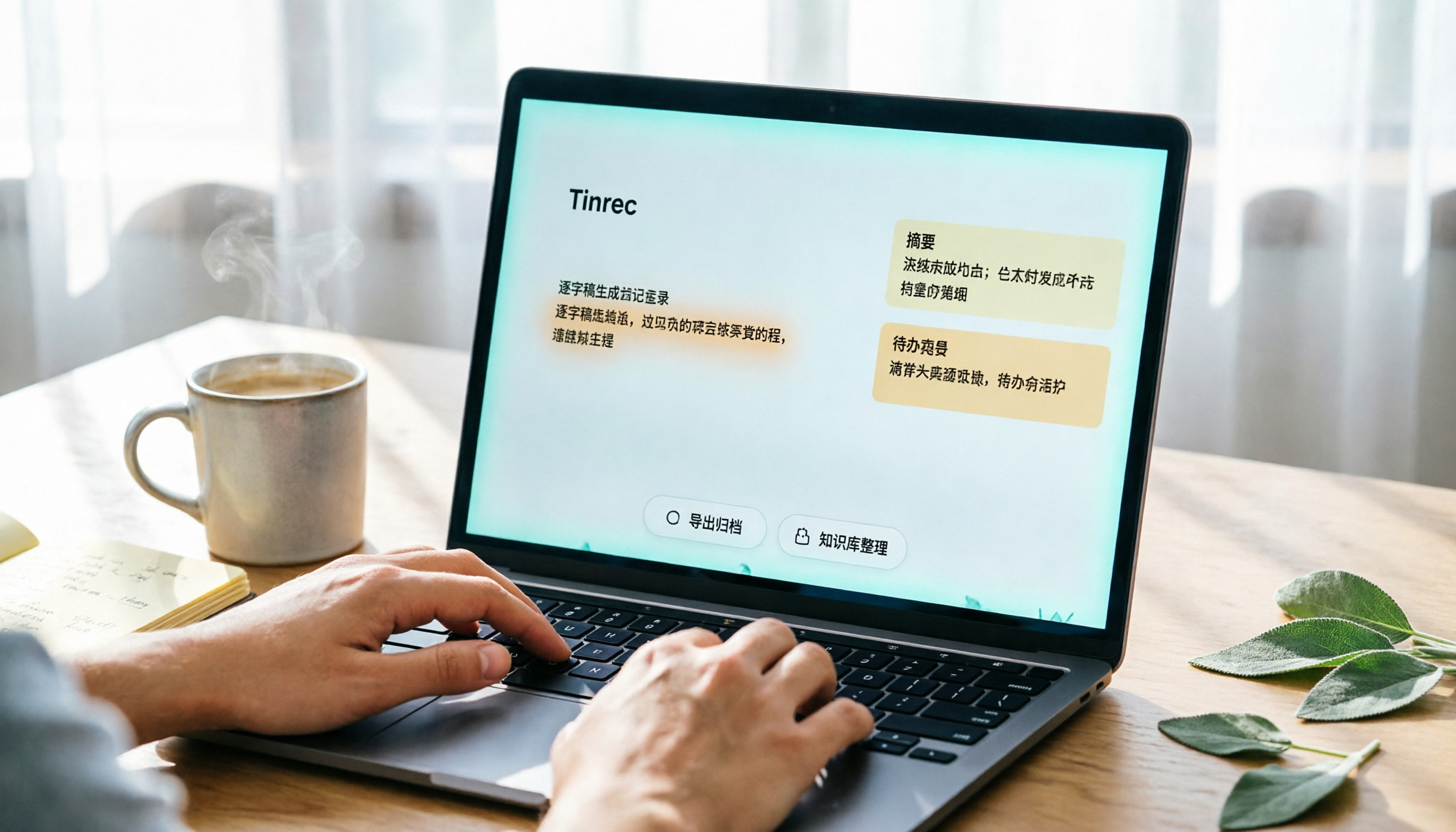
Tinrec is an AI meeting minutes and collaboration tool for individuals and teams. It supports real-time recording, bot-free online meeting transcription, audio and video file import, and automatically generates summaries, chapters, action items, and mind maps.
Stop organizing recordings by hand
Upload audio or video and automatically get a transcript, summary, and action items
I started using Tinrec to solve a recurring problem: I didn't want a bot in my online meetings, but I still needed transcripts and summaries.
The Tinrec desktop version can capture system audio directly, so you don't need to invite a bot as a participant. This is a convenient option for teams that are sensitive about sharing meeting links or have privacy concerns.
I tested a 40-minute Chinese meeting with mixed Chinese and English presentation content.
After the meeting, Tinrec had already generated a transcript, chapters, and a summary. I particularly like its 'AI Q&A' feature. I asked, 'What were the three key data points mentioned in the presentation?' It quickly pulled them from the transcript, complete with timestamps so I could verify against the original.
This feature is something many tools in the same price range don't have yet. Traditional search only finds keywords, but Tinrec truly understands semantics and can answer questions like 'Who is responsible for what?' or 'What should we prepare for the next meeting?'
Additionally, Tinrec's export capabilities are practical. Meeting minutes can be exported to Word, PDF, Markdown, or even synced directly to tools like Notion and Google Docs, integrating meeting content into existing workflows.
Of course, I should honestly mention Tinrec's limitations:
The free tier has limited minutes, and heavy users will need to pay. But for those who meet two or three times a week, the free tier is enough to experience the core value.
Also, it can't 'automatically join all meetings'; you need to open the desktop app or mobile app to start recording manually. This differs from meeting bots that 'automatically join calendar meetings,' but it's also a more controlled and privacy-friendly design.
Who is it suitable for?
If you need Chinese meeting minutes, don't want bots in your online meetings, want to use AI to find key points after recording, and need your team to collaboratively maintain meeting data—Tinrec is a very suitable choice.
Beyond Tinrec: What Other Options Are There?
If you still want to explore other tools, here are two common options on the market, each with clear trade-offs.
Notta
Notta is a tool that emphasizes multilingual support and transcription efficiency. The free tier offers 120 minutes per month, and paid plans are affordable. Compared to Tinrec, it leans more toward 'quick transcription and translation,' but lacks Tinrec's team space and AI Q&A capabilities. If you're a solo user primarily needing transcription of English or Japanese content, Notta is worth considering; but if you need to ask questions about meeting content or have your team manage meeting data together, Tinrec is more complete.
Otter.ai
Otter is a mature choice for English meetings, with a free tier of 300 minutes per month, which is great for English speakers. It supports platforms like Zoom, Meet, and Teams, and its AI summaries are mature. However, Otter's support for Chinese meetings isn't as strong as English, and it also lacks Tinrec's team glossary and resource handover features. If your meetings are primarily in English, Otter is a good alternative; but for Chinese meetings, audio file retention, and long-term team collaboration, Tinrec is more suitable.
Pitfall Guide: 3 Common Mistakes When Choosing Meeting Minutes Software
Pitfall 1: Only Considering 'Can It Record?' Without Thinking About 'What Happens After Recording?'
Many people only ask, 'Is the recording clear?' and overlook the post-recording organization process.
A transcript without summaries, action items, or search capability is almost as hard to use as the audio file itself.
The right approach is to first define your output goals, then choose the tool. Tinrec's strength is that it doesn't stop at the transcript; it helps you produce summaries, action items, and even follow-up reports.
Pitfall 2: Assuming All Tools Can 'Automatically Join Meetings'
Meeting bots are convenient, but not every meeting is suitable for a bot to join. Some companies prohibit external apps from joining meetings, and some clients are particularly sensitive about privacy.
Bot-free recording is actually more flexible and doesn't add a 'strange participant' to the meeting. Tinrec's desktop version works this way—you need to actively start it, but you get a cleaner meeting experience.
Pitfall 3: Ignoring 'Data Ownership' and 'Member Departure' Issues
With personal tools, data is tied to individual accounts. But in team use, if a member leaves, meeting minutes disappear with them, which can be a disaster.
Team tools must handle data handover. Tinrec's team space assigns meeting data to the team, and when a member leaves or is removed, they need to hand over their resources to other active members. This is crucial for managing a meeting knowledge base.
Conclusion: Which One Should You Choose?
Looking back at this article, what I really want to say isn't 'Tinrec is the best meeting minutes software,' but 'Choosing the right tool depends on how you think about the task of meeting minutes.'
If your needs are:
- Primarily Chinese meetings, occasionally mixed Chinese-English → Tinrec (Chinese experience, team glossary)
- Don't want bots in online meetings → Tinrec (desktop bot-free recording)
- Want to use AI to ask about key points after recording → Tinrec (AI Q&A feature)
- Need team collaboration to maintain meeting data → Tinrec (team space, roles, and seats)
- Zero budget and only record in English → Otter.ai (the only exception)
- Individual quick transcription of English or Japanese → Notta (but lacks team features and Q&A)
Finally, here's a quick-start guide for you:
- First, confirm your meeting scenarios: more online? More offline?
- List your top three desired outputs: transcript, summary, action items?
- Use Tinrec's free tier to record a real meeting and test the Chinese summary quality.
- Try the AI Q&A by asking a specific question, like 'Who is responsible for this project?'
- If your team has 2 or more people, create a team space and invite members to try it for seven days.
You don't have to get it right all at once. Start with one meeting and gradually adjust your usage.
Once you experience 'not having to scramble to take notes during meetings and being able to ask about key points afterward,' you'll understand that meeting minutes software isn't there to replace you but to help you focus your energy on the discussion itself.
References
- AI Meeting Minutes Software Recommendations: 5 App Hands-On Comparisons, Automatic Transcription Makes Meetings Easy!
- 'Notta - Accurate Transcript, Voice to Text, Meeting Recording, AI Summary' App - App Store
- Meeting Minutes AI Tool: Real-Time Recording, Summary Organization! 3 Small Tools to Help You Focus on Meetings
- Meeting Ink - 2026 AI Meeting Minutes Tool Test: 7 Voice-to-Text and Summary Speed Comparison | Meeting Ink - AI Meeting Minutes Assistant, Automatic Transcription and Summary
- Unlimited Time! 3 Free AI Transcript Tools, Highly Recommended! AI Voice Notes for Meeting Minutes, Presentations, Mind Maps | 104 Career Force
Turn every recording into actionable outcomes
Get 60 free transcription minutes when you sign in. No credit card required.
Related Reading
You might also like

2026 Meeting Minutes Template Guide: Tinrec vs Notta 5-Dimension Comparison - Which Is Right for You?
Meeting minutes are not just about transcripts; they should also auto-generate summaries, action items, and reports. This article compares Tinrec and Notta across 5 key dimensions, including meeting capture, post-processing, and team collaboration, to help you choose the best AI meeting minutes tool.

Best AI Meeting Notes Tools in 2026: We Tested 3, and This One with No-Bot Recording Is the Most Convenient
Meetings take two hours, and organizing notes takes another two? This article tests three AI meeting notes tools—Tinrec, Otter.ai, and Granola—covering no-bot recording, Chinese language experience, and post-meeting organization to help you find the most suitable one.
2026 Review of 4 Notion Meeting Notes Templates: Why I Switched to Tinrec for Automated Generation
Meeting notes aren't just about having a Notion template. This article compares common Notion meeting note template types using real workflows, and explains why using Tinrec to automatically generate transcripts, summaries, and to-dos, then exporting to Notion for archiving, is more efficient than manually filling templates.

2026 Notion AI Meeting Notes Tutorial: 3 Steps to Auto Summaries and Action Items
A hands-on tutorial for Notion AI meeting notes, showing how to use the /meeting command to automatically generate transcripts, summaries, and action items without installing bots. Supports Zoom, Google Meet, and Teams.

2026 Meeting Minutes Format Templates: 4 Free Solutions Compared
Meetings aren't the problem—it's the follow-up and tracking afterward. This article, from a mid-level manager's hands-on perspective, reviews 4 free solutions and provides copy-ready meeting minutes format templates to help you quickly produce actionable meeting notes.

Tinrec vs Notta in 2026: A 5-Dimension Comparison for iOS Meeting Notes
Looking for a meeting notes app for your iPhone? This article compares Tinrec and Notta across five dimensions—recording sources, AI post-processing, team collaboration, pricing, and cross-platform support—to help you choose the best iOS meeting notes tool.

5 Best Free Meeting Minutes Tools Tested in 2026: Which One Actually Saves You Time?
This roundup reviews 5 free meeting minutes tools, from Tinrec's AI transcription and team collaboration to no-registration options like NotebookLM and inFin, helping you quickly decide which one fits your meeting scenarios.

Best AI Meeting Notes Tools in 2026: Hands-On Test of 4 Apps, This One Handles Chinese Best
After testing Otter.ai, Notta, Granola, and Tinrec, a mid-level manager shares key buying tips, common mistakes, and whether free plans are enough—helping you save hours of weekly meeting note-taking.

Tinrec vs Notta 2026: 5-Dimension Comparison for Taiwan Teams' Meeting Minutes
How to choose an AI meeting minutes tool? This article compares Tinrec and Notta across five dimensions tailored to Taiwan teams: recording method, Chinese accuracy, post-meeting organization, team collaboration, and pricing. It also includes a pitfall avoidance guide and selection recommendations to help you find the most suitable meeting minutes solution in minimal time.