
Turn recordings into transcripts and summaries in minutes
Upload audio or video for multilingual transcription, AI notes, and action items
International meetings can be a headache—not only do you need to keep up with fast English conversations and industry jargon, but afterward you also spend hours replaying English recordings to produce Chinese transcripts and summaries. If you're dealing with these language comprehension and organization pain points, now is the time to leverage AI assistance.
This article will explain how to choose the right voice translation tool and provide in-depth reviews of 6 popular AI transcription solutions, including multilingual support, pricing, and summary features, along with practical step-by-step guides and FAQs.
Quick Navigation:
- If you want a one-stop solution for "speech-to-text + multilingual translation + meeting action items": check out Vocol.ai or Tinrec.
- If you need free short-daily quotas for processing audio: prioritize MyEdit or PowerDirector.
- If you value extensive language support but don't mind slower processing: try Good Tape.
4 Key Evaluation Dimensions for Choosing an English Recording-to-Chinese Tool
There are many speech-to-text websites, but for "foreign language meeting" scenarios, we recommend filtering with these four criteria:
1. Cross-Language Translation & Recognition Accuracy Pure transcription tools may lack translation. When choosing, verify whether the tool supports "directly translating foreign speech into Chinese transcripts" or at least offers post-transcription text translation to reduce secondary processing time.
2. Transcription & Processing Speed If a 1-hour meeting recording takes hours to transcribe, efficiency suffers. During free trials, upload a short audio clip to test generation speed.
3. Meeting Minutes & Action Item Extraction Traditional transcripts are dense with text—tens of thousands of words make it hard to quickly grasp key points. Newer tools should have AI-powered smart summaries that directly organize meeting conclusions and to-do lists, turning recordings into actionable content.
4. Pricing & Free Quota Thresholds Tools typically offer "monthly subscriptions," "per-minute plans," or "credit-based systems." Choose a plan that fits your monthly meeting frequency and recording length.
2026's Top 6 High-Efficiency AI Transcription Tools
1. Vocol.ai
This is an AI voice collaboration platform ideal for business users. It provides accurate speech-to-text, AI-generated summaries and action items, and transcript translation into other languages (supports Chinese, English, Japanese). It includes a discussion area for team collaboration on transcripts. Downsides: a complex pricing structure (credit-based, monthly subscription starts at NT$357) and occasional speaker misidentification. Registration offers 200 minutes free.
2. Tinrec (Seconds Audio Recorder)
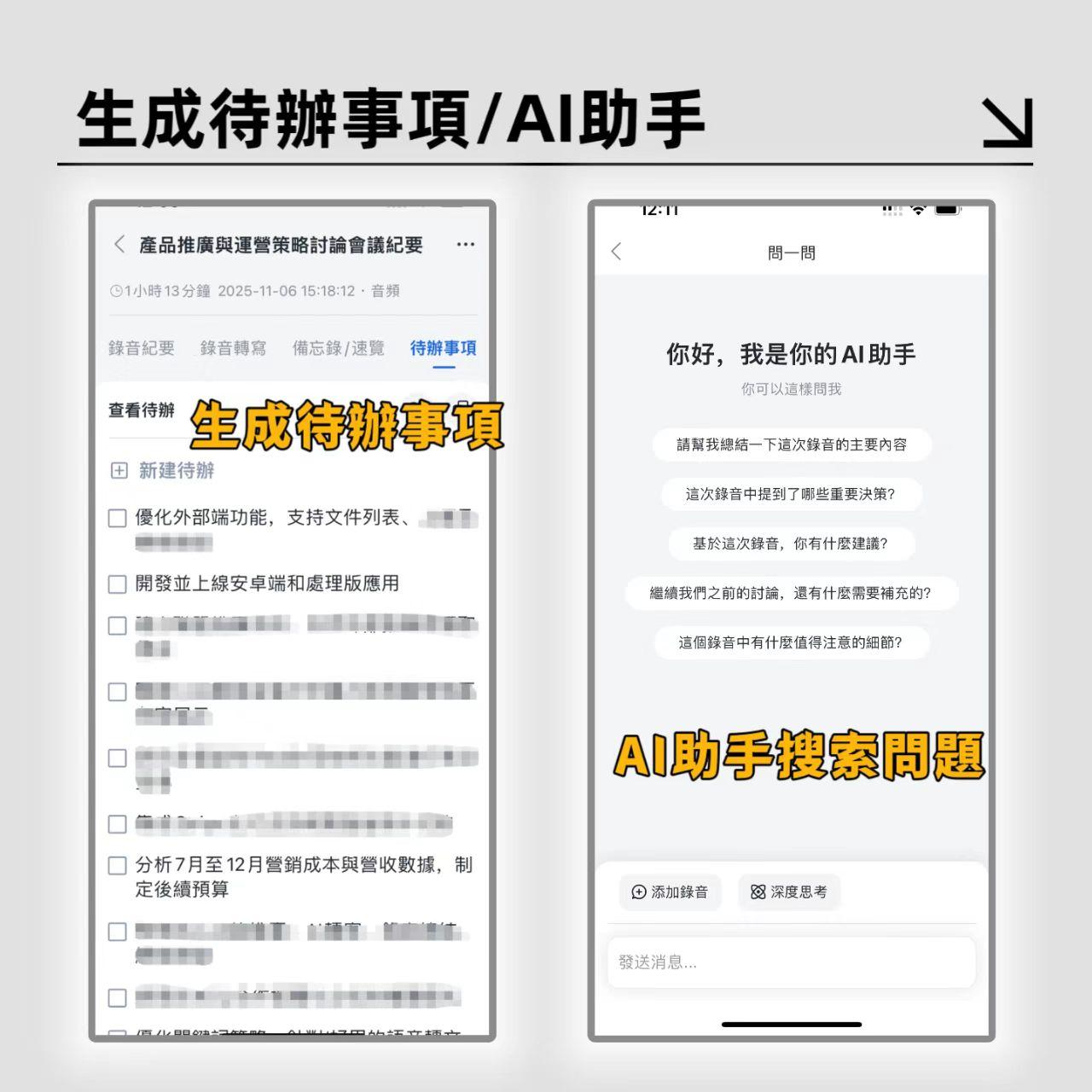
This is a multi-device AI recording assistant that focuses on the complete workflow from "record → understand → act." It supports automatic recognition of 10+ languages including Chinese, English, and Japanese. In international meeting scenarios, it not only transcribes foreign languages but also automatically generates meeting minutes and to-do action items, solving the readability issues of traditional transcripts. Additionally, its built-in semantic-based "AI Chat Query" feature lets you ask the AI about meeting details directly. Free plan offers 100 minutes per month; Basic plan is $4.9/month (600 minutes).

3. MyEdit
An intuitive, ad-free online tool. Supports speech-to-text for 9 languages including Chinese and English; tested transcription speed is very fast. Its standout feature is rich audio optimization capabilities (e.g., noise removal, wind removal) to enhance audio quality before transcription. When editing the transcript, the audio automatically jumps to the corresponding segment. Downsides: no automatic speaker identification. Free quota: 3 minutes daily after login; subscription starts at NT$120/month.
4. PowerDirector
Primarily a video editing software, but it has a powerful built-in "AI Speech-to-Text" feature, ideal for users who need to process videos and add subtitles. Supports 10 languages including Chinese, English, Japanese, and can export transcribed text as SRT subtitle files or plain TXT files. Offers 3-minute daily trial after login; monthly subscription starts at NT$165.
5. Good Tape
Created by a Danish innovation media company; its highlight is support for over 90 languages, making it suitable for rare language transcription. It automatically breaks transcripts into paragraphs; the paid version can identify speakers. Downsides: free version transcription speed is very slow (1 minute of audio may take 1 hour), and you cannot edit the transcript online. Free version offers 3 audio segments per month.
Stop organizing recordings by hand
Upload audio or video and automatically get a transcript, summary, and action items
6. Yating Transcriber
A well-known Taiwanese Chinese transcription tool that supports Chinese, English, and Taiwanese Hokkien. Provides online sharing and keyword summary features. Downsides: slow transcription speed, occasional summary function failure, and lacks advanced audio editing. New accounts receive 300 minutes free trial (must be used within one month).
Core Comparison Table of English Recording-to-Chinese Tools
| Dimension | Tinrec | Vocol.ai | MyEdit | Good Tape | Yating Transcriber |
|---|---|---|---|---|---|
| Languages Supported | Auto-recognizes 10+ languages including Chinese & English | Chinese, English, Japanese | 9 languages including Chinese & English | 90+ languages | Chinese, English, Taiwanese |
| Transcription Speed | Fast (real-time/high efficiency) | Fast | Fast | Slow | Slow |
| Summary & Action Items | Supported (auto-generated) | Supported (AI smart analysis) | Not supported | Not supported | Supported (sometimes fails) |
| AI Query Interaction | Supports dialogue-based retrieval | Not supported | Not supported | Not supported | Not supported |
| Export Formats | Multiple formats integrated | Multiple | TXT, SRT, etc. | Multiple | TXT, DOCX, etc. |
| Pricing/Free Quota | Free 100 min/month; Paid from $4.9/month | Free 200 min total; Paid from NT$357/month | Free 3 min/day; Paid from NT$120/month | Free 3 segments/month; Paid approx. NT$515/month | Free 300 min for first month; Pay-as-you-go |
Hands-On Tutorial: How to Quickly Convert English Recordings to Chinese and Extract Key Points
Using Tinrec as an example, for different meeting and learning scenarios, you can quickly turn English voice content into valuable Chinese text with these steps:
Scenario 1: In-Person International Meeting (Real-Time Transcription)
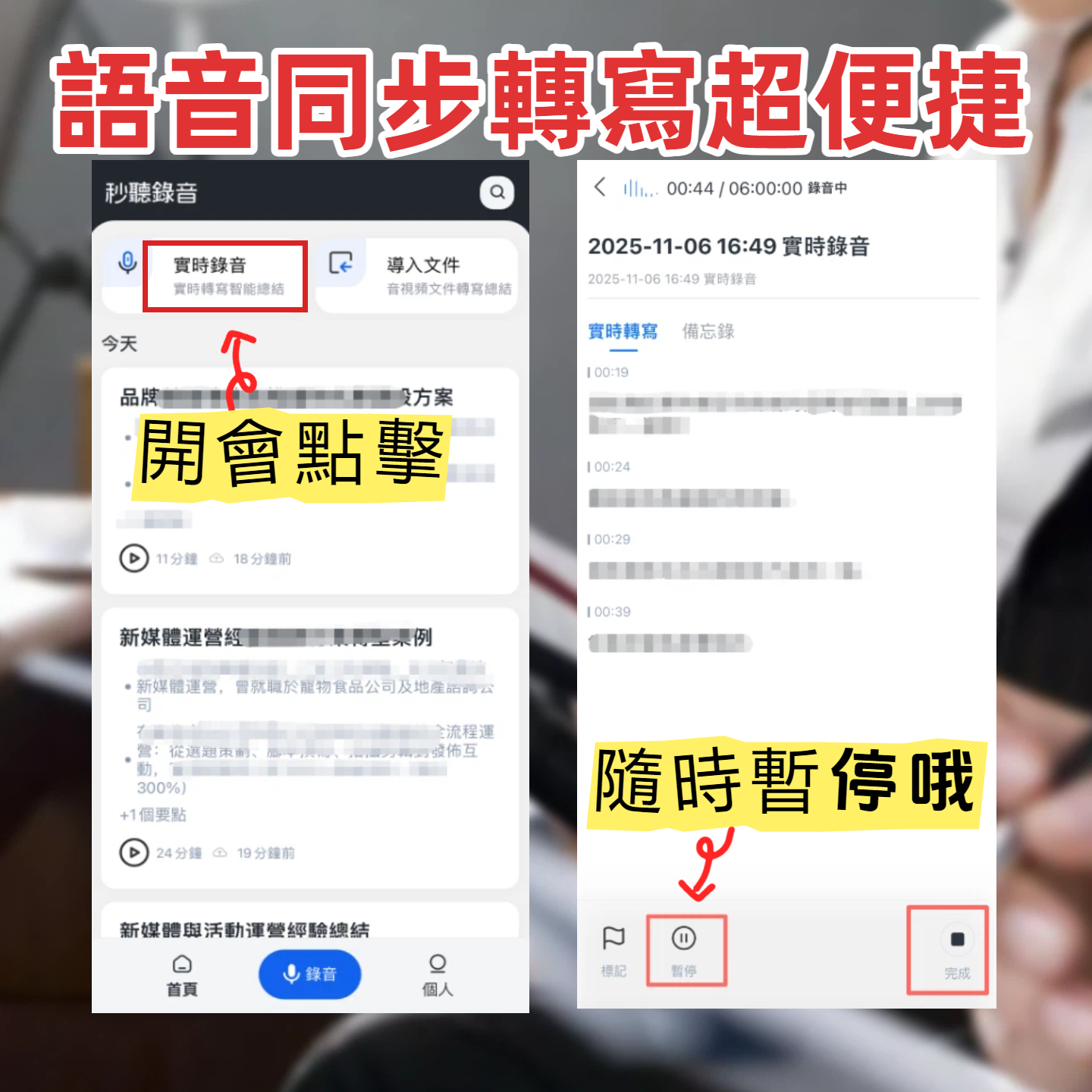
- Open the tool on your phone or web, click "Real-Time Transcription".
- Place the device in the center of the conference table; the system will perform real-time speech recognition, converting the English conversation into text displayed on the screen—no need to wait until the meeting ends to grasp the content.
Scenario 2: Remote Meeting Recording from Your Manager (Audio File to Text)
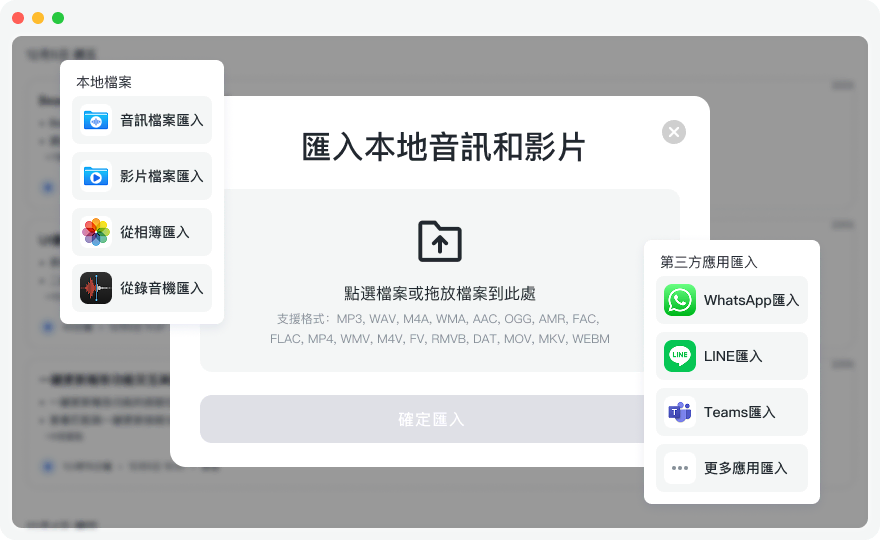
- Go to the "Audio File to Text" section.
- Upload the English recording file downloaded from Teams or Meet (supports multiple audio formats).
- The system will quickly complete transcription, automatically distinguish speakers, and generate an AI summary including meeting conclusions and action items.

Scenario 3: Online International Webinars & Courses (Video Link to Text)
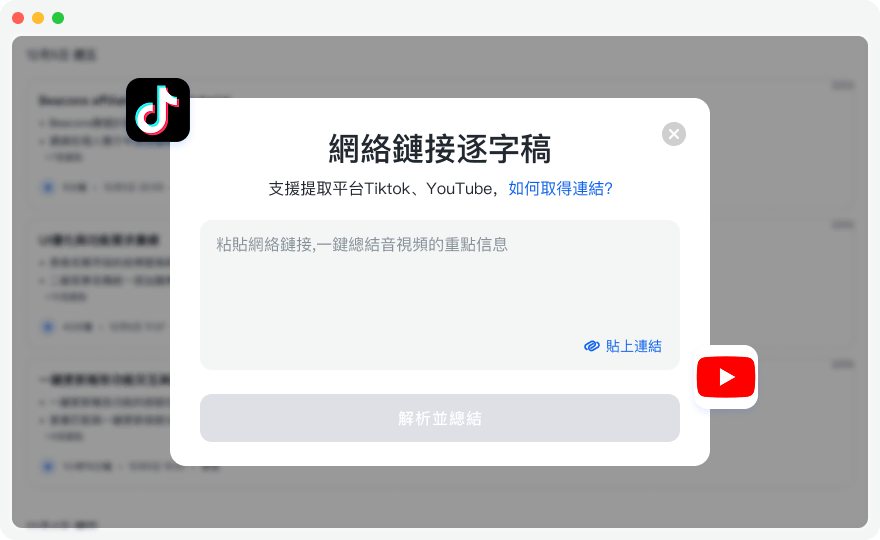
- If you don't want to download large video files, simply copy the YouTube or podcast video link.
- Go to the "Podcast/Online Video to Text" module, paste the URL, and submit.
- The tool will automatically parse the cloud video audio track, converting the English lesson into structured Chinese notes.
Scenario 4: Quickly Finding Conclusions Afterward (AI Chat Query)
- Tens of thousands of words of transcript make it hard to search for context using traditional Ctrl+F.
- Use the "AI Chat Query" feature, type directly in the dialog: "What is the Q3 budget target mentioned in the meeting?"
- The AI will synthesize an answer in Chinese based on the English recording content, saving you time searching through files.
Frequently Asked Questions (FAQ)
1. Can iPhone recordings be directly translated into Chinese transcripts? iPhone's built-in "Dictation" memo feature can transcribe recordings, but setup is cumbersome and it lacks direct foreign language translation and summary features. For converting English recordings to Chinese, we recommend using multi-device AI tools like Tinrec or Vocol.ai for better efficiency.
2. Can English meeting recordings from Teams or Meet be converted to Chinese? Yes. Download the meeting recording from Teams or Meet, extract the audio (e.g., MP3 or WAV), then upload it to a foreign-language-capable transcription online tool to get full Chinese subtitles or summaries.
3. Which AI transcription tool's free quota is best for light users? If you only need to process very short audio daily, MyEdit's 3-minute daily quota is a good choice. If you need a stable monthly quota for several medium-sized meetings, Tinrec offers 100 minutes free per month, covering typical daily work and study needs.
4. Plain text transcripts are hard to read—can AI help extract key points? Traditional tools mostly only provide text transcription. Newer tools (such as Vocol.ai or Tinrec) come with built-in AI analysis that automatically condenses thousands of words into meeting minutes, key conclusions, and action items.
5. Can AI handle audio that mixes Chinese and English? Most modern AI voice models (like those supporting multilingual auto-recognition) can handle mixed Chinese-English speech well, accurately detecting language and transcribing accordingly. However, before choosing a tool, we recommend using the free quota to upload a test clip of your typical mixed-language meeting.
6. What's the difference between hiring a human transcriber and using AI? Hiring a professional to manually transcribe costs about NT$500 to NT$1,500 per half hour, with higher cost and turnaround time (depending on urgency), but no proofreading needed. AI tools typically finish in minutes, with subscription costs often under NT$200 per month, significantly reducing budget. Generating a first draft via AI and then fine-tuning is currently the most efficient approach for businesses and individuals.
Turn every recording into actionable outcomes
Get 60 free transcription minutes when you sign in. No credit card required.
Related Reading
You might also like

5 Best AI Meeting Recorders Tested in 2026: Which One Works Best for Chinese Meetings and Team Collaboration?
Struggling with meeting notes and post-meeting cleanup? This hands-on comparison of 5 AI meeting note tools, led by Tinrec, covers bot-free recording, Chinese transcription, AI summaries, and team collaboration to help you decide which one is worth it.

2026 Tinrec Smart Meeting Minutes Review: Cantonese Transcription, AI Auto-Generated To-Dos
Tired of spending hours after meetings transcribing recordings? We tested Tinrec, a smart meeting minutes app that uses AI to save you overtime. It supports Cantonese transcription, auto-generates to-dos, and can record online meetings without a bot.

2026 Smart Meeting Minutes Tools Compared: Hands-On Test of 5, Why Tinrec Is Our Top Pick
Spending two hours in a meeting and another two hours writing up the minutes? This article evaluates Tinrec, Otter.ai, Notta, PLAUD Note, and others based on practical criteria like bot-free recording, Chinese transcription, AI post-processing, and team collaboration, to tell you which one is most worth using.

The Complete Guide to AI Meeting Notes Apps in 2026: Auto-Generated Summaries, Action Items, and Team Collaboration
This guide starts by addressing common pitfalls, helps you understand the key factors in choosing an AI meeting notes app, and shares hands-on experience with Tinrec (秒听录音) on how it uses bot-free recording, AI summaries, and team collaboration to save you time after meetings.

2026 Review of 5 Online AI Meeting Minutes Tools: Which Free Version Is Most Useful?
This hands-on comparison, focusing on Tinrec, breaks down the core features, real-world use cases, buying considerations, and FAQs of online AI meeting minutes software to help you decide if the free version is sufficient.

What Is AI Meeting Minutes in 2026? A 4-Step Comparison of Tinrec vs. Otter
AI meeting minutes go beyond speech-to-text, turning meetings into searchable, queryable, and collaborative assets. This article compares Tinrec and Otter across four key dimensions to help you understand the core features of AI meeting minutes and choose the right AI meeting tool for your needs.
5 Best AI Meeting Note Apps Tested in 2026: No-Bot Recording, Chinese Meetings & Team Collaboration
Tired of manually writing meeting minutes? This article tests Tinrec (秒听录音) as the main focus, covering no-bot recording, Chinese meeting transcription, AI summaries, and team collaboration. It provides buying tips and FAQs to help you find a truly time-saving AI meeting notes tool.
How to Create Smart Meeting Minutes in 2026: 5 Steps to Choose the Right Software for Automatic Transcripts and Summaries
A practical guide for mid-level managers and professionals on using AI meeting minutes software to automatically generate transcripts, summaries, and action items. It highlights hands-on testing of Tinrec (秒听录音), briefly reviews Notta, Otter.ai, and Plaud Note, and offers tips to avoid common pitfalls and make the right choice.
2026 Smart Meeting Recorder Alternatives: 5 Tested Advantages of Tinrec
Still considering buying a smart meeting recorder? This article tests Tinrec, an AI meeting notes tool, comparing it with hardware voice recorders. From bot-free online meeting recording, AI summaries, team collaboration to cost, find out why a software solution is better for most office workers.