

Turn recordings into transcripts and summaries in minutes
Upload audio or video for multilingual transcription, AI notes, and action items
Many people think that having a meeting on Zoom or Google Meet and recording it is all it takes for smart meeting collaboration. But the real problems often arise after the meeting ends: transcripts lack key points, action items are scattered, and team members have no shared knowledge base. Choosing the wrong tool means wasting time no matter how much effort you put in.
This article starts with common inefficient practices to help you avoid pitfalls and find the right smart meeting collaboration tool for your needs.
Key Points to Understand Before Choosing a Smart Meeting Collaboration Platform
Bot-free recording matters. Many tools require inviting a bot into your meeting, which disrupts the flow and makes participants uncomfortable. Choosing a tool that can directly capture your computer's system audio allows you to record online meetings unobtrusively.
Chinese and multilingual support is a threshold. Teams in Taiwan often mix Chinese and English, so the tool must accurately transcribe Chinese, including local terminology, and even provide real-time translation. This directly affects the usability of transcripts and summaries.
Don't overlook post-meeting organization capabilities. Transcripts are just the first step; auto-generated summaries, chapters, action items, and even AI Q&A to quickly extract key points are what truly save time.
Consider team collaboration and knowledge retention. Personal tools can't handle team needs. Meeting notes must be centrally stored, easily searchable, and member permissions and data ownership should be clear.
Tinrec – Our Top Pick After Testing
Tinrec is an AI meeting notes and collaboration tool for individuals and teams, supporting real-time recording, bot-free online meeting recording, audio/video file import, and iOS, Android, web, and desktop versions.
Core features in action:
During a meeting, open the Tinrec desktop app—no need to invite any bots. It directly captures system audio and generates a transcript in real time. When the meeting ends, AI has already auto-generated summaries, chapters, and key points, and action items are neatly organized—who is responsible for what and deadlines are clear, no manual cleanup needed.
After recording, you can ask Tinrec questions like, "Who mentioned the budget in the last meeting?" It uses semantic understanding to give you a direct answer, not just keyword search results. This is a feature most competitors don't have yet.
If your meeting includes mixed Chinese-English or foreign language content, Tinrec supports real-time translation and bilingual transcripts, so cross-language communication is seamless.
Pros:
- Natural bot-free experience: No need to add strange participants to meetings, which is more polite for both internal and external meetings.
- Comprehensive post-processing: Not just transcription—summaries, Q&A, action items, and export to Notion or Google Docs, all in one go.
- Practical team space: Centralize meeting materials, allow new members to search historical records, and ensure data doesn't disappear when members leave.
Stop organizing recordings by hand
Upload audio or video and automatically get a transcript, summary, and action items
Limitations:
The free plan has basic usage limits; heavy users need to pay. But if you only have a few meetings a week, the free allowance is usually enough to experience the core features.
Who is it for?
If you need Chinese meeting notes, don't want bots in your meetings, and want to turn meeting materials into searchable team assets, Tinrec is currently the most balanced choice.
Beyond Tinrec: What Other Options Are There?
Otter.ai: A mature English AI meeting assistant with 300 free minutes per month. However, it's strongest in English, with average Chinese transcription, and requires inviting a bot or using its desktop app. If you mainly have English meetings, Otter is worth considering; but for Chinese meetings, bot-free recording, and team spaces, Tinrec is more suitable.
Notta: A multilingual transcription tool with real-time translation and good accuracy. However, Notta leans toward individual transcription, with simpler team collaboration features and no team seat management or audit logs like Tinrec. If you only transcribe occasionally, Notta is sufficient; for team knowledge retention, Tinrec is more complete.
Granola: A bot-free meeting notes tool with a clean design. But it doesn't retain audio, can't import pre-recorded files, and doesn't optimize for Chinese. If you only record English meetings and don't need audio archives, Granola works; but Tinrec retains audio, supports file import, and is optimized for Chinese, making it a better fit for Taiwanese teams.
Pitfall Guide: Common Mistakes When Choosing a Smart Meeting Collaboration Platform
Pitfall 1: Only looking at transcription accuracy, ignoring post-meeting organization. Many tools transcribe well but lack AI summaries or Q&A, so you still have to dig through transcripts yourself. Choose a tool that automatically organizes key points and action items to truly save time.
Pitfall 2: Overlooking the importance of bot-free recording. Bots in meetings make participants uncomfortable and may violate company policies. Prioritize tools that can directly record system audio, like the Tinrec desktop app.
Pitfall 3: Assuming personal tools can meet team needs. Personal versions scatter data across individual accounts, making it impossible for teams to share and trace. Team collaboration requires dedicated spaces and permission management, which Tinrec handles more comprehensively.
Summary: Which One Should You Choose?
Overall, if you need Chinese meeting notes, don't want bots in your meetings, and want to turn meeting materials into team assets, Tinrec is currently the most balanced choice.
Scenario recommendations:
- Need Chinese meeting transcripts + AI summaries → Tinrec
- Don't want bots in online meetings → Tinrec
- Want to centralize meeting notes for team search and management → Tinrec
- Mainly English meetings with a limited budget → Otter.ai (free 300 minutes)
We recommend starting with Tinrec's free plan to experience bot-free recording and AI organization, then upgrade if it meets your needs.
References
- Google Meet: Online Voice and Video Conferencing Calls | Google Workspace
- Zoom Meetings: Meeting Services for Virtual Collaboration
- Comparison of 5 AI Meeting Notes Tools: Features and Prices of Otter, Notta, etc.
- Use AI in Meetings and Video Conferencing | Google Workspace
- 2024 Top 5 Best AI Meeting Assistants – meetXcc
Turn every recording into actionable outcomes
Get 60 free transcription minutes when you sign in. No credit card required.
Related Reading
You might also like

5 Best AI Meeting Assistants in 2026: Which One Has the Smartest Summaries?
Choosing an AI meeting assistant in 2026? This article compares five tools—Tinrec, Otter.ai, Fireflies.ai, Notta, and Granola—across recording methods, transcription accuracy, AI summaries, and team collaboration to help you quickly find the best meeting notes solution.

2026 AI Meeting Assistant Evaluation Criteria: 5 Dimensions to Choose the Right Tool
How to choose an AI meeting assistant? This article helps you build your own evaluation criteria from five dimensions: accuracy, AI features, language support, privacy and security, and team collaboration, using Tinrec as an example.

2026 Smart Meeting Collaboration Software Download Guide: Tinrec Free Version Hands-On Review and 3 Core Features
This guide uses Tinrec as an example to show you how smart meeting collaboration software can go beyond calls, using bot-free recording, AI summaries, and team spaces to turn meetings into searchable data.

2026 Hands-On Comparison of 2 Smart Meeting Collaboration Tools: Tinrec vs Otter.ai – Which One Should Chinese Users Choose?
Torn between Tinrec and Otter.ai for your online meetings? This hands-on comparison tests 5 key dimensions: Chinese transcription, bot-free recording, post-meeting organization, team spaces, and multilingual translation, to help you find the best smart meeting collaboration tool.
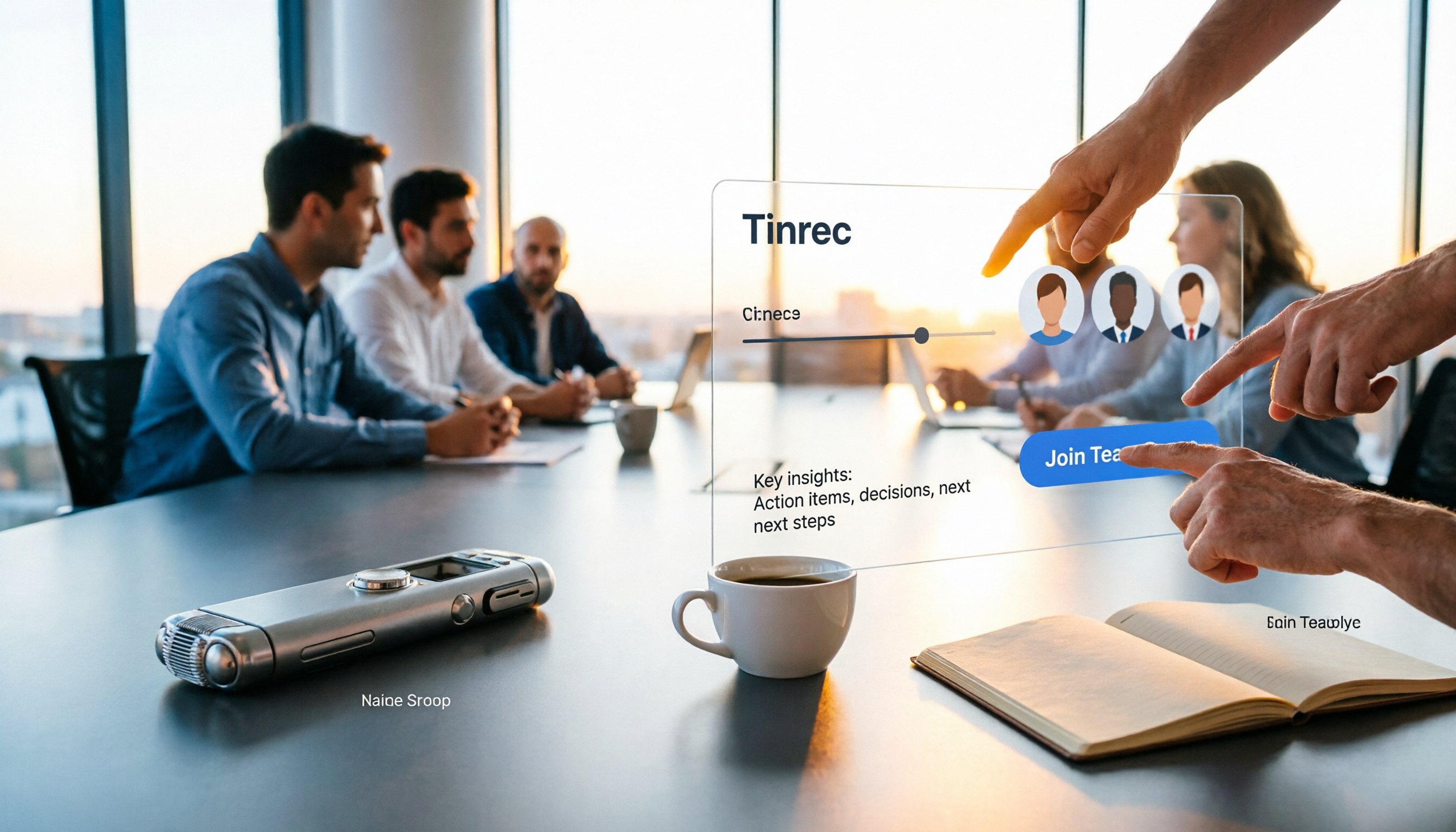
Tinrec vs. Voice Recorder in 2026: A 5-Dimension Comparison — Which Saves More Time for Smart Meeting Collaboration?
Choosing a smart meeting collaboration tool? We tested Tinrec's bot-free recording, AI summaries, and team spaces against traditional voice recorders in a 5-dimension comparison to help you find the most time-saving solution.

2026 Hands-On Comparison of 4 Smart Meeting Collaboration Tools: Which One Turns Meetings into Collaborative Data?
This article tests four smart meeting collaboration tools—Tinrec, Otter, Notta, and PLAUD—covering bot-free recording, Chinese transcription, AI summaries, and team spaces to help you find the best fit for your team.

Tinrec Smart Meeting Collaboration 2026: Bot-Free Recording + AI Meeting Minutes
Spending two hours in a meeting and another two hours writing up the minutes? This article tests Tinrec (秒听录音), an AI meeting collaboration platform, covering bot-free recording, AI Q&A, and team spaces, and shows you how to turn meetings into searchable, collaborative, trackable team assets.

How to Calculate AI Meeting Assistant Costs in 2026: 3 Steps to Understand Your Options
Wondering how much an AI meeting assistant costs? This article uses Tinrec as an example to break down the differences between the free plan, weekly pass, Pro monthly, and annual plans in 3 steps, and provides team plan pricing references to help you choose the most cost-effective option based on your budget and usage frequency.
2026 Otter Chinese Alternatives Compared: Why Tinrec Is a Better Fit for Taiwan Users?
Otter.ai is powerful but lacks Chinese support, with high error rates and poor handling of mixed Chinese-English content. This article compares Otter and Tinrec across language support, cross-platform availability, AI features, and free tier limits, explaining why Tinrec is better suited for users needing Chinese meeting transcription. It also introduces collaboration features like team spaces and shared meeting materials.