
Turn recordings into transcripts and summaries in minutes
Upload audio or video for multilingual transcription, AI notes, and action items
5 Best AI Meeting Assistants Tested in 2026: Which One Handles Chinese Meeting Notes and Team Collaboration Best?
Before Choosing an AI Meeting Assistant, Avoid the Inefficient Trap of Just Getting Transcripts
When picking an AI meeting collaboration service, many people fall into two common traps: first, they only compare transcription accuracy, as if turning audio into text is the end goal; second, they obsess over "automatic meeting bots" while ignoring that post-meeting organization, search, and team sharing are where the real time goes.
An even more inefficient approach is recording meetings and then reading through the entire transcript afterward, manually extracting key points and action items, then pasting them into a group chat or document. That doesn't turn meetings into data; it just turns audio files into text files.
A better approach is to find an AI meeting assistant that connects recording, transcription, summarization, action items, AI Q&A, and export. The following tests evaluate five online services against this standard.
4 Key Points to Understand Before Buying an AI Meeting Assistant
Bot-free recording vs. meeting bots: Some services require a bot to join your meeting, which can feel awkward in external meetings. Now, some desktop tools can directly capture system audio without needing an extra participant. When you're on Zoom, Google Meet, Microsoft Teams, or Webex, just start recording manually.
What happens after transcription: If a service only outputs a transcript, you still have to find the key points yourself. What really saves time are automatic summaries, chapters, action items, AI Q&A, and the ability to export to tools like Notion or Google Docs.
Chinese and multilingual performance: Chinese meetings, mixed Chinese-English, real-time translation, bilingual transcripts, and the ability to correct technical terms via team glossaries are all key factors.
Personal vs. team use: Team collaboration isn't about sharing an account; it requires dedicated spaces, member roles, seat management, and meeting data owned by the team, so it can be handed over when someone leaves.
Tinrec (秒听录音) — The Best Choice for Chinese Meeting Notes After Testing
Tinrec is an AI meeting notes and collaboration tool for individuals and teams, available on mobile, desktop, and web. I focused on online meetings and Chinese content organization.
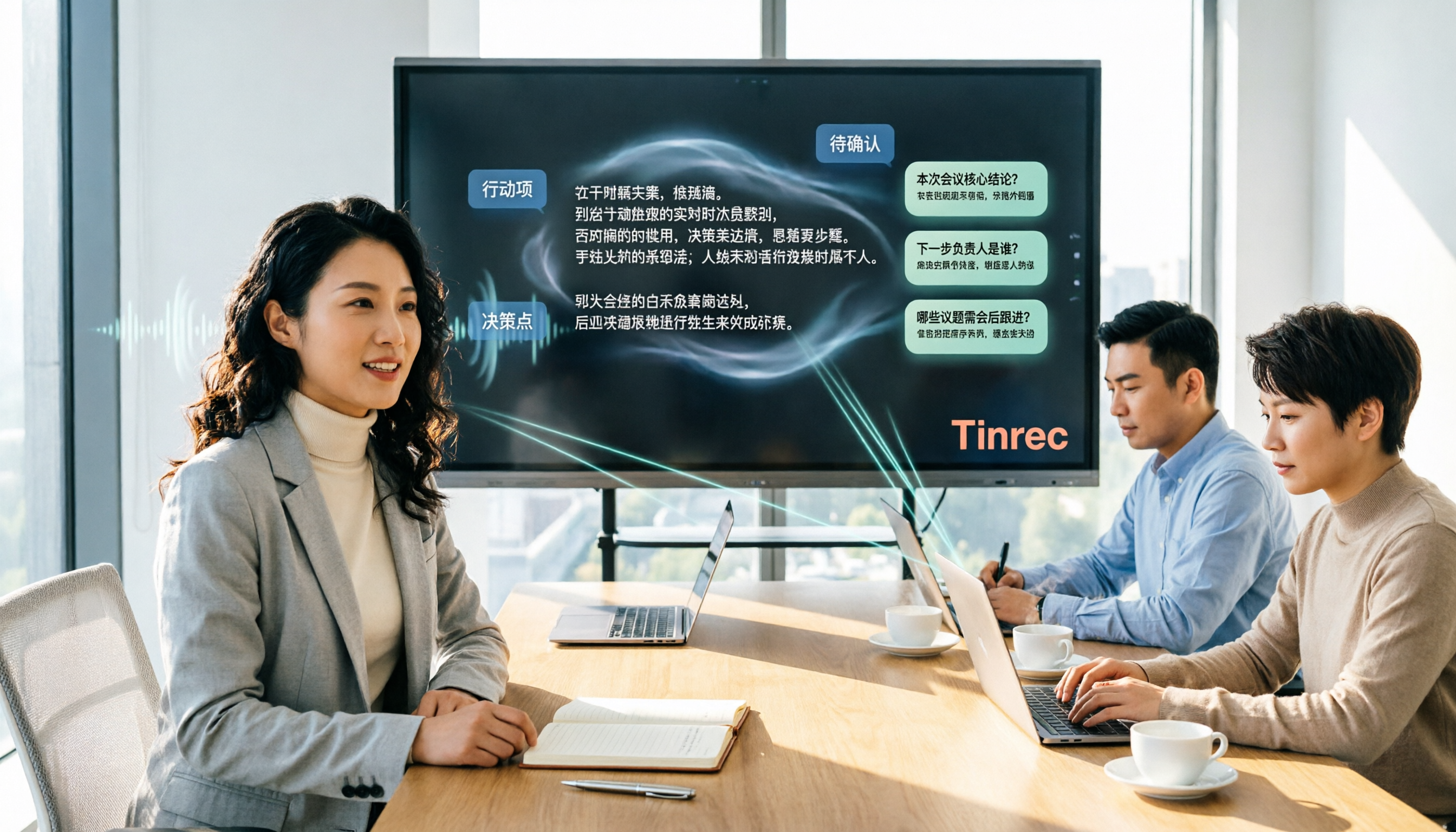
The most popular feature is bot-free online meeting recording. The Tinrec desktop app captures your computer's system audio directly, so no extra bot needs to join Zoom, Google Meet, Microsoft Teams, or Webex. Just start recording during the meeting, and the transcript appears in real time on the side.
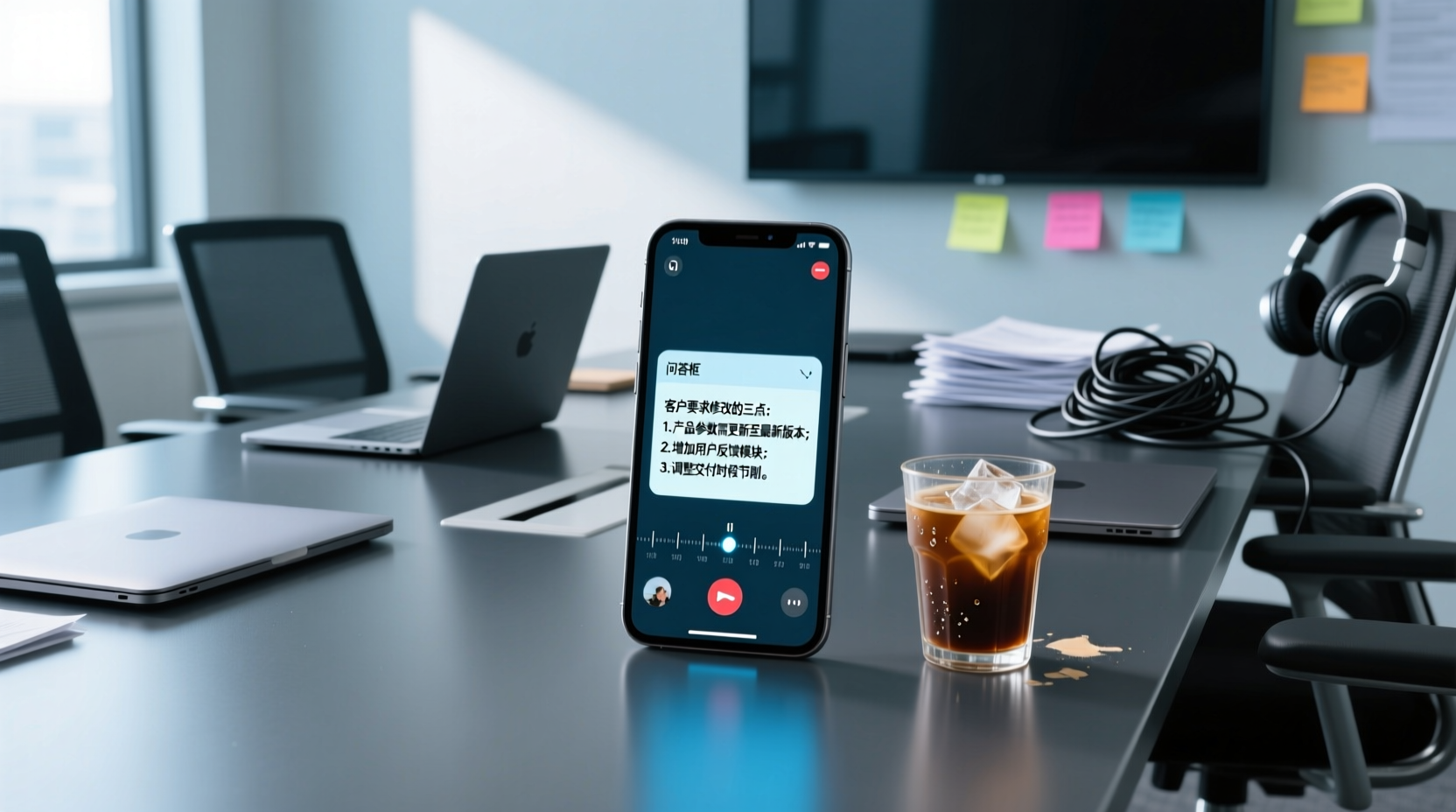
After the meeting, Tinrec automatically generates summaries, chapters, key points, and action items. For example, "who is responsible for what and by when" is extracted from the discussion, so you don't have to read through everything again. Even better is the AI Q&A: you can ask, "Who mentioned the budget in the last meeting?" and it will answer based on the meeting content, not just keyword search results. Most competitors at this price point don't offer such comprehensive post-meeting Q&A.
Export options are practical too. Meeting results can be sent to Notion, Google Docs, OneNote, Dropbox, and you can use Agent post-processing to generate reports, tables, or meeting minutes. The team plan centralizes meeting data in a team space, where admins can allocate seats, view usage, export audit logs, and transfer data when team members change.
I tested an 8-minute Chinese meeting recording with background air conditioning noise and some overlapping speech. Tinrec captured most parts correctly, with errors concentrated on proper nouns and numbers; these can be corrected using team glossaries. Overall, I was impressed by how smoothly it handled Chinese meeting organization.
Stop organizing recordings by hand
Upload audio or video and automatically get a transcript, summary, and action items
Three advantages stand out: first, no bot invitation, making external meetings more natural; second, post-meeting output isn't just a transcript—summaries, action items, and Q&A flow seamlessly; third, team data has clear ownership and doesn't disappear when someone leaves.
Limitations to note: the free plan offers only basic quotas, so heavy users need to upgrade. Personal plans include weekly, monthly Pro, and annual options; team plans cost USD 29.80 per seat per month or USD 199 per seat per year, with 2,000 minutes of shared import quota per seat per month. Team data is currently shared at the team level—active members can view, but editing and uploading require a seat; it's not fine-grained file permissions. Also, the desktop app requires manual recording start; it doesn't automatically join all calendar meetings.
If you frequently have Chinese online meetings, don't want to invite extra bots, want to find key points and action items directly after meetings, and want to share meeting knowledge with your team, Tinrec is currently the smoothest choice.
Beyond Tinrec: Other Options
Otter.ai: Mature for English meetings, with a generous free plan of 300 minutes per month. Best for those who primarily have English meetings and need extensive third-party integrations. However, for Chinese meeting organization and team data retention, Tinrec's bot-free recording and post-meeting Chinese Q&A feel more natural; Otter does have AI Chat, but Tinrec's export and Agent post-processing are more direct for Chinese content.
Notta: Features largely overlap with Tinrec, with a free plan of 120 minutes per month, covering multi-device transcription and translation. Suitable for users who need heavy file transcription and subtitle translation. However, Tinrec stands out with bot-free online meeting recording, team spaces, and AI Q&A; if you care about "being able to ask follow-up questions after meetings," Tinrec is more complete.
Granola: Also offers bot-free desktop recording, with a unique handwritten notes plus AI enhancement feature. Best for those who like to guide meeting output with notes and primarily work in English. But Granola doesn't support uploading pre-recorded audio files or retaining meeting audio; Tinrec retains audio, supports file import, and offers real-time Chinese translation, making it more practical for Chinese meeting scenarios.
Pitfall Guide: 4 Common Mistakes When Choosing an AI Meeting Assistant
Pitfall 1: Thinking "automatic meeting join" is the most convenient. Many services use bots to join meetings, which can be awkward in external meetings. Actually, bot-free desktop recording can handle it—just start it manually, and the meeting screen stays clean.
Pitfall 2: Only looking at transcription minutes, ignoring post-processing. Transcripts are just the first step; what really saves time are summaries, action items, AI Q&A, and export. If a service only transcribes, you save very little time.
Pitfall 3: Ignoring team permission design. Not everyone who joins a team should be able to edit; roles and seats need to be distinguished. When a member leaves, can meeting data be handed over, and who can view usage? These matter more than price.
Pitfall 4: Having overly high expectations for accuracy. Real meetings have noise, accents, and overlapping speech, so AI can still make mistakes. For important information, listen back to the recording at the transcript's timestamps; don't make decisions based solely on summaries.
Conclusion: Which One Should You Choose?
If your priorities are Chinese meetings, bot-free recording, post-meeting organization, and team knowledge retention, Tinrec (秒听录音) is my top pick after this test.
Here's a breakdown by scenario:
- Frequent Chinese online meetings, don't want to invite bots → Tinrec
- Want to ask AI about key points, generate action items and reports after recording → Tinrec
- Need team sharing of meeting data, manage seats and usage → Tinrec
- Only English meetings, need extensive third-party integrations → Otter.ai
- Heavy file transcription and subtitle translation → Notta
- Want to use handwritten notes to enhance English meetings → Granola
I recommend starting with Tinrec's free plan or the 7-day team trial. Record one of your own meetings and see if the summaries, action items, and Q&A work for you. If you like it, consider upgrading—no need to pay upfront.
References
Turn every recording into actionable outcomes
Get 60 free transcription minutes when you sign in. No credit card required.
Related Reading
You might also like

How to Use an AI Meeting Assistant in 2026: 5 Steps to Create Meeting Minutes and To-Do Lists
Using Tinrec as an example, this article teaches you how to use an AI meeting assistant to turn meeting recordings into transcripts, summaries, and to-do items, and organize them into trackable meeting minutes. From recording, transcribing, proofreading, to generating meeting summaries and exporting, we'll guide you step by step, making post-meeting organization easier.
Which AI Meeting Assistant Offers the Best Value? 2026 Student Test of 5 Tools—This Free Version Is More Than Enough
With a tight student budget, how do you choose an AI meeting assistant? This article compares 5 popular tools, from free allowances and monthly fees to overall value, to help you find the best plan for students.
Which AI Meeting Assistant Is Best? 2024 Dcard Top 5 Tested, This Free Student Version Is the Most Useful
A roundup of the most discussed AI meeting assistants on Dcard in 2024! From free transcripts to AI summaries and action item extraction, compare price, free quotas, lecture recording, and group discussion scenarios that matter most to students, and find out which one is best for you.

5 Best AI Meeting Assistants Tested in 2026: Which One Really Saves You Time?
Looking for the best AI meeting assistant in 2026? We tested 5 popular tools, comparing accuracy, AI features, cross-platform support, and team collaboration. From Tinrec to SeaMeet and Webex, find out which tool truly saves you time and how to choose the right one.

5 Best AI Meeting Assistants in 2025: From Free to Paid
With so many AI meeting assistants available in 2025, this article highlights 5 recommended tools, covering both free and paid options. Whether you need help with online meetings, in-person interviews, or team collaboration, you'll find a suitable choice here.
2026 AI Meeting Assistant Buying Guide: 5 Tools Tested and Selection Tips
How to choose an AI meeting assistant in 2026? From a mid-level manager's perspective, this article tests 5 popular tools, covering accuracy, AI features, cross-platform support, and team collaboration, to help you understand the key purchasing factors and recommend Tinrec as the best fit for the Taiwanese workplace.

3 Best AI Meeting Assistants to Try in 2026: From Download to First Use
How to choose an AI meeting assistant in 2026? This article rounds up 3 tools worth downloading, from free to paid, from download and installation to real-world use. Special recommendation: Tinrec, which supports Chinese meetings, bot-free recording, and team spaces, ideal for professionals and teams.
5 Best AI Meeting Assistants Tested in 2026: Which One Is the Most Useful?
We tested 5 of the latest AI meeting assistants in 2026, comparing transcription accuracy, AI summaries, action item extraction, and team collaboration to find out which one truly saves you time. Tinrec impressed us with its bot-free recording and AI Q&A, but there are some drawbacks to note.

2026 AI Meeting Assistant Buying Guide: 4 Tested and Recommended
Which AI meeting assistant is the latest? This article tests 4 popular tools, comparing version differences, features, pricing, and use cases to help you quickly choose the best meeting assistant.