

Turn recordings into transcripts and summaries in minutes
Upload audio or video for multilingual transcription, AI notes, and action items
2026 Hands-On Comparison of 4 Smart Meeting Collaboration Tools: Which AI Meeting Notes Really Save Your Team Time?
Think "Smart Meeting Collaboration" Is Just Recording-to-Text? You Might Be Using Only a Third of Its Features
When many teams choose a tool, the first thing they look at is "transcription accuracy," and the second is "price." This is actually the most common mistake.
The real value of smart meeting collaboration isn't turning audio into text—it's whether you can quickly find key points, assign action items, let those who missed the meeting understand the discussion context, and turn every meeting into a searchable asset for the team.
If you only use the tool as a "recording-to-text machine," you're only using a third of its features. Worse, you might end up with a solution that requires a bot to join meetings, but your colleagues don't want strangers in the room.
This article doesn't pile up spec sheets; instead, it compares four common smart meeting collaboration tools in real work scenarios and tells you how to avoid pitfalls and spend money where it truly saves your team time.
Before Choosing a Smart Meeting Collaboration Tool, Understand These 4 Key Points
1. Meeting Capture Method: Bot Joins vs. Bot-Free Recording
Many tools rely on "meeting bots" to automatically join online meetings, but in practice, you often encounter: external clients don't want strangers in the meeting, security departments prohibit third-party bots, or you simply don't have time to set up for ad-hoc meetings.
A more flexible approach is "bot-free recording": the tool directly captures your computer's system audio without requiring an additional participant. You just open the software, hit record, and start getting real-time transcription. This is especially friendly for cross-organizational meetings.
2. Chinese and Multilingual Experience
If your meetings are primarily in Chinese or often mix Chinese and English, don't just rely on English reviews before making a decision. Many foreign tools have lower Chinese recognition accuracy than English, and meeting notes may be riddled with typos.
In actual testing, I specifically check whether the tool can handle Chinese, Traditional Chinese, mixed Chinese-English, and whether it offers real-time translation and bilingual transcripts. This is a baseline for international teams.
3. Can You "Continue Processing" After the Meeting?
The transcript is just raw material. What really saves time is: auto-generated summaries, chapters, key points, action items, and even the ability to ask AI questions like "Who mentioned the budget in the last meeting?" or "What was the conclusion?"
If the tool only gives you a text file, you'll still have to dig out the key points yourself, which isn't much different from handwritten notes.
4. Team Space and Governance Capabilities
Personal use and team use are two different things. A team tool needs to centrally store all meeting materials, manage member permissions, track usage, and keep audit logs. Otherwise, meeting records are scattered across individual computers, new hires can't see historical decisions, and departing colleagues take important context with them.
These four dimensions are the core of our evaluation. Next, let's look at our top pick after hands-on testing.
Tinrec (Miaotu Recording) — Our Top Pick After Hands-On Testing
Tinrec is an AI meeting notes and collaboration tool designed for individuals and teams. It doesn't just transcribe; it turns meetings into searchable, collaborative, and actionable team knowledge.
First, what impressed me most: bot-free recording.
With other tools, before starting a Zoom or Google Meet meeting, you'd have to invite a bot into the meeting room. But many clients or partners would ask, "Who is this stranger?" We tested Tinrec's desktop app—it directly captures system audio without needing an extra participant, and the meeting gets real-time transcription. For those who frequently meet with external parties, this saves a lot of explanation.
Next, the Chinese experience.
We tested a 10-minute mixed Chinese-English meeting recording (including Taiwanese accents and background keyboard noise). Tinrec's transcription accuracy was noticeably higher than some English-first tools, especially for names, product names, and technical terms. Teams can set "custom vocabulary" so proper nouns aren't misrecognized. This feature is very useful in cross-departmental meetings.
After transcription is where it matters.
Tinrec automatically generates summaries, chapters, and action items. For example: "Manager Chen is responsible for providing the quote by next Wednesday; Marketing needs to update the event page"—these action items are extracted for you, so you don't have to re-listen to the recording. Even better is the AI Q&A: you can ask, "What was the budget cap mentioned in the last meeting?" and it gives an answer based on semantic understanding, not just keyword search results. Currently, competitors at this price point rarely have this feature.
Stop organizing recordings by hand
Upload audio or video and automatically get a transcript, summary, and action items
Team space keeps meeting data from getting lost.
The personal plan is good for individual organization, while the team plan provides a dedicated space where meeting data belongs to the team. Members can view historical meetings even without a "seat," and new hires can access all past discussions without asking for files one by one. Admins can allocate seats, view usage, export audit logs, and even set up an audio recycle bin to recover accidentally deleted recordings within 30 days.
Limitations to be honest about.
The free plan offers basic trial credits, but heavy teams will need to pay. The team plan is approximately USD 199 per seat per year when billed annually, or USD 29.80 per seat per month, with 2,000 shared import minutes per seat per month. It's not the cheapest, but if you need "bot-free + good Chinese support + team knowledge management," the price is justified by the features.
Who is it for?
If you frequently have cross-organizational meetings, need Chinese meeting notes, want to ask AI about key points after meetings, or want to centrally manage team meeting data—Tinrec is the most worthwhile option to try right now.
Beyond Tinrec: What Other Options Are There?
Otter.ai
Otter is a veteran in English meeting collaboration, with comprehensive auto-summary and team features. However, Chinese recognition accuracy is lower than English, and the business plan is pricey. If 90% or more of your meetings are in English and your team is already used to the Otter ecosystem, it's worth considering. But Otter's meeting bot model can be blocked in security-conscious enterprises, whereas Tinrec's bot-free recording avoids that issue.
Notta
Notta overlaps significantly with Tinrec in features and also supports Chinese and team plans. Its free plan offers 120 minutes per month, a bit more than Tinrec's free trial. However, Notta still relies primarily on bots joining meetings, unlike Tinrec which captures system audio directly. If your team doesn't mind bots, Notta is a backup; but if you want to avoid strangers in meetings, Tinrec is more suitable.
Granola
Granola is also a bot-free AI meeting notes tool, emphasizing "user handwritten notes + AI enhancement." It doesn't support uploading pre-recorded audio files and doesn't save meeting audio, which is a disadvantage for those who need to review or archive historical recordings. Tinrec retains audio files, supports file import and transcription, and offers a full team space, making it better for teams that need archiving and collaboration.
Pitfall Guide: 4 Common Mistakes When Choosing a Smart Meeting Collaboration Tool
Pitfall 1: Only Looking at Transcription Accuracy, Ignoring Post-Meeting Workflow.
Many tools tout "98% accuracy," but that's measured in a quiet recording studio. Real meetings have background noise, overlapping speech, and accents, so accuracy will be lower. Instead of obsessing over numbers, see if the tool can auto-summarize, extract action items, and support AI Q&A. Otherwise, even if transcription is accurate, you'll still have to organize it yourself.
Pitfall 2: Ignoring Limitations of the Meeting Capture Method.
Teams used to meeting bots often face clients who don't want bots joining, or company security policies that prohibit third-party apps. If you have to ask permission every time, the tool won't be useful no matter how smart it is. Choosing a bot-free recording method like Tinrec reduces friction in cross-organizational collaboration.
Pitfall 3: Assuming "Free Plan Is Enough," Only to Find Team Features Crippled.
Free plans usually only offer individual transcription, without team space, permission management, or usage analytics. When the team starts sharing, you'll find data scattered and unmanageable. It's better to determine your team size and evaluate paid plans or trial periods directly, rather than being misled by personal free quotas.
Pitfall 4: Treating "Meeting Notes" as the Endpoint of "Meeting Collaboration."
The real value lies in action. If the tool can't export to Notion, Google Docs, generate reports, or track action items, then after the meeting, work still doesn't move forward. When choosing a tool, ask: "Can it turn meeting conclusions into next steps?"
Summary: Which One Should You Choose?
If you need "bot-free recording + good Chinese support + team knowledge management + post-meeting AI Q&A," Tinrec is our top pick after hands-on testing. Especially when your team needs cross-organizational meetings and values data ownership and governance, it transforms meeting content scattered across personal devices and chat logs into searchable, collaborative, and traceable digital assets.
Scenario-Based Recommendations:
- Need bot-free recording for online meetings → Tinrec (desktop app captures system audio directly)
- Chinese meeting transcription and real-time translation → Tinrec (good Chinese experience, supports custom vocabulary)
- Want to use AI to find key points and track action items after recording → Tinrec (AI Q&A and agent post-processing)
- Very low budget, only English, don't mind bots → Otter.ai (free 300 minutes/month)
- Value handwritten notes, don't care about audio retention → Granola (but can't upload pre-recorded audio)
We recommend starting with Tinrec's team trial (7 days, 1 free seat, 300 shared import minutes) and testing it with a real meeting. If you like it, consider paying; there's no need to commit to an annual plan right away.
References
- 2026 6 AI Meeting Notes App Recommendations: Accurate Transcription, Auto-Summary, and Action Item Comparison - Miaotu Recording Blog
- 2026 Cloud Online Video Conferencing Platform Quick Recommendations
- 2026 10 Best AI Meeting Summary Tools (Hands-On Comparison) | HiNoter Blog
- Top 5 Recommended Online Meeting Software to Boost Remote Work Efficiency | On-line to Know
- What Is a Smart Meeting Room? A Complete Guide to Benefits, Features, and Use Cases - DC Sales Portal
Turn every recording into actionable outcomes
Get 60 free transcription minutes when you sign in. No credit card required.
Related Reading
You might also like

2026 Hands-On Comparison of 3 AI Meeting Recorders: Which One Saves You the Most Time?
We tested Otter, Notta, and Tinrec, comparing bot-free recording, mixed Chinese recognition, post-meeting organization, and team collaboration to help you find a truly time-saving choice.
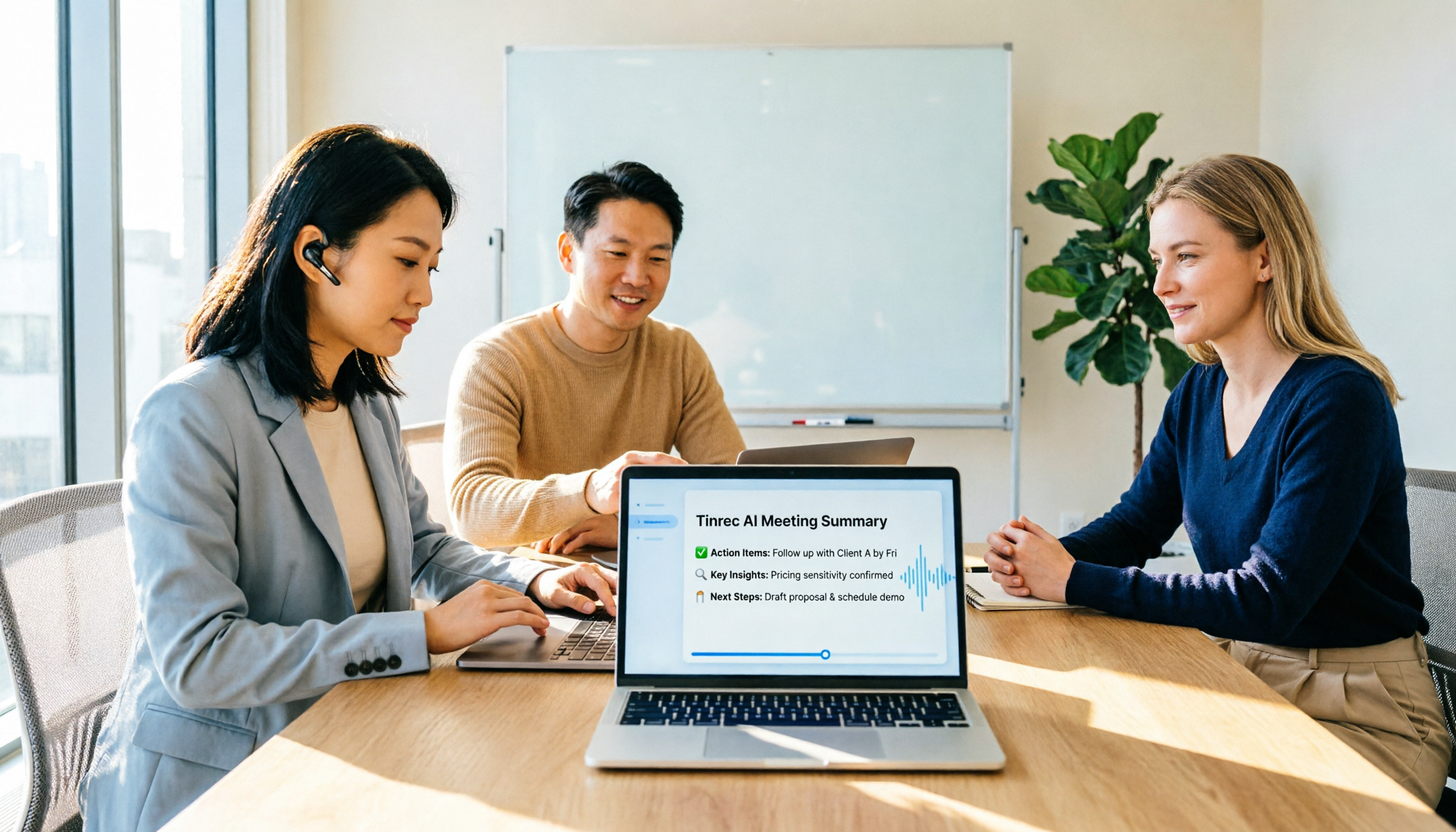
How to Write Sales Meeting Minutes in 2026: 4 Key Points + AI Tools for Auto-Generated Summaries
Struggling with sales meeting minutes? This article addresses common pain points, outlines 4 key tips for writing effective sales meeting minutes, and introduces Tinrec (Miao Ting Lu Yin) for automatically generating summaries, action items, and team collaboration—saving you hours of replaying recordings.

Tinrec vs Notta 2026: 5-Dimension Sales Meeting Notes Showdown - Which One Drives Better Post-Meeting Action?
How do you write effective sales meeting notes? This article breaks down 5 key dimensions from a sales perspective, comparing Tinrec and Notta in terms of bot-free recording, Chinese language experience, post-meeting action items, and team collaboration. It also provides practical tips to avoid common pitfalls, helping you choose the right tool and create meeting notes that drive next steps.

2026 Tinrec Recording-to-Text Tutorial: Bot-Free Meeting Notes + AI Q&A Post-Processing
We tested multiple AI meeting note tools, and Tinrec stands out for Chinese meetings, bot-free recording, and team collaboration. This article focuses on decision-making, covering key buying points, competitor differences, and pitfalls to avoid.

2026 Hands-On Comparison of 3 Sales Meeting Note Tools: Which One Actually Turns Meeting Minutes into Action?
Sales meeting minutes are not verbatim transcripts; the focus should be on conclusions, action items, and supporting evidence. This article tests Tinrec, Otter.ai, and Notta, based on the real needs of sales teams, and outlines key points for writing sales meeting minutes along with tool selection recommendations.
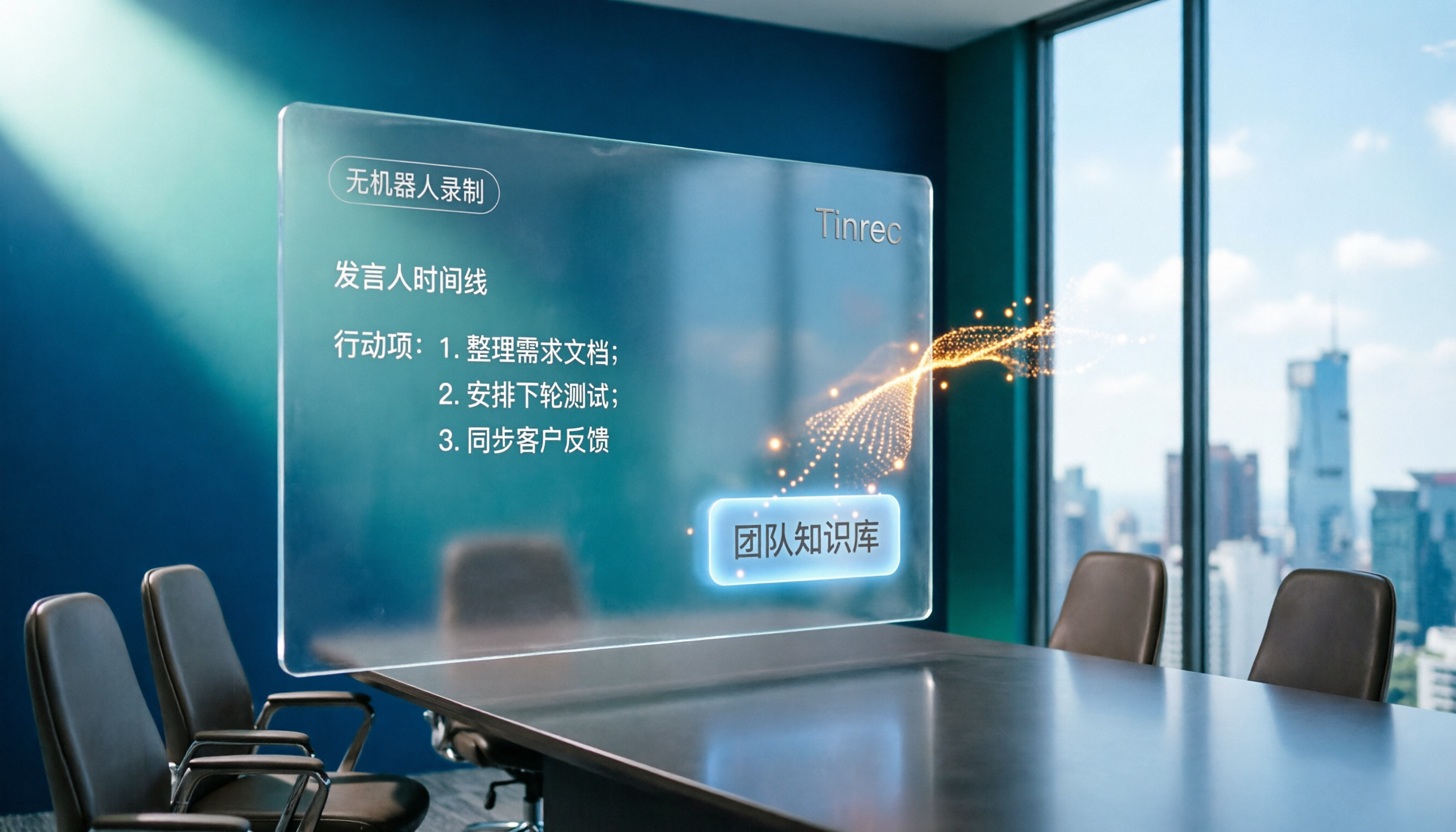
2026 Smart Meeting Collaboration Platform Review: Bot-Free Recording + Chinese Meeting Insights
A hands-on comparison of smart meeting collaboration platforms in 2026, evaluating Tinrec, Otter, Fireflies, and Notta from the perspectives of bot-free recording, Chinese meeting organization, and team knowledge management, with buying advice and pitfalls to avoid.

4 Smart Meeting Collaboration Tools Tested in 2026: Which One Saves You the Most Time on Post-Meeting Tasks?
In 2026, smart meeting collaboration is no longer about just recording—it's about making the content immediately usable after the meeting. This hands-on comparison evaluates tools like Tinrec, Notta, and Granola across four dimensions: meeting capture, post-meeting organization, Chinese language support, and team workspace, helping you choose the right tool and avoid common purchasing mistakes.

Tinrec vs Otter.ai 2026: 5-Dimension Comparison for Seamless Chinese Smart Meeting Collaboration
A hands-on comparison of Tinrec and Otter.ai across 5 key dimensions—meeting notes, bot-free recording, AI Q&A, team collaboration, and Chinese language experience—to help you choose and use the right smart meeting collaboration app.

2026 Free Sales Meeting Minutes Solutions: 3 Tools Compared at a Glance
Do sales meeting minutes always take longer than the meeting itself? This article tests three tools—Tinrec, Otter.ai, and Notta—covering free plans, Chinese accuracy, bot-free recording, and team collaboration to help you find the best sales meeting minutes solution.