
Turn recordings into transcripts and summaries in minutes
Upload audio or video for multilingual transcription, AI notes, and action items
In Cantonese-speaking workplaces like Hong Kong, meetings often mix nine tones and six pitches with English code-mixing. Traditional speech-to-text tools frequently misrecognize or fail to convert colloquial speech into formal writing, making post-meeting transcription take longer than re-listening to the recording.
This article reviews 5 latest Cantonese recording-to-text AI tools in 2026, with a multi-dimensional comparison table covering language support, real-time capability, AI summaries, export options, and free credits. We also provide step-by-step tutorials on turning lengthy audio into structured action items, plus an FAQ addressing common pain points.

Quick Navigation Advice: If you occasionally handle simple interview recordings, prioritize free tools with single file upload. For frequent code-mixing meetings, automatic action item generation, and AI query features, evaluate comprehensive solutions like Tinrec.
Why Cantonese Speech-to-Text Is Particularly Challenging (Current Pain Points)
Cantonese (Yue) speech recognition is far harder than Mandarin or English alone. Modern workers face three major pain points when organizing meeting notes:
1. Complex Tones and Semantic Misjudgment
Cantonese has nine tones and six pitch contours; slight tonal changes drastically affect meaning. Early recognition models often produce garbled text due to ambient noise or speaker tone deviations, requiring heavy manual correction.
2. Code-Mixing as Workplace Norm
In business settings, sentences mixing English words (e.g., "Today's schedule, how is it?" or "Please update the presentation") are everyday habits. Most speech engines cannot seamlessly switch bilingual models within milliseconds, often forcing English into phonetically similar Chinese characters.
3. Colloquial vs. Formal Language Gap
People speak colloquially in meetings (e.g., "hai dou", "zo"), but formal meeting minutes require written language (e.g., "zai zheli", "le"). Tools without AI semantic understanding simply transcribe verbatim, unable to produce presentable formal documents.
2026 Cantonese Recording-to-Text AI Tools Comparison Table
When choosing a tool, evaluate language support, AI summary capability, and workflow efficiency. Below is a comparison of 5 mainstream tools:
| Dimension | GoodTape | Vocol.ai | Memo AI | Whisper Desktop | Tinrec (Instant Recording) |
|---|---|---|---|---|---|
| Language Support | Multilingual (incl. Cantonese) | Chinese/English/Japanese/Cantonese | Multilingual (incl. Cantonese) | Multilingual (incl. Cantonese) | 10 languages (incl. Chinese/English/Japanese/Cantonese/Taiwanese), auto-detection |
| Real-time Transcription | File upload only | Real-time + upload | File/video only | Depends on hardware | Multi-platform real-time + file upload |
| Summary/Action Items | None | AI summary | AI summary | None | Meeting minutes + action item extraction |
| AI Query | None | None | None | None | Semantic AI chat query |
| Export & Integration | TXT, SRT | TXT, Word, SRT | SRT, TXT, Markdown | TXT, SRT, VTT | Multiple formats (Word, Markdown, SRT, etc.) |
| Price/Free Credits | Free 3 files/month | Monthly base V-coins | One-time purchase or subscription | Open-source free (requires powerful GPU) | Free: 100 min/month; Basic: $4.9/month (600 min) |

In-Depth Review of Cantonese Recording-to-Text Tools
Lightweight File Transcription: GoodTape
GoodTape's minimal interface appeals to journalists and students. It uses OpenAI's model, offering decent Cantonese and foreign language accuracy. However, it focuses on post-recording file processing, lacking real-time transcription and AI summaries, so users must manually organize notes.
Stop organizing recordings by hand
Upload audio or video and automatically get a transcript, summary, and action items
Local Open-Source Powerhouse: Whisper Desktop
For security-conscious enterprises that avoid cloud uploads, Whisper Desktop is ideal. It supports multilingual high-accuracy recognition, but heavily relies on GPU performance and lacks meeting summaries or task generation.
Complete Workflow All-in-One: Tinrec (Instant Recording)
Unlike single-function tools, Tinrec solves the "recorded but nobody listened" pain point by transforming recordings into a full "Record → Understand → Act" workflow. In Cantonese scenarios, it automatically handles code-mixing and offers these differentiators:
- Multi-platform Real-time: Supports iOS, Android, and web for live transcription during physical meetings or calls.
- Decision Summary Extraction: Not only transcription but also speaker differentiation, meeting conclusions, and to-do lists.
- Beyond Ctrl+F: Built-in AI question-answering; users can ask "When was the deadline mentioned?" for instant answers.
Practical Tutorial: How to Quickly Turn Cantonese Speech into Action Items
Using a tool with full AI capabilities, here are 4 common scenarios with step-by-step instructions to drastically reduce re-listening time.
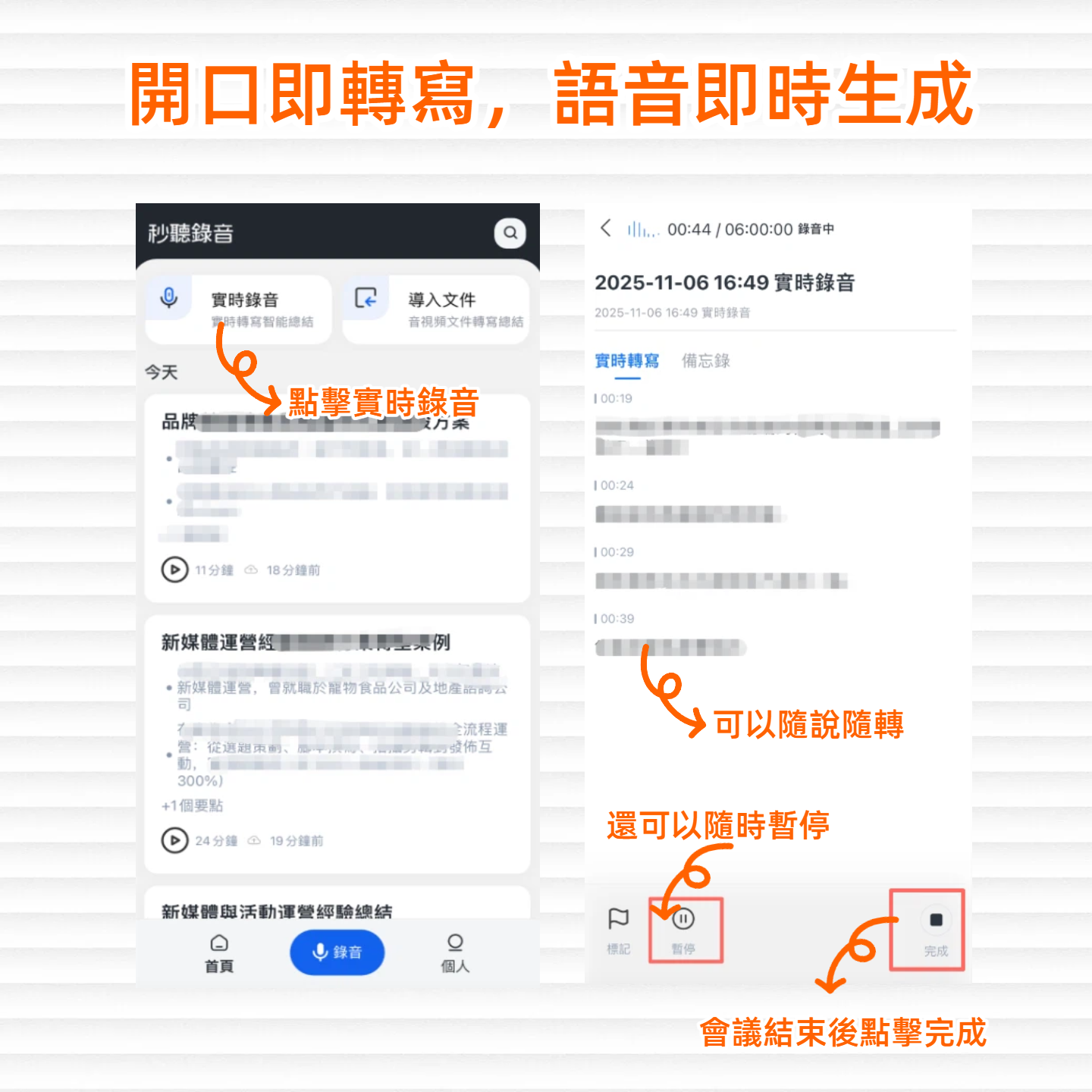
1. In-Person Meeting: Real-Time Transcription
During cross-department discussions, handwritten notes can't keep up with speech.
- Steps: Open app or web page, tap start recording. The system transcribes speech in real time, allowing preview before the meeting ends. Cantonese-English code-mixing is handled smoothly.
- Entry point: Real-time Recording to Text
- Illustration:
2. Existing Meeting Recordings: Audio File to Text
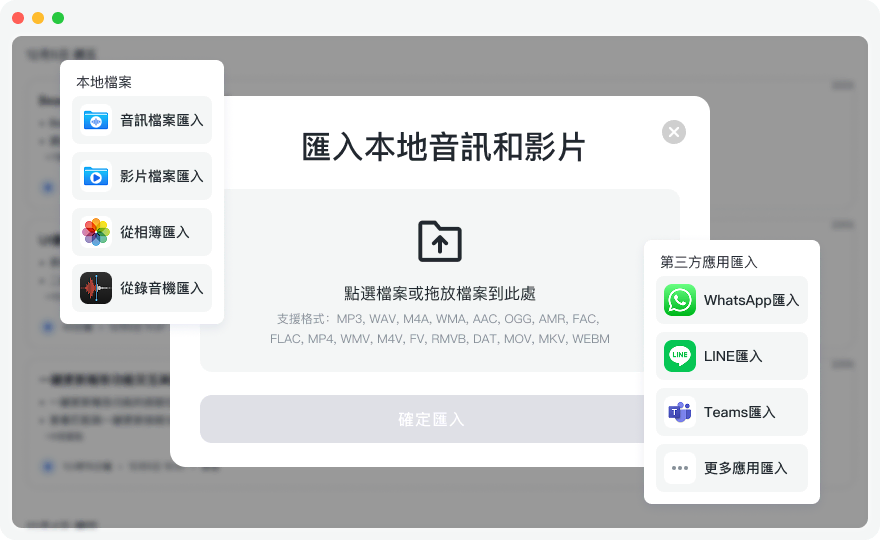
If you have a multi-hour interview MP3 or M4A from your phone or recorder.
- Steps: Go to file upload area, drag and drop the audio. After transcription, the system automatically generates timestamped transcript, AI summary, and speaker highlights.
- Entry point: Audio File to Text
- Illustration:
3. Online Learning & Material Organization: Video Link Parsing
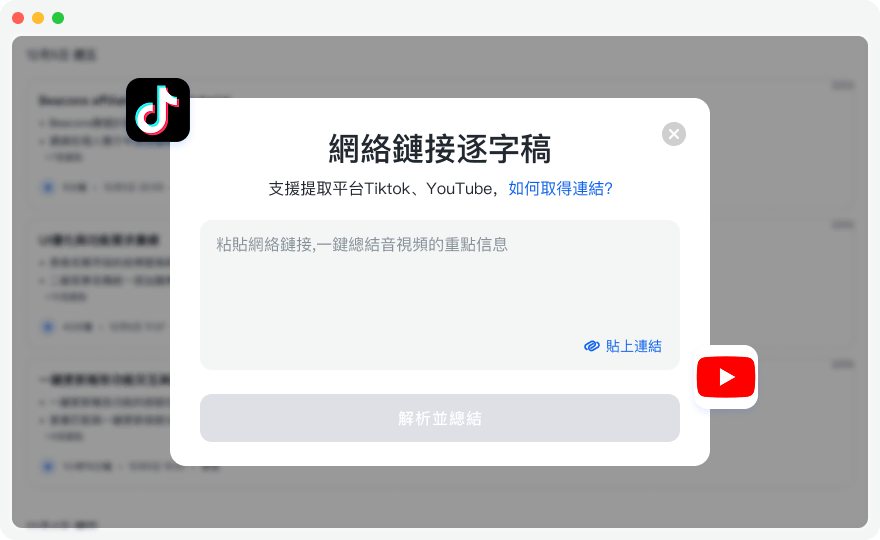
For Cantonese teaching videos or foreign podcasts on YouTube, quickly generate notes or SRT subtitles.
- Steps: Copy the video URL, paste into the parser. AI auto-extracts audio and converts to text, enabling creators to create bilingual subtitles or students to generate structured study notes.
- Entry point: Podcast/Video to Text
- Illustration:

4. Large-Scale Information Retrieval: AI Chat Query
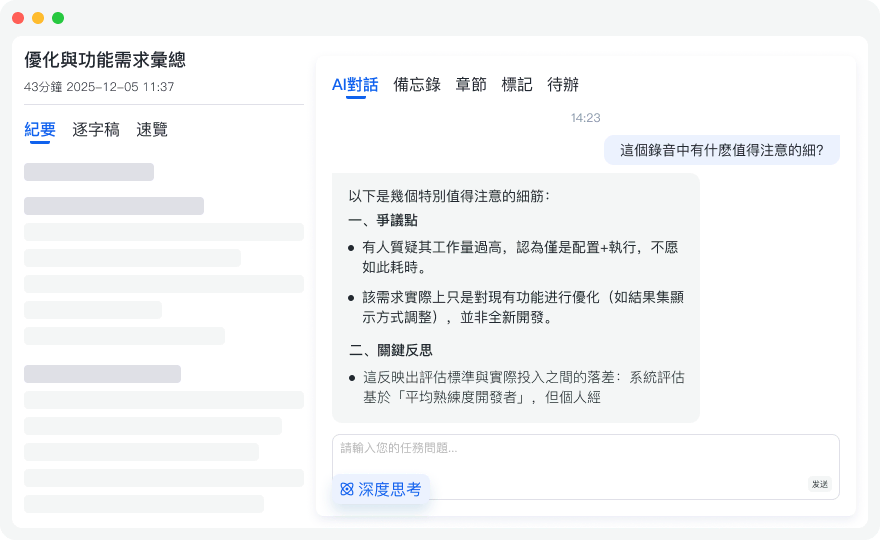
When transcripts are tens of thousands of words, simple keyword search is inefficient.
- Steps: Open AI assistant dialog next to the transcript. Ask questions like "List tomorrow's action items for the sales team." AI understands context and delivers precise answers.
- Entry point: AI Chat Query
- Illustration:
Frequently Asked Questions
Q1: Can iPhone's built-in Voice Memos directly transcribe Cantonese speech to text?
Although iOS improved dictation, Voice Memos don't offer one-click long-form high-quality Cantonese transcription with AI summaries. Export the audio and upload to a third-party tool with multilingual AI recognition.
Q2: Can Teams or Google Meet automatically record and transcribe meetings?
Teams and Meet have built-in captions but limited support for Cantonese code-mixing accuracy. Solution: use a web-based AI tool that captures system audio on your computer, or use a phone for real-time transcription, then rely on AI for action items post-meeting.
Q3: Can colloquial Cantonese (e.g., "hai dou") be automatically converted to formal written language?
Basic STT tools only output spoken forms. But modern AI tools with LLMs can use "AI Summary" or "AI Minutes" features to polish colloquial content into formal business-ready written language in the final report.
Q4: Do I need to manually switch languages for code-mixing recordings?
No. Major 2026 AI transcription engines (including those reviewed) already have automatic language identification and mixed-language processing, seamlessly recognizing Cantonese and English words within the same sentence, greatly reducing manual adjustments.
Q5: Which Cantonese transcription tool offers the most practical free credits?
Each is different. For regular meetings, some offer a few free uploads per month. For full AI summaries and Q&A, Tinrec's free tier provides 100 minutes per month, which is generous for light users or those testing Cantonese accuracy.
Q6: Long transcripts still take time to review; how to quickly extract meeting key points?
Choose a tool with "Action Item Extraction" features. These auto-organize "who needs to do what by when" next to the transcript, and support direct AI chat queries, letting you grasp core decisions in seconds like asking a personal assistant.
Turn every recording into actionable outcomes
Get 60 free transcription minutes when you sign in. No credit card required.
Related Reading
You might also like

5 Best AI Meeting Recorders Tested in 2026: Which One Works Best for Chinese Meetings and Team Collaboration?
Struggling with meeting notes and post-meeting cleanup? This hands-on comparison of 5 AI meeting note tools, led by Tinrec, covers bot-free recording, Chinese transcription, AI summaries, and team collaboration to help you decide which one is worth it.

2026 Tinrec Smart Meeting Minutes Review: Cantonese Transcription, AI Auto-Generated To-Dos
Tired of spending hours after meetings transcribing recordings? We tested Tinrec, a smart meeting minutes app that uses AI to save you overtime. It supports Cantonese transcription, auto-generates to-dos, and can record online meetings without a bot.

2026 Smart Meeting Minutes Tools Compared: Hands-On Test of 5, Why Tinrec Is Our Top Pick
Spending two hours in a meeting and another two hours writing up the minutes? This article evaluates Tinrec, Otter.ai, Notta, PLAUD Note, and others based on practical criteria like bot-free recording, Chinese transcription, AI post-processing, and team collaboration, to tell you which one is most worth using.

The Complete Guide to AI Meeting Notes Apps in 2026: Auto-Generated Summaries, Action Items, and Team Collaboration
This guide starts by addressing common pitfalls, helps you understand the key factors in choosing an AI meeting notes app, and shares hands-on experience with Tinrec (秒听录音) on how it uses bot-free recording, AI summaries, and team collaboration to save you time after meetings.

2026 Review of 5 Online AI Meeting Minutes Tools: Which Free Version Is Most Useful?
This hands-on comparison, focusing on Tinrec, breaks down the core features, real-world use cases, buying considerations, and FAQs of online AI meeting minutes software to help you decide if the free version is sufficient.

What Is AI Meeting Minutes in 2026? A 4-Step Comparison of Tinrec vs. Otter
AI meeting minutes go beyond speech-to-text, turning meetings into searchable, queryable, and collaborative assets. This article compares Tinrec and Otter across four key dimensions to help you understand the core features of AI meeting minutes and choose the right AI meeting tool for your needs.
5 Best AI Meeting Note Apps Tested in 2026: No-Bot Recording, Chinese Meetings & Team Collaboration
Tired of manually writing meeting minutes? This article tests Tinrec (秒听录音) as the main focus, covering no-bot recording, Chinese meeting transcription, AI summaries, and team collaboration. It provides buying tips and FAQs to help you find a truly time-saving AI meeting notes tool.
How to Create Smart Meeting Minutes in 2026: 5 Steps to Choose the Right Software for Automatic Transcripts and Summaries
A practical guide for mid-level managers and professionals on using AI meeting minutes software to automatically generate transcripts, summaries, and action items. It highlights hands-on testing of Tinrec (秒听录音), briefly reviews Notta, Otter.ai, and Plaud Note, and offers tips to avoid common pitfalls and make the right choice.
2026 Smart Meeting Recorder Alternatives: 5 Tested Advantages of Tinrec
Still considering buying a smart meeting recorder? This article tests Tinrec, an AI meeting notes tool, comparing it with hardware voice recorders. From bot-free online meeting recording, AI summaries, team collaboration to cost, find out why a software solution is better for most office workers.