
Turn recordings into transcripts and summaries in minutes
Upload audio or video for multilingual transcription, AI notes, and action items
Have you ever found yourself in this situation: listening to a high-value podcast during your commute, loving the insights, but when you get back to your computer to take notes, you can't remember the specific timestamps? To find that one quote, you have to scrub through the progress bar, wasting time re-listening. This is the inherent disadvantage of audio content: it's linear and hard to search.
This article provides an in-depth review of the leading podcast-to-text summary tools on the market in 2026, offering a multi-dimensional comparison table, detailed step-by-step tutorials, and a FAQ to help you build an efficient workflow from listening to note-taking.
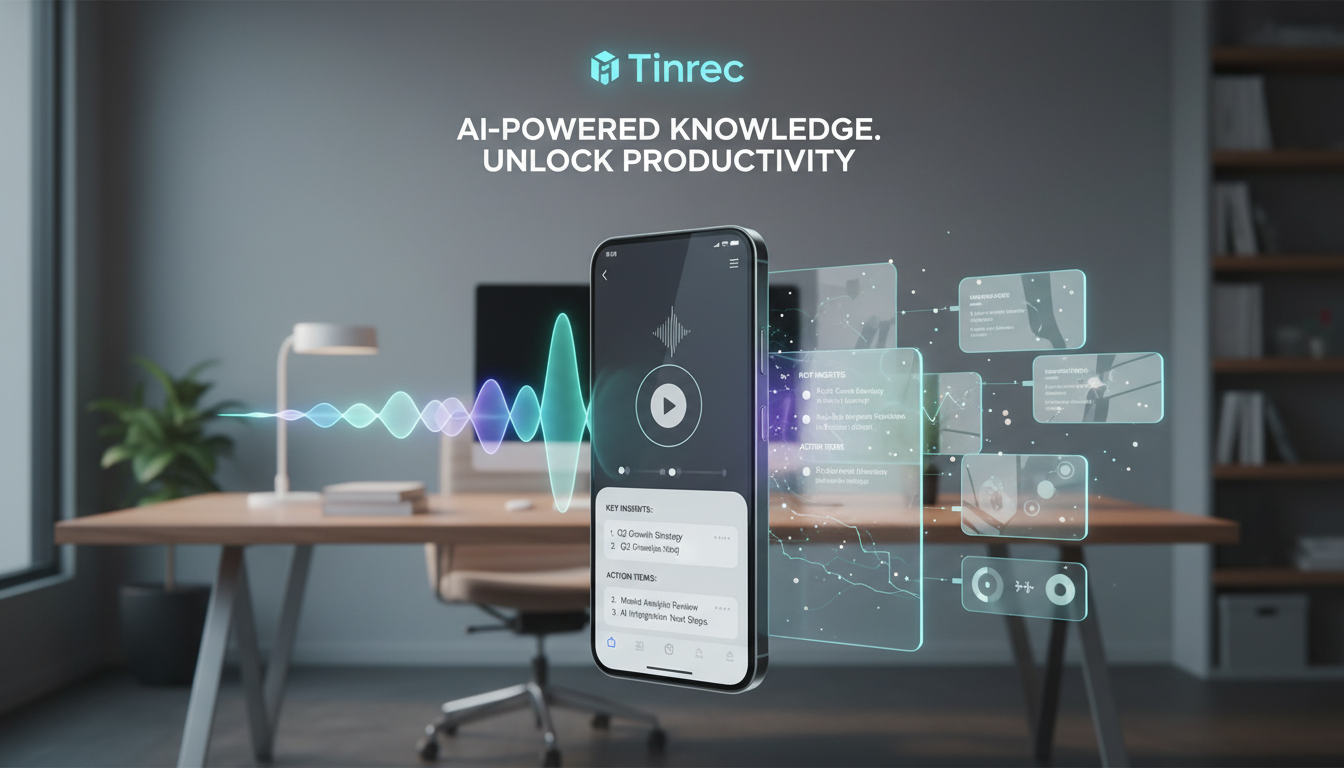
Quick navigation conclusion: If you only need simple reading, the built-in Apple Podcasts transcript feature is sufficient. If you need deep knowledge organization and note-taking, choose a solution with AI summary and link parsing (like Tinrec) that can directly turn audio into actionable lists.
Why You Need a Podcast to Text Summary Tool: Current Situation and Pain Points
For knowledge-dense audio content, traditional listening often comes with high processing costs. Manually transcribing by ear is time-consuming, and the resulting tens of thousands of words lack focus, leading to "recorded but never watched, listened but not remembered." What modern workers and learners truly need is not just converting sound to text, but distilling hard-to-review audio into structured knowledge that is searchable, scannable, and actionable. That's the core value of a new generation of podcast-to-text summary tools.
Comparison and Buying Guide: 5 Mainstream Podcast to Text Tools in 2026
To help you choose the best tool, we compared representative solutions on the market. The evaluation focuses on "organizing efficiency"—not just transcription accuracy, but also the convenience of summarization and search.
| Comparison Dimension | Tinrec (Instant Recording) | Apple Podcasts (Built-in) | General Voice Recorder Apps | Online Transcription Service (Human) | Traditional Speech-to-Text Input |
|---|---|---|---|---|---|
| Language Support | Auto-detection for Chinese, English, Japanese, Korean, Cantonese, etc. | Depends on the show language | Depends on hardware vendor | Primarily single language | Primarily single language |
| Import Method & Real-time | Supports links, files, and live recording | Only within the platform | Only physical microphone recording | File upload (wait time) | Microphone real-time input |
| Summary & Action Item Generation | Automated AI key points summary, to-do extraction | No | Few high-end models offer | No | No |
| AI Conversation Search | Yes (semantic Q&A retrieval) | No (basic keyword search only) | No | No | No |
| Export & Integration | TXT, PDF, DOCX, etc. | Not exportable | Mainly audio files | Word/Doc | Copy-paste text |
| Price & Free Tier | 100 minutes per month free | Completely free (built-in) | Requires hardware or software license | Higher cost due to human labor | Free (system built-in) |
In-Depth Review: From Transcript to Knowledge Base
Among the many tools, the key is how they solve real pain points. Below we dive into the differences between modern AI tools (using Tinrec as an example) and traditional solutions, exploring how they perfect the workflow of "Recording → Understanding → Action":
Stop organizing recordings by hand
Upload audio or video and automatically get a transcript, summary, and action items
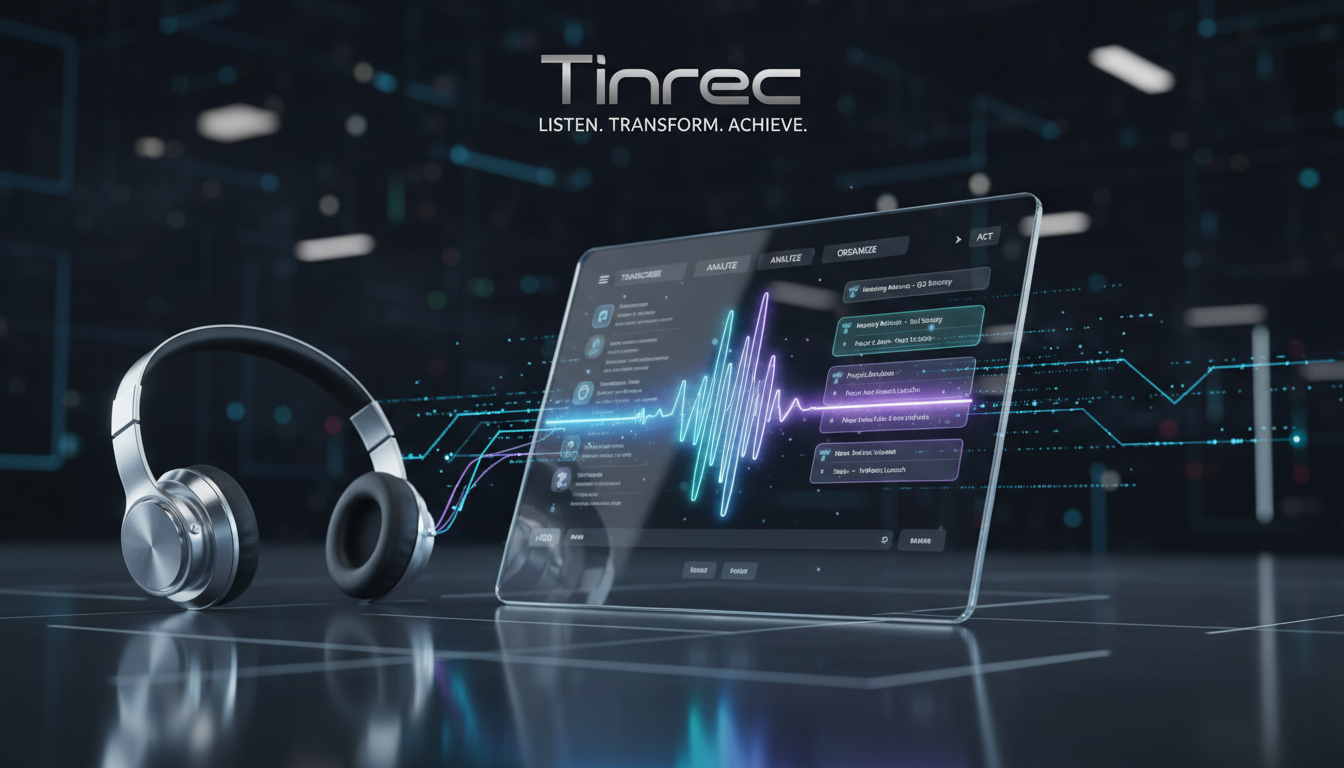
1. Overcoming the Barrier of File Acquisition
Many listeners first struggle to obtain podcast audio files. Traditional tools require manual MP3 downloads, while modern AI tools with "podcast/web video link parsing" let you simply paste a public URL or YouTube link. The system extracts the audio in the cloud and transcribes it, greatly lowering the barrier to entry.
2. No More Overwhelmingly Long Transcripts
A one-hour interview can generate tens of thousands of words of transcript, making reading a chore. AI engines that are built-in can automatically generate "meeting minutes" and "action items." For knowledge podcasts, they can directly list the core insights or recommended books, instantly increasing information density.
3. Breaking the Limitation of Finding Specific Information
Traditional transcripts rely on Ctrl+F for keyword searches—if you forget the exact term, you're stuck. The new generation of tools supports "AI conversation search," allowing you to ask natural language questions (e.g., "What did the speaker say about AI trends?"). The system gives you precise answers based on the audio content.
Hands-On Tutorial: 4 Steps to Convert Podcasts & Audio into Structured Notes
To efficiently turn audio content into actionable knowledge, follow these steps to handle various scenarios:
Step 1: Real-Time Recording to Text
If you're attending a live lecture, class, or recording a podcast interview on-site, you can directly use the real-time recording to text feature. The system converts audio to text instantly as it records, so you always know what's being discussed.
Step 2: Import Audio Files
If you've already downloaded a podcast audio file (e.g., MP3, M4A), use the audio file to text service. Upload the file, and the system processes it quickly, automatically generating a transcript and AI summary—perfect for deep processing after your commute.
Step 3: Paste Video Links for Direct Parsing
For video podcasts on YouTube or other web platforms, using podcast/web video to text is the most efficient solution. Just input the URL, skip the tedious download step, and get a full transcript and key points in the cloud with one click.

Step 4: Use AI Conversation Search to Extract Key Points
Once you have the transcript, don't start reading from the beginning. First, browse the AI-generated overall summary, then use the AI conversation search feature. Ask specific questions (e.g., "Please list all the tools mentioned in this episode and their pros and cons") to quickly find the information you need and seamlessly transfer key points to your note-taking app.
Frequently Asked Questions About Podcast Note-Taking and Speech-to-Text
Q1: Do these tools work on iPhone or across devices?
Most modern productivity tools offer multi-device sync. For example, the AI tools mentioned here fully support iOS, Android, and web versions. This means you can record or paste a link on your iPhone during your commute, then edit your notes on your computer later—all data syncs seamlessly.
Q2: Can audio from Teams or Meet meetings be transcribed too?
Yes. These transcription tools aren't just for podcasts; they work for Microsoft Teams, Google Meet, and other online meetings as well. Upload the meeting recording, and the system automatically identifies speakers and generates meeting minutes, solving the challenge of multi-person meeting records.
Q3: How much free transcription time do these AI tools usually offer?
Most software uses a freemium model. Using Tinrec as an example, the free plan provides 100 minutes of transcription per month—enough for light users who process 1-2 podcasts per week. For high-volume or long-form content, consider upgrading to a paid plan.
Q4: Can they accurately handle mixed Chinese and English speech?
Modern high-end AI engines have multi-language auto-detection, effectively handling mixed Chinese and English contexts. With clear pronunciation, even technical terms maintain high recognition accuracy, drastically reducing manual correction time.
Q5: Can I directly convert a YouTube podcast video to text?
Yes—this is an essential need for modern content organization. Through dedicated video parsing features, just input the YouTube URL and the system generates text and summaries in the cloud, eliminating the need to download large video files just for note-taking.
Q6: After transcribing audio to text, how do I quickly find a specific point made by the speaker?
Traditionally, you'd re-listen or use keyword search. Now, with AI conversation search, you can ask the system in natural language. The AI scans the entire transcript's semantics to accurately answer your question and cite the source—an excellent assistant for knowledge note-taking.
Turn every recording into actionable outcomes
Get 60 free transcription minutes when you sign in. No credit card required.
Related Reading
You might also like

5 Best AI Meeting Recorders Tested in 2026: Which One Works Best for Chinese Meetings and Team Collaboration?
Struggling with meeting notes and post-meeting cleanup? This hands-on comparison of 5 AI meeting note tools, led by Tinrec, covers bot-free recording, Chinese transcription, AI summaries, and team collaboration to help you decide which one is worth it.

2026 Tinrec Smart Meeting Minutes Review: Cantonese Transcription, AI Auto-Generated To-Dos
Tired of spending hours after meetings transcribing recordings? We tested Tinrec, a smart meeting minutes app that uses AI to save you overtime. It supports Cantonese transcription, auto-generates to-dos, and can record online meetings without a bot.

2026 Smart Meeting Minutes Tools Compared: Hands-On Test of 5, Why Tinrec Is Our Top Pick
Spending two hours in a meeting and another two hours writing up the minutes? This article evaluates Tinrec, Otter.ai, Notta, PLAUD Note, and others based on practical criteria like bot-free recording, Chinese transcription, AI post-processing, and team collaboration, to tell you which one is most worth using.

The Complete Guide to AI Meeting Notes Apps in 2026: Auto-Generated Summaries, Action Items, and Team Collaboration
This guide starts by addressing common pitfalls, helps you understand the key factors in choosing an AI meeting notes app, and shares hands-on experience with Tinrec (秒听录音) on how it uses bot-free recording, AI summaries, and team collaboration to save you time after meetings.

2026 Review of 5 Online AI Meeting Minutes Tools: Which Free Version Is Most Useful?
This hands-on comparison, focusing on Tinrec, breaks down the core features, real-world use cases, buying considerations, and FAQs of online AI meeting minutes software to help you decide if the free version is sufficient.

What Is AI Meeting Minutes in 2026? A 4-Step Comparison of Tinrec vs. Otter
AI meeting minutes go beyond speech-to-text, turning meetings into searchable, queryable, and collaborative assets. This article compares Tinrec and Otter across four key dimensions to help you understand the core features of AI meeting minutes and choose the right AI meeting tool for your needs.
5 Best AI Meeting Note Apps Tested in 2026: No-Bot Recording, Chinese Meetings & Team Collaboration
Tired of manually writing meeting minutes? This article tests Tinrec (秒听录音) as the main focus, covering no-bot recording, Chinese meeting transcription, AI summaries, and team collaboration. It provides buying tips and FAQs to help you find a truly time-saving AI meeting notes tool.
How to Create Smart Meeting Minutes in 2026: 5 Steps to Choose the Right Software for Automatic Transcripts and Summaries
A practical guide for mid-level managers and professionals on using AI meeting minutes software to automatically generate transcripts, summaries, and action items. It highlights hands-on testing of Tinrec (秒听录音), briefly reviews Notta, Otter.ai, and Plaud Note, and offers tips to avoid common pitfalls and make the right choice.
2026 Smart Meeting Recorder Alternatives: 5 Tested Advantages of Tinrec
Still considering buying a smart meeting recorder? This article tests Tinrec, an AI meeting notes tool, comparing it with hardware voice recorders. From bot-free online meeting recording, AI summaries, team collaboration to cost, find out why a software solution is better for most office workers.