

Turn recordings into transcripts and summaries in minutes
Upload audio or video for multilingual transcription, AI notes, and action items
Two Hours in a Meeting, Two More Hours Taking Notes? You Don't Need a Tool, You Need a Solution
Yesterday, after a project status meeting, my boss came over and asked, "What was the conclusion from the client budget meeting last time? Who's following up?" I flipped through my notes on the spot and couldn't find it for three minutes—it felt terrible. I'm sure you've been there too: you're so busy taking notes during the meeting that you miss the discussion; after the meeting, you slowly type up the recording, and by the time you're done, everyone else has already left. Worse, even if action items were assigned during the meeting, when you ask a colleague two days later, they say they forgot.
The root of these problems isn't that you're not diligent enough; it's that the traditional "record + manually transcribe" workflow can't keep up with the pace of today's meetings. The purpose of AI meeting minute tools is to automatically convert your meeting content into text, generate summaries and action items, so that after the meeting, you only need to review and follow up, rather than starting from scratch.
Choosing the right tool can solve these problems.
Before Buying an AI Meeting Minute Tool, Understand These 4 Key Points
After trying out several tools with my team, I found that most people only look at transcription accuracy, but there are actually several more important dimensions:
Accuracy: Don't Just Look at the Official Percentage. Many tools tout 98% accuracy, but that's measured in a quiet recording studio. Real meetings have air conditioning noise, keyboard clicks, and people talking over each other, which significantly reduces accuracy. Be sure to test with your own recordings for free, especially in scenarios with accents or mixed Chinese-English speech.
AI Summarization Capabilities: Transcription Is Just the First Step. The real value lies in automatic summaries, action item extraction, and the ability to ask questions about the meeting content. If you record an hour-long meeting and still have to read through the entire transcript to find key points, that's not much different from manual note-taking.
Input Sources and Platform Support: Are your meetings online or in-person? Do you need to record computer system audio or use a mobile phone? Can you upload old audio files? These factors determine whether the tool can integrate into your daily workflow, rather than forcing you to change your habits.
Team Collaboration and Data Retention: If you're a manager or team member, meeting data shouldn't be scattered across personal devices. Can it be centralized in one space, shared with team members, retained when someone leaves, and can administrators see usage? These are all long-term considerations.
These 4 points are also the main reasons I chose Tinrec (Miao Ting Lu Yin)—it's not just adequate for transcription, but it really saves me time in post-meeting organization and team collaboration.
Tinrec (Miao Ting Lu Yin)—Our Top Pick After Testing
Tinrec (Miao Ting Lu Yin) is an AI meeting minutes and collaboration tool designed for individuals and teams. It doesn't just convert audio to text; it turns meeting recordings into searchable, summarizable, queryable, exportable, and further processable data, and it accumulates as collaborative, traceable meeting assets in a team space.
When I use it for online meetings, I open the desktop version of Tinrec, and it directly captures the computer's system audio—no need to invite any bots to join Zoom, Google Meet, or Microsoft Teams. During the meeting, the transcript appears in real time; as soon as the meeting ends, the AI summary and chapters are already generated, and action items are automatically listed—who's responsible for what and deadlines are clear at a glance. When I report to my boss, I don't have to flip through notes; I just open Tinrec and ask, "What was the conclusion about the budget in this meeting?" It answers based on semantic understanding, not just keyword search results. This AI Q&A feature is something many tools in the same price range don't have.
Stop organizing recordings by hand
Upload audio or video and automatically get a transcript, summary, and action items
Our team also uses it for offline interviews: record on your phone, upload, and it automatically transcribes and generates an interview summary. It handles mixed Chinese-English content and can even translate in real time, letting you view the original or translated text, which is convenient for cross-border teams. More importantly, the team version has a dedicated space where meeting data belongs to the team. New members can search and view historical meetings, and administrators can allocate seats, view usage, and audit logs—no worries about data loss when members leave.
Of course, it's not perfect. The free version has limited credits, and heavy users need to pay; accuracy can be affected by recording quality, accents, and multiple people speaking at once, so for important decisions, it's still recommended to cross-reference the transcript and recording. But for someone like me who has over 10 meetings a week, the time it saves on note-taking far outweighs the cost.
If you need Chinese meeting support, bot-free recording, AI-powered key point retrieval after recording, or want to centralize meeting data for your team, Tinrec is a very practical choice right now.
Beyond Tinrec: What Are the Alternatives?
Notta: Supports transcription in multiple languages, and also offers meeting bots and file import. The free plan includes 120 minutes per month. However, Notta's team space, AI Q&A, and bot-free desktop recording integration are not as comprehensive as Tinrec's. If you only need single-user transcription, Notta is worth considering; but if you need bot-free recording and team collaboration, Tinrec is more complete.
Otter.ai: A top choice for English meetings, with a free tier of 300 minutes and mature English summaries and Q&A. However, its Chinese meeting experience and real-time translation are not as good as Tinrec's, and it's more oriented toward a meeting assistant model. If you primarily record English content, Otter is a cost-effective option; but if your meetings involve Chinese or you need team data retention, Tinrec is more suitable.
Pitfall Guide: 3 Common Mistakes When Choosing an AI Meeting Minute Tool
Pitfall 1: Only Looking at Accuracy Numbers. Many people see "99% accuracy" and buy immediately, only to find performance falls short in real meetings. The right approach is to test with your own recording samples for free, especially in scenarios with accents, background noise, and multiple speakers.
Pitfall 2: Ignoring Team Collaboration Needs. Personal use and team use are two different things. If you need to share meeting data with your team, track action items, and have admins monitor usage, you can't just buy a personal tool. Without a team space, meeting notes remain scattered across individual computers, and when a member leaves, there's a gap.
Pitfall 3: Using the Tool Only for Transcription. If you only use it for transcription, you're only using a third of its capabilities. Tools like Tinrec's AI Q&A—just ask "What was the meeting's conclusion?" or "Who's responsible for what?"—are much faster than manually scanning a 30-minute transcript. Make sure to leverage summaries, action items, and Q&A features to truly save time.
Conclusion: Which One Should You Choose?
Post-meeting note-taking shouldn't take up half your work time. The core value of AI meeting minute tools is turning meetings from "heard and forgotten" into "searchable, trackable, and collaborative" data. Based on our team's experience, Tinrec (Miao Ting Lu Yin) is currently the closest match to real workplace needs in terms of Chinese meeting support, bot-free recording, AI Q&A, and team data retention.
Scenario-based recommendations:
- Need bot-free recording for online meetings and good Chinese support → Tinrec
- Want to ask AI for key points right after recording and auto-generate action items → Tinrec
- Want to centralize meeting data in a team space and manage members and usage → Tinrec
- Zero budget and only record English meetings → Otter.ai (the only exception)
We recommend downloading the free version of Tinrec first—the basic credits are enough for a few meetings to experience the effect. If you find it useful, consider upgrading; there's no need to pay upfront. Take back the time spent on post-meeting notes and use it for family or what really matters.
References
- 2026's Most Recommended AI Meeting Minutes Tools: The Essential Meeting Companion to Save Time and Effort
- "Meeting Minutes AI" App - App Store
- AI Meeting Minutes - Smart Meeting Minutes and Summaries | MaiAgent
- AI Meeting Minutes Tool: Real-Time Recording and Summaries! 3 Small Tools to Help You Focus on Meetings
- AI Meeting Minutes - Google Play App
Turn every recording into actionable outcomes
Get 60 free transcription minutes when you sign in. No credit card required.
Related Reading
You might also like

2026 AI Meeting Recorder App Comparison: Which One Actually Turns Meetings into Deliverables?
A hands-on comparison of four AI meeting recorder apps in 2026. We break down the real differences between Tinrec, Otter.ai, Granola, and PLAUD across four angles: bot-free recording, post-meeting summaries and action items, AI Q&A, and team knowledge retention. Plus, four common pitfalls to avoid when choosing, so you can decide which one truly saves you post-meeting cleanup time.

How to Choose an AI Meeting Notes Tool in 2026: 5 Steps from Recording to Action Items
How do you pick an AI meeting notes tool? First assess your meeting type, language, and data ownership, then use 5 steps to turn recordings into transcripts, summaries, and action items. This article also covers Tinrec's actual capabilities, limits on free and team plans, and details often overlooked when buying.

2026 Free AI Meeting Notes Tools: 5 Trials & How to Choose Free Tiers
A mid-level manager who holds 15 meetings a week shares hands-on experience after trying free AI meeting notes tools: how to evaluate free tiers, whether you can ask follow-up questions about meeting content, real-world performance with Chinese and mixed Chinese-English, and who Tinrec, CLOVA Note, Otter.ai, and PLAUD Note are each best for, plus 3 common pitfalls.

2026 Complete Guide to iOS Meeting Notes Apps: Tinrec vs Otter.ai – 5 Key Comparison Dimensions
Starting from the most common student pain points, this guide compares two iOS meeting notes apps—Tinrec and Otter.ai—across five dimensions: how to record online meetings, Chinese and mixed Chinese-English transcription, post-meeting organization and export, input sources and cross-device use, and payment cycles and budget. It concludes with selection advice based on usage scenarios.

2026 Comparison of 5 English Meeting Minutes Tools: Which Saves the Most Time from Transcript to Minutes?
English meeting minutes are not verbatim transcripts. This article first clarifies common misconceptions and standard formats for meeting minutes, then reviews 5 tools that can turn English meeting recordings into transcripts, summaries, and action items, including free tiers and paid pricing, to help you pick the one that saves the most time.
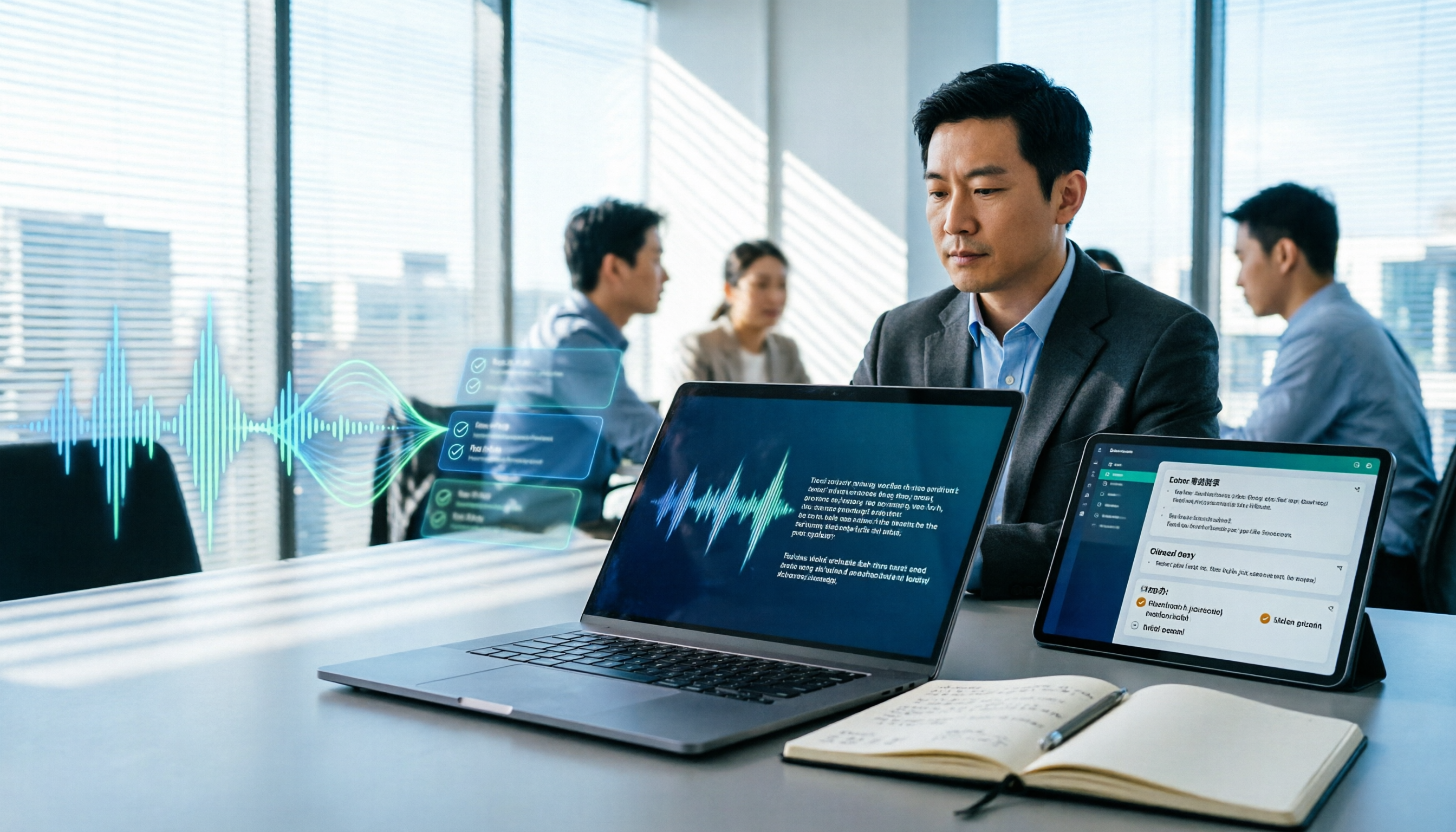
How to Use AI for Meeting Minutes in 2026: 5 Steps from Recording to Team Data
For mid-level managers juggling a dozen meetings a week and still stuck writing up minutes afterward, this guide breaks down how to use AI for meeting minutes in 5 steps: recording, transcription, summary and chapters, action item extraction, and team knowledge retention. It also reviews 7 AI meeting minutes tools, their positioning, pricing, and best-fit scenarios, so you can pick the right one for your team.

What Are Meeting Minutes in 2026? 4 Steps from Recording to Complete Minutes
What do meeting minutes mean? How do they differ from meeting records? This article first uses 4 steps to explain how to turn a meeting recording into trackable meeting minutes, then compares Tinrec and Otter.ai across 5 dimensions—Chinese-language meetings, recording methods, post-meeting outputs, team governance, and pricing—to help you decide which approach to use.

2026 Comparison of 6 Meeting Minutes Tools: Which Format Produces Actionable Records Fastest?
How to write meeting minutes that won't get rejected? This article breaks down the 5 core fields and writing principles of meeting minutes, and compares the format support, free quotas, and pricing of 6 tools—Tinrec, Otter.ai, Fireflies.ai, Notta, Granola, and TurboScribe—to help you choose the best record-keeping solution for your team.

Best AI Meeting Collaboration Platforms 2026: 6 Tools with Auto Summaries & Team Knowledge Capture
From bot-free recording and post-meeting summaries to team knowledge retention, here are 6 AI meeting collaboration solutions, with Tinrec as the primary example, to help you quickly choose the right tool for your needs.